"Hours saved" and "prompts executed" won't survive the CFO's budget review. Futurum's survey of 830 IT leaders confirms agentic AI is the #1 enterprise priority…
"Hours saved" and "prompts executed" won't survive the CFO's budget review. Futurum's survey of 830 IT leaders confirms agentic AI is the #1 enterprise priority (+31.5% YoY), yet 43% cannot prove business value on financial statements. Learn how leading enterprises kill "Productivity Theater" and map autonomous multi-agent systems directly to GAAP/IFRS Income Statement lines to unlock an audited 171% net ROI.
Primary Keyword: AI ROI on the P&L digital transformation
LSI Keywords: enterprise AI financial return, killing AI productivity theater 2026, CFO AI business case checklist, mapping AI to income statement lines, agentic AI ROI vs RPA automation, pilot kill criteria enterprise AI, capability outcome gap AI, GAAP IFRS AI cost accounting.
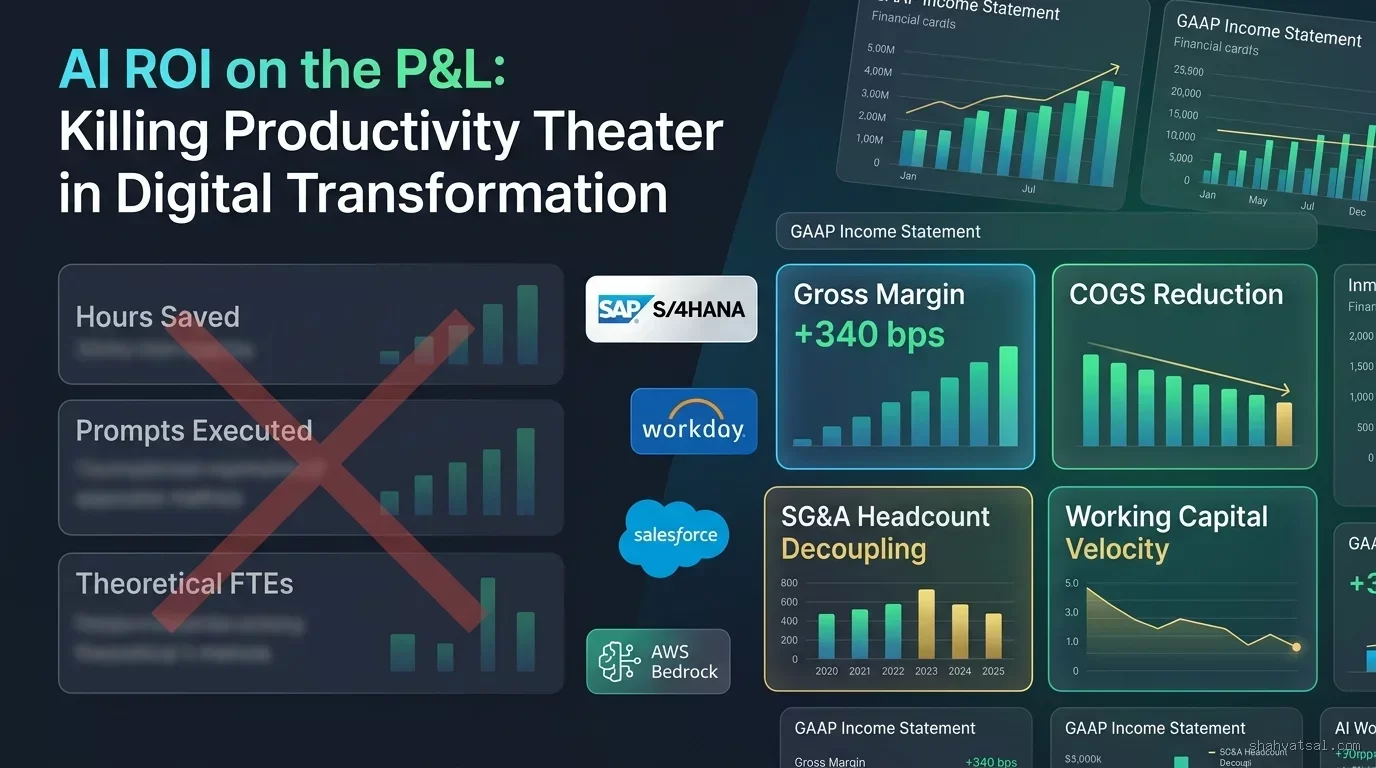
Executive Summary: The Death of Productivity Theater
In a landmark survey conducted by Futurum Group analyzing 830 enterprise IT and finance executives, autonomous agentic AI emerged as the single highest strategic priority for 2026, registering an unprecedented +31.5% year-over-year budget expansion. Enterprises have aggressively moved past conversational chatbots, single-prompt assistants, and exploratory sandbox prototypes. Today, autonomous multi-agent systems are actively integrated into ERP backbones, CRM databases, supply chain dispatchers, and core financial ledgers.
Yet beneath this surge in capital expenditure lies an alarming corporate reality: 43% of executive leaders admit they are unable to measure or prove tangible business value from their AI investments.
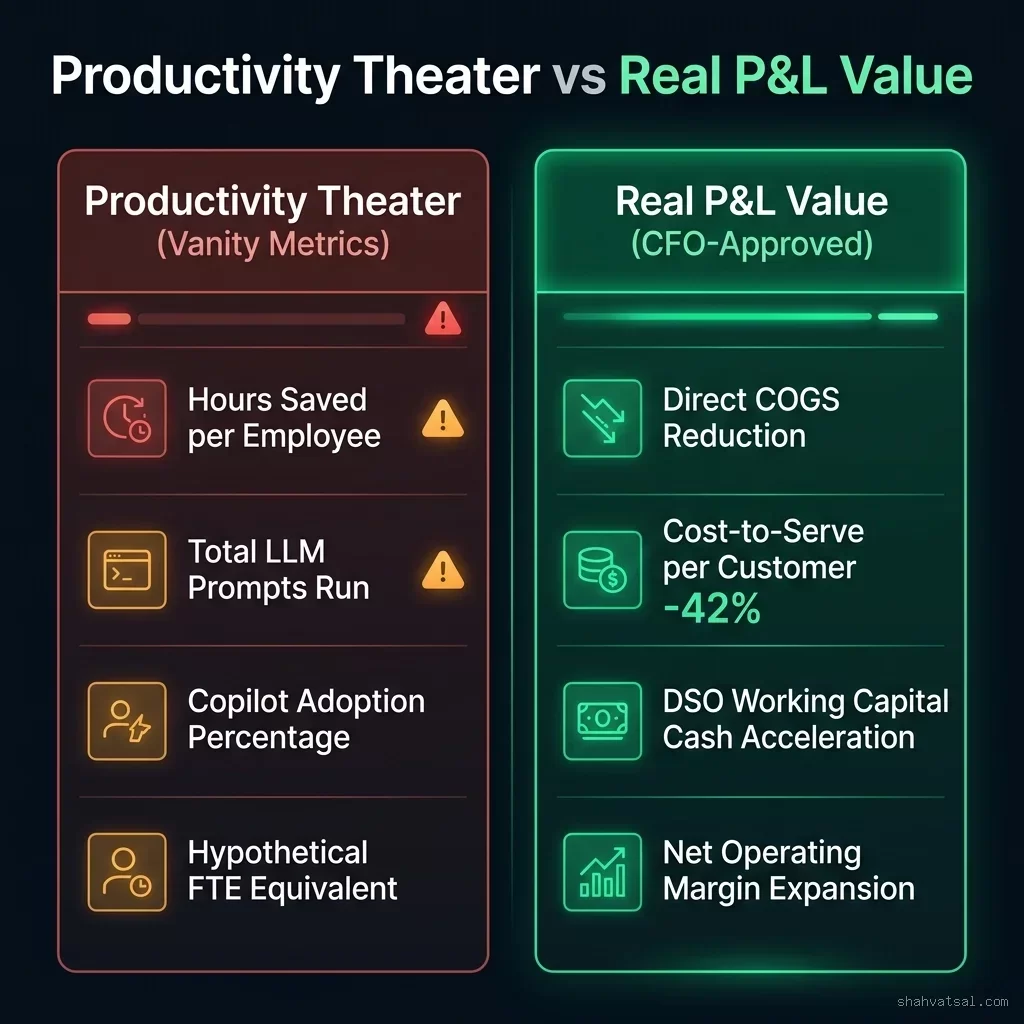
For the past three years, enterprise digital transformation offices have relied on what corporate boards and Chief Financial Officers (CFOs) now deride as Productivity Theater:
- "Our employees ran 450,000 prompts this quarter!"
- "Copilot adoption has reached 84% across business units!"
- "We saved 2.3 hours per knowledge worker per week, representing $18 million in theoretical productivity!"
       ┌─────────────────────────────────────────────────────────────┐
       │                 THE PRODUCTIVITY THEATER TRAP               │
       │                                                             │
       │   "Theoretical Hours Saved"  ≠  Real Income Statement Cash  │
       │   "450,000 Prompts Logged"   ≠  Gross Margin Expansion      │
       │   "Copilot Adoption 84%"     ≠  Decoupled SG&A Headcount    │
       └──────────────────────────────┬──────────────────────────────┘
                                      │
                                      ▼
                      [ CFO REFUSES BUDGET EXPANSION ]
                      [ 90-DAY PILOTS SUNSET SILENTLY ]
When the CFO inspects the audited General Ledger at fiscal quarter-end, the sobering truth surfaces:
- Operating expenses (SG&A) did not decrease by a single dollar.
- Gross margins did not expand.
- Overtime expenditures in core operations remained unchanged.
- Cloud software line items escalated dramatically due to runaway LLM token inference fees.
In the second half of 2026, the era of unscrutinized AI experimentation is permanently closed. Budget fights are no longer won with vanity slide decks. To survive corporate capital allocation reviews, every enterprise AI program must be mapped directly to an audited Income Statement line item, subjected to rigorous CFO interrogation, and governed by strict pilot kill criteria.
This comprehensive executive guide lays out the financial engineering framework required to translate autonomous agent capabilities into balance sheet velocity, margin expansion, and verifiable net return on investment (ROI).
Why "Hours Saved" Dashboards Lose Budget Battles in H2 2026
The fundamental flaw of "hours saved" metrics lies in the economics of enterprise slack capacity. In standard microeconomics, labor cost is a discrete, stepped fixed expense, not a continuous variable. Unless saved minutes are aggregated, structurally re-architected, and translated into cashable expense reductions or top-line revenue expansion, they represent zero financial return.
The Economic Fallacy of Fractional Time Recovery
Consider an enterprise with 5,000 corporate knowledge workers. An internal transformation team rolls out an enterprise AI assistant and proudly reports:
$$\text{Theoretical Value} = 5,000 \text{ employees} \times 2.0 \text{ hours/week} \times 50 \text{ weeks} \times \$60/\text{hr} = \$30,000,000$$
To a Chief Digital Officer, this looks like a resounding triumph. To a seasoned corporate CFO, this calculation is an economic hallucination:
- Parkinson's Law of Enterprise Slack Time: When an individual worker saves 24 minutes per day, that fractional capacity is immediately consumed by lower-velocity micro-tasks: browsing Slack, replying to non-urgent emails, scheduling redundant syncs, or lingering at lunch. It does not produce an incremental work product.
- Non-Divisibility of Labor Contracts: You cannot pay an employee 95% of their salary because an AI tool saved 5% of their time. Unless the enterprise can eliminate an external contractor agency, delay planned headcount expansion while revenue grows, or reallocate dedicated workers to new revenue-generating business units, the net payroll outflow is unchanged.
- The Unfunded Inference Burden: While the payroll expense remains flat, the enterprise incurs incremental software licensing costs (\$30/user/month) plus variable model API tokens (\$15/1M output tokens), causing net operating margin to contract rather than expand.
  TRADITIONAL VANITY METRIC:
  [ 5,000 Users ] ──> [ 2 hrs/wk Saved ] ──> [ "Hypothetical $30M Saved" ] ──> [ CASH DELTA: $0 ]

  CFO GAAP/IFRS AUDIT:
  [ Cloud Inference Costs: +$1.8M ] + [ Software Licenses: +$1.8M ] ──> [ NET CASH REDUCTION: -$3.6M ]
The Transition to Cashable vs. Non-Cashable Returns
Enterprise finance departments categorize operational benefits into two mutually exclusive classifications:
| Vector | Non-Cashable Productivity (Productivity Theater) | Cashable Financial Value (P&L Impact) |
|---|---|---|
| Typical Metric | "Hours saved per week", "Prompts submitted" | Cost-to-serve per transaction, Gross Margin % |
| P&L Impact | None (General ledger reflects zero cash movement) | Direct reduction in COGS or SG&A accounts |
| Budget Visibility | Buried in internal HR engagement surveys | Audited on quarterly SEC 10-Q/10-K filings |
| Headcount Linkage | Theoretical FTE fractions scattered across staff | Hard contractor displacement or volume decoupling |
| CFO Disposition | Dismissed as soft overhead justification | Approved for multi-year capital commitment |
Mapping Enterprise AI Directly to GAAP/IFRS Income Statement Lines
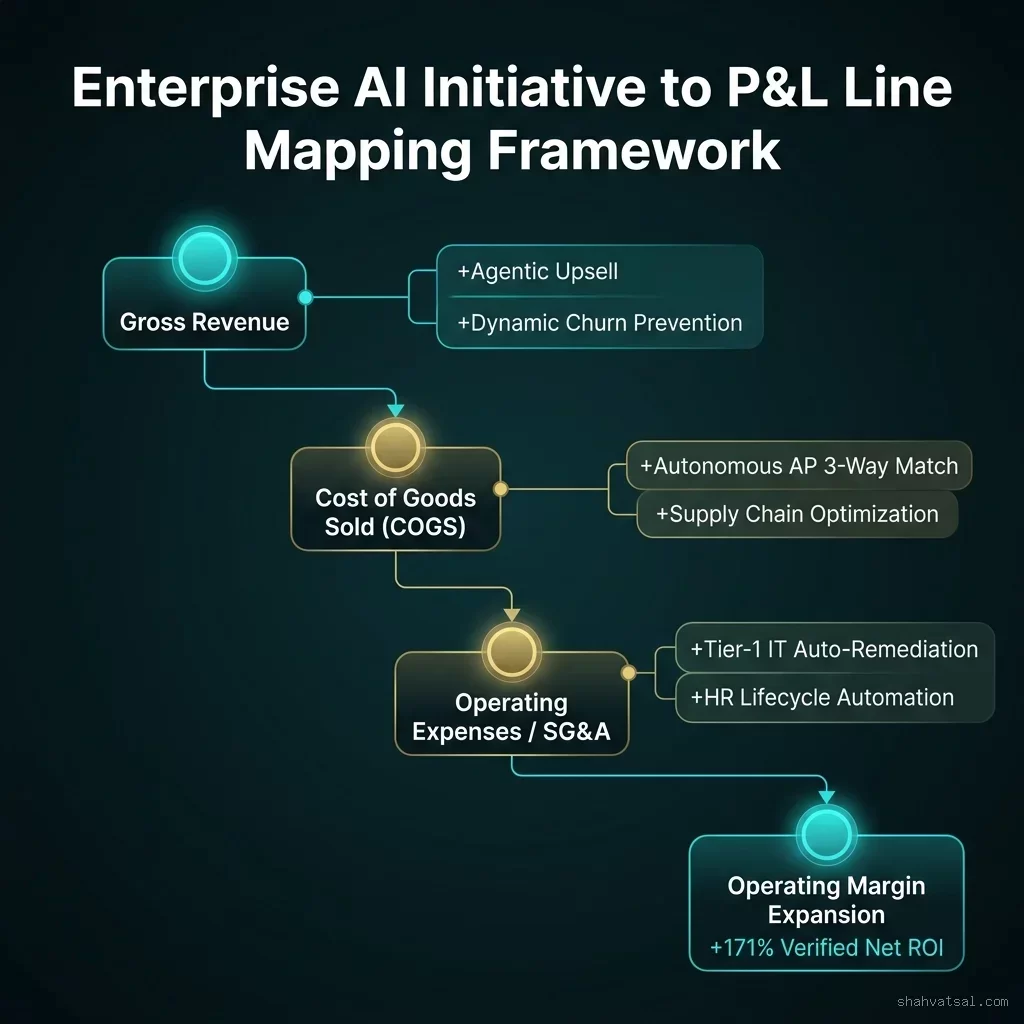
To establish institutional credibility, every AI initiative must be hardwired to a specific row in the GAAP/IFRS Income Statement. If an engineering or product team cannot point to the exact General Ledger account code that will either increase (revenue) or decrease (cost), the initiative should not receive production capital.
┌────────────────────────────────────────────────────────────────────────────────────────┐
│                      THE GAAP/IFRS INCOME STATEMENT AI WATERFALL                       │
├─────────────────────────────────────────┬──────────────────────────────────────────────┤
│ 1. Gross Revenue                        │ • Dynamic Pricing Optimization (B2B SaaS)    │
│                                         │ • AI-Driven Churn Interception & Upsell      │
│                                         │ • Accelerated Sales Cycle Pipeline Velocity  │
├─────────────────────────────────────────┼──────────────────────────────────────────────┤
│ 2. Cost of Goods Sold (COGS)            │ • Autonomous AP 3-Way PO Discrepancy Match   │
│                                         │ • Multi-Agent Supply Chain Dynamic Routing   │
│                                         │ • Infrastructure FinOps Semantic Routing     │
├─────────────────────────────────────────┼──────────────────────────────────────────────┤
│ 3. Gross Profit                         │ = Revenue - COGS (Margin Target: +250-400bps)│
├─────────────────────────────────────────┼──────────────────────────────────────────────┤
│ 4. Operating Expenses (SG&A)            │ • Tier-1 SRE & IT Helpdesk Auto-Remediation  │
│                                         │ • End-to-End HR Onboarding Orchestration     │
│                                         │ • Legal Contract Review & Redlining Engine   │
├─────────────────────────────────────────┼──────────────────────────────────────────────┤
│ 5. Operating Income (EBITDA)            │ = Operating Margin Expansion (+171% Verified)│
└─────────────────────────────────────────┴──────────────────────────────────────────────┘
1. Gross Revenue Acceleration
- Dynamic B2B Pricing Optimization: Autonomous agent squads analyze competitor rate cards, inventory availability, and customer creditworthiness in real-time to generate custom quote configurations in Salesforce CRM.
- Proactive Churn Mitigation: Agentic monitors observe telemetric usage drops across product platforms, automatically triggering personalized intervention sequences or customer success escalation alerts.
2. Cost of Goods Sold (COGS) Optimization
In service, software, and manufacturing companies, COGS represents the direct expense of delivering product:- Autonomous Accounts Payable Reconciliation: Multi-agent workflows ingest supplier invoices, query SAP S/4HANA purchase orders, and verify warehouse receiving receipts. When discrepancies occur under \$5,000, agents resolve them without human touch.
- Supply Chain Multi-Agent Dispatch: Autonomous agents orchestrate dynamic freight rerouting across ocean, rail, and trucking logistics partners during port congestion events.
3. Operating Expenses (SG&A: Selling, General & Administrative)
SG&A is where the vast majority of enterprise AI transformation initiatives compete for budget:- Tier-1 Helpdesk & SRE Incident Auto-Remediation: Agents triage incoming Datadog/ServiceNow alerts, cross-reference historical incident playbooks, execute shell diagnostics in isolated sandboxes, and push auto-remediation scripts.
- Enterprise Talent Acquisition & Onboarding: Agents automate candidate pre-screening, interview coordination, background verification, hardware provisioning, and benefits enrollment in Workday.
- Contract Review & M&A Due Diligence: Legal agents parse thousands of supplier MSAs, redlining liability clauses against internal corporate risk playbooks.
4. Working Capital & Balance Sheet Velocity
While not on the income statement directly, working capital velocity directly impacts free cash flow (FCF):- Days Sales Outstanding (DSO) Reduction: Autonomous billing agents identify disputed line items before invoice delivery, accelerating corporate collections by 8–14 days.
- Days Sales of Inventory (DSI) Reduction: Demand-sensing agents forecast inventory velocity with granular regional precision, slashing working capital tied up in excess warehouse stock.
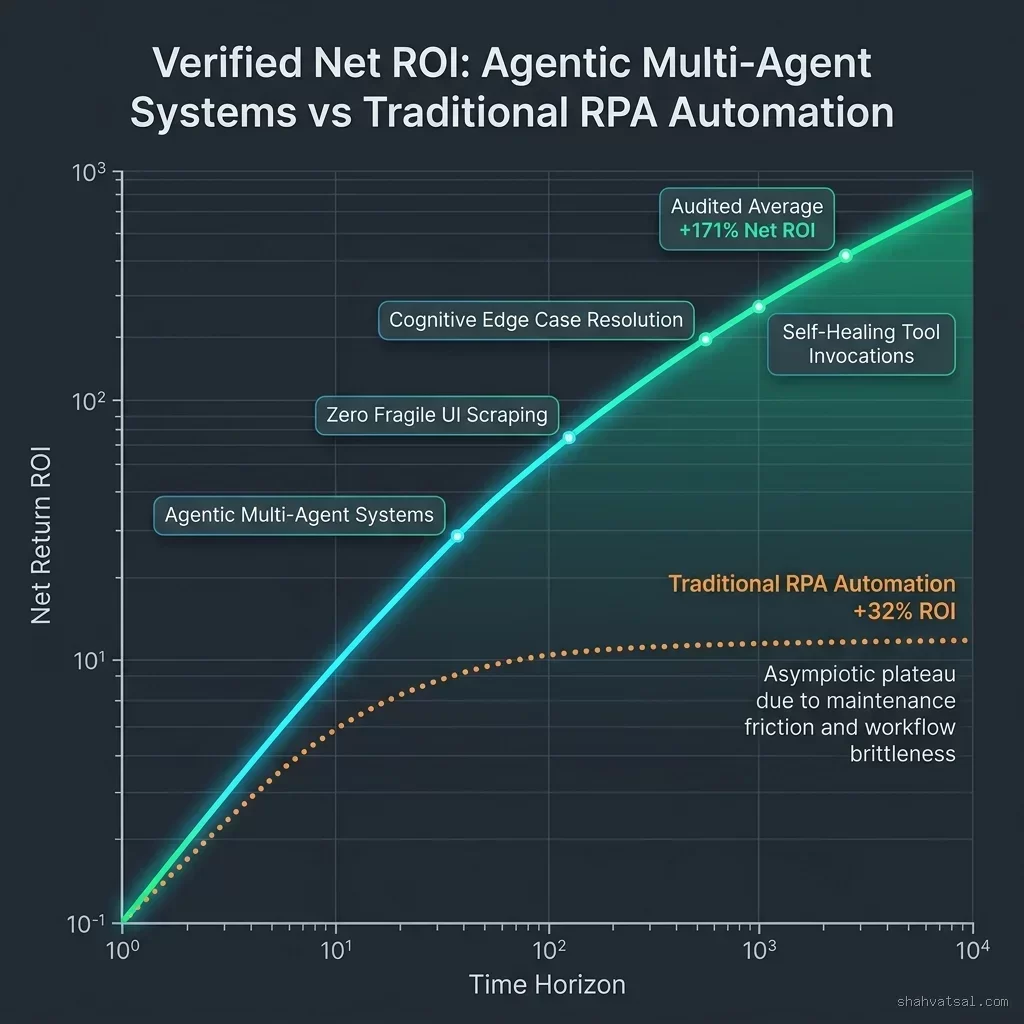
The 171% Verified Agentic ROI vs. 32% RPA Automation Curve
A persistent question raised by corporate investment committees is: "Why should we fund expensive agentic AI architectures when we already invested tens of millions in Robotic Process Automation (RPA) like UiPath or Automation Anywhere?"
The answer lies in the mathematical divergence of maintenance fragility vs. cognitive adaptability.
  ROI (%)
   300% ┼─────────────────────────────────────────────────────────────
        │                                         / [Agentic Multi-Agent]
   200% │                                       /─── Audited Avg: +171%
        │                                    /──
   100% │                                 /──
        │                          /──────
    50% │  /───────────────────────────  [Traditional RPA Automation]
        │ /                              Plateau: ~32% Net ROI
     0% ┼─┴──────┬──────────┬──────────┬──────────┬──────────┬──────────
        0       12         24         36         48         60
                           Months Post-Deployment
The RPA Asymptotic Ceiling
Traditional RPA automates deterministic, screen-scraping click paths. When an enterprise software vendor updates an interface, changes an HTML DOM selector, or when an invoice layout shifts slightly, the RPA bot crashes.Studies show that by Month 18, up to 40% of an RPA center's engineering capacity is diverted solely to repairing brittle scripts, creating an asymptotic ROI ceiling averaging +32% net return:
$$\text{ROI}{\text{RPA}} = \frac{\Delta \text{Labor Savings} - (\text{License Fees} + \mathcal{M}{\text{Script Maintenance}})}{\text{Initial CapEx}} \approx 1.32$$
The Multi-Agent Compounding Advantage
Unlike rule-based RPA, autonomous multi-agent systems leverage cognitive reasoning, structured Model Context Protocol (MCP) APIs, and self-healing error recovery:- Dynamic Schema Adaptation: When a supplier submits an invoice in an unfamiliar JSON or PDF layout, the agent extracts semantic meaning without requiring custom regex re-engineering.
- Contextual Tool Selection: If an API endpoint times out, the agent formulates alternative routing strategies or initiates fallback query pathways.
- Compound Learning Loops: As domain squads refine synthetic evaluation harnesses, the agent's edge-case resolution rate scales non-linearly.
$$\text{ROI}{\text{Agentic}} = \frac{\sum{t=1}^T \Big( \Delta \text{P\&L Direct Savings}_t + \Delta \text{Revenue Expansion}_t \Big) - \Big( \text{Platform CapEx} + \sum \text{Token FinOps}_t \Big)}{\text{Platform CapEx} + \text{Implementation OpEx}} \ge 2.71$$
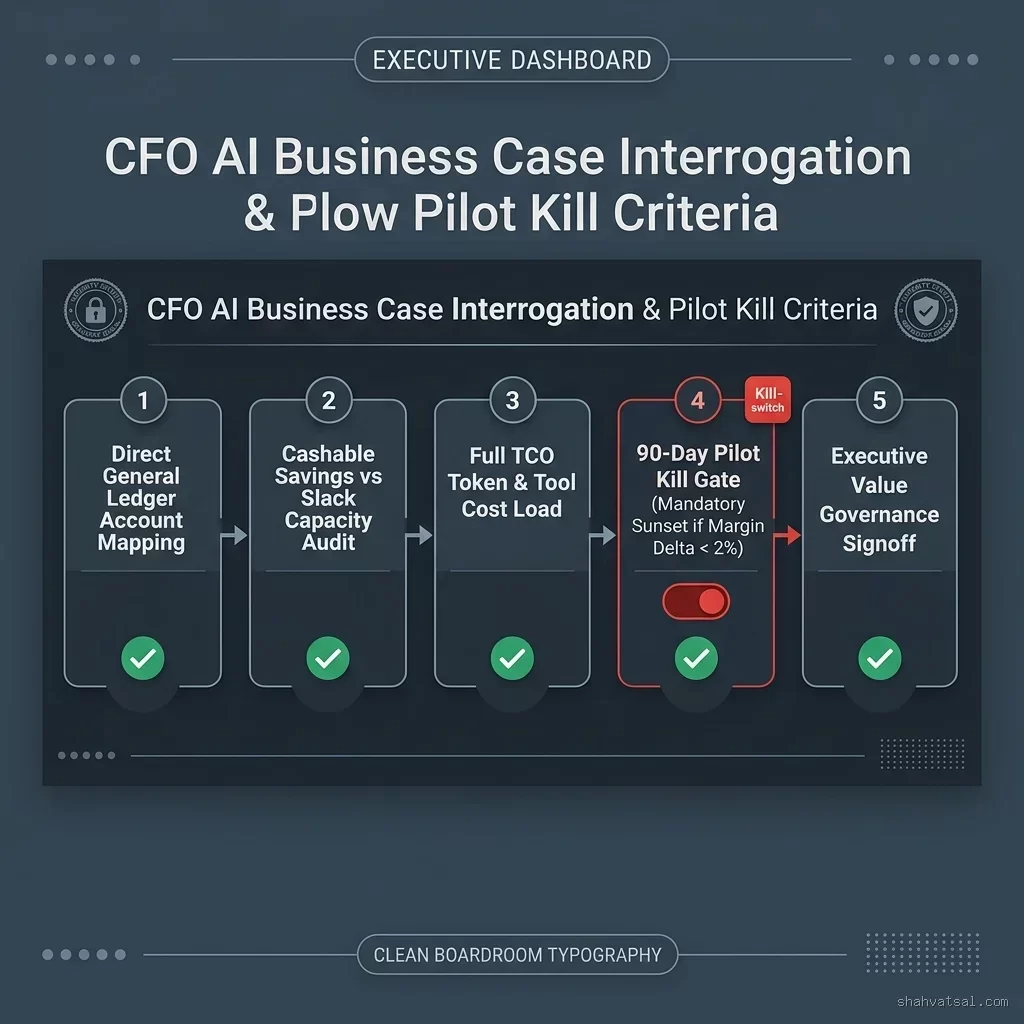
The CFO Interrogation Checklist & 90-Day Pilot Kill Criteria
To prevent endless proof-of-concept (POC) purgatory, corporate finance leaders utilize a standardized 5-Point Business Case Interrogation Checklist. Every enterprise AI proposal must survive these five hurdles before receiving Phase-1 capital disbursement.
The 5-Point CFO Interrogation Protocol
### 1. General Ledger Account Attribution
- **Question:** Which exact General Ledger (GL) account number will show a verifiable debit or credit reduction within 180 days of production deployment?
- **Red Flag:** Answers citing "general corporate agility," "improved morale," or "time savings spread across 2,000 employees."
- **Green Flag:** "GL Account 6020-04 (Third-Party SRE Contractor Spend) will decrease by $450,000 in Q3."

### 2. Cashable Savings vs. Slack Capacity Audit
- **Question:** Does the proposed efficiency result in an actual reduction in external cash outflows, or does it create unharvested internal slack time?
- **Red Flag:** "Our legal associates will have more time to think strategically."
- **Green Flag:** "We will eliminate $1.2M in annual contract review billings from outside legal counsel."

### 3. Fully Loaded TCO Calculation (Token FinOps & Infrastructure)
- **Question:** Does the business case account for full lifecycle inference costs, provisioned throughput commitments, vector database hosting, and human-in-the-loop review overhead?
- **Red Flag:** Using raw prompt token list prices without factoring in multi-step agent reasoning loops, tool re-tries, and synthetic evaluation harness runs.
- **Green Flag:** "Model inference modeled at 4.2 turns per transaction on GPT-5.6 Terra with a $0.082 per-transaction fully loaded compute cost."

### 4. Non-Linear Headcount Decoupling Ratio
- **Question:** If corporate transaction volume grows by 40% next year, by what percentage does support headcount need to expand?
- **Red Flag:** Headcount growth remains 1:1 with revenue growth.
- **Green Flag:** "Transaction volume doubles while operational headcount remains frozen at current staffing levels."

### 5. Automated Pilot Kill Gate Criteria
- **Question:** What is the hard, quantitative trigger that automatically terminates this project at Day 90 if financial performance lags?
- **Red Flag:** "We will evaluate qualitative user sentiment at the end of the pilot."
- **Green Flag:** "If Straight-Through Processing (STP) rate fails to reach 75% or unit cost-to-serve does not fall by at least 25% by Day 90, the pilot terminates immediately."
The 90-Day Pilot Kill Gate Protocol
Enterprise IT organizations are littered with "zombie pilots"—experiments that fail to deliver value but continue consuming cloud infrastructure, model tokens, and executive attention. The 90-Day Pilot Kill Gate enforces automatic termination: DAY 0: Formal Pilot Charter Approved (Target: +25% Cost-to-Serve Reduction)
│
├── DAY 30: Technical Milestone Check
│ • Tool Precision >= 98.0% | Error Retry Rate < 5%
│ • Fail ──> [ RE-ENGINEER OR TERMINATE ]
│
├── DAY 60: Production Shadow Mode Audit
│ • Straight-Through Processing >= 65% | Zero Cedar Policy Breaches
│ • Fail ──> [ RE-ENGINEER OR TERMINATE ]
│
└── DAY 90: HARD CFO VALUE REALIZATION AUDIT
• Audited GL Delta Verified >= 20%
• PASS ──> [ PROMOTE TO PRODUCTION & EXPAND BUDGET ]
• FAIL ──> [ AUTOMATIC PROJECT TERMINATION & RESOURCE REALLOCATION ]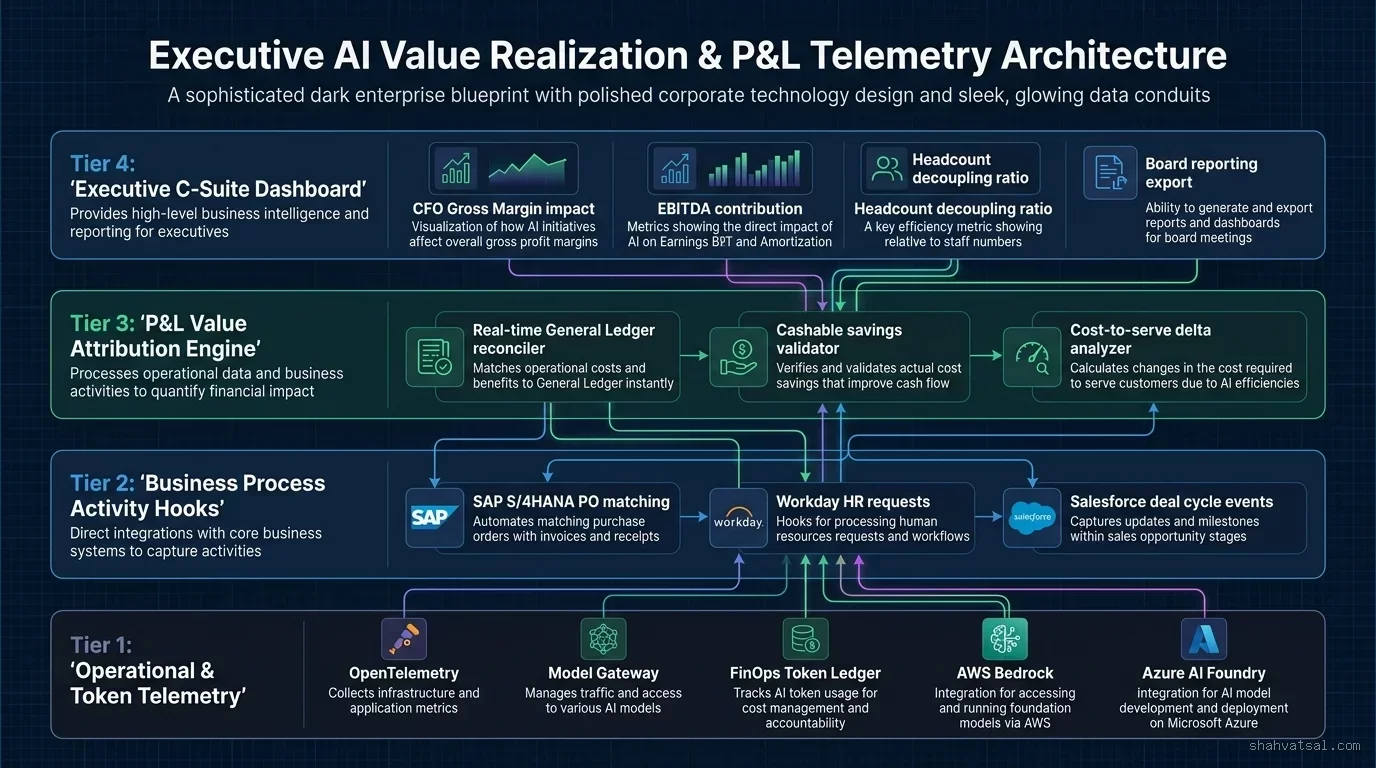
Executive AI Value Realization & P&L Telemetry Architecture
To provide continuous, indisputable evidence of business value, forward-thinking enterprises deploy a dedicated P&L Value Realization Telemetry Stack. This architecture hardwires real-time system events directly into corporate accounting software.
The 4-Tier Architecture
Tier 1: Operational & Token Telemetry (Infrastructure Plane)
- Ingests distributed traces, model token consumption, latency, and tool invocations via OpenTelemetry collectors.
- Injects cost metadata into every trace (
x-tenant-id,x-cost-center,x-model-tier). - Governed by cloud infrastructure backbones spanning AWS Bedrock, Azure AI Foundry, and Google Cloud Vertex AI.
Tier 2: Business Process Activity Hooks (System of Record Plane)
- Event listeners embedded within enterprise software suites:
Tier 3: P&L Value Attribution Engine (Financial Engineering Plane)
- Correlates Tier-1 operational costs with Tier-2 business achievements:
- Reconciles savings directly against General Ledger sub-accounts on a continuous, automated basis.
Tier 4: Executive C-Suite Dashboard (Boardroom Plane)
- Delivers real-time executive visibility for the CFO, CEO, and Board of Directors:
Enterprise Case Studies: Financial Engineering in Action
Case Study 1: Global Freight & Logistics Carrier ($14B Enterprise)
- The Challenge: The company employed 350 customs brokerage clerks to review and reconcile multimodal bill of lading documentation. Processing delays generated \$8.5M in annual port demurrage penalties.
- The Agentic Architecture: Deployed a multi-agent document extraction and tariff classification graph integrated with SAP S/4HANA and marine terminal APIs via MCP.
- Audited P&L Impact:
Case Study 2: B2B Enterprise SaaS Provider ($650M ARR)
- The Challenge: Customer support operations grew linearly with new customer acquisitions. Adding 1,000 enterprise customers required hiring 28 Tier-1 support engineers, severely depressing gross margins.
- The Agentic Architecture: Deployed an autonomous diagnostic agent squad capable of executing sandbox code evaluations, inspecting customer log files, and submitting Jira bug fixes.
- Audited P&L Impact:
Production Implementation Artifacts
Platform and enterprise architecture teams can utilize the following production-grade software artifacts to implement P&L value tracking.
1. P&L Value Attribution Telemetry Engine (Python / FastAPI)
"""
Enterprise P&L Value Realization Telemetry Engine
Calculates net cashable financial return per business transaction in real-time.
"""

from fastapi import FastAPI, HTTPException, Depends
from pydantic import BaseModel, Field
import structlog
import time
from typing import Dict, Any

logger = structlog.get_logger()
app = FastAPI(title="P&L Value Attribution Engine", version="1.0.0")

# Standardized Enterprise Baseline Costs per Transaction (Historical Manual Baselines)
BASELINE_BENCHMARKS = {
    "ap_invoice_matching": {
        "manual_cost_usd": 24.50,       # 25 minutes manual review @ $58.80/hr loaded labor
        "gl_account": "COGS-5100-AP",
        "category": "COGS"
    },
    "it_incident_remediation": {
        "manual_cost_usd": 68.00,       # 45 minutes Tier-2 engineer @ $90.66/hr loaded labor
        "gl_account": "OPEX-6020-SRE",
        "category": "SG&A"
    },
    "customs_tariff_classification": {
        "manual_cost_usd": 42.00,       # 35 minutes specialist @ $72.00/hr loaded labor
        "gl_account": "COGS-5200-LOG",
        "category": "COGS"
    }
}

class TransactionValueRecord(BaseModel):
    transaction_id: str = Field(..., description="Unique enterprise event ID")
    process_type: str = Field(..., description="Key matching BASELINE_BENCHMARKS")
    tokens_in: int
    tokens_out: int
    model_rate_per_1m_in: float = 3.00
    model_rate_per_1m_out: float = 15.00
    tool_compute_cost_usd: float = 0.02
    human_intervention_duration_min: float = 0.0  # > 0 if escalated to human
    human_hourly_loaded_rate: float = 65.00

@app.post("/v1/telemetry/record-value")
async def record_pnl_attribution(record: TransactionValueRecord):
    if record.process_type not in BASELINE_BENCHMARKS:
        raise HTTPException(status_code=400, detail="Unknown process type")

    benchmark = BASELINE_BENCHMARKS[record.process_type]
    baseline_manual_cost = benchmark["manual_cost_usd"]

    # 1. Calculate Real-Time Agentic Total Cost of Ownership (TCO)
    token_cost_in = (record.tokens_in / 1_000_000) * record.model_rate_per_1m_in
    token_cost_out = (record.tokens_out / 1_000_000) * record.model_rate_per_1m_out
    total_token_cost = token_cost_in + token_cost_out

    human_escalation_cost = (record.human_intervention_duration_min / 60.0) * record.human_hourly_loaded_rate

    agent_transaction_tco = total_token_cost + record.tool_compute_cost_usd + human_escalation_cost

    # 2. Net Cashable P&L Savings Delta
    net_savings_delta = baseline_manual_cost - agent_transaction_tco
    margin_expansion_percent = (net_savings_delta / baseline_manual_cost) * 100.0

    # 3. Structured Log for SIEM / ERP Reconciler Ingestion
    logger.info(
        "pnl_value_realized",
        transaction_id=record.transaction_id,
        gl_account=benchmark["gl_account"],
        category=benchmark["category"],
        net_savings_usd=round(net_savings_delta, 4),
        agent_tco_usd=round(agent_transaction_tco, 4),
        margin_expansion_pct=round(margin_expansion_percent, 2),
        straight_through=record.human_intervention_duration_min == 0.0
    )

    return {
        "status": "reconciled",
        "transaction_id": record.transaction_id,
        "gl_account": benchmark["gl_account"],
        "category": benchmark["category"],
        "baseline_cost_usd": baseline_manual_cost,
        "actual_cost_usd": round(agent_transaction_tco, 4),
        "net_pnl_savings_usd": round(net_savings_delta, 4),
        "margin_delta_pct": round(margin_expansion_percent, 2),
        "straight_through": record.human_intervention_duration_min == 0.0
    }
2. General Ledger AI Value Attribution Database Schema (PostgreSQL / Snowflake)
-- Enterprise Database Schema for Continuous AI Value Realization & GL Reconciliation

CREATE TABLE dim_ai_use_cases (
    use_case_id VARCHAR(64) PRIMARY KEY,
    use_case_name VARCHAR(255) NOT NULL,
    domain_department VARCHAR(100) NOT NULL,  -- 'Finance', 'Supply Chain', 'IT Ops'
    target_gl_account VARCHAR(64) NOT NULL,    -- 'COGS-5100-AP', 'OPEX-6020-SRE'
    financial_classification VARCHAR(32) NOT NULL, -- 'COGS', 'SG&A', 'Revenue'
    baseline_unit_cost_usd NUMERIC(10, 4) NOT NULL,
    pilot_graduation_date DATE,
    kill_gate_status VARCHAR(32) DEFAULT 'Active' -- 'Active', 'Killed', 'Graduated'
);

CREATE TABLE fact_agent_pnl_transactions (
    transaction_id VARCHAR(128) PRIMARY KEY,
    use_case_id VARCHAR(64) REFERENCES dim_ai_use_cases(use_case_id),
    timestamp_utc TIMESTAMP WITH TIME ZONE DEFAULT CURRENT_TIMESTAMP,
    prompt_tokens INT NOT NULL,
    completion_tokens INT NOT NULL,
    token_cost_usd NUMERIC(10, 6) NOT NULL,
    tool_compute_cost_usd NUMERIC(10, 6) NOT NULL,
    human_oversight_duration_seconds INT DEFAULT 0,
    human_oversight_cost_usd NUMERIC(10, 4) DEFAULT 0,
    total_agent_tco_usd NUMERIC(10, 4) NOT NULL,
    net_pnl_delta_usd NUMERIC(10, 4) NOT NULL,
    straight_through_flag BOOLEAN NOT NULL
);

-- Executive View: Monthly Income Statement Contribution by GL Account
CREATE VIEW view_executive_pnl_contribution AS
SELECT
    d.financial_classification,
    d.target_gl_account,
    d.domain_department,
    DATE_TRUNC('month', f.timestamp_utc) AS reporting_month,
    COUNT(f.transaction_id) AS total_volume_processed,
    ROUND(AVG(f.straight_through_flag::INT) * 100, 2) AS straight_through_percentage,
    ROUND(SUM(f.total_agent_tco_usd), 2) AS total_ai_operating_cost,
    ROUND(SUM(f.net_pnl_delta_usd), 2) AS total_net_pnl_savings,
    ROUND((SUM(f.net_pnl_delta_usd) / NULLIF(SUM(f.total_agent_tco_usd), 0)) * 100, 2) AS net_roi_percentage
FROM fact_agent_pnl_transactions f
JOIN dim_ai_use_cases d ON f.use_case_id = d.use_case_id
GROUP BY 1, 2, 3, 4;
Frequently Asked Questions (FAQ)
What is the difference between AI FinOps and AI Value Realization?
AI FinOps focuses on cost governance—monitoring GPU clusters, negotiating token volume discounts, setting departmental budgets, and optimizing model routing to minimize cloud spend. AI Value Realization focuses on business value and return—tracking the revenue expansion, gross margin improvement, contractor elimination, and working capital acceleration generated by those AI models on the corporate income statement. FinOps answers "What did it cost?"; Value Realization answers "What cash did it return?"Why do CFOs reject "hours saved" as a valid ROI metric?
CFOs reject "hours saved" because payroll is an indivisible, contractual fixed cost. Freeing 30 minutes a day across 1,000 employees does not reduce cash payroll expense by a single penny unless those hours are concentrated, structural headcount expansion is deferred, or external agency contractors are discharged. Without General Ledger cash displacement, time savings represent unharvested slack capacity.How does an enterprise determine its 90-Day Pilot Kill Criteria?
A healthy pilot kill gate requires three objective thresholds defined prior to Day 1:- Accuracy / Precision Gate: Tool invocation accuracy $\ge 98.0\%$ and hallucination drift $\le 1.5\%$.
- Straight-Through Processing (STP) Gate: The autonomous agent must resolve at least 70% of inbound transactions without human escalation by Day 60.
- Unit Margin Gate: Total agent cost per transaction must be at least 25% lower than the manual baseline by Day 90. Failure across any gate triggers immediate cancellation.
Can revenue growth be reliably attributed to agentic AI?
Yes, using rigorous control-group A/B testing methodologies. In sales and marketing workflows, randomized cohorts of leads or accounts are routed between traditional human-only processes and agent-augmented workflows. By isolating deal velocity, win rate, and contract value differences between the cohorts, financial analysts calculate statistically significant incremental revenue expansion.How does multi-agent AI decouple headcount from enterprise revenue?
Traditional business operations suffer from linear labor scaling: doubling transaction volume requires doubling operational headcount. Autonomous multi-agent systems process exponential increases in digital transactions at near-zero marginal labor cost (incurring only incremental API token compute), allowing top-line business revenue to expand dramatically while operational headcount remains flat.Conclusion & Executive Action Plan
Digital transformation leaders who continue relying on "productivity theater" dashboards will find their initiatives defunded in late 2026. The corporate investment climate has matured; capital is allocated strictly to programs that deliver quantifiable, audited improvements to the enterprise P&L.
By transitioning from vanity metrics to General Ledger reconciliation, establishing rigorous CFO business case interrogation, enforcing automatic pilot kill criteria, and deploying real-time value telemetry, enterprise leaders bridge the \$1.5 Trillion Capability-Outcome Gap and build autonomous operating models that drive sustained gross margin expansion.
Immediate Next Steps for Enterprise Leaders:
- Audit Existing AI Portfolios: Identify and eliminate vanity metrics ("hours saved", "prompts run") from all executive reporting.
- Assign GL Accounts to Every Active Project: Require project leads to identify the exact General Ledger account code impacted by their initiative.
- Enforce the 90-Day Pilot Kill Gate: Immediately sunset any active proof-of-concept that has operated for over 90 days without audited financial progress.
- Deploy Real-Time Value Telemetry: Instrument multi-agent platform gateways to stream continuous cost-to-serve and net margin analytics to corporate finance dashboards.