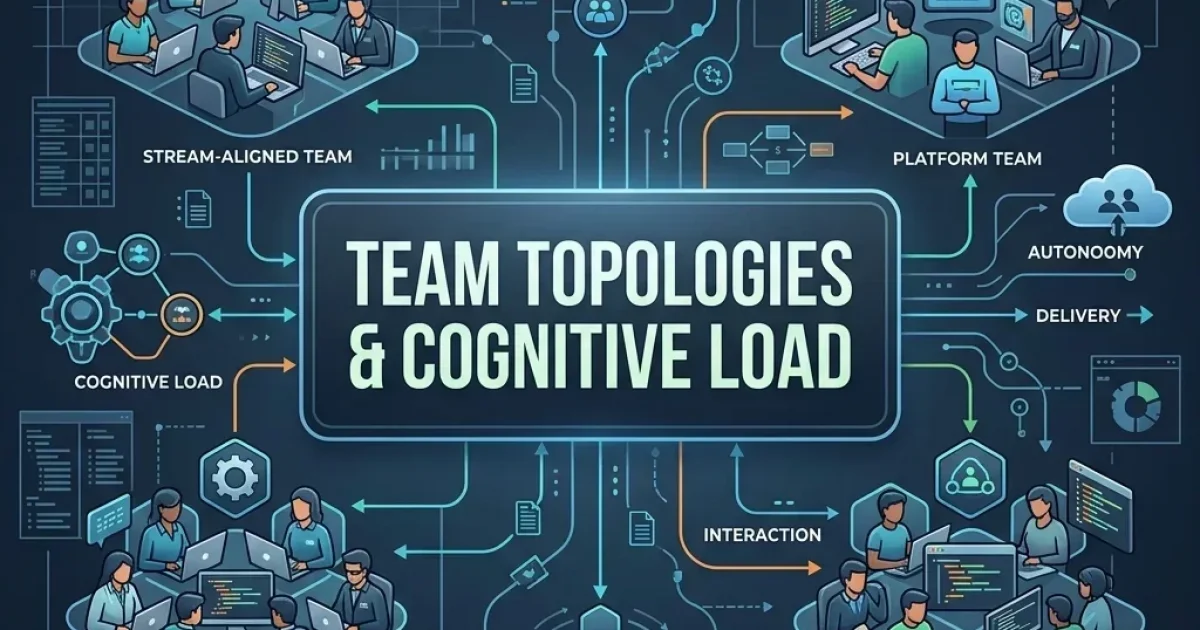
TL;DR: Generative AI tools and autonomous coding agents are dramatically increasing the speed and volume of code production, pushing developer cognitive load to…
The AI-Era Engineering Organizational Crisis
The software engineering sector in 2026 is grappling with a paradox. While generative AI models and autonomous coding assistants have accelerated raw code creation by orders of magnitude, the cycle time for shipping complex, production-grade applications has not decreased proportionally. Instead, organizations are finding that their deployment pipelines are bottlenecked by human review, integration friction, and architectural sprawl.
The root cause of this bottleneck is not technical capability; it is organizational layout.
As developer agents automate code blocks, the volume of codebase assets that a single human team must understand, review, and maintain has multiplied. Traditional engineering structures—characterized by fragmented microservices squads, manual handoffs, and meeting-heavy agile ceremonies—are failing under this weight. The cognitive load of maintaining bloated systems is causing severe developer burnout and slowing down shipping speeds.
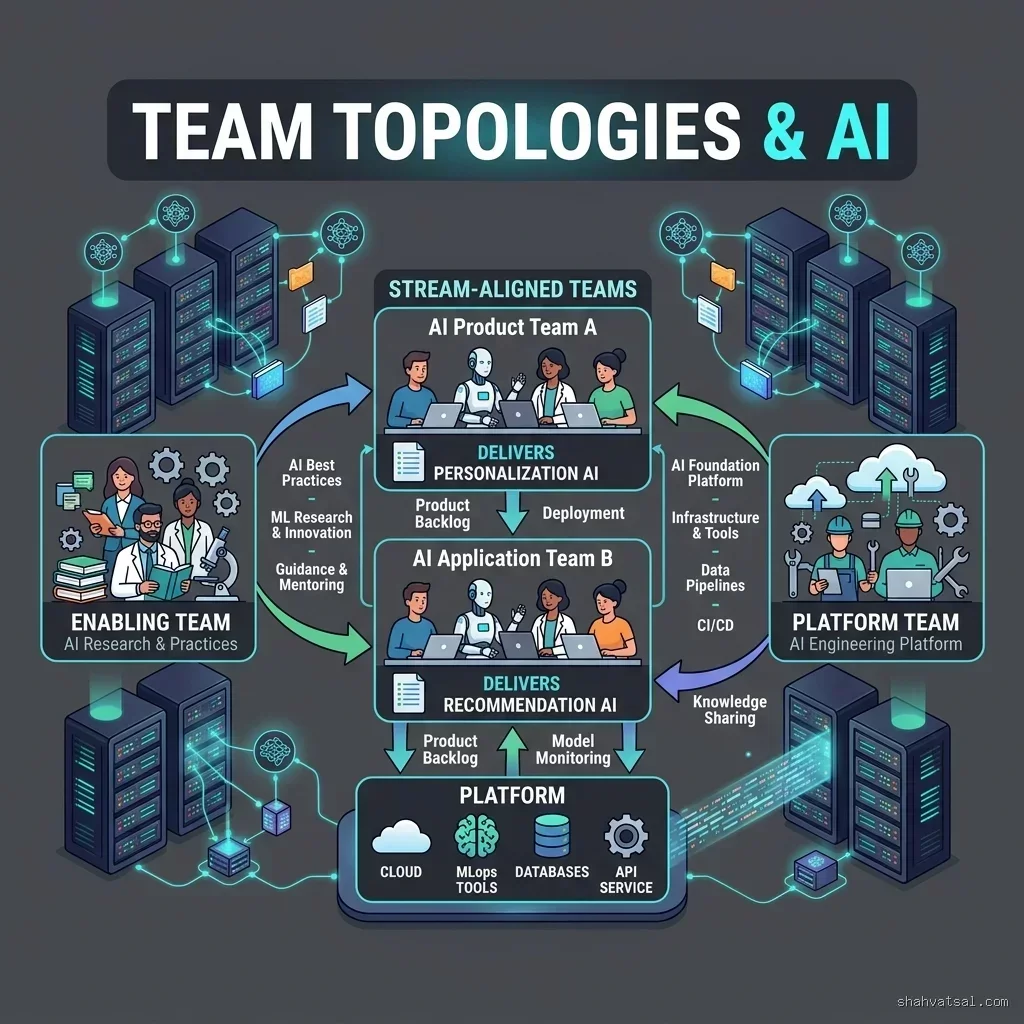
To address this crisis, engineering leaders are looking to the Team Topologies framework. Originally introduced by Matthew Skelton and Manuel Pais, Team Topologies provides a model for organizing teams based on cognitive load boundaries and clean interface dynamics. In the AI era, this framework is no longer an optional organizational strategy; it is a critical requirement for scaling engineering teams without collapse.
H2: The Core Challenge: Developer Cognitive Overload
To design an effective engineering organization, leadership must treat developer cognitive load as the primary constraint. Cognitive load, a theory developed by educational psychologist John Sweller, refers to the total amount of mental effort being used in the working memory.
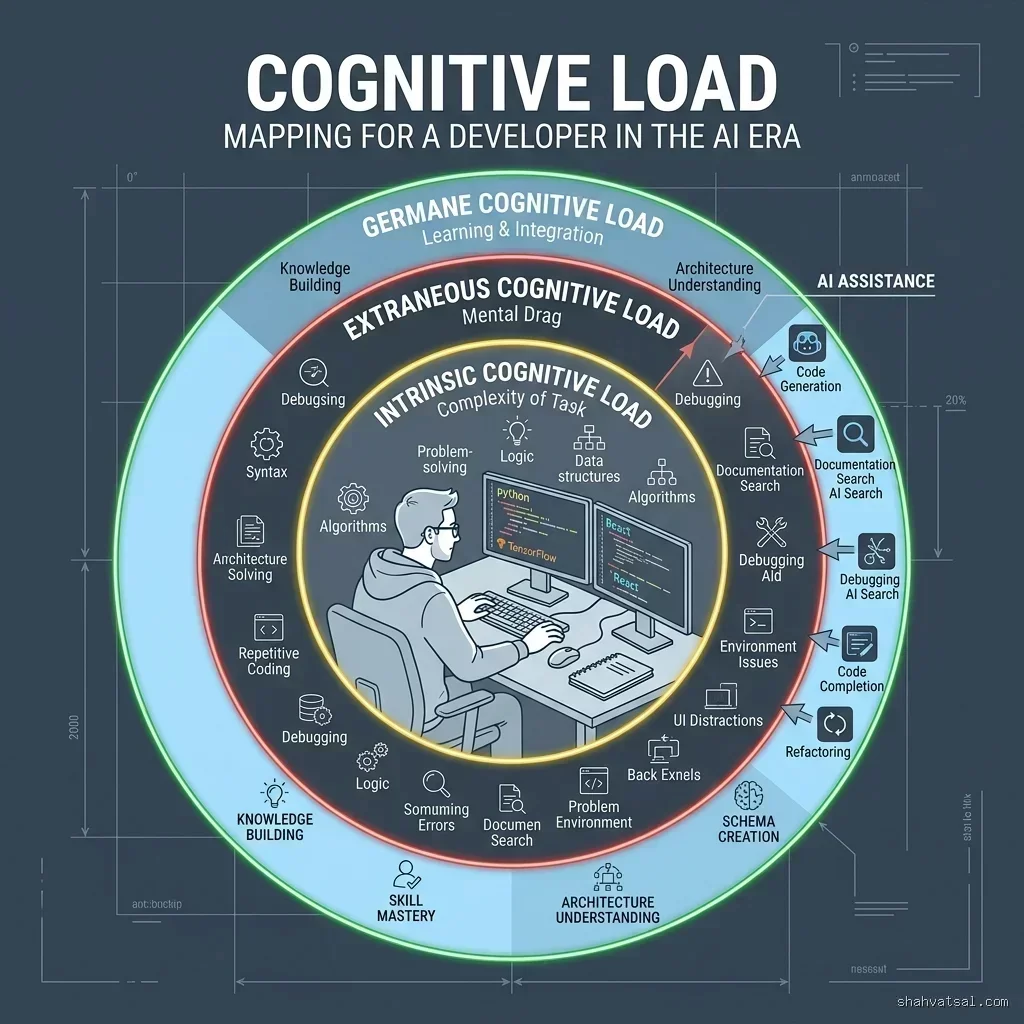
Cognitive load is classified into three distinct categories:
- Intrinsic Cognitive Load: Mental effort related to the core logic of the task (e.g., understanding the syntax of a programming language or the details of an algorithm).
- Extraneous Cognitive Load: Mental effort wasted on environmental details that do not add value to the problem (e.g., manual deployment scripts, configuring server environments, or searching for API credentials).
- Germane Cognitive Load: Mental effort dedicated to processing information and building a mental model of the system (e.g., thinking about database design patterns or optimizing user flow logic).
How AI Tooling Amplifies Extraneous Load
Generative AI tools are highly effective at accelerating tasks that belong to intrinsic cognitive load (such as writing standard functions or unit tests). However, they also create a code amplification effect. Because agents can write thousands of lines of code in seconds, human engineers are forced to spend their mental energy reading, auditing, and debugging generated code blocks.Without clear organizational boundaries, developers quickly experience cognitive overload. When a team of five developers is expected to maintain twenty microservices, build their own CI/CD pipelines, monitor Kubernetes clusters, and audit AI-generated code inputs, they spend the majority of their mental energy on extraneous tasks. As a result, germane cognitive load drops, code quality declines, and architectural integrity decays.
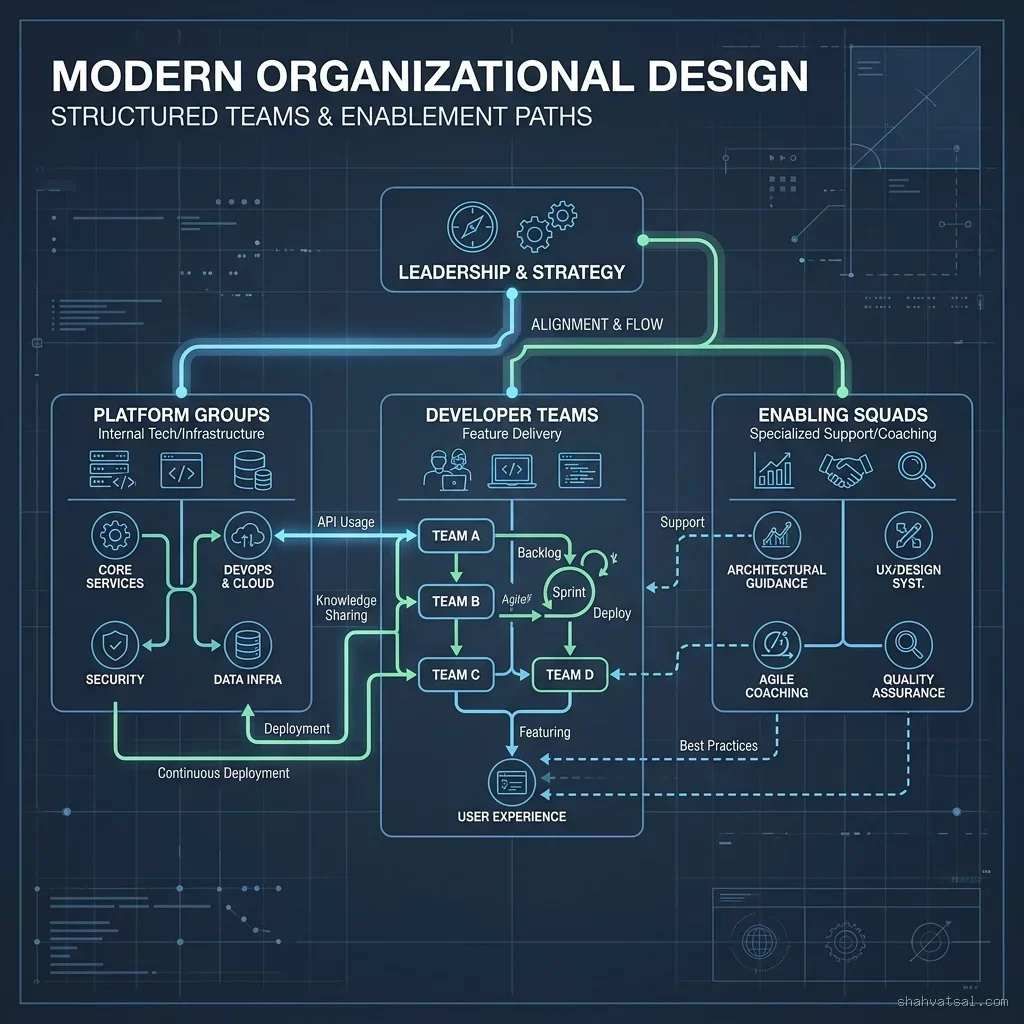
To restore balance, organizations must design team boundaries that limit the scope of responsibility, allowing platform self-services and enabling teams to handle extraneous infrastructure tasks.
H2: Conway’s Law and the Inverse Conway Maneuver
Any discussion of organizational design and software architecture must address Conway’s Law, formulated by computer programmer Melvin Conway:
"Organizations which design systems are constrained to produce designs which are copies of the communication structures of these organizations."
If an organization has three database teams and four backend application teams, the resulting software system will inevitably feature three separate database layers and four distinct backend service pools connected by complex networks.
                           CONWAY'S LAW ALIGNMENT
+--------------------------------------------------------------------------+
|  Organizational Layout (Siloted Communication)                           |
|  [ Team Alpha ] ◄───────────► [ Team Beta ] ◄───────────► [ Team Gamma ]  |
|                                                                          |
|  Software System (Coupled Architecture)                                  |
|  [ Service A ] ◄────────────► [ Service B ] ◄───────────► [ Service C ]  |
+--------------------------------------------------------------------------+
The Inverse Conway Maneuver
Instead of allowing communication patterns to dictate the software architecture, organizations can execute the Inverse Conway Maneuver. This is the practice of designing the target software architecture first, and then aligning the team topologies and communication boundaries to match that architecture.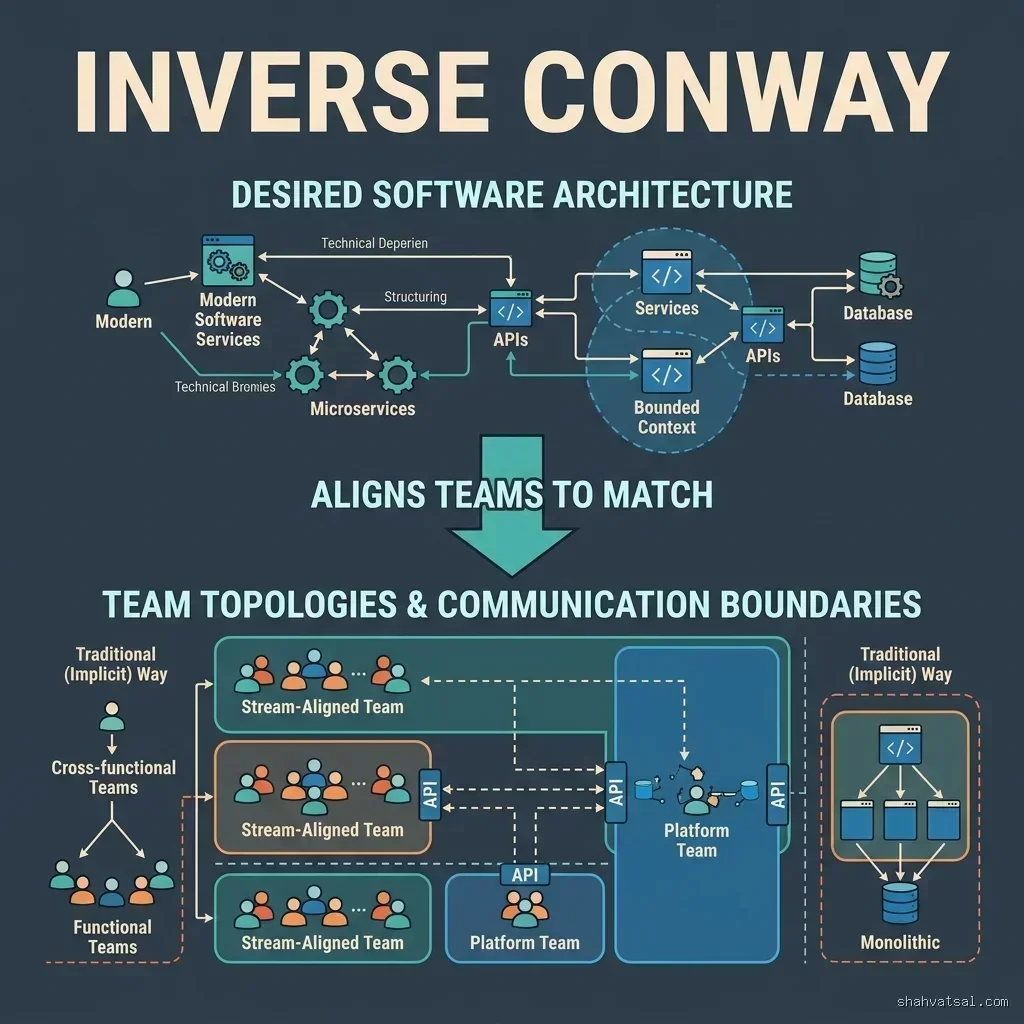
If you want to build a decoupled, event-driven microservices architecture with minimal cross-service dependency, you must organize your teams into autonomous, self-contained units that do not share backlogs or execute manual code handoffs. By limiting the communication paths between these teams to formal APIs (Team API Contracts), the software system is naturally constrained to remain decoupled and modular.
In the AI era, where agents can rapidly generate coupled code structures if left unchecked, the Inverse Conway Maneuver is essential for maintaining architectural sanity.
H2: The Four Core Team Topologies in 2026
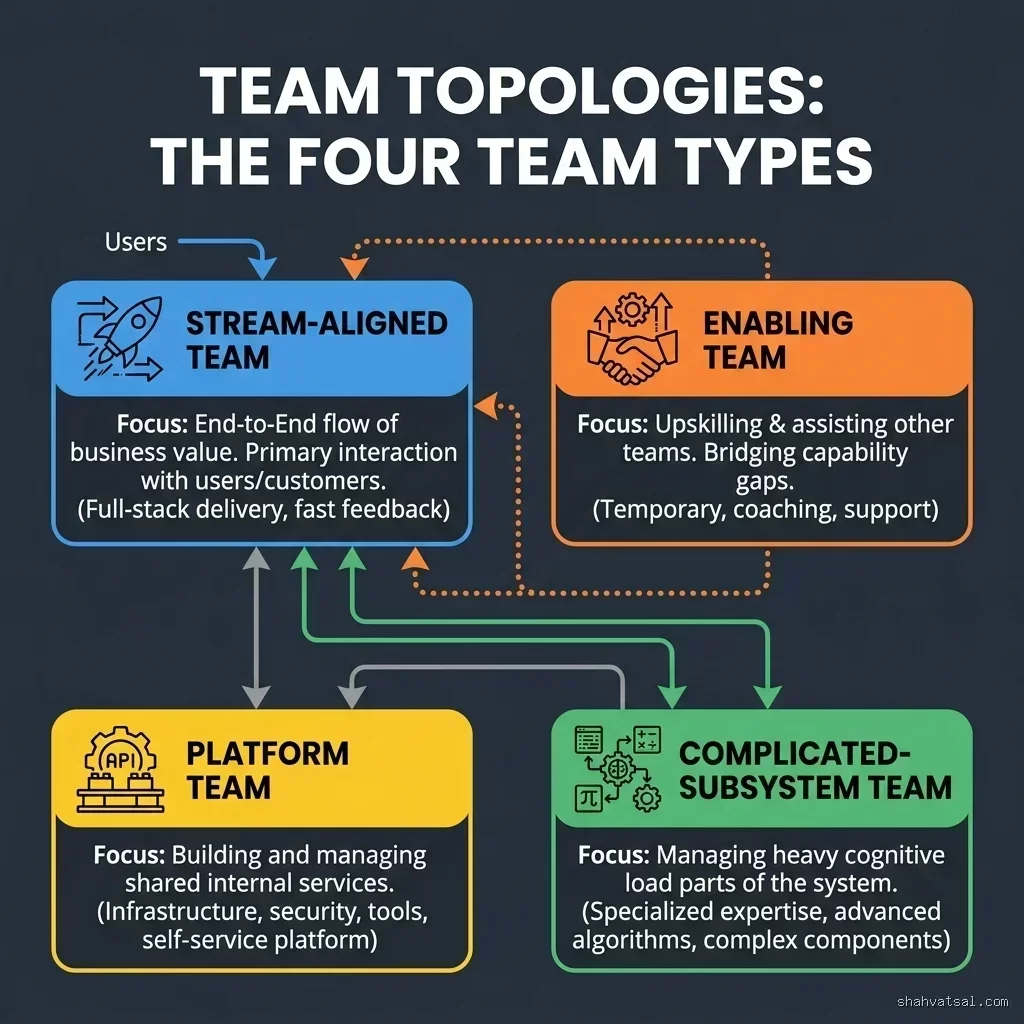
The Team Topologies model establishes four organizational team types to manage system complexity:
1. Stream-Aligned Teams
A Stream-Aligned Team is aligned to a single flow of work—typically a product feature, a user journey, or a customer segment. In 2026, these are cross-functional squads containing developers, product managers, designers, and site reliability engineers.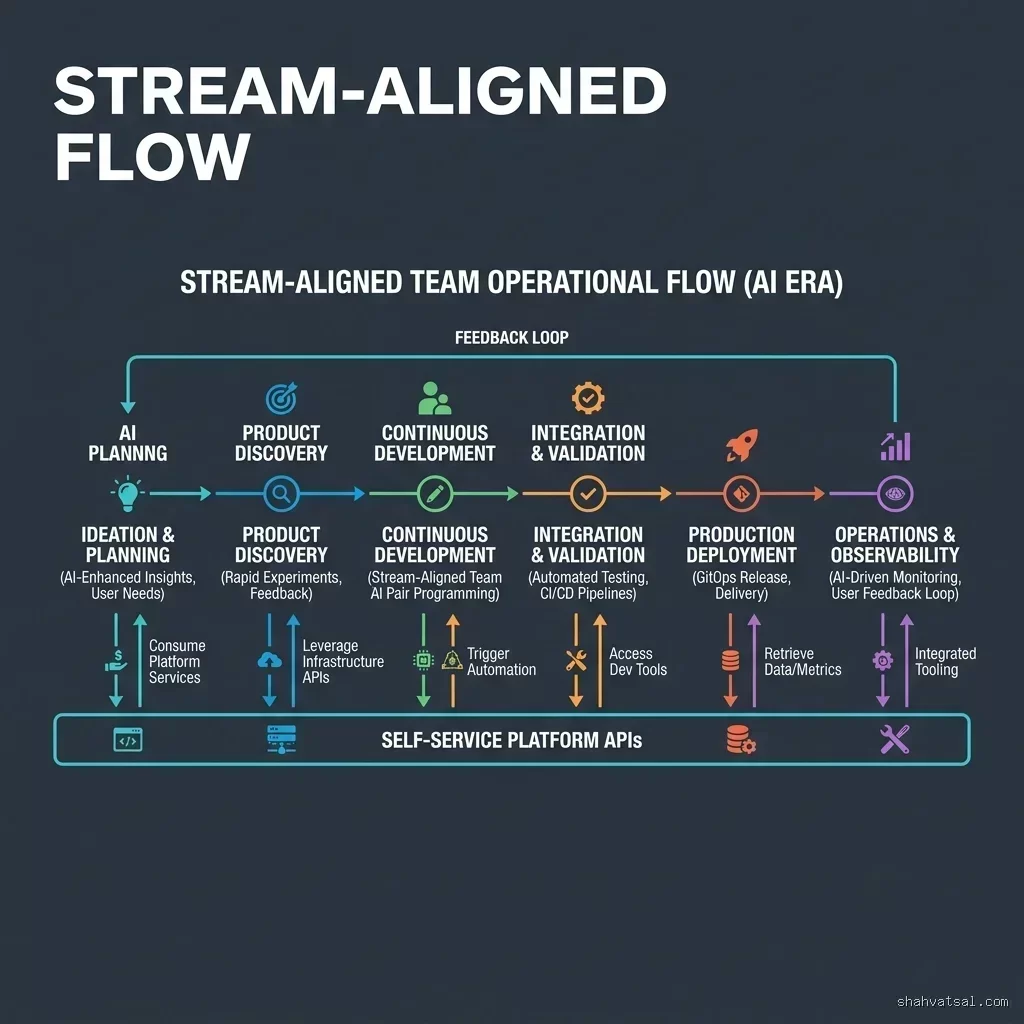
The core characteristic of a stream-aligned team is autonomy. They must have all the skills and permissions required to take a feature from concept to production without waiting on external teams. Their cognitive load is limited to a single business domain, and they consume self-service APIs from the platform team to execute infrastructure tasks.
2. Enabling Teams
An Enabling Team is composed of specialists who investigate new technologies, tools, and methodologies, and then transfer that knowledge to stream-aligned teams. In the AI era, enabling teams are critical for introducing developer platforms, custom LLM models, and AI agent integration patterns.Rather than building features directly, enabling teams act as internal consultants. They work with a stream-aligned team for a limited period (typically 2 to 6 weeks) to pair-program, set up tooling, and establish best practices, before moving on to another team. This prevents the stream-aligned team from spending their cognitive budget on researching infrastructure patterns.
3. Complicated-Subsystem Teams
A Complicated-Subsystem Team is dedicated to building and maintaining a specific module that requires specialized, mathematical, or scientific expertise. Examples include:- A custom audio processing codec.
- An optimization engine for logistics routing.
- A custom machine learning inference pipeline.
4. Platform Teams
A Platform Team is dedicated to building and maintaining an internal developer platform (IDP) that enables stream-aligned teams to deliver work autonomously. In 2026, platform teams deliver "X-as-a-Service" products, such as:- Self-service database provisioning APIs.
- Automated deployment and monitoring templates.
- Identity management and security compliance infrastructure.
H2: Designing Team Interaction Modes
Managing team structures is only half the battle; organizations must also define how these teams interact. Team Topologies establishes three primary Interaction Modes:
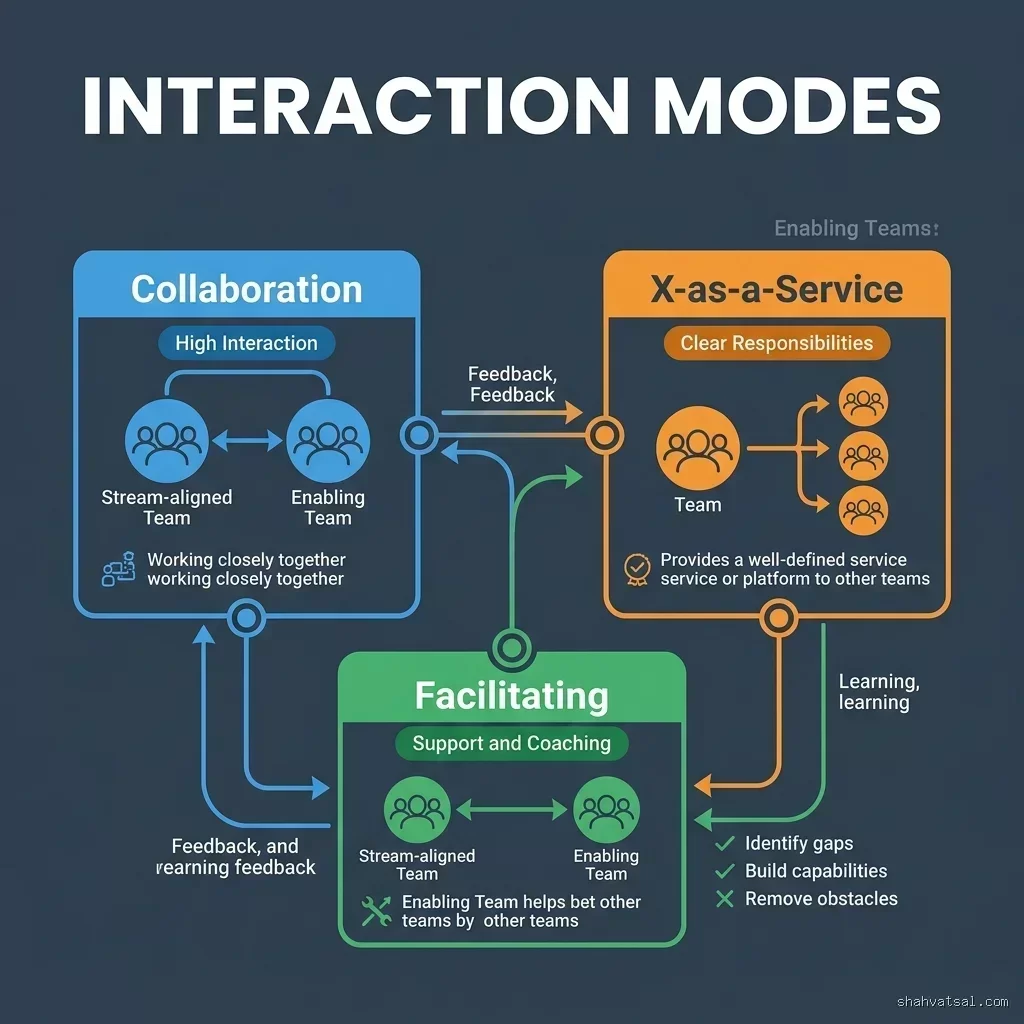
- Collaboration: Teams work together closely to discover new architectures, build prototypes, or define API boundaries. Collaboration is high-bandwidth but expensive, and should only be used for discovery phases.
- X-as-a-Service: One team consumes a service or API provided by another team. The boundaries are clean, communication is asynchronous, and there is no coordination overhead. This is the ideal interaction mode for platform consumption.
- Facilitating: One team (usually an enabling team) mentors and coaches another team to adopt a tool or practice, reducing their learning curve.
Team API Contracts
To prevent ad-hoc communication channels (which lead to meeting overload and coupled dependencies), teams must establish formal Team API Contracts. A Team API contract is a documented set of guidelines defining:- What services, APIs, and libraries the team owns.
- How other teams can consume these services (endpoints, inputs, and outputs).
- The team's communication channels (Slack channels, office hours, and support tickets).
- The team's SLA/SLO metrics for queries and issues.
# Team API Contract Configuration Schema
# Path: config/team-api/platform-db-services.yaml
team:
  name: "Platform Database Services Team"
  handle: "team-platform-db"
  domain: "Cloud Infrastructure & Data Storage"
  onboarding_contact: "https://shahvatsal.com/about"

# Communication SLA boundaries
communication:
  slack_channels:
    public_queries: "#ask-platform-db"
    alerts: "#platform-db-incidents"
  office_hours:
    schedule: "Tuesday and Thursday, 14:00 - 15:30 UTC"
    calendar_link: "https://shahvatsal.com/speaking"
  support_sla:
    critical_p0: "30 minutes (24/7 pager)"
    normal_p2: "4 business hours"
    feature_requests: "Next cycle planning (2-week cool-down)"

# Owned Services and Integration Interfaces
services:
  - name: "PostgreSQL Self-Service Provisioner"
    version: "2.4.0-rc1"
    endpoint: "https://db.platform.internal/v2/provision"
    documentation: "https://shahvatsal.com/resources"
    interaction_mode: "X-as-a-Service"
    payload_spec:
      required_params:
        - "team_id"
        - "environment" (dev | staging | prod)
        - "storage_gb"
      output_format:
        - "db_connection_string"
        - "iam_role_arn"

  - name: "Zerobus Real-Time Event Sync Gateway"
    version: "1.1.2"
    endpoint: "https://zerobus.platform.internal/v1/sync"
    interaction_mode: "Collaboration"
    description: "Used to synchronize transactional database outbox events with analytical delta lakes without replication."

# Codebase and Repository Ownership Boundaries
ownership:
  repositories:
    - "github.com/vatsalshah-office/platform-postgres-operator"
    - "github.com/vatsalshah-office/zerobus-metadata-router"
  dependencies:
    - "postgres >= 16.2"
    - "redis-cluster >= 7.2"
H2: Strategic Case Study: Restructuring for AI-Agent Integration
Consider the case of a typical SaaS enterprise in 2026. The organization was struggling with feature delivery bottlenecks. Their engineering structure consisted of six microservices teams. Each team owned a set of APIs but was also responsible for setting up their own AWS infrastructure, writing Terraform files, and managing deployment monitoring.
The Problem: Extraneous Load Explosion
When the enterprise introduced GitHub Copilot and custom code generation agents, the volume of code increased by 40%. However, deployments ground to a halt. Developers spent hours reviewing complex PRs generated by AI tools, database configurations broke under new payload volumes, and security breaches occurred because teams configured open IAM policies to bypass deployment bottlenecks. The developers were in a constant state of cognitive overload, spending 70% of their time on extraneous infrastructure tasks.The Restructuring Plan
Using the Team Topologies model, the enterprise executed a structural reorganization: SQUAD RESTRUCTURING
+--------------------------------------------------------------------------+
| Before: Coupled Feature Factory |
| [ Feature Team 1 ] ──► (Owns Code + Infra + Security + QA) ──► Coupled |
| [ Feature Team 2 ] ──► (Owns Code + Infra + Security + QA) ──► Coupled |
| |
| After: Team Topologies Model |
| [ Stream-Aligned Feature Squads ] ◄── Consume APIs ──► [ Platform ] |
| ▲ ▲ |
| │ (Mentored by) │ (Built by)|
| [ Enabling Team (AI Tooling) ] ─────────────────────────────┘ |
+--------------------------------------------------------------------------+- Formed a Platform Team: Consolidated four infrastructure engineers into a dedicated Platform Team. Their mandate was to build a self-service deployment developer portal, abstracting AWS, Terraform, and Kubernetes complexity behind simple API endpoints.
- Formed an Enabling Team for AI Tooling: Created a temporary Enabling Team composed of senior software architects. Their role was to research AI agent integration patterns, build custom template blocks, and mentor the stream-aligned teams on how to audit generated code.
- Refined Stream-Aligned Feature Squads: Structured the remaining engineers into four Stream-Aligned Squads focused entirely on business domains (e.g., Billing, User Management, Search).
The Results
By offloading infrastructure management to self-service platform APIs, the extraneous cognitive load on feature developers dropped significantly. The stream-aligned teams could focus on domain logic and feature quality. Within three months, cycle times for feature deployments decreased by 60%, and developer satisfaction scores reached an all-time high.H2: Verdict: The 2026 Organizational Layout Playbook
For engineering executives and senior technical managers, designing a modern org structure requires taking specific action items:
Action Item 1: Audit Your Cognitive Load
Perform a qualitative assessment of your engineering squads. Ask your developers: "What percentage of your week is spent on writing business logic versus debugging environment configurations, deploying servers, or waiting on external approvals?" If the latter exceeds 30%, your teams are suffering from extraneous cognitive overload, and you must invest in platform self-services.Action Item 2: Define Team API Contracts
Enforce the creation of formal Team API Contracts for every squad in your organization. Document team ownership, SLAs, communication channels, and API formats. This asynchronous boundary minimizes coordinate meetings and prevents architecture coupling.Action Item 3: Invest in Enabling Teams for AI Adoption
AI adoption cannot be left to individual developers. Establish an Enabling Team to define standards for code reviews, verify security guardrails, and train feature teams on auditing AI outputs.Key Takeaways
- Cognitive Load is the Primary Constraint: Engineering structures must be designed to limit the cognitive load of individual teams.
- Decoupled Stream Alignment: Stream-aligned teams must own business domains with full autonomy, supported by platform services.
- The Platform as a Product: Platform teams must treat internal developers as customers, delivering easy-to-use, self-service APIs.
- Interaction Mode Enforcement: Teams must interact through defined modes (Collaboration, X-as-a-Service, or Facilitating) to minimize communication overhead.
- Team API Contracts: Documented service boundaries and communication rules prevent coupled system dependencies and coordinate blockages.
FAQ