The defining PMO trend of 2026 is unambiguous: RAG (Red/Amber/Green) status reporting is dying, and outcome measures have won. While traditional Project Managem…
The defining PMO trend of 2026 is unambiguous: RAG (Red/Amber/Green) status reporting is dying, and outcome measures have won. While traditional Project Management Offices (PMOs) obsess over whether projects are delivered on-time and on-budget, modern Value Management Offices (VMOs) govern whether the right work was funded in the first place and harvest actual EBITDA gains long after go-live. Explore the dual-track governance engine, multi-criteria prioritization, and the 6-step transformation playbook.
Primary Keyword: VMO vs PMO value management office transformation 2026
LSI Keywords: PMO to VMO migration playbook, Value Management Office vs PMO, dual track project execution value realization, multi criteria value prioritization scoring, post close benefits realization curve, House of PMO Planisware Shibumi standards, stop pivot continue portfolio governance, RAG status report replacement value metrics.
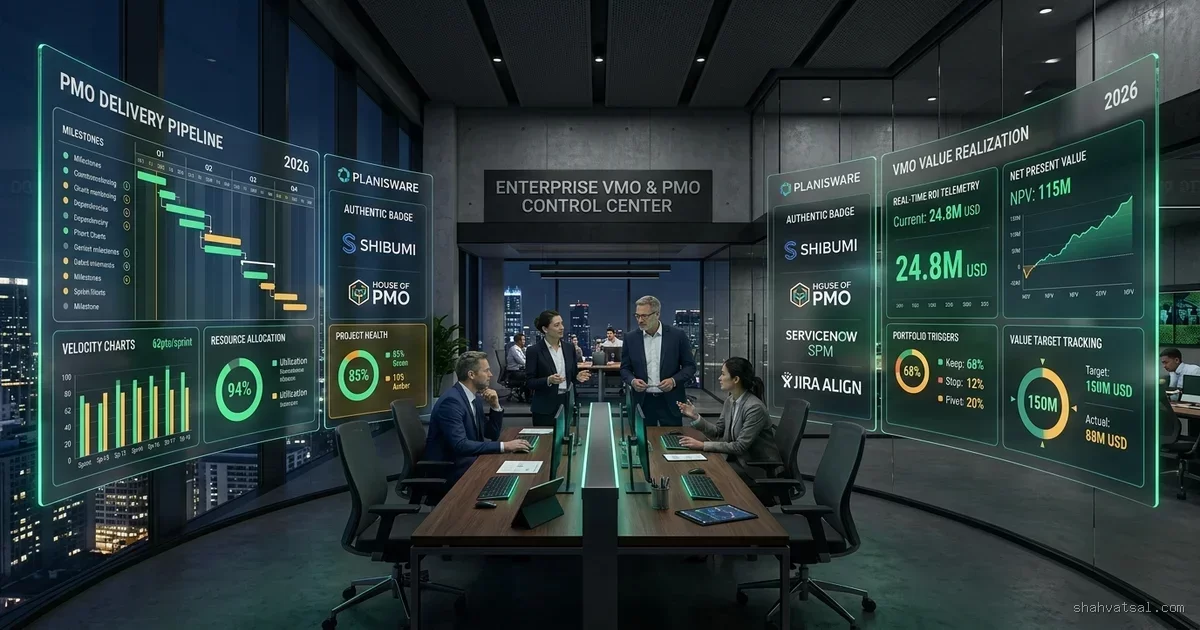
Executive Summary: 2026 PMO Trend #1 — The Death of RAG Dashboards and the Rise of Outcome Governance
For nearly half a century, the Project Management Office (PMO) was evaluated against a single sacred canon: The Triple Constraint. A project was declared a sterling triumph if it crossed the finish line on time, within budget, and in accordance with the pre-approved scope statement.
To communicate this compliance to executive leadership, the PMO relied on the ubiquitous RAG (Red, Amber, Green) dashboard. Every Monday morning, senior vice presidents stared at spreadsheets and slide decks bathed in soothing emerald hues.
Yet, behind this comforting visual veneer lay one of corporate enterprise's most expensive open secrets: The Watermelon Effect. Projects appeared crisp, healthy, and green on the outside, but when sliced open, were dripping in red—beset by phantom user adoption, negative operational return on investment (ROI), and complete failure to alter the enterprise's bottom-line financial trajectory.
In 2026, the corporate tolerance for delivery-centric vanity metrics has reached its structural end.
┌────────────────────────────────────────────────────────────────────────────────────────┐
│                        THE ENTERPRISE GOVERNANCE SHIFT (2026)                          │
└────────────────────────────────────────────────────────────────────────────────────────┘

    TRADITIONAL PMO (1980–2024)                         MODERN VMO (2025–2026+)
  [ Focus: "Doing Things Right" ]                    [ Focus: "Doing the Right Things" ]
  ┌───────────────────────────────┐                  ┌───────────────────────────────┐
  │ • Triple Constraint (Scope,   │                  │ • Direct EBITDA & Margin Lift │
  │   Schedule, Budget)           │                  │ • Post-Close Value Harvesting │
  │ • Subjective RAG Dashboards   │       VS         │ • Algorithmic Prioritization  │
  │ • Celebration at "Go-Live"    │                  │ • Active Stop/Pivot/Continue  │
  │ • Zero Post-Close Audits      │                  │ • Value Telemetry Telemetry   │
  └──────────────┬────────────────┘                  └───────────────┬───────────────┘
                 │                                                   │
                 ▼                                                   ▼
     [ 65% Value Destruction ]                           [ 3.4x Capital Efficiency ]
     [ "The Watermelon Effect" ]                         [ Compounded Enterprise ROI ]
Global research consortiums, leading industry bodies like the House of PMO, and premier enterprise strategic portfolio platforms like Planisware and Shibumi have codified the defining shift of the decade: The structural migration from Project Management Offices to Value Management Offices (VMOs).
The distinction is foundational:
- The PMO answers an operational question: "Is the work being delivered according to schedule, cost, and process standards?"
- The VMO answers a strategic and fiduciary question: "Was this the highest-leverage use of enterprise capital in the first place, is the value hypothesis holding true in production, and should we pivot or terminate this initiative today?"
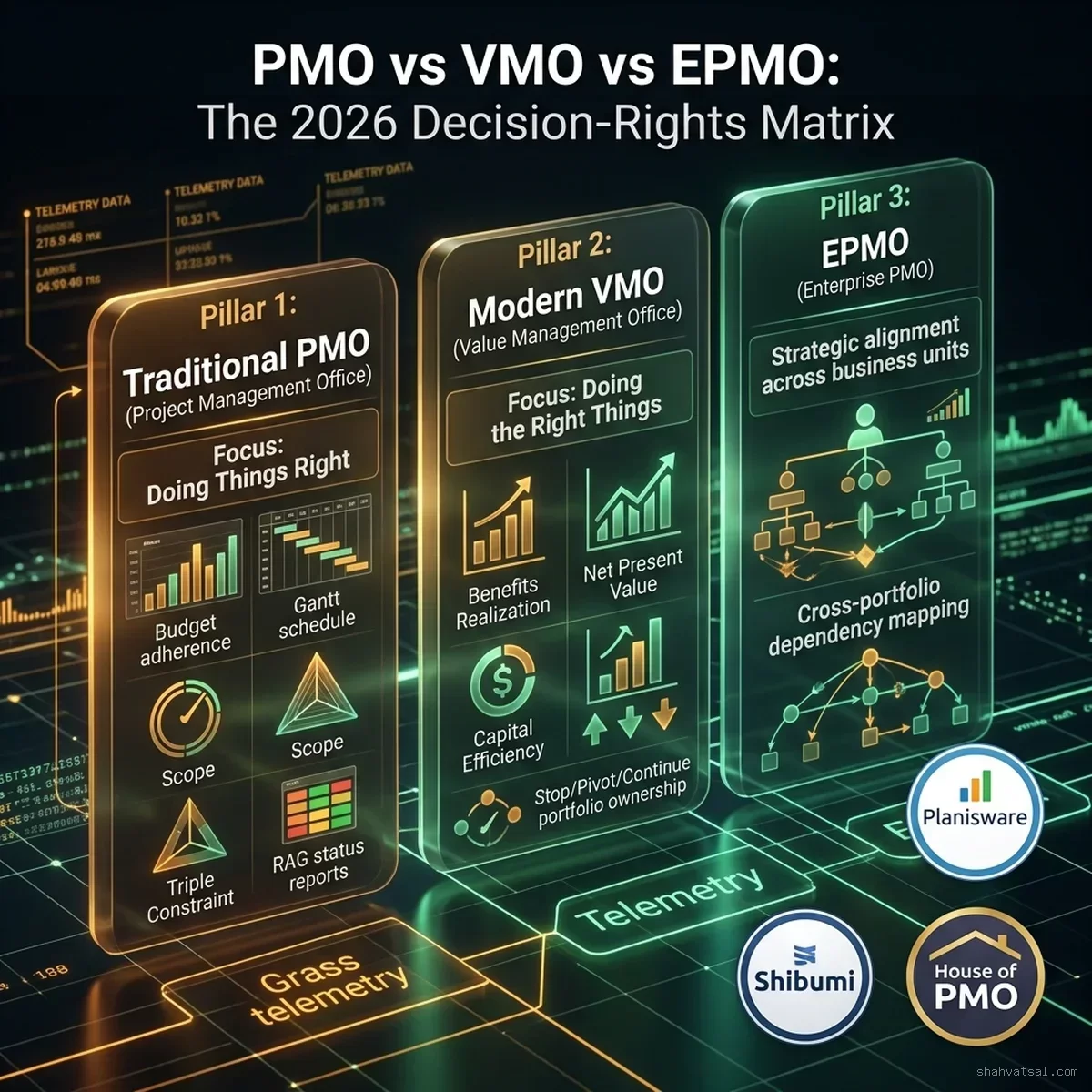
The PMO vs VMO vs EPMO Decision-Rights Matrix: Who Owns What?
A catastrophic failure mode during organizational redesign is creating semantic confusion. Executives often rename their existing PMO to "Value Management Office" on company organizational charts while changing nothing about daily routines, decision rights, or reward systems.
To avoid cosmetic rebranding, enterprise leaders must enforce an unambiguous Decision-Rights Matrix across the three operational tiers: the Traditional PMO, the Enterprise PMO (EPMO), and the Value Management Office (VMO).
The Three Organizational Pillars
- The Traditional PMO (Project Management Office):
- The EPMO (Enterprise Project Management Office):
- The Modern VMO (Value Management Office):
Detailed Comparative Decision-Rights Matrix
| Governance Dimension | Traditional PMO | Enterprise PMO (EPMO) | Modern VMO (Value Management Office) |
|---|---|---|---|
| Guiding Philosophy | "Deliver what was asked on schedule." | "Coordinate deliveries across the enterprise." | "Maximize return on capital and customer outcome." |
| Primary Metric | Triple Constraint (Scope, Budget, Time) | Portfolio throughput & resource utilization | Net Present Value (NPV), EBITDA lift, Cost Avoided |
| Portfolio Authority | Recommends timeline and resource changes | Coordinates cross-department resource contention | Owns Stop, Pivot, or Continue decision rights |
| Lifecycle Horizon | Concludes at Go-Live and Project Handover | Concludes at Operational Steady-State | Monitors benefits for 12–24 months post-launch |
| Reporting Status | Subjective RAG (Red/Amber/Green) self-reports | Aggregated milestone schedule variances | Automated value telemetry and metric variance tracking |
| Prioritization Model | Departmental lobbying / High-Med-Low | Capacity matching against executive requests | Multi-criteria algorithmic value scoring ($\ge 85$ funded) |
| Executive Reporting Line | Director of IT or Program Management | Vice President of IT / Operations | Chief Financial Officer (CFO) / Chief Strategy Officer |
| Primary Toolset | Jira, Microsoft Project, Smartsheet | Clarity, Monday.com, Jira Align | Planisware, Shibumi, ServiceNow SPM |
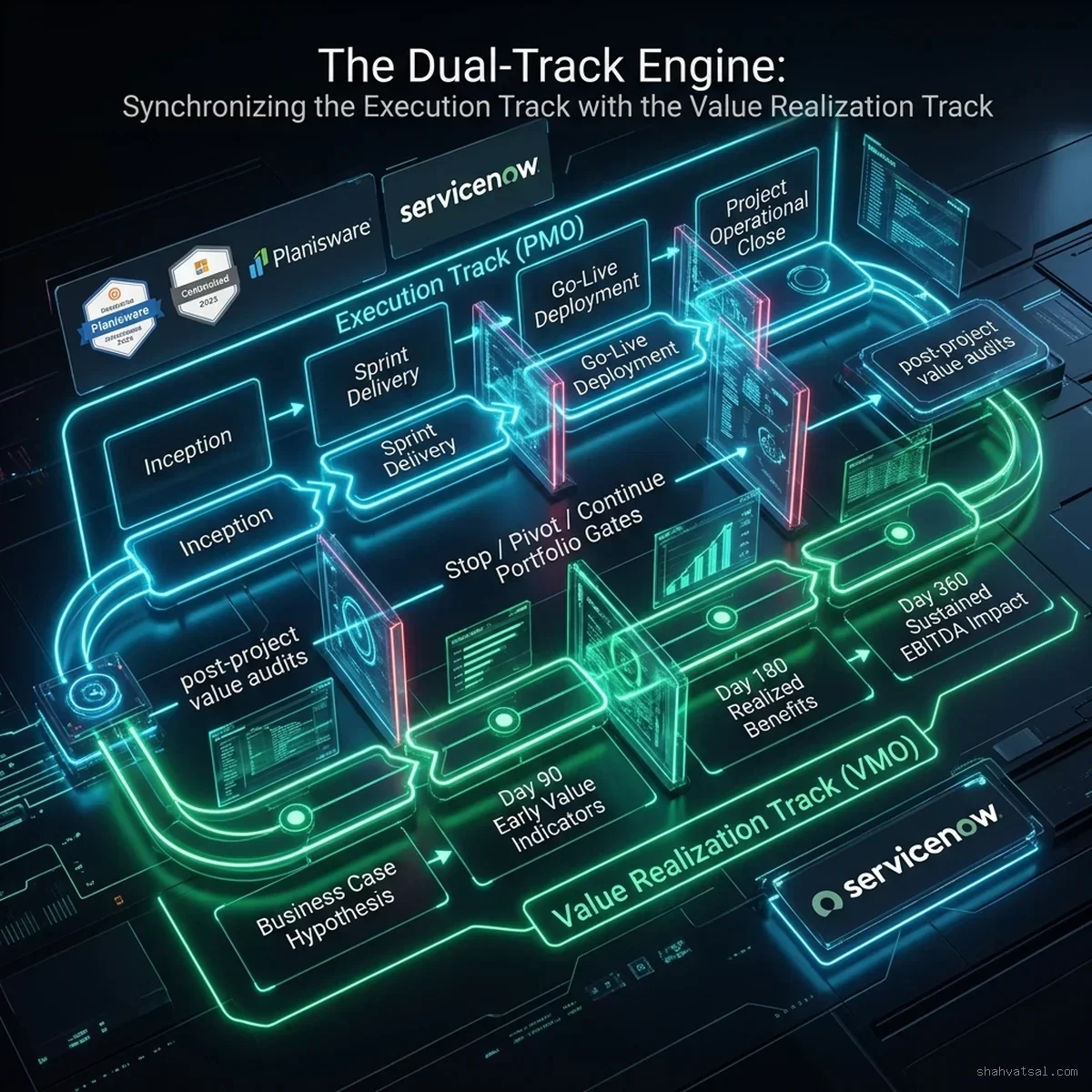
The Dual-Track Governance Engine: Harmonizing the Execution Track and the Value Track
A common misconception among agile advocates is that focusing on value means eliminating delivery tracking. In reality, attempting to measure financial value without robust execution tracking leads to chaotic, uncoordinated software releases.
Top-tier organizations operationalize value governance through the Dual-Track Engine. This model synchronizes two distinct but tightly coupled lifecycles: The Execution Track (PMO) and The Value Realization Track (VMO).
┌────────────────────────────────────────────────────────────────────────────────────────┐
│                        THE DUAL-TRACK VALUE ENGINE                                     │
└────────────────────────────────────────────────────────────────────────────────────────┘

  TRACK 1: EXECUTION TRACK (PMO)
  ┌───────────────┐     ┌───────────────┐     ┌───────────────┐     ┌───────────────┐
  │ Project       │──►  │ Sprint        │──►  │ Go-Live       │──►  │ Operational   │
  │ Inception     │     │ Delivery      │     │ Deployment    │     │ Handover      │
  └───────┬───────┘     └───────┬───────┘     └───────┬───────┘     └───────┬───────┘
          │                     │                     │                     │
          ▼                     ▼                     ▼                     ▼
  [ GATE 0: FUNDING ]   [ GATE 1: PIVOT ]     [ GATE 2: ADOPTION ]  [ GATE 3: HARVEST ]
          ▲                     ▲                     ▲                     ▲
          │                     │                     │                     │
  ┌───────┴───────┐     ┌───────┴───────┐     ┌───────┴───────┐     ┌───────┴───────┐
  │ Business Case │──►  │ Day 90 Early  │──►  │ Day 180 Net   │──►  │ Day 360 Sust. │
  │ Hypothesis    │     │ Indicators    │     │ Realization   │     │ EBITDA Lift   │
  └───────────────┘     └───────────────┘     └───────────────┘     └───────────────┘
  TRACK 2: VALUE REALIZATION TRACK (VMO)
1. The Execution Track (PMO Domain)
The Execution Track focuses on the mechanics of building and shipping.- Sprint Execution: Engineering squads execute Jira sprints, manage pull requests, and clear technical blockers.
- Milestone Tracking: The PMO monitors dependencies between microservices, vendor deliverables, and infrastructure readiness.
- Cost Burn Rate: Tracks actual vendor and labor spending against approved initial budgets.
2. The Value Realization Track (VMO Domain)
The Value Realization Track begins before execution starts and extends long after execution ends.- Hypothesis Definition (Inception): Before a single developer writes a line of code, the sponsor must quantify the causal mechanism of value creation. (e.g., "Automating supplier invoice parsing will reduce invoice cycle time from 72 hours to 90 seconds, freeing 14 FTEs to redeploy to vendor recovery audits, recapturing $3.2M annually").
- Day 90 Early Value Indicators: Following initial deployment, the VMO measures behavioral adoption metrics: Are users logging into the system? Is transaction volume migrating? If adoption is below 60%, execution is flagged for a strategic pivot.
- Day 180 Realized Benefits: Audits operational efficiency: Have customer service ticket volumes dropped? Did unit labor costs decline?
- Day 360 Sustained EBITDA Lift: In collaboration with corporate finance, the VMO verifies that projected cost savings or revenue gains actually materialized on the general ledger.
Stop, Pivot, or Continue Portfolio Gates
The interaction between these two tracks is governed by Active Portfolio Gates:
- Gate 0 (Funding Gate): The business case is scored via the Multi-Criteria Prioritization Engine. Projects scoring below 70 are rejected regardless of executive sponsor seniority.
- Gate 1 (Mid-Flight Pivot Gate): If execution velocity drops by 35% or market conditions change, the VMO reviews whether continued investment is justified. If the expected NPV has degraded, the project is terminated immediately, preserving unspent capital.
- Gate 2 (Adoption Gate - Post Go-Live): Evaluates user engagement 90 days post-launch. If user adoption is lagging, future phased releases are paused until change management hurdles are resolved.
- Gate 3 (Value Harvesting Gate - Day 360): Final financial verification. Realized benefits are certified, and capital efficiency multipliers are fed into next year's planning models.
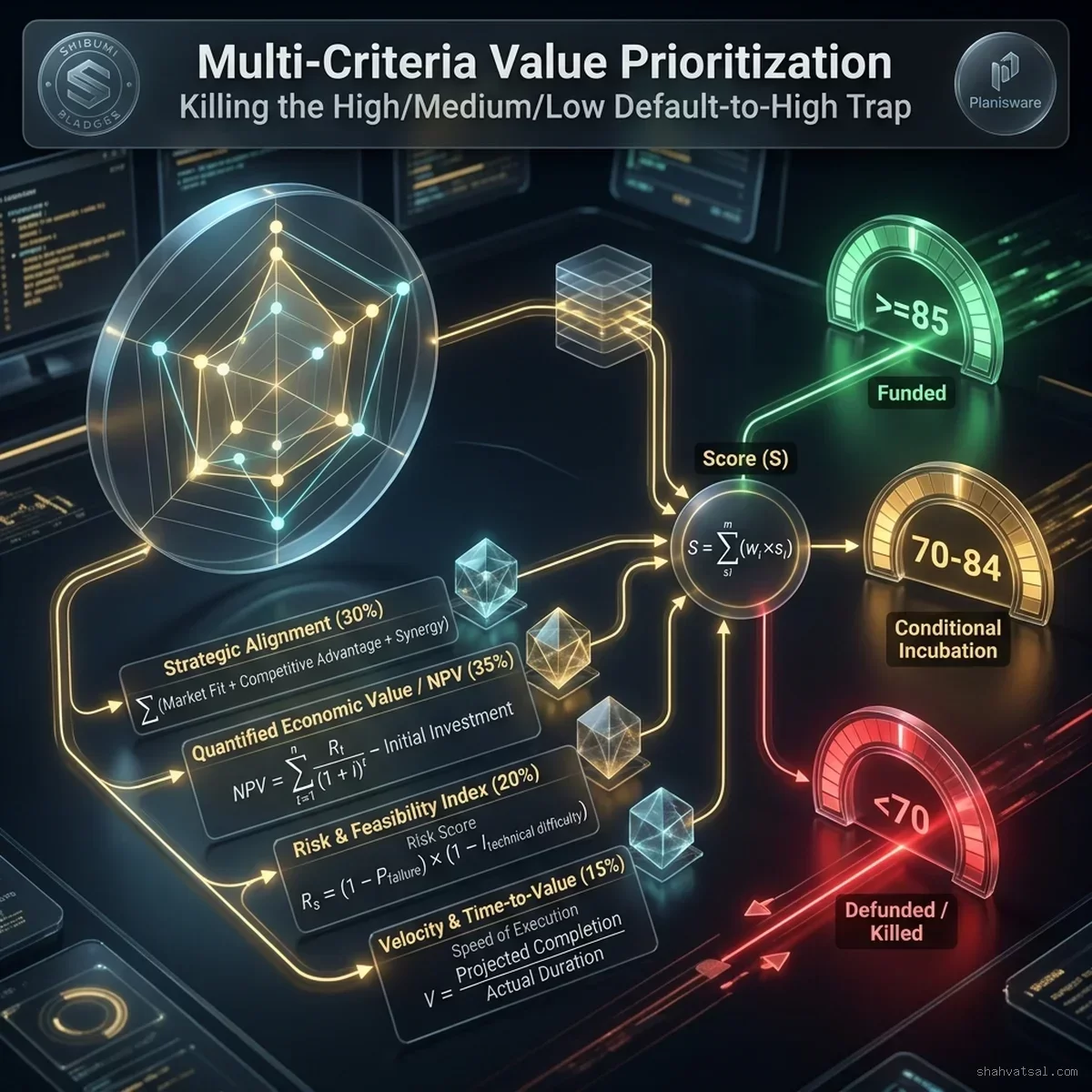
Multi-Criteria Value Prioritization: Killing the "High / Medium / Low" Default-to-High Trap
In traditional enterprise planning, portfolio prioritization is an exercise in political lobbying. Business unit leaders submit lists of projects categorized as High, Medium, or Low priority.
Within 72 hours, every single project magically becomes "High Priority" or "Urgent."
Because traditional PMOs lack an objective, mathematical scoring framework, capital allocation defaults to executive seniority: the loudest executive in the room secures budget, while high-ROI, cross-functional automation projects starve.
The VMO eradicates this dynamic by enforcing an Algorithmic Multi-Criteria Prioritization Engine.
The 4-Vector Mathematical Scoring Framework
Every candidate initiative is evaluated across four normalized vectors ($0.0$ to $100.0$), weighted according to corporate strategic priorities:
$$S_{\text{total}} = w_1 S_{\text{strat}} + w_2 S_{\text{econ}} + w_3 S_{\text{risk}} + w_4 S_{\text{veloc}}$$
Where weights typically follow enterprise standards:
- Strategic Alignment ($w_1 = 0.30$): Alignment with multi-year corporate objectives (market expansion, digital platform transition, regulatory compliance).
- Quantified Economic Value / NPV ($w_2 = 0.35$): Discounted cash flow (DCF), 3-year Net Present Value (NPV), direct cost elimination, and margin expansion.
- Risk & Feasibility Index ($w_3 = 0.20$): Inverse measure of implementation complexity, architectural dependencies, regulatory exposure, and organizational change barriers.
- Time-to-Value & Velocity ($w_4 = 0.15$): Speed to first tangible value delivery (rewarding initiatives that deliver measurable value within 90 days over multi-year monolithic programs).
Portfolio Threshold Triage Gates
- Score $\ge 85$ (Tier A - Fully Funded & Accelerated): High-conviction, high-yield initiatives. Fast-tracked through procurement and resource allocation.
- Score $70–84$ (Tier B - Conditional Incubation / Sandbox): Promising concepts requiring scope refinement or proof-of-value validation before full capital commitment.
- Score $< 70$ (Tier C - Defunded / Terminated): Unviable initiatives. Capital and engineering capacity are immediately protected from dilution.
Production Implementation: Multi-Criteria Value Prioritization Engine
Below is an enterprise Python script utilizing Pydantic models to score and triage a corporate project portfolio algorithmically:
"""
Enterprise Multi-Criteria Value Prioritization Engine (VMO Core)
Platform: Algorithmic Portfolio Triage with Weighted Strategic Vectors
Author: Vatsal Shah (https://shahvatsal.com)
"""

from typing import List, Dict, Any
from pydantic import BaseModel, Field
import json
import logging

logging.basicConfig(level=logging.INFO)
logger = logging.getLogger("VMO_ScoringEngine")

class PortfolioCandidate(BaseModel):
    project_id: str
    name: str
    sponsor_department: str
    requested_budget_usd: float
    projected_3yr_npv_usd: float

    # 0 to 100 Raw Vector Inputs
    strategic_fit_score: float = Field(..., ge=0.0, le=100.0)
    regulatory_mandate: bool = False
    technical_feasibility_score: float = Field(..., ge=0.0, le=100.0)
    time_to_first_value_months: int = Field(..., ge=1, le=36)

class PrioritizationResult(BaseModel):
    project_id: str
    name: str
    composite_value_score: float
    verdict: str
    allocated_funding_usd: float
    rationale: str

class VMOPrioritizationEngine:
    WEIGHT_STRATEGIC = 0.30
    WEIGHT_ECONOMIC = 0.35
    WEIGHT_FEASIBILITY = 0.20
    WEIGHT_VELOCITY = 0.15

    def calculate_economic_score(self, budget: float, npv: float) -> float:
        """Calculates normalized ROI/NPV multiple score (0 to 100)."""
        if budget <= 0:
            return 0.0
        roi_multiple = npv / budget
        # A 5x multiple represents a perfect 100 score
        return min(100.0, max(0.0, (roi_multiple / 5.0) * 100.0))

    def calculate_velocity_score(self, months: int) -> float:
        """Shorter time-to-value earns higher velocity points."""
        if months <= 3:
            return 100.0
        elif months <= 6:
            return 80.0
        elif months <= 12:
            return 50.0
        else:
            return max(0.0, 100.0 - (months * 3.5))

    def evaluate_candidate(self, candidate: PortfolioCandidate) -> PrioritizationResult:
        logger.info(f"Evaluating Candidate: {candidate.project_id} - {candidate.name}")

        econ_score = self.calculate_economic_score(candidate.requested_budget_usd, candidate.projected_3yr_npv_usd)
        veloc_score = self.calculate_velocity_score(candidate.time_to_first_value_months)

        # Override: Regulatory mandates receive automatic strategic alignment boost
        strat_score = 100.0 if candidate.regulatory_mandate else candidate.strategic_fit_score

        composite = (
            (strat_score * self.WEIGHT_STRATEGIC) +
            (econ_score * self.WEIGHT_ECONOMIC) +
            (candidate.technical_feasibility_score * self.WEIGHT_FEASIBILITY) +
            (veloc_score * self.WEIGHT_VELOCITY)
        )

        if composite >= 85.0:
            verdict = "FUNDED_ACCELERATED"
            allocated = candidate.requested_budget_usd
            rationale = "High strategic alignment and compelling economic return."
        elif composite >= 70.0:
            verdict = "CONDITIONAL_SANDBOX"
            allocated = candidate.requested_budget_usd * 0.25
            rationale = "Viable concept; funded for 90-day proof-of-value phase."
        else:
            verdict = "DEFUNDED_REJECTED"
            allocated = 0.0
            rationale = "Insufficient composite value return; capital preserved."

        return PrioritizationResult(
            project_id=candidate.project_id,
            name=candidate.name,
            composite_value_score=round(composite, 2),
            verdict=verdict,
            allocated_funding_usd=allocated,
            rationale=rationale
        )

# Example Execution Run
if __name__ == "__main__":
    engine = VMOPrioritizationEngine()

    candidates = [
        PortfolioCandidate(
            project_id="PRJ-2026-081",
            name="Autonomous AP Invoice Discrepancy Mesh",
            sponsor_department="GBS Global Finance",
            requested_budget_usd=450000.00,
            projected_3yr_npv_usd=2800000.00,
            strategic_fit_score=92.0,
            regulatory_mandate=False,
            technical_feasibility_score=88.0,
            time_to_first_value_months=3
        ),
        PortfolioCandidate(
            project_id="PRJ-2026-044",
            name="Legacy Intranet Portal Aesthetic Redesign",
            sponsor_department="Corporate Communications",
            requested_budget_usd=300000.00,
            projected_3yr_npv_usd=50000.00,
            strategic_fit_score=35.0,
            regulatory_mandate=False,
            technical_feasibility_score=75.0,
            time_to_first_value_months=14
        )
    ]

    for c in candidates:
        res = engine.evaluate_candidate(c)
        print(res.model_dump_json(indent=2))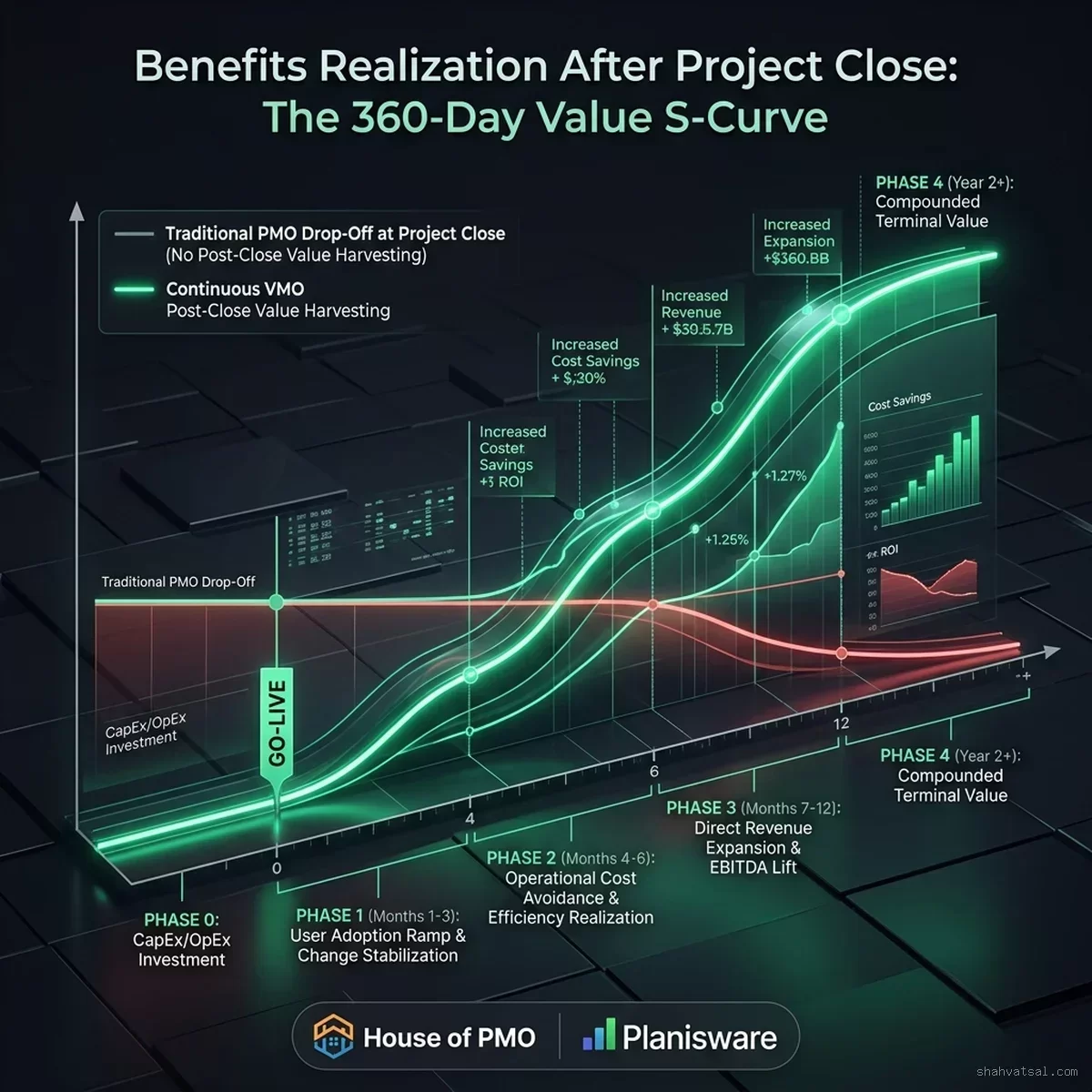
Benefits Realization After Project Close: Why True Value Begins at Go-Live
The most damaging cultural illusion in corporate program management is the belief that Go-Live equals Success.
In traditional PMO dogma:
- A software system launches on November 1st.
- The project team hosts a launch party, congratulates itself on meeting the deadline, and disbands.
- The project manager logs the project as "Closed" in Jira or Clarity and transitions to a new assignment.
- Nobody ever returns to verify if anyone actually uses the software or if the projected financial savings were achieved.
┌────────────────────────────────────────────────────────────────────────────────────────┐
│                        THE 360-DAY VALUE REALIZATION S-CURVE                           │
└────────────────────────────────────────────────────────────────────────────────────────┘

  FINANCIAL IMPACT ($)
       │                                                         [ PHASE 4: COMPOUNDED VALUE ]
       │                                                              (Year 2+: Sustained EBITDA)
       │                                            ▲
       │                                            │  [ PHASE 3: DIRECT REVENUE LIFT ]
       │                                            │     (Months 7–12: Margin Expansion)
       │                              ▲             │
       │                              │  [ PHASE 2: COST AVOIDANCE ]
       │                              │     (Months 4–6: Efficiency Realized)
       │                ▲             │
       │                │  [ PHASE 1: ADOPTION RAMP ]
       │                │     (Months 1–3: Behavior Stabilization)
  ─────┼────────────────┴─────────────┴─────────────┴─────────────────────────────────────►
       │             Day 90        Day 180       Day 360                               TIME
  CapEx Investment
  Ends at GO-LIVE
The Value Management Office inverts this paradigm by establishing a mandatory 360-Day Post-Close Benefits Realization Protocol.
The 4 Phases of Post-Close Value Harvesting
Phase 1: User Adoption Ramp & Change Stabilization (Months 1–3)
- Primary Metric: Active User Seat Saturation, Feature Usage Frequency, Transaction Volume Transition.
- VMO Action: Monitors whether users are abandoning legacy workarounds. If users continue bypassing the new platform to execute manual spreadsheets, the VMO deploys targeted operational retraining before bad habits harden.
Phase 2: Operational Cost Avoidance & Efficiency Realization (Months 4–6)
- Primary Metric: Process Cycle Time Reduction, First-Contact Resolution (FCR), Overtime Hours Eliminated.
- VMO Action: Audits departmental labor capacity. Verifies that claimed time-savings actually translate into reduced contractor spend or reallocated capacity rather than unproductive slack time.
Phase 3: Direct Revenue Expansion & Margin Protection (Months 7–12)
- Primary Metric: Customer Lifetime Value (LTV), Churn Reduction, Recaptured Cash Flow, Direct EBITDA Contribution.
- VMO Action: Conducts formal joint reconciliation with Corporate Finance. Validates that the revenue growth or margin improvements claimed by business unit leaders are explicitly identifiable in monthly profit-and-loss (P&L) filings.
Phase 4: Compounded Terminal Value & Continuous Optimization (Year 2+)
- Primary Metric: System Maintainability Index, API Integration Density, Organic Feature Expansion.
- VMO Action: Incorporates baseline performance data into the central portfolio knowledge graph, refining future scoring models and capital allocation decisions.
The Coexistence Operating Model: Bridging PMO Discipline with VMO Decision Rights
A common error made by transformation consultants is recommending the wholesale elimination of the PMO. They argue that in an agile, product-driven enterprise, project management offices are obsolete bureaucratic relics.
This advice is disastrous. Dismantling delivery discipline leads to missed regulatory deadlines, blown cloud budgets, and uncoordinated architectural drift.
The objective of enterprise transformation is not to destroy the PMO; it is to establish a symbiotic Coexistence Operating Model where the PMO maintains delivery rigor while the VMO holds portfolio stop/pivot/continue decision rights.
┌────────────────────────────────────────────────────────────────────────────────────────┐
│                        THE COEXISTENCE GOVERNANCE COMPACT                              │
└────────────────────────────────────────────────────────────────────────────────────────┘

                                ┌────────────────────────┐
                                │   EXECUTIVE COUNCIL    │
                                │  (CFO, CIO, COO, BU)   │
                                └───────────┬────────────┘
                                            │
                                 Portfolio Steering & Capital
                                            │
                    ┌───────────────────────┴───────────────────────┐
                    ▼                                               ▼
       ┌────────────────────────┐                      ┌────────────────────────┐
       │   TRADITIONAL PMO      │                      │      MODERN VMO        │
       │  (Execution Engine)    │                      │  (Strategic Guardian)  │
       └───────────┬────────────┘                      └───────────┬────────────┘
                   │                                               │
             Delivery Plans,                                 Stop/Pivot Gates,
             Sprints, Milestones                             Benefits Audits
                   │                                               │
                   └───────────────────────┬───────────────────────┘
                                           ▼
                               [ OPERATIONAL SQUADS ]
The Division of Responsibilities
The PMO (How and When):
- Owns daily execution frameworks (Agile, Scrum, Kanban, Waterfall).
- Manages cross-team dependencies, vendor deliverables, and release schedules.
- Identifies critical path bottlenecks and resource contention.
- Reports delivery milestones and technical debt accumulation.
The VMO (What and Why):
- Owns the enterprise capital prioritization scoring rubric.
- Evaluates economic business cases and validates ROI hypotheses.
- Monitors leading value indicators during mid-flight execution.
- Holds unilateral authority to call a Portfolio Stop/Pivot Review.
- Conducts post-go-live benefits audits and signs off on final value realization reports.
The Portfolio Stop / Pivot / Continue Committee
In traditional organizations, shutting down a failing project is viewed as an unforgivable career failure. Consequently, teams spend millions on "zombie projects"—programs everyone knows are obsolete, but no one has the political courage to kill.
The VMO transforms corporate culture by institutionalizing project termination as a strategic victory:
- The VMO hosts a monthly Stop, Pivot, or Continue Committee with the CFO and executive sponsors.
- If a project's mid-flight market conditions evaporate or its economic NPV turns negative, the committee terminates the project immediately.
- The engineering capacity and remaining budget are celebrated as Capital Preserved and Redeployed toward Tier-A initiatives.
Tooling & Platform Ecosystem: From Gantt Spreadsheets to Strategic Value Platforms
The transition from PMO to VMO requires a modern technology stack. Traditional task management tools (Jira, Asana, Trello) and legacy desktop planning software (Microsoft Project) are architected exclusively around activity tracking. They track tickets, tasks, and percent-complete estimates, but possess zero native awareness of economic value, discount rates, or post-close financial ledgers.
Modern Value Management Offices deploy dedicated Strategic Portfolio Management (SPM) and Value Governance platforms.
┌────────────────────────────────────────────────────────────────────────────────────────┐
│                        THE ENTERPRISE VMO TOOLING STACK                                │
└────────────────────────────────────────────────────────────────────────────────────────┘

  TIER 1: STRATEGIC VALUE & BENEFITS REALIZATION
  ┌────────────────────────────────────────────────────────────────────────────────────┐
  │ • SHIBUMI: Real-time business cases, dynamic benefits curves, EBITDA tracking       │
  │ • PLANISWARE: Enterprise portfolio simulation, multi-scenario capital allocation   │
  └─────────────────────────────────────────┬──────────────────────────────────────────┘
                                            │
  TIER 2: STRATEGIC PORTFOLIO ALIGNMENT     ▼
  ┌────────────────────────────────────────────────────────────────────────────────────┐
  │ • SERVICENOW SPM: Strategy-to-execution mapping, demand management, IT governance   │
  │ • JIRA ALIGN: Enterprise Agile portfolio mapping, OKR tracking, value stream flows  │
  └─────────────────────────────────────────┬──────────────────────────────────────────┘
                                            │
  TIER 3: TEAM-LEVEL EXECUTION ENGINE       ▼
  ┌────────────────────────────────────────────────────────────────────────────────────┐
  │ • JIRA / LINEAR / GITHUB ISSUES: Sprint tasks, bug tracking, developer commits     │
  └────────────────────────────────────────────────────────────────────────────────────┘
Premier Enterprise Platform Profiles
- Shibumi:
- Planisware:
- ServiceNow SPM (Strategic Portfolio Management):
- Jira Align (Atlassian):
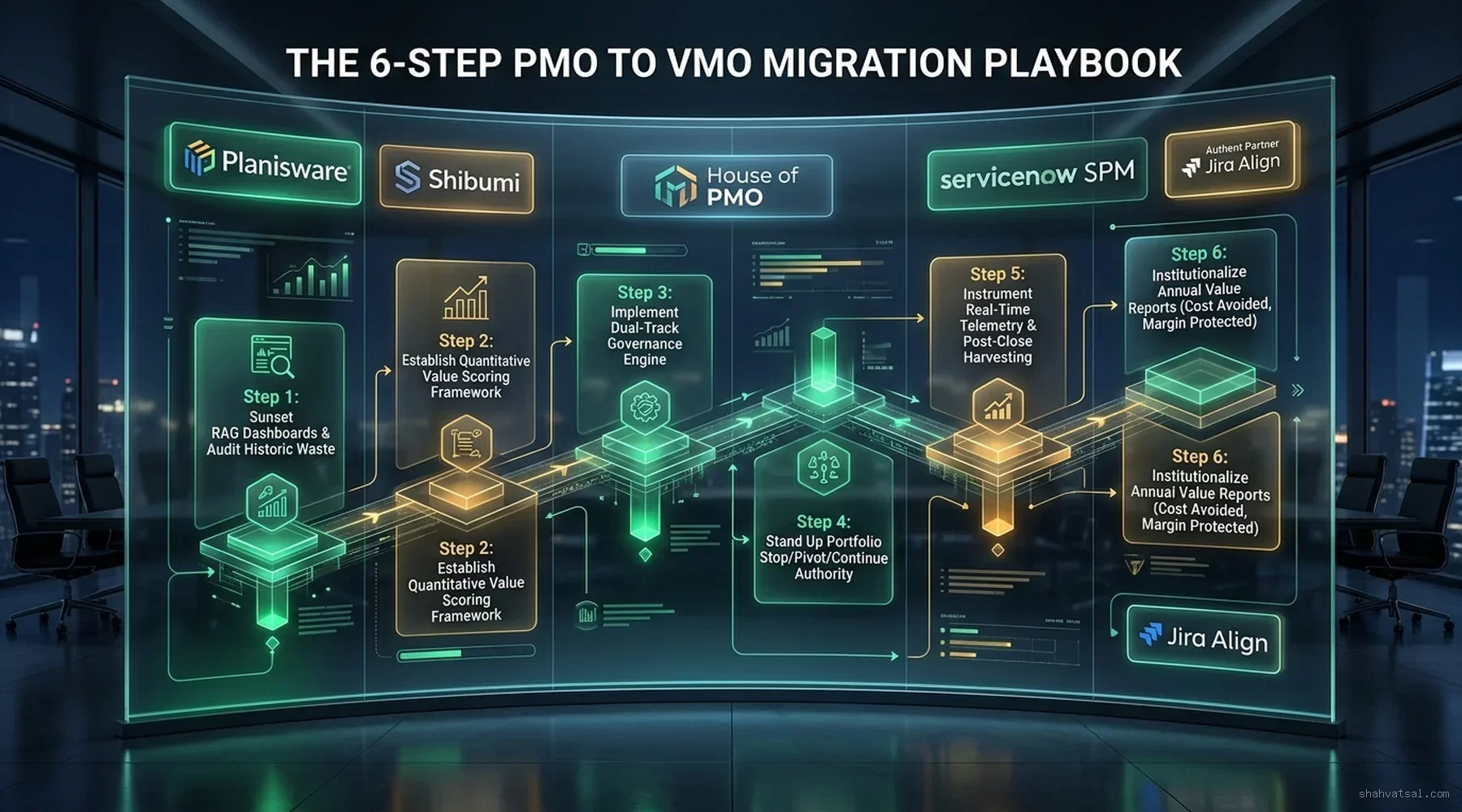
The 6-Step PMO to VMO Migration Playbook: A 180-Day Transformation Roadmap
Transitioning an enterprise from a delivery-focused PMO to an outcome-driven Value Management Office is a structured organizational transformation. Attempting to overhaul decades of project management habits overnight leads to defensive resistance from middle management and confusion among engineering teams.
Follow this battle-tested 180-Day Migration Playbook:
Step 1: Sunset RAG Dashboards & Conduct the Zombie Project Audit (Days 1–30)
- Core Action: Ban subjective Red/Amber/Green status reports in executive steering committees. Require status updates to report variance against leading value indicators instead.
- The Zombie Audit: Review every active project currently funded across the enterprise. Identify initiatives that have experienced more than 6 months of schedule slippage or whose original business case assumptions are no longer valid.
- Deliverable: Terminate or pause the bottom 15% of underperforming initiatives, immediately capturing unspent capital.
Step 2: Establish the Quantitative Value Scoring Framework (Days 31–60)
- Core Action: Design and ratify the enterprise's 4-Vector Multi-Criteria Prioritization rubric with the Chief Financial Officer and executive leadership.
- Operationalization: Embed the scoring engine into the enterprise intake portal. Mandate that all future capital requests undergo algorithmic scoring before receiving committee review.
- Deliverable: A transparent, published portfolio prioritization scoring standard.
Step 3: Implement the Dual-Track Governance Engine (Days 61–90)
- Core Action: Establish the formal operational boundaries between the Execution Track (PMO) and the Value Realization Track (VMO).
- Process Integration: Embed value checkpoints at Inception, Sprint Mid-Flight, Go-Live, Day 90, and Day 180.
- Deliverable: The Dual-Track Operating Charter ratified across IT and business leadership.
Step 4: Stand Up the Portfolio Stop / Pivot / Continue Authority (Days 91–120)
- Core Action: Institutionalize the monthly Stop/Pivot/Continue governance board.
- Cultural Shift: Reframe project termination as a metric of executive competence and capital efficiency rather than failure.
- Deliverable: First monthly governance review conducting active portfolio adjustments.
Step 5: Instrument Real-Time Telemetry & Post-Close Harvesting (Days 121–150)
- Core Action: Deploy enterprise strategic portfolio tooling (Shibumi, Planisware, or ServiceNow SPM).
- Telemetry Links: Connect application performance telemetry (OpenTelemetry, Datadog) and financial ERP systems (SAP, Oracle) directly to post-close value ledgers.
- Deliverable: Real-time visibility into post-launch adoption and financial return.
Step 6: Institutionalize the Annual Value Realization Report (Days 151–180)
- Core Action: Publish the inaugural Enterprise Value Report for the Board of Directors and Executive Committee.
- Financial Validation: Quantify verified cost avoidance, margin expansion, and capital efficiency gains achieved across the entire portfolio.
- Deliverable: Full enterprise operationalization of the Value Management Engine.
The Annual Value Report: Demonstrating Cost Avoided, Margin Protected & Capital Efficiency
The ultimate proof of a successful PMO-to-VMO transformation is the Enterprise Annual Value Report.
In traditional PMO regimes, the end-of-year report is a dreary compilation of projects completed: "We completed 42 projects, closed 1,200 Jira epics, and maintained an 84% on-time delivery rate." To the CFO and Chief Executive, this data is meaningless—it reveals nothing about whether those 42 projects made the company a single dollar richer or more competitive.
The VMO Annual Value Report reads like a corporate investment fund report:
┌────────────────────────────────────────────────────────────────────────────────────────┐
│                        2026 ENTERPRISE VMO VALUE LEDGER SUMMARY                        │
└────────────────────────────────────────────────────────────────────────────────────────┘

  PORTFOLIO CAPITAL DEPLOYED                  $120,000,000 USD
  ───────────────────────────────────────────────────────────────────────────────────────
  Active Initiatives Funded                   38 Programs (Scored >= 85)
  Proposals Defunded at Intake Gate           24 Proposals ($32M Capital Preserved)
  Mid-Flight "Zombie" Terminations            6 Projects ($18.5M Capital Redeployed)
  ───────────────────────────────────────────────────────────────────────────────────────
  VERIFIED POST-CLOSE BENEFITS HARVESTED (DAY 180–360)
  ───────────────────────────────────────────────────────────────────────────────────────
  Direct Top-Line Revenue Expansion           $46,200,000 USD (EBITDA Certified)
  Structural OpEx Cost Avoidance              $38,400,000 USD (Contractor & Vendor Elim.)
  Working Capital Freed (Cash Flow)           $14,800,000 USD (DSO & Inventory Accel.)
  ───────────────────────────────────────────────────────────────────────────────────────
  NET CAPITAL EFFICIENCY MULTIPLIER           3.42x Portfolio Return
The Three Pillars of Executive Value Reporting
- Capital Preserved Through Early Termination:
- Verified Margin Protection & Cost Avoidance:
- Portfolio ROI Multiplier:
Comprehensive Strategic & Technical FAQ
Q1: Does establishing a VMO require firing our existing project managers?
No. Project managers possess invaluable institutional knowledge, stakeholder relationships, and organizational navigation skills. The transformation elevates their career path. Project managers transition into Value Stream Managers, Benefits Realization Analysts, and Portfolio Strategy Partners. They shift their focus from policing Gantt milestones to optimizing business outcomes.Q2: How does a VMO measure intangible benefits like "customer satisfaction" or "employee morale"?
The VMO rejects vague, unmeasurable intangibles. Every initiative must establish a Proxy Economic Value Metric. For example:- Employee Morale: Measured via voluntary turnover rate in critical engineering squads. The economic value is calculated by multiplying reduced turnover by the cost of recruiting and onboarding senior talent ($150,000 per engineer).
- Customer Satisfaction: Measured via Net Promoter Score (NPS) correlation to gross retention rate and customer lifetime value (LTV).
Q3: How do we prevent business unit leaders from gaming the Multi-Criteria Prioritization Engine?
By enforcing Post-Close Auditing Accountability. In traditional PMOs, sponsors make wildly inflated ROI promises on project intake forms because they know nobody will ever audit them. In a VMO, the executive sponsor's annual performance bonus is directly tied to whether the business case benefits materialize during the Day 180 and Day 360 audits. When sponsors know they will be audited, their business case projections become remarkably accurate.Q4: What is the optimal reporting line for the Head of the VMO?
The most effective reporting line is directly to the Chief Financial Officer (CFO) or Chief Strategy Officer (CSO), with a secondary dotted line to the Chief Information Officer (CIO). Reporting to finance guarantees that value governance maintains fiduciary teeth and avoids being compromised by delivery deadlines.Q5: How does the VMO interact with decentralized Agile and Product squads?
The VMO does not manage Jira backlogs or dictate daily standups. It operates at the Portfolio Investment Horizon. The VMO allocates funding to product value streams based on strategic scoring, defines the required outcome telemetry metrics, and leaves the implementation methodology entirely to the agile product squads.Q6: Can small and mid-sized enterprises (SMEs) implement a VMO?
Yes. While Fortune 500 enterprises deploy dedicated 20-person VMO teams, a mid-sized organization can launch a highly effective VMO with a single Value Governance Lead partnering with a Senior Financial Analyst. The foundational principles—algorithmic prioritization, killing zombie projects, and tracking 180-day post-close benefits—deliver massive ROI regardless of company scale.Q7: What is the single biggest operational pitfall during VMO migration?
Failing to establish executive decision rights to terminate projects. If the VMO can only recommend cancellations but lacks the authority to enforce funding cuts, it becomes just another toothless advisory committee. Executive leadership must back the VMO's authority to kill underperforming initiatives.Q8: How quickly can an enterprise expect to see positive ROI from a VMO rollout?
Most enterprises achieve full payback within 90 to 120 days. The initial "Zombie Project Audit" (Step 1 of the playbook) typically identifies and terminates 3 to 5 failing initiatives, immediately freeing millions of dollars in unspent capital that offsets the cost of VMO implementation.Conclusion & Architectural Readiness Checklist
The death of the traditional PMO and the rise of the Value Management Office is the natural evolution of modern corporate governance. In an era demanding ruthless capital efficiency and rapid strategic adaptation, enterprises can no longer afford the comforting illusion of RAG dashboards and vanity delivery metrics.
By coupling delivery discipline with multi-criteria prioritization, active stop/pivot decision rights, and rigorous 360-day post-close benefits harvesting, the Value Management Office transforms corporate delivery organizations into strategic engines of enterprise value creation.
The 10-Point VMO Readiness Checklist
Before launching your enterprise VMO transformation, ensure compliance with this 10-point architectural bar:
- [ ] Abolish Subjective RAG: Replace Red/Amber/Green dashboards with quantitative leading value indicator variance metrics.
- [ ] Mandate Quantitative Intake: Every project proposal must submit an explicit financial hypothesis and causal value diagram.
- [ ] Implement 4-Vector Scoring: Portfolio prioritization is governed by an objective mathematical model ($\ge 85$ funded).
- [ ] Dual-Track Charter: Formally separate execution tracking (PMO) from value realization tracking (VMO).
- [ ] Active Stop/Pivot Authority: The VMO and CFO co-chair a monthly governance board with unilateral power to kill projects.
- [ ] Mandatory 360-Day Audits: Benefits realization is formally tracked and reported for 12 months post-go-live.
- [ ] Bonus Accountability: Executive sponsor compensation is tied to post-close benefit delivery, eliminating inflated business cases.
- [ ] SPM Tooling Deployment: Migrate from spreadsheets to enterprise value platforms (Planisware, Shibumi, ServiceNow SPM).
- [ ] Capital Redeployment Metric: Track and celebrate capital saved from terminated zombie projects as an executive win.
- [ ] Annual Value Report: Publish an annual audited report quantifying certified EBITDA contribution and portfolio capital efficiency.
About the Author
Vatsal Shah is a software executive, enterprise systems architect, and operational transformation advisor specializing in Strategic Portfolio Governance, Value Management Office Architecture, and Autonomous Enterprise Operating Models. He advises Fortune 500 CIOs, CFOs, and transformation leaders on modernizing delivery organizations to maximize return on invested capital. Explore more research, technical blueprints, and executive playbooks at shahvatsal.com.