In a significant architectural pivot, Jarred Sumner, the creator of Bun, has announced that the popular JavaScript runtime is undergoing a complete rewrite. The…
In a significant architectural pivot, Jarred Sumner, the creator of Bun, has announced that the popular JavaScript runtime is undergoing a complete rewrite. The project is migrating its core systems codebase from Zig to Rust.
The transition begins with the release of Bun v1.4.0. The previous release, v1.3.14, marks the final stable version written primarily in Zig. The migration is designed to address memory management challenges and build a more stable contributor ecosystem, positioning Bun as a robust alternative in the [node runtime Bun 2026] ecosystem.
According to the announcement, the migration was accelerated using advanced AI models, specifically Claude Fable 5, to assist in porting the complex systems codebase. The initial Rust-based canary build has already resolved over 128 legacy engine bugs that persisted in the Zig implementation.

The Catalyst for the Rewrite: Stability Over Novelty
When Bun was first released, its choice of Zig as a systems programming language was highlighted as a key factor in its speed. Zig's manual memory management and lack of hidden control flow allowed Bun to achieve fast startup times and efficient I/O operations, outperforming Node.js and Deno in early benchmarks.
However, as the runtime grew to support complex Node.js APIs, the engineering team encountered memory safety challenges. Manual memory management in Zig, while performant, proved difficult to scale as the contributor base expanded. Memory leaks, use-after-free bugs, and concurrency issues became harder to debug in the manual allocation model.
"Zig is a powerful language for writing low-level utilities, but as a runtime grew to hundreds of thousands of lines of code, manual memory management became a bottleneck for stability," Sumner explained. "By porting to Rust, we get compile-time safety guarantees through the borrow checker, making it easier for external contributors to write safe, concurrent code without risking segmentation faults."
Memory Safety: Zig vs. Rust in the Bun Runtime
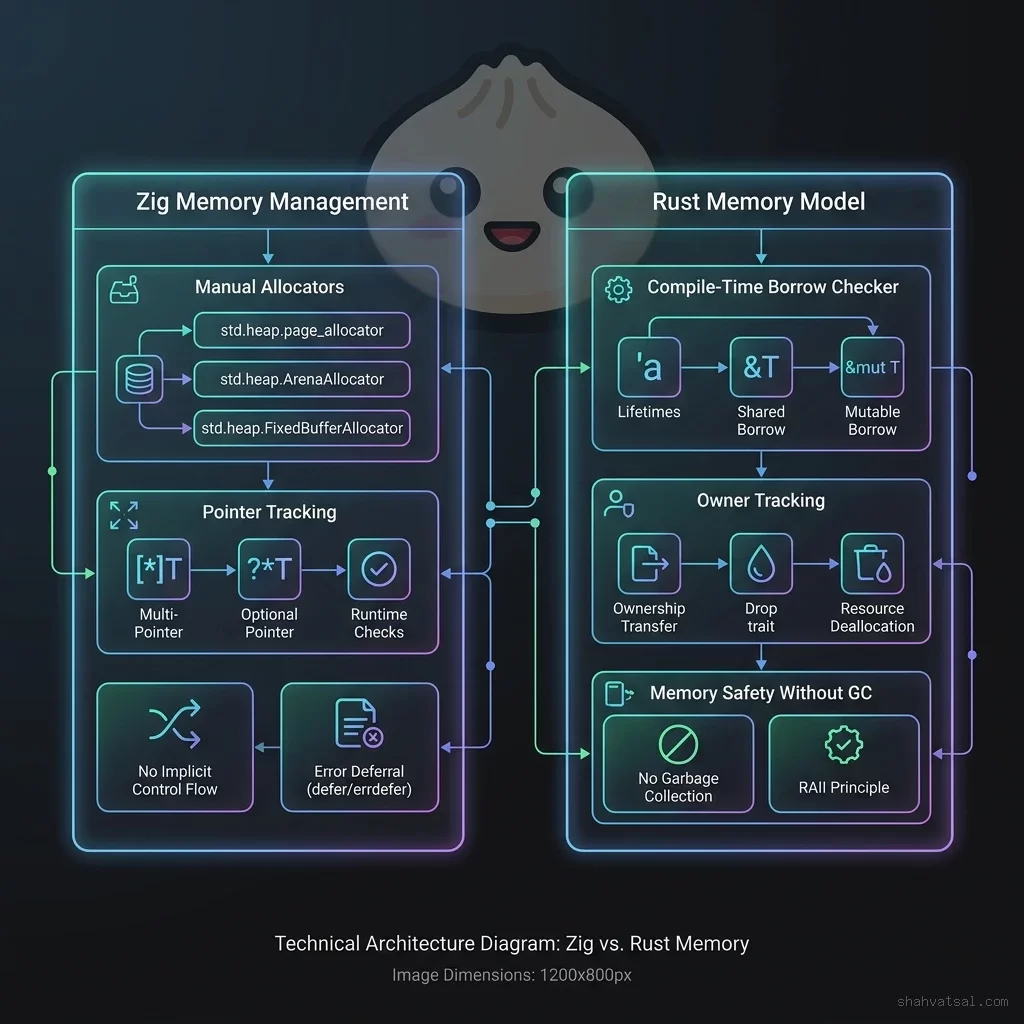
The core difference driving this rewrite is how each language handles memory safety:
Zig's Explicit Allocator Model
In Zig, memory allocation is explicit. Functions that require heap allocation must accept an allocator parameter. While this design makes memory costs clear, it leaves pointer safety and memory freeing entirely in the hands of the developer. As Bun added support for complex multi-threaded operations, tracking pointer lifecycles across asynchronous boundaries became increasingly difficult.Rust's Borrow Checker and Ownership Model
Rust enforces memory safety at compile time through its ownership model. The compiler tracks variable lifecycles, ensuring memory is freed when its owner goes out of scope and preventing data races in concurrent code. This shift allows the Bun team to write multi-threaded I/O code with confidence, eliminating a class of runtime bugs that affected earlier versions.Architectural Changes: The New Bun Runtime Pipeline
The transition from Zig to Rust has required rewriting the I/O multiplexing layer and the bindings for the JavaScriptCore (JSC) engine:
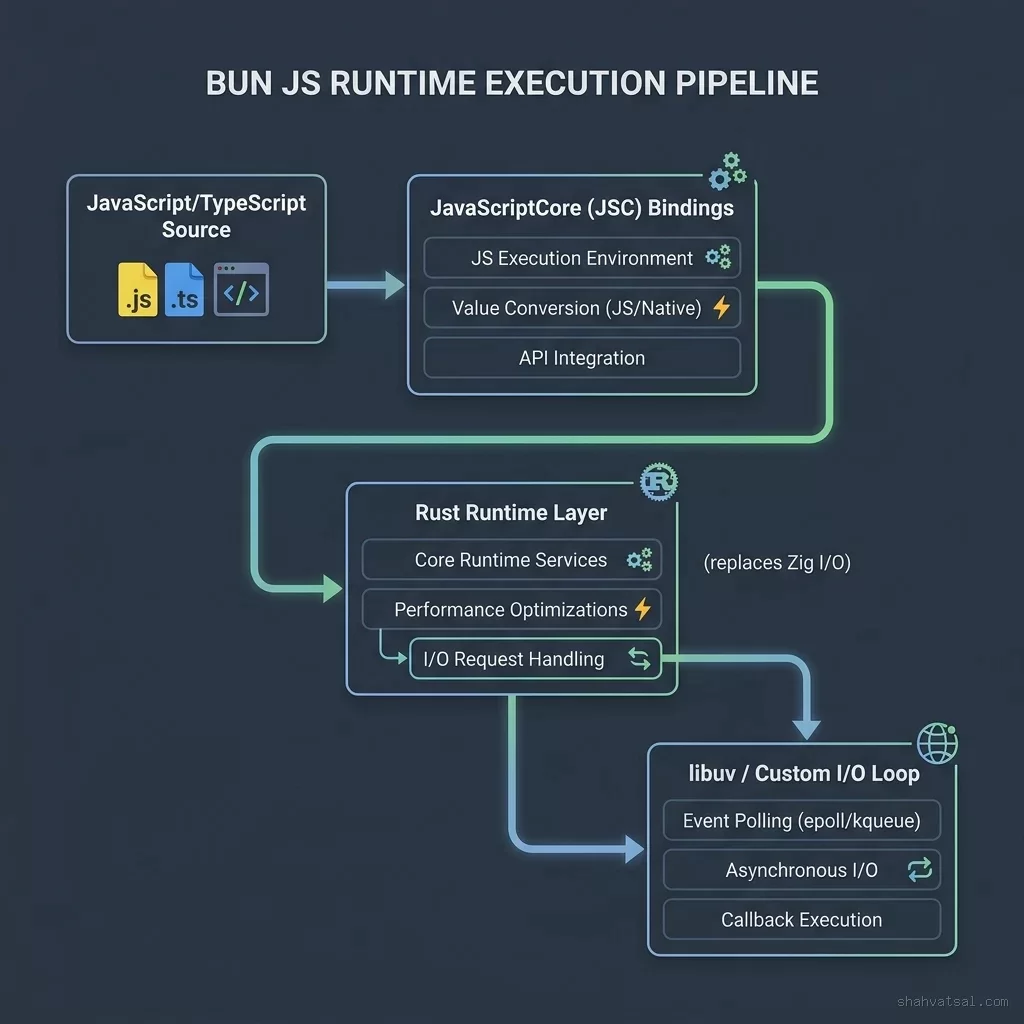
The rewritten execution pipeline maintains Bun's high performance by using Rust's ecosystem for low-level tasks:
- Bindings Layer: The bindings between the JavaScriptCore engine and the native runtime have been rebuilt using Rust's Foreign Function Interface (FFI).
- I/O Event Loop: The custom event loop, previously implemented in Zig, has been ported to Rust, leveraging the
tokioormiocrates for high-performance non-blocking network I/O. - Node.js Compatibility: Complex Node.js APIs (such as
fs,net, andhttp) are being systematically rewritten in Rust, resolving 128 long-standing compatibility bugs in the process.
AI-Assisted Migration: Accelerating the Port
Rewriting a systems-level project of Bun's scale is typically a multi-year effort. To speed up the process, the engineering team used Claude Fable 5, an advanced code-generation AI model.
The AI model was trained on Bun's existing Zig codebase and used to generate equivalent Rust code structures. While human engineers reviewed every line of code, the AI-assisted workflow automated the tedious parts of the translation, such as translating Zig struct definitions, basic allocator patterns, and FFI bindings into safe Rust.
"Using Claude Fable 5 allowed us to prototype the Rust port in a fraction of the time," said Sumner. "The AI was particularly effective at identifying equivalent Rust abstractions for Zig's manual memory blocks, letting us focus on high-level architecture and performance optimization."
This rapid migration highlights the growing role of strategic alignment agents in accelerating major engineering transitions.
Technical Performance and Bun 1.4 Features
Beyond the language migration, Bun v1.4.0 introduces several new features and performance enhancements built on the new Rust architecture:
Improved Concurrent HTTP Throughput
Leveraging Rust's safe concurrency model, theBun.serve() HTTP server handles concurrent connections more efficiently, showing a 15% reduction in latency under heavy load.
Stable Node.js Compatibility
The rewrite resolves long-standing compatibility issues with Node.js modules, particularly those relying on complex native C++ addons.Faster Package Installation
Bun's fast package manager has been ported to Rust, showing improved caching behavior and faster dependency resolution on multi-core processors.Community and Contributor Impact
The shift to Rust is expected to expand Bun's developer ecosystem. While Zig has a passionate community, Rust has a much larger developer base and a mature ecosystem of libraries (crates).
By migrating to Rust, the Bun team hopes to make it easier for community developers to contribute to the runtime's core. The safety guarantees of the Rust compiler reduce the risk of community pull requests introducing subtle memory leaks or security vulnerabilities, simplifying the review and merge pipeline.