What Happened On July 7, 2026, Google published a significant update to the Gemini API Managed Agents runtime. Four features shipped simultaneously: background …
What Happened
On July 7, 2026, Google published a significant update to the Gemini API Managed Agents runtime. Four features shipped simultaneously: background execution, remote MCP server integration, custom function calling, and network credential refresh. Each one addresses a specific production pain point that has blocked enterprise adoption of cloud-hosted agent frameworks.
This is not a research preview. These features are live in the Gemini API today, built on top of the Gemini Interactions API that hit general availability in June 2026. The Interactions API acts as the unified control plane: server-side conversation state, observable execution steps, and now — the infrastructure to run agents that outlive a single HTTP request.
Feature Breakdown: What Actually Shipped
1. Background Execution
The most operationally significant of the four. Before this update, Managed Agent tasks required a persistent HTTP connection for the duration of execution. Any network interruption killed the job. Long-running tasks — multi-step research loops, document analysis chains, data transformation workflows — were effectively impossible to run reliably in production.
Background execution fixes this with one flag:
response = gemini_client.agents.interact(
    agent_id="my-agent",
    user_input="Analyze Q2 financials and draft board summary",
    background=True  # returns immediately
)
interaction_id = response.interaction_id
The API returns the interaction_id in milliseconds. The agent runs inside Google's managed cloud sandbox. The client can disconnect entirely, come back hours later, and poll for results or set a webhook to be notified on completion.
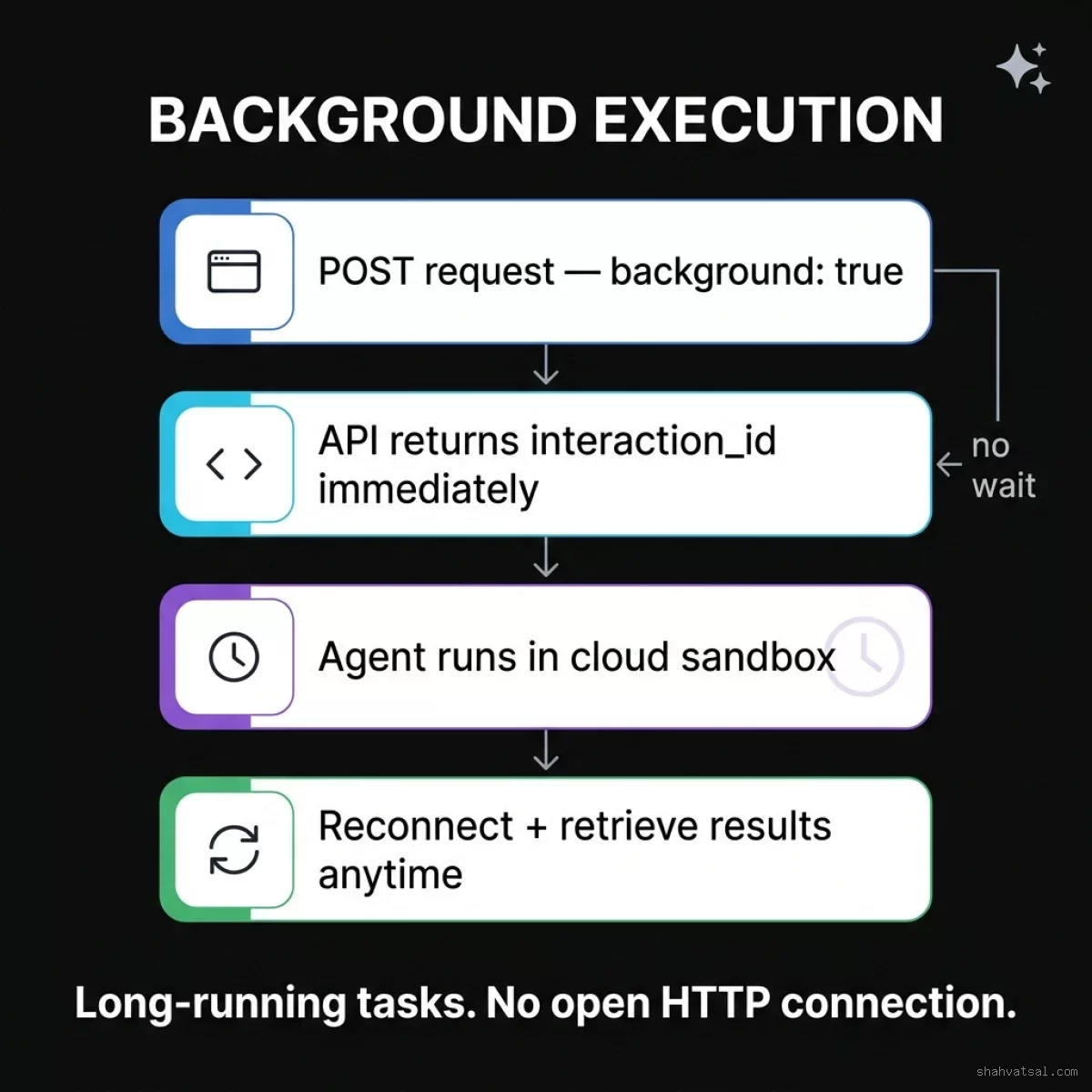
This is the difference between a demo agent and a production agent. Most enterprise workflows last minutes to hours, not seconds. Without background execution, you're either writing custom state management or accepting reliability constraints that don't belong in production systems.
2. Remote MCP Server Integration
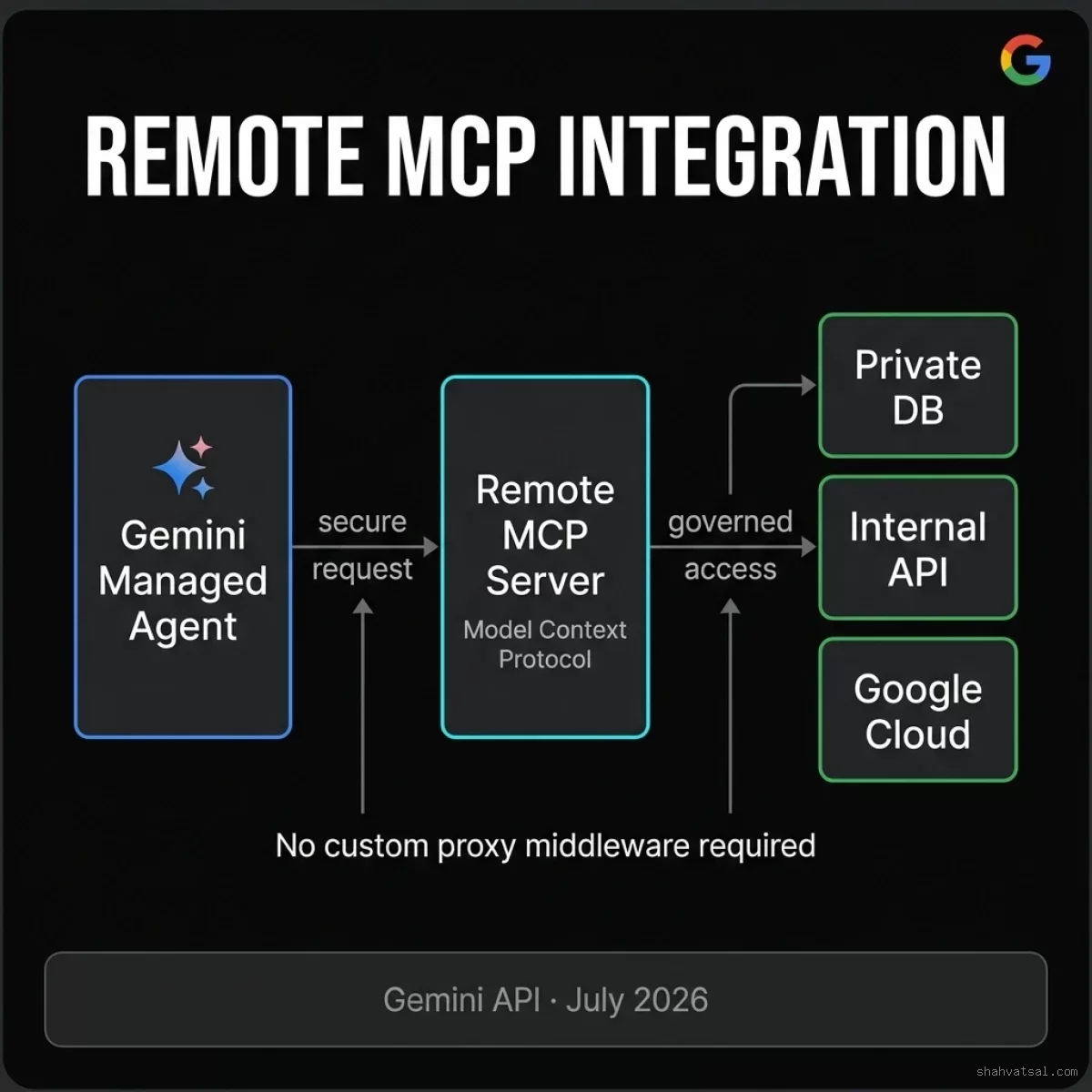
Model Context Protocol (MCP) has become the de facto standard for agent-tool connectivity since the MCP 1.0 GA in early 2026. The challenge: running MCP locally inside a cloud-hosted sandbox required custom proxy layers — developers had to build middleware to bridge their internal resources to the agent sandbox.
Gemini Managed Agents now support remote MCP server connections natively. The agent connects directly to an MCP server you control, whether that server sits in your private VPC, a Google Cloud project, or any network-accessible endpoint:
agent_config = {
    "mcp_servers": [
        {
            "url": "https://my-internal-mcp.corp.example.com",
            "auth": {"type": "bearer", "token_env": "MCP_TOKEN"}
        }
    ]
}
That MCP server can expose your private databases, internal APIs, proprietary data sources — anything your business logic needs. The agent gets governed, audited access without routing everything through a custom proxy layer.
3. Custom Function Calling
Built-in sandbox tools (code execution, web search, Google Workspace) cover broad use cases. But enterprise agents almost always need to call proprietary business logic: trigger a specific internal approval workflow, invoke a domain-specific scoring model, write to a legacy system.
Custom function calling lets you register your own functions alongside the built-in tool set. The agent routes to your function when the task requires it, just like it routes to any other tool. No patching, no workarounds — first-class support.
4. Network Credential Refresh
Long-lived agents break on expired tokens. Before this update, rotating credentials mid-session required terminating and restarting the interaction. The new credential refresh mechanism lets you pass an updated network configuration with an existing environment_id — the agent picks up the new token without restarting:
gemini_client.agents.refresh_network(
    environment_id="env-abc123",
    network_config={"auth": {"token": new_token}}
)
This is critical for any agent running against OAuth-gated APIs (Google Drive, Salesforce, internal SSO systems) where tokens expire on 1-hour cycles.
Why It Matters
Agents That Outlive a Browser Tab
The single biggest gap in cloud-hosted agent runtimes has been durability. LangGraph, CrewAI, AutoGen — all require you to manage your own persistence and resumption logic. Background execution in Gemini Managed Agents offloads that to Google's infrastructure. The agent is now Google's problem to keep alive, not yours.
For enterprise buyers, this is the capability that unlocks the RFP checkbox: "Can the agent run unattended for hours without manual supervision?" The answer is now yes, natively, without custom engineering.
Remote MCP Closes the Middleware Tax
Every team building production agents has a middleware story. Some version of "we wrote a proxy service that bridges the agent to our internal systems." That's real engineering cost, real operational overhead, real failure surface. Remote MCP server integration in Managed Agents eliminates that entirely for the Gemini stack.
This is Google's direct answer to how OpenAI ChatGPT Work approaches integrations — ChatGPT Work uses a connector marketplace; Gemini uses MCP as the open protocol layer. Different architectures, same destination: agents that can reach your actual business data.
Gemini Interactions API as the Unified Control Plane
The updates don't exist in isolation. They're built on top of the Gemini Interactions API (GA June 2026), which introduced server-side conversation state and observable execution steps. What Google is assembling here is a layered stack: Interactions API as the foundation, Managed Agents as the execution runtime, background mode as the scheduling primitive, MCP as the integration bus.
That's a coherent production agent platform. Not features bolted onto a chat API.
What to Watch Next
- Webhook support for background tasks — the current pattern is poll-based (
GET /interactions/{id}/status). Webhook callbacks on task completion would eliminate polling overhead for high-volume deployments. - MCP server marketplace — Google's Gemini Enterprise Agent Platform already hosts a remote MCP server for Cloud resources. Expect a curated catalog of pre-built MCP connectors (Salesforce, Jira, SAP) to emerge in Q3 2026.
- Cost model for long-running background jobs — background execution in a managed cloud sandbox raises billing questions for multi-hour tasks. Google has not published pricing for background execution duration at launch.
Source
Google Developers Blog — Gemini API Managed Agents Updates (Jul 7, 2026)
Related on shahvatsal.com: