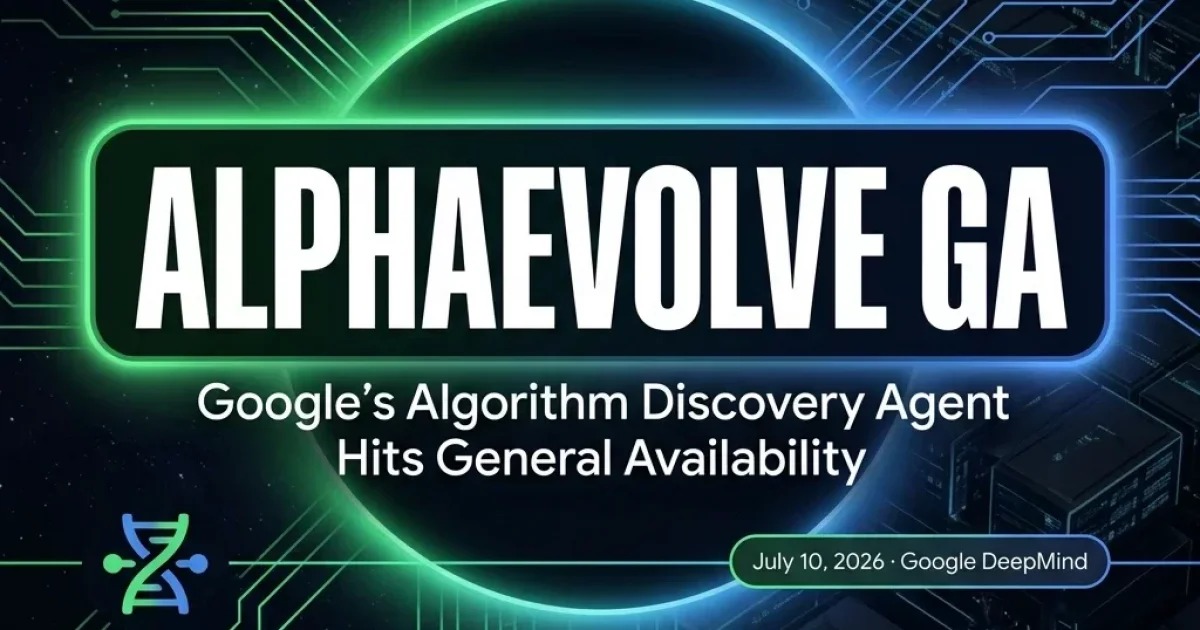
Google Cloud and DeepMind announce General Availability for AlphaEvolve — a closed-loop algorithm discovery and optimization agent designed to find breakthrough code structures and TPUs circuits.
What Happened
AI code assistants are excellent at writing boilerplate, but when it comes to discovering new, mathematically optimized algorithms or squeezing performance from cutting-edge hardware, traditional LLMs hit a wall. On July 10, 2026, Google Cloud and Google DeepMind launched AlphaEvolve into General Availability (GA) to solve exactly this challenge.
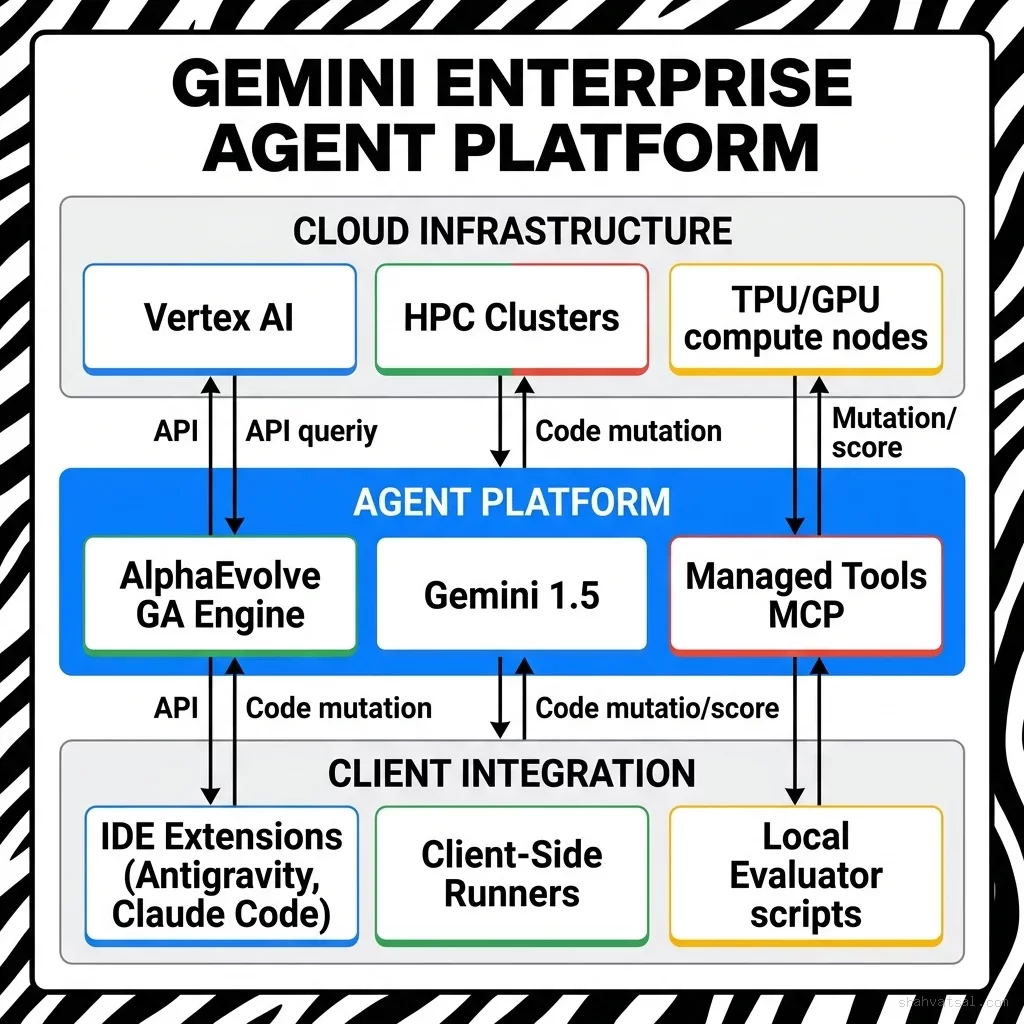
AlphaEvolve is a code optimization and algorithm discovery agent integrated into the Gemini Enterprise Agent Platform. Unlike traditional coding assistants that work as chat companions, AlphaEvolve functions as an executable search framework. It iteratively mutates code structures, executes them on target environments, and uses a client-side evaluator to score performance, search-optimizing code iteratively.
Originally limited to select enterprise and scientific partners, the GA release opens the AlphaEvolve API and matching IDE Skill paths for all Google Cloud customers.
How the Closed-Loop Search Works
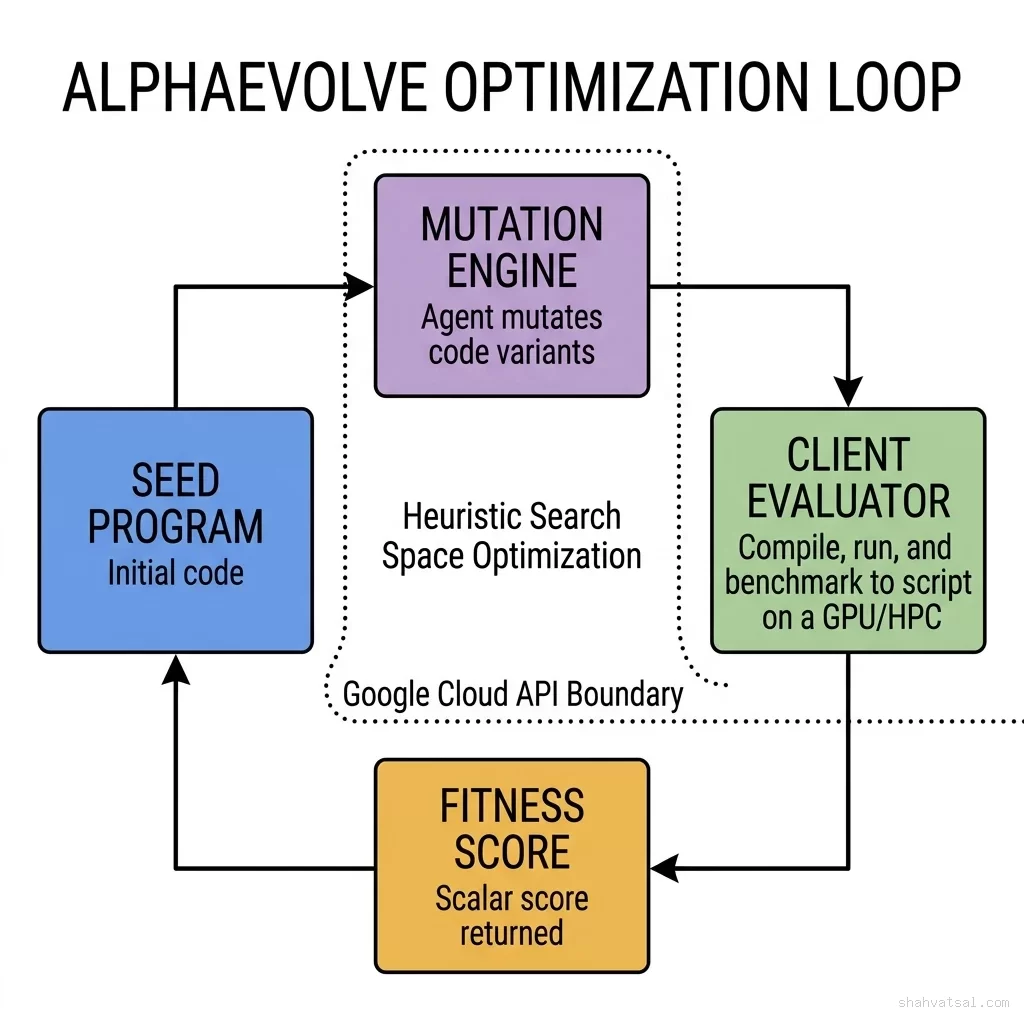
Traditional LLM code generation is open-loop: the model outputs code, and the developer hopes it runs efficiently. AlphaEvolve operates on a closed-loop evolutionary process:
- Seed Program: The developer provides the initial algorithm written as code (e.g., in Python, C++, Go, or CUDA) and designates which segments are open to optimization.
- Mutation Engine: AlphaEvolve proposes syntactic and logical variations to the target code.
- Client-Side Evaluator: A local script compiles the mutated program, runs it on target hardware (e.g., GPUs, TPUs, or CPU clusters), and calculates a scalar fitness score based on metrics like latency, accuracy, or resource usage.
- Sampling & Feedback: The runner submits the score back to the AlphaEvolve API, which samples the highest-performing mutants to guide subsequent generations.
Where AlphaEvolve Fits in the Google Agentic Stack
AlphaEvolve is positioned as a specialized runtime optimization engine within the Gemini Enterprise Agent Platform.
Instead of writing application code from scratch, AlphaEvolve sits alongside development agents like Claude Code or Google's own Antigravity. While a developer uses Antigravity to structure a backend application, they call the AlphaEvolve IDE Skill to optimize bottlenecked database query algorithms, compiler paths, or GPU kernels.
For large-scale tasks, the client runner can be integrated directly into HPC compute clusters or Kubernetes pipelines on GCP, allowing parallel evaluation of hundreds of candidate variations.
Internal & Scientific Proof Points
Google and early-access partners have documented significant performance gains:
1. High-Performance Computing (HPC) & Supercomputing
- Oak Ridge National Laboratory (ORNL): Run on Frontier (the world's first exascale supercomputer) under DeepMind's Genesis Mission partnership. AlphaEvolve successfully optimized mixed-precision GPU kernels directly on the supercomputer's AMD GPUs, finding novel variants that bypassed manual optimization limits.
- Substrate: CEO James Proud confirmed using AlphaEvolve to optimize computational lithography simulations for semiconductor design, achieving a multi-fold increase in runtime speed.
- qBraid: Discovered error-correcting codes for quantum chemistry with significantly higher error efficiency, accelerating quantum simulation algorithms.
2. Google Infrastructure & TPUs
- TPU Circuit Layout: Optimized circuit layout designs for next-generation TPU silicon, producing counterintuitive layouts that improve heat dissipation and routing density.
- Google Spanner: Refined the Log-Structured Merge-tree compaction heuristics for Spanner, reducing write amplification by 20%.
- Willow Quantum Processor: Designed quantum circuits with 10x lower error rates for molecular simulation workloads on Google's Willow processor.
3. Biological & Industrial Science
- PacBio: Applied AlphaEvolve to its DeepConsensus model (Google Research's model for correcting DNA sequencing errors), resulting in a 30% reduction in variant detection errors.
- Schrödinger: Quadrupled the speed of molecular discovery simulations, shortening drug discovery and material design R&D cycles.
- Old Dominion University: The Qin Lab used AlphaEvolve across 500 evaluations to search aging mortality rate equations. The agent independently rediscovered the Kannisto logistic mortality model without prior literature access and improved Emergent Aging Model scores by 19%.
What You Should Do to Get Started
For teams looking to integrate algorithm optimization:
- Access the API: Set up the AlphaEvolve API through the Google Cloud Console under Vertex AI.
- Review Onboarding Resources: Check out the official Google Cloud documentation and clone the Colab notebooks from the Google Cloud AI GitHub repository.
- Define Evaluator Metrics: Ensure your client-side evaluator script is deterministic and returns a precise scalar metric to guide the mutation model.
- IDE Skill Integration: Enable the AlphaEvolve skill inside Antigravity or Claude Code to optimize functions directly from your terminal.
Sources
- Google Cloud Blog: AlphaEvolve is available for everyone
- Google DeepMind: AlphaEvolve Impact and Supercomputing Partnerships