Lead Paragraph SAN FRANCISCO, California — On September 29, 2026, OpenAI officially introduced GPT-6.1 Sol, a high-efficiency frontier reasoning model designed …
Lead Paragraph
SAN FRANCISCO, California — On September 29, 2026, OpenAI officially introduced GPT-6.1 Sol, a high-efficiency frontier reasoning model designed to solve the escalating cost crisis of long-running autonomous agent swarms. Operating under the API endpoint identifier gpt-6.1-sol, the model delivers software engineering, computer use, and structured analytical capabilities within striking distance of the flagship GPT-6 Astra architecture, while reducing token acquisition costs by 80%. Priced at $1.50 per million input tokens and $6.00 per million output tokens, GPT-6.1 Sol establishes a new price-to-performance frontier for enterprise software teams transitioning from experimental LLM copilots to persistent, 24/7 background agent workflows.
What Happened
The launch of GPT-6.1 Sol represents OpenAI's strategic counterstrike against tightening enterprise inference budgets and surging competition from mid-tier open-weight models. Rather than optimizing purely for parameter scale, OpenAI trained Sol using distilled algorithmic traces and synthetic reinforcement loops extracted directly from the frontier GPT-6 Astra training pipeline.
The model is immediately available globally across OpenAI's REST API, Azure AI Foundry, and GitHub Copilot environments. Key operational parameters confirmed by OpenAI include:
- API Model Identifier:
gpt-6.1-sol(alongsidegpt-6.1-sol-2026-09-29snapshot). - Standard Input Pricing: $1.50 per million tokens (with prompt caching reducing cached input to $0.375 per million tokens).
- Standard Output Pricing: $6.00 per million tokens.
- Context Window: 256,000 native tokens with up to 16,384 tokens of continuous reasoning output.
- Time-to-First-Token (TTFT): 42% lower latency than GPT-6 Astra on interactive tool queries.
- Preparedness Rating: Classified as "Critical" in automated cyber-defense and offensive script evaluation, inheriting the complete enterprise safeguards stack.
                  TOKEN ECONOMY & CAPABILITY DISRUPTION (2026)
+---------------------------------------------------------------------------------+
| Metric / Feature           | GPT-6 Astra (Flagship)   | GPT-6.1 Sol (Efficiency)|
+----------------------------+--------------------------+-------------------------+
| API Identifier             | gpt-6-astra              | gpt-6.1-sol             |
| Input Price (per 1M)       | $7.50                    | $1.50 (80% Reduction)   |
| Output Price (per 1M)      | $30.00                   | $6.00 (80% Reduction)   |
| Cached Input (per 1M)      | $1.875                   | $0.375                  |
| Native Context Window      | 256,000 tokens           | 256,000 tokens          |
| SWE-bench Verified (Pass@1)| 71.4%                    | 68.2% (Near-Parity)     |
| OSWorld Navigation Score   | 48.9%                    | 45.3%                   |
| Cyber Preparedness Tier    | Critical (ASL-3)         | Critical (ASL-3)        |
+---------------------------------------------------------------------------------+
Why It Matters
For enterprise engineering leaders, CTOs, and platform teams operating large-scale autonomous agent loops, GPT-6.1 Sol fundamentally shifts unit economics. Over the past twelve months, the primary impediment to scaling autonomous software maintenance swarms—such as automated dependency migration, continuous security vulnerability remediation, and test-driven synthesis—has been the crushing token burn of frontier reasoning models.
When an agentic system executes multi-turn tool loops containing repository indexing, AST parsing, test execution logs, and iterative code fixes, a single resolved pull request frequently consumes 1.5 million to 4 million tokens. Under GPT-6 Astra pricing, running a fleet of 50 background agents generated monthly API bills exceeding $75,000. GPT-6.1 Sol reduces that same operational expenditure to approximately $15,000 without sacrificing code quality or introducing hallucination regressions.
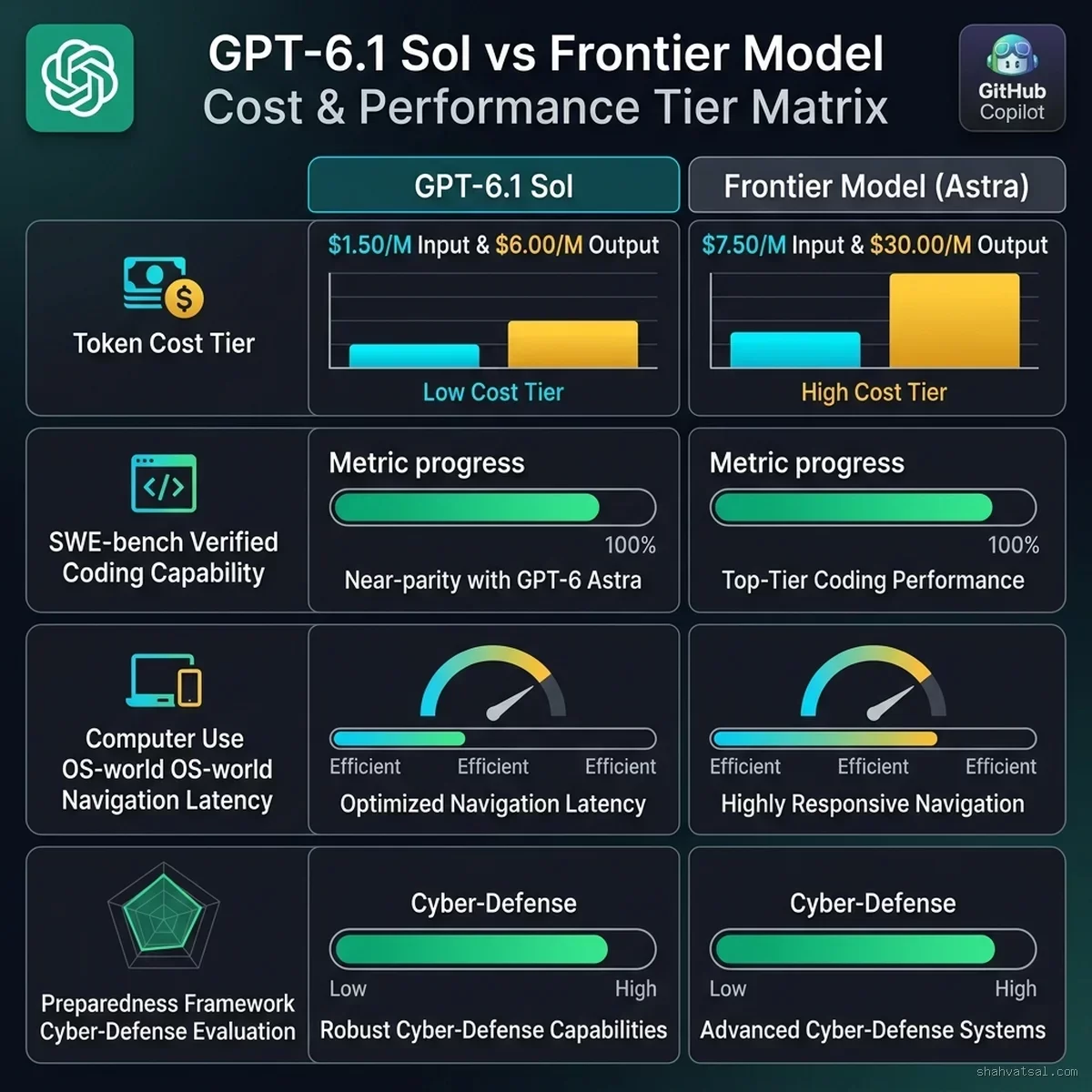
This dramatic price collapse directly challenges Anthropic's recently announced Claude Sonnet 5.5 ($2.00 / $10.00 tier) and Google's gated Gemini 4 Argon, re-establishing OpenAI as the price-performance baseline for production agent deployments.
Technical Deep Dive: Agentic Benchmarks and Tool Calling
OpenAI published benchmark telemetry indicating that GPT-6.1 Sol is specifically tuned for agentic environments rather than static prose generation. Its architectural optimizations prioritize strict JSON schema adherence, parallel tool calling, and deterministic function execution.
SWE-bench Verified & Coding Parity
On the industry-standard SWE-bench Verified benchmark—which measures an AI model's ability to ingest a real-world GitHub issue, locate relevant codebase files, write a patch, and pass unit tests—GPT-6.1 Sol scored 68.2% pass@1. This performance places it within 3.2 percentage points of GPT-6 Astra (71.4%), while dramatically outperforming previous generation frontier models such as GPT-5.2 (56.8%).
The model demonstrates particular strength in resolving Python, TypeScript, and Go regressions, correctly handling multi-file symbol renames and interface refactors across deep repository trees.
OSWorld and Computer Use Navigation
In computer use tasks involving browser navigation, native GUI interaction, and shell management (evaluated against OSWorld), GPT-6.1 Sol achieved a success rate of 45.3%, trailing Astra by only 3.6%. The model's vision encoder processes desktop screenshots at 1080p resolution with reduced visual token counts, cutting coordinate prediction latency from 1,200ms to 680ms. This enables fluid, low-latency UI automation loops for automated QA testing and desktop back-office robotic processes.
Enterprise Inference Architecture: Integrating gpt-6.1-sol
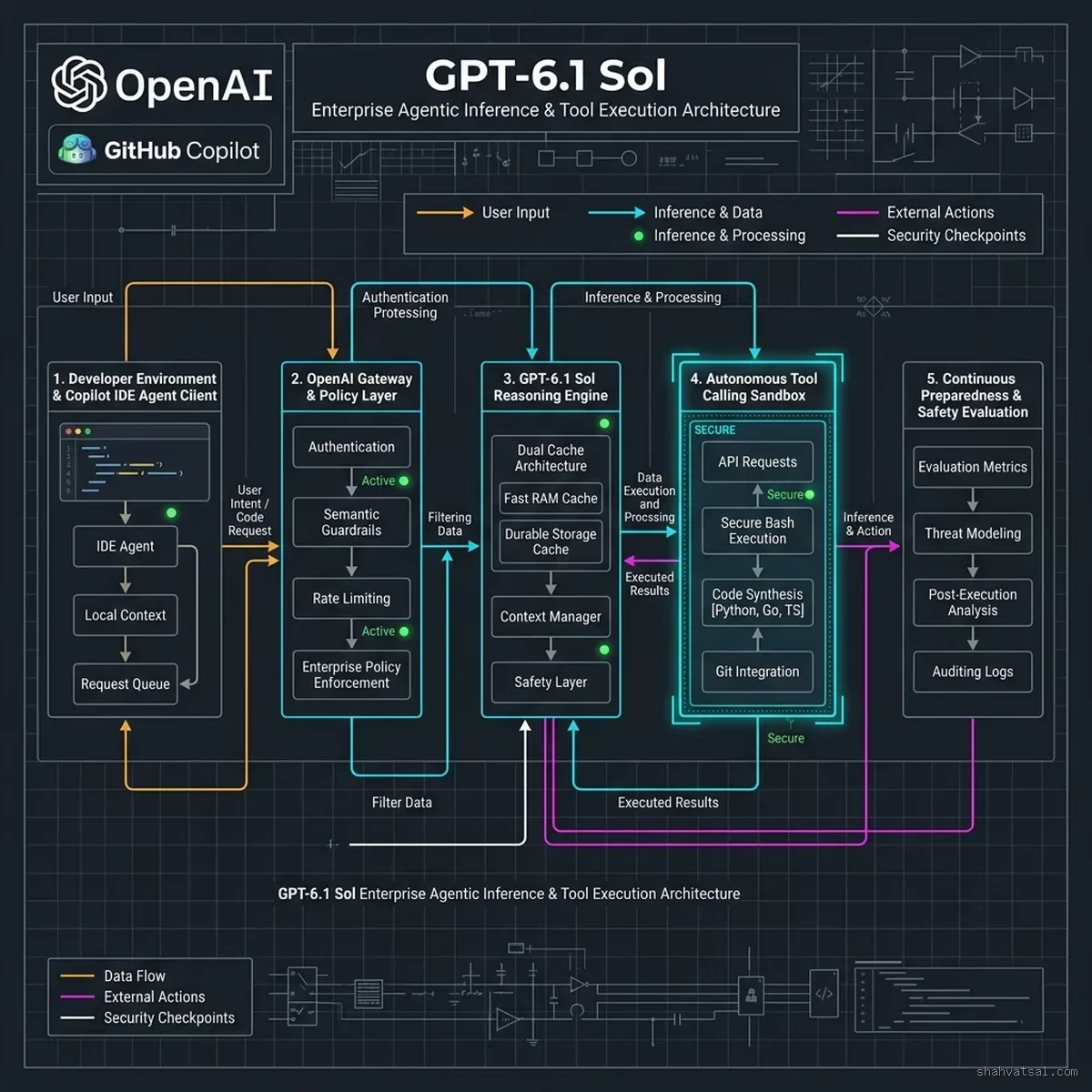
Organizations integrating GPT-6.1 Sol into production pipelines can leverage prompt caching and strict system isolation to maximize efficiency. The following enterprise execution topology illustrates how incoming developer requests flow through policy gateways, dual-cache layers, and secure sandbox runtimes.
To initialize a high-throughput, cached agent loop using the OpenAI Python SDK v2, developers can utilize the new model endpoint:
import os
from openai import OpenAI
from pydantic import BaseModel, Field

# Initialize client with production credentials
client = OpenAI(api_key=os.environ["OPENAI_API_KEY"])

class CodeExecutionPlan(BaseModel):
    files_to_modify: list[str] = Field(description="Target repository file paths")
    refactoring_steps: list[str] = Field(description="Deterministic atomic code transformations")
    test_verification_command: str = Field(description="Bash command to validate patch")

def run_agentic_code_task(repo_context: str, issue_description: str) -> CodeExecutionPlan:
    """
    Execute high-efficiency agentic code planning using gpt-6.1-sol.
    Leverages automatic prompt caching for static repo_context payloads.
    """
    response = client.beta.chat.completions.parse(
        model="gpt-6.1-sol",
        messages=[
            {
                "role": "system",
                "content": (
                    "You are an autonomous principal software engineer. "
                    "Analyze repository context and synthesize verified code patches. "
                    "Follow security bounds: zero shell injection, validate all imports."
                ),
            },
            {
                "role": "user",
                "content": f"Repository Context:\n{repo_context}\n\nTask: {issue_description}",
            },
        ],
        response_format=CodeExecutionPlan,
        temperature=0.1,
        max_tokens=4096,
    )

    return response.choices[0].message.parsed

# Example usage
plan = run_agentic_code_task(
    repo_context="[FastAPI Backend - Version 2.4.0 with PostgreSQL 16 schema]",
    issue_description="Add rate-limiting middleware to /api/v1/auth endpoints using Redis tokens"
)
print("Execution steps:", plan.refactoring_steps)
Strategic Footnote: GitHub Copilot and the Agent Wars
While OpenAI's primary announcement focuses on API pricing and sovereign developer hosting, Microsoft confirmed that GPT-6.1 Sol is rolling out immediately as an optional preview engine inside GitHub Copilot.
Within Copilot, Sol powers multi-file workspace editing and terminal CLI agent sessions. By deploying Sol as the background workhorse, Microsoft can dramatically lower the compute subsidization costs of its Copilot subscriptions while offering near-frontier coding suggestions. However, industry analysts note that the Copilot integration is merely a distribution channel; the true economic disruption lies in independent enterprise platforms building custom agent swarms directly on the bare API.
Preparedness Framework and Cybersecurity Safeguards
Because GPT-6.1 Sol demonstrates frontier-grade capability in discovering zero-day software vulnerabilities, generating executable exploits, and executing multi-hop lateral network movements, OpenAI's internal Preparedness Framework evaluated the model as Critical in cybersecurity capability.
To mitigate potential threat vectors while preserving developer utility, OpenAI has implemented:
- Automated Sandbox Containment: Native API tool executions that generate bash or binary scripts are subjected to dynamic taint analysis before network egress.
- Dual-Key Enterprise Authorization: Organizations deploying
gpt-6.1-solfor autonomous cyber-defense or penetration testing workflows must register corporate identity metadata and sign specialized usage addendums. - Proactive Red-Teaming Audits: Evaluated under third-party external oversight to ensure the distilled weights do not bypass biological or physical security threat barriers.
What to Watch Next
As engineering organizations evaluate GPT-6.1 Sol over the coming quarter, watch for three decisive industry indicators:
- Enterprise Inference Migration: Track whether large-scale agent platforms (Cursor, Windsurf, Devin, and in-house enterprise GCCs) migrate their primary reasoning tiers from Claude Sonnet 5.5 and GPT-6 Astra to Sol.
- Token Pricing Pressure on Competitors: Expect Anthropic and Google to respond with revised enterprise discounting tiers or mid-cycle refreshes to protect their developer market share.
- Autonomous Agent Fleet Proliferation: Observe whether the 80% price reduction leads to an explosion in continuous background repository auditing, automated pull request generation, and autonomous QA testing across Fortune 500 codebases.
Source
Primary source announcement: OpenAI — Introducing GPT-6.1 Sol (Published September 29, 2026).