Salesforce has launched Agentforce 3, deploying advanced Atlas Reasoning Engine improvements and multi-agent coordination capabilities built directly into CRM metadata.
What Happened
Salesforce has officially launched Agentforce 3, the latest iteration of its autonomous agentic framework, designed to scale digital labor across complex sales, service, and marketing pipelines. Operating natively within the Salesforce CRM architecture, Agentforce 3 moves beyond single-purpose chatbots to introduce multi-agent orchestration. The platform enables autonomous CRM agents to communicate with one another, share context, and coordinate multi-step customer workflows without requiring human intervention or complex middleware.
By embedding AI capabilities directly into the core metadata layer, Salesforce allows organizations to build, customize, and deploy agents using existing low-code tools. This update represents a major evolutionary step in Salesforce's strategy to replace rigid, rule-based scripts with goal-driven autonomous systems that scale to handle millions of interactions simultaneously.

Technical Comparison
Building custom agents on raw LLM orchestrators requires extensive pipeline engineering, state management, and manual connector setup. The table below highlights how Agentforce 3 compares to traditional custom-coded agent builders:
| Capability | Custom Agent Builders (LangChain / LlamaIndex) | Salesforce Agentforce 3 |
|---|---|---|
| Data Context | Requires external vector databases & API pipelines | Native Data Cloud Integration with zero-ETL access |
| Security & Governance | Custom guardrails, encryption, and permission mapping | Built-in Trust Layer with inheritance of CRM profiles |
| Orchestration | Manual state charts, custom routing, and API links | Automated Atlas Reasoning Engine coordination |
| Pricing Structure | Custom API tokens, server costs, maintenance overhead | Standard consumption-based pricing with flex credits |
Why It Matters
For enterprise technology leaders, the release of Agentforce 3 shifts the focus from building AI agents to coordinating them. By relying on the updated Atlas Reasoning Engine, agents can construct execution plans, call authorized actions (such as Flows or Apex classes), and dynamically react to real-time events. Because these capabilities inherit Salesforce's existing sharing rules, the risk of data leakage is minimized compared to external agent wrappers.
Furthermore, Salesforce is transitioning its pricing model toward consumption-based pricing, utilizing "Flex Credits" that bill enterprises only when an agent successfully executes a specific transaction or completes a conversation session. Developers can also interact with these agents programmatically. The following example demonstrates how a TypeScript microservice triggers an autonomous case resolution flow via the Salesforce Agentforce API:
import { SalesforceAgentClient } from '@salesforce/agentforce-sdk';

const client = new SalesforceAgentClient({
  instanceUrl: process.env.SF_INSTANCE_URL,
  accessToken: process.env.SF_ACCESS_TOKEN,
  apiVersion: 'v62.0'
});

async function initiateCRMHandback(caseId: string, customerFeedback: string) {
  try {
    const response = await client.agents.execute({
      agentId: 'service_tier_one_agent_id',
      actionName: 'EscalateToInternalSales',
      parameters: {
        caseId,
        feedback: customerFeedback,
        priority: 'High'
      }
    });

    console.log(`[Agentforce] Routing status: ${response.status}`);
    console.log(`[Agentforce] Action Plan ID: ${response.actionPlanId}`);
  } catch (error) {
    console.error('[Agentforce Error] Failed to route action:', error);
  }
}

// Example invocation
initiateCRMHandback('5008000000Dabcd', 'Requesting custom enterprise pricing quote.');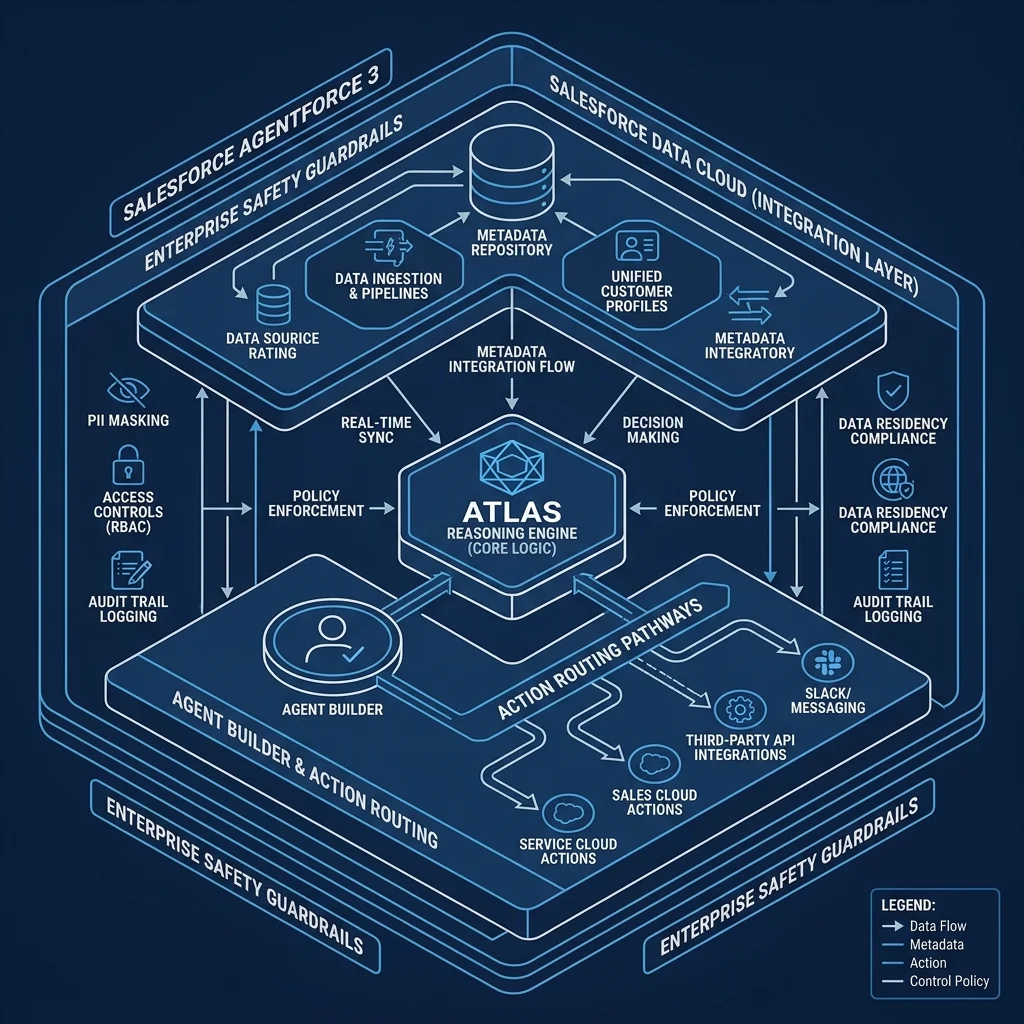
What to Watch Next
As enterprises deploy multi-agent networks, the focus will turn to orchestrating across vendors. The immediate challenge is managing communication between Salesforce's agents and external systems built on Microsoft Copilot Studio or custom enterprise frameworks. We expect Salesforce to launch open-standard gateway APIs later this year to facilitate interoperability between ecosystems, ensuring that Salesforce remains the central ledger for agentic business workflows.