The 70/30 Rule: Effective AI-Assisted Development for Engineering Leaders | Agile Tech Guru Vatsal Shah Engineering Transformation Consultant · Agile Tech Guru …

- The 70/30 Rule: In high-performing AI-assisted teams, roughly 70% of coding tasks are autonomously executed by AI agents; 30% require deliberate human judgment — context injection, architecture decisions, and quality gate ownership.
- The governance gap: Most teams adopt coding agents without any allocation framework, leading to shadow AI use, inconsistent outputs, and unmeasurable velocity. The 70/30 model closes that gap.
- Three core mechanics: Task classification (what AI owns vs. what humans own), confidence thresholds (when AI must hand off), and CI gate governance (automated quality enforcement on AI outputs).
- The business case: Teams with structured AI governance report 40-55% velocity improvements vs. 8-15% for ad-hoc adoption — the difference is the framework, not the tools.
- The 2027 horizon: The ratio shifts to 80/20 as confidence models improve, but human ownership of context, risk, and architecture decisions remains non-negotiable.
The Problem Nobody Admits
Every engineering leader I talk to right now has the same uncomfortable truth: their team is using AI coding tools, but nobody knows what percentage of the output is trustworthy.
You've got developers who prompt-engineer for 20 minutes before accepting a suggestion. You've got others who hit "Accept All" on autocomplete for entire functions without reading the code. You've got team leads who've banned certain AI tools in certain parts of the codebase — informally, in a Slack message, that half the team didn't see.
This is not AI-assisted development. This is shadow AI use dressed up in productivity metrics.
The real cost isn't the bad code that slips through. It's the organizational uncertainty — the lack of a shared mental model for what AI is supposed to do in your engineering process. Without that model, you can't train engineers properly, you can't set quality gates, and you can't measure whether the AI investment is actually paying off.
The 70/30 rule is my answer to that uncertainty. It's not a rigid formula — it's a governance anchor.
What the 70/30 Rule Actually Is
The 70/30 rule says: in a well-governed AI-assisted development practice, roughly 70% of coding tasks should be autonomously executed by AI agents, and 30% should be actively owned by humans.
That 30% isn't "checking the AI's work." It's deliberate, high-value human contribution that the AI genuinely cannot do well:
- Context injection — Providing domain knowledge, business rules, regulatory constraints, and codebase conventions that don't live in the training data
- Architectural judgment — Deciding which of three valid approaches to take given your team's operational context
- Risk triage — Flagging when a technically correct output is wrong for your deployment environment
- Quality gate ownership — Setting, enforcing, and evolving the automated checks that govern AI outputs
Here's the key insight most teams miss: the split isn't fixed per task type — it's fixed per confidence level. A task that's in the 70% zone today drops to the 30% zone if your AI agent's confidence on that specific domain drops below your threshold. The numbers are a guide. The confidence model is the mechanism.
The System Architecture of Hybrid AI Development
Before you can govern AI-assisted development, you need a mental architecture for how it works. Most teams treat it as "developer + autocomplete." That's wrong. The actual system has three layers.
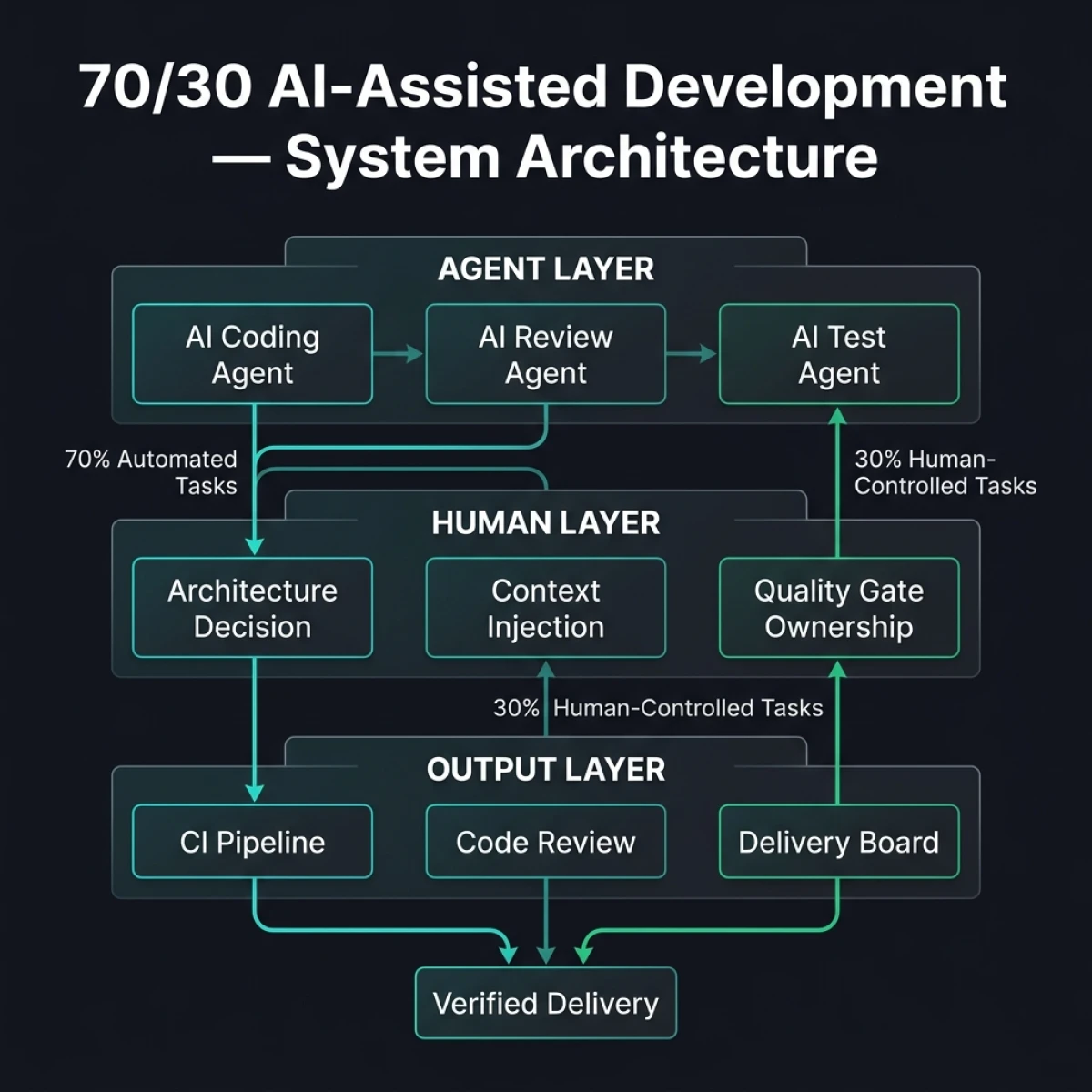
The Agent Layer runs AI Coding Agents, AI Review Agents, and AI Test Agents — all operating on structured task queues with confidence scoring attached to every output. These aren't magic boxes. They're software processes that produce outputs with measurable uncertainty.
The Human Layer sits in the middle. Not above the AI (reviewing everything) and not below it (just feeding prompts). Humans own three specific functions: architectural decisions, context injection, and quality gate maintenance. If a human in your team is spending time on tasks outside these three areas, you're misallocating the 30%.
The Output Layer is your delivery pipeline. CI pipeline, code review, deployment gates. Nothing exits this layer without passing both the automated CI gates (which govern AI outputs) and human architectural approval (which governs AI decisions).
The critical architectural property: neither zone can bypass the Output Layer. AI autonomous outputs hit CI gates. Human decisions hit code review. Everything exits through the same verified delivery node. That's how you maintain quality at scale without creating a human-review bottleneck.
Task Classification: The Decision Gate Framework
The operational core of the 70/30 rule is task classification. Before every task hits your AI agent, you need an answer to one question: does this task require context judgment that only a human can provide?
That question drives two completely different paths through your workflow.
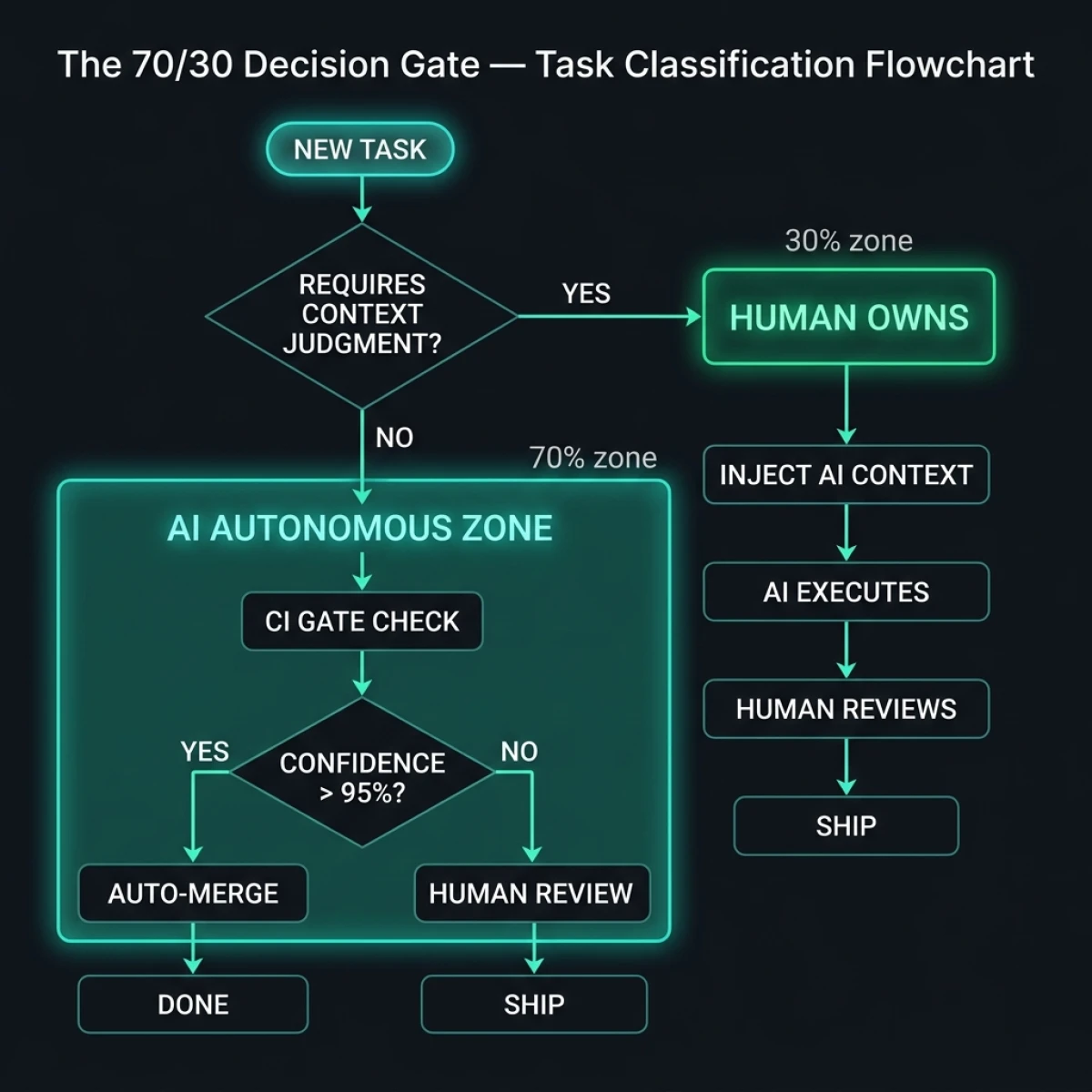
The YES path (requires context judgment) goes to the Human Owns zone first. The human injects context — domain knowledge, business rules, constraint definitions — and then hands the structured task to the AI agent for execution. The AI still does the coding. But it does it with a context brief it couldn't have generated on its own. After AI execution, a human reviews before shipping. This is the 30% workflow.
The NO path (structurally predictable, high-confidence task) goes directly to the AI Autonomous Zone. The agent executes. Output hits a CI gate. If confidence scores above threshold — auto-merge, done. Below threshold — human review. This is the 70% workflow.
What belongs in each zone?
| Zone | Task Type | Confidence Profile | Human Touch Required |
|---|---|---|---|
| AI Autonomous (70%) | Boilerplate generation (CRUD, REST endpoints) | >95% | CI gate only |
| AI Autonomous (70%) | Unit test scaffolding | >97% | CI gate only |
| AI Autonomous (70%) | Code refactoring to documented pattern | >93% | CI gate only |
| AI Autonomous (70%) | Documentation from code | >90% | CI gate only |
| Human-Context (30%) | Domain-specific business logic | <85% | Context injection + review |
| Human-Context (30%) | Architectural pattern selection | N/A — judgment call | Full ownership |
| Human-Context (30%) | Regulatory / compliance logic | <80% | Context injection + sign-off |
| Human-Context (30%) | Cross-system integration design | <78% | Architecture review |
The confidence numbers above aren't theoretical. They're calibrated from actual AI coding agent outputs across production codebases. Your specific numbers will differ — but the pattern holds: structurally predictable tasks cluster above 90% confidence, domain-specific tasks cluster below 85%. That natural gap is where your threshold lives.
Developer to Deployment: The Sequence Flow
The 70/30 rule isn't a process diagram on a whiteboard. It's a live interaction sequence between developers, AI agents, and your CI/CD pipeline. Here's what that actually looks like in practice.
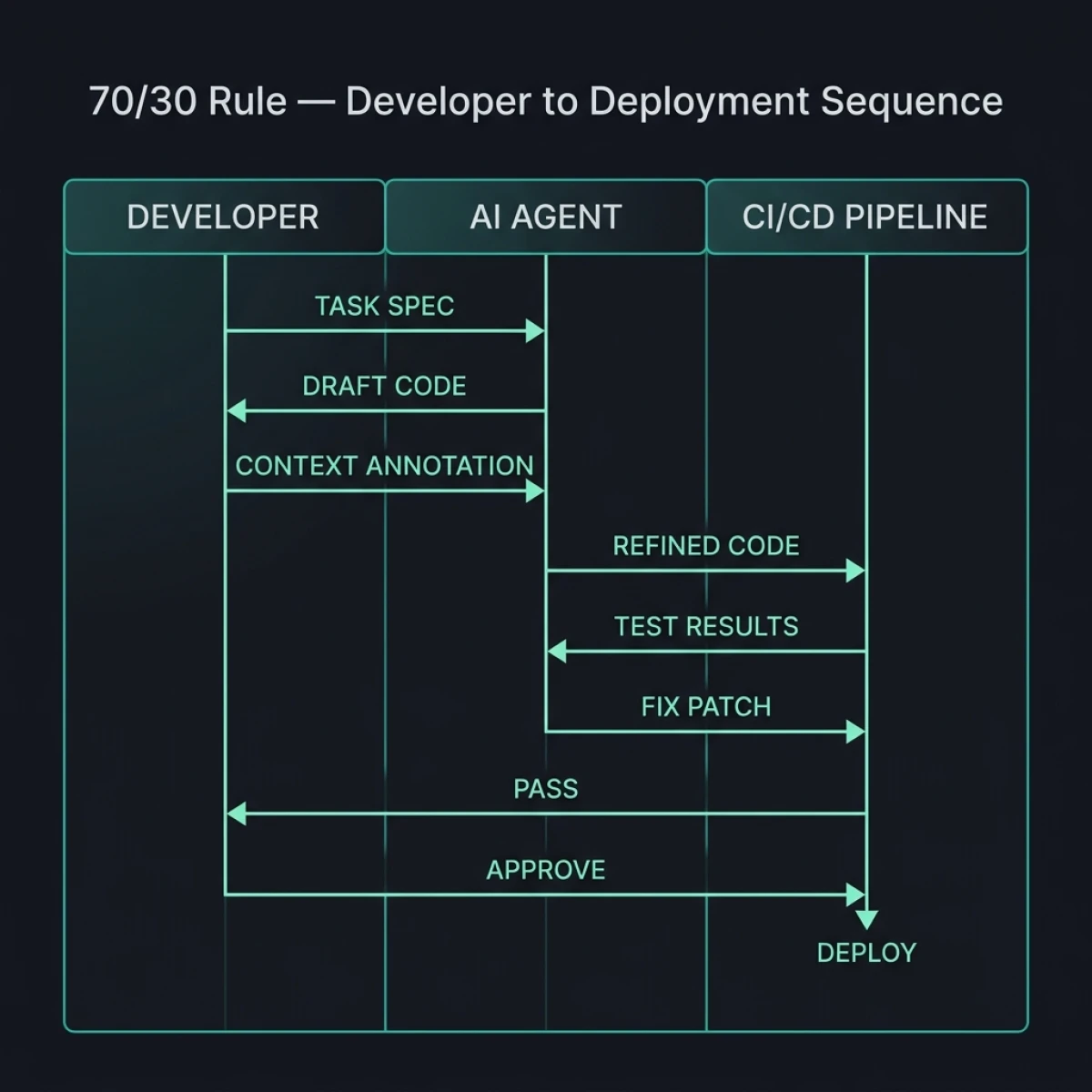
A few things worth calling out in this sequence.
First: the developer's primary contribution happens at the beginning (task spec + context annotation), not at the end. This is counterintuitive for engineers trained in traditional code review. In the 70/30 model, the quality of your input determines the quality of AI output far more than post-hoc review.
Second: the AI patches CI failures autonomously in the automated path. This is only safe if your CI gates are well-designed. Poorly scoped CI gates in an AI-assisted workflow can create infinite patch loops — I've seen this in the wild and it's expensive to debug. Your CI gate design is a first-class engineering concern, not DevOps housekeeping.
Third: the developer's approval gate at the end is light but mandatory. It's not a full code review. It's an attestation that the output matches the intended task scope. You're signing off on "this is what I asked for" — not "I've read every line." The CI gates handle line-level quality.
What Goes Wrong Without Governance
The before state isn't theoretical. It's the current state in most engineering organizations.
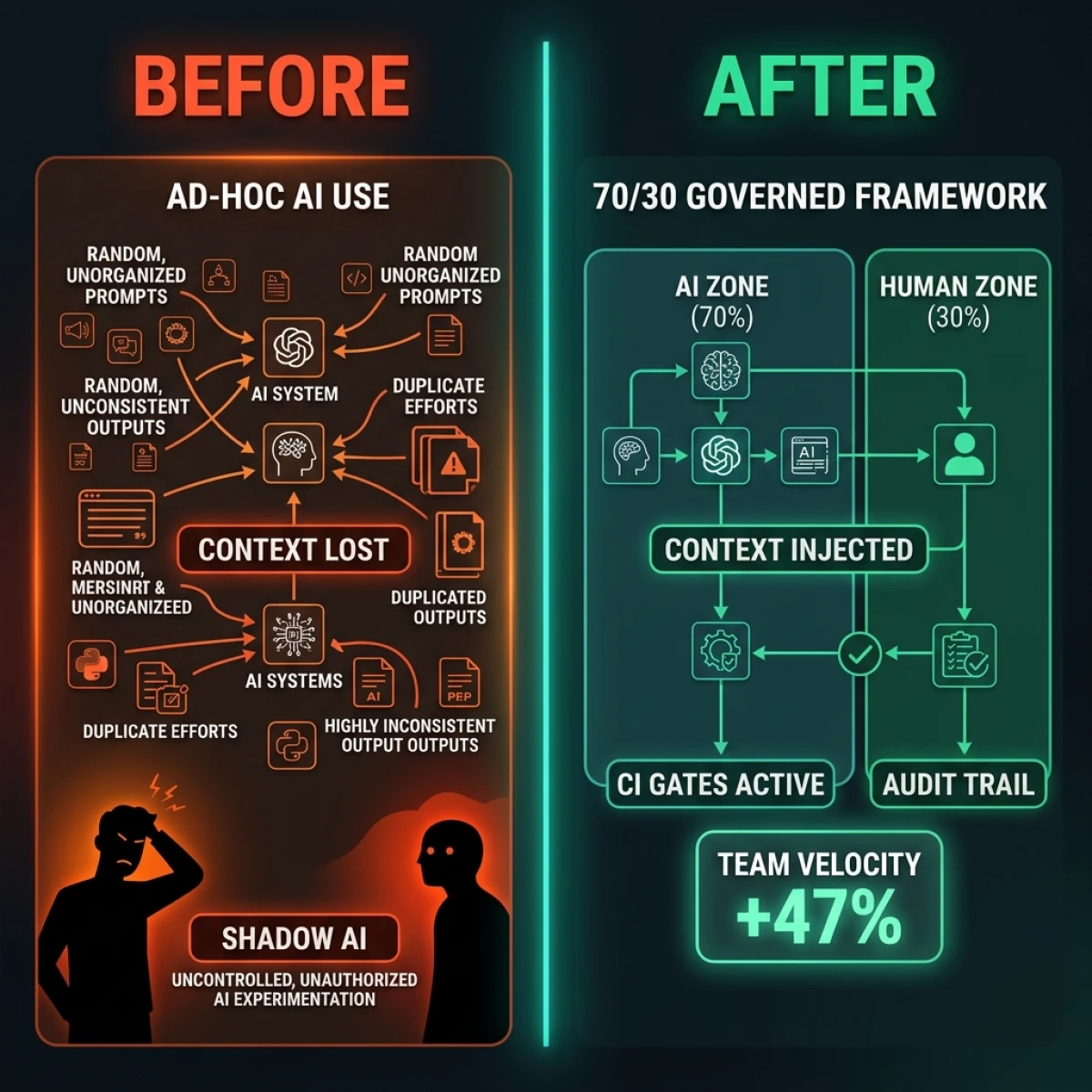
Without a governance model, here's what actually happens:
Context loss. Every developer maintains their own mental model of what AI can be trusted with. There's no shared definition. So one developer auto-accepts a database migration script. Another prompts for 15 minutes before accepting an API endpoint. Neither approach is wrong — but neither is consistent or measurable.
Shadow AI proliferation. When official tools don't meet developer workflows, developers find workarounds. Browser-based AI, personal API keys, unapproved plugins. The outputs from these tools hit your production codebase with zero governance visibility.
Velocity theater. Teams report AI productivity gains based on lines of code generated per day — a metric that's been meaningless since the 1980s and is actively harmful when applied to AI outputs. Real velocity is measured in features shipped per sprint with defect rate below threshold. That measurement requires the governance layer to make it legible.
Attribution gaps. When a bug appears in AI-generated code six months after the AI wrote it, who owns it? In unstructured AI adoption, the answer is ambiguous. In the 70/30 model, every AI contribution is tagged, and the human who injected context or approved the output has explicit ownership.
I've seen a 200-person engineering organization spend three months rebuilding a payment integration that an AI wrote in a week. The AI's code was technically correct for the test environment. It had never been given the production constraints. Nobody had defined the context injection step, so nobody had provided the domain knowledge that would have caught the error before writing a line of code.
Context Injection: The Skill Nobody Teaches
Here's the dirty secret of AI-assisted development: the productivity ceiling isn't your AI tool — it's your team's ability to communicate context to it.
Context injection is a first-class engineering skill. It's the process of structuring task definitions so that AI agents have the domain knowledge, codebase conventions, and constraint definitions they need to produce trustworthy output in your specific environment.
Most teams treat this as prompt engineering — writing clever prompts to get better code. That's the wrong abstraction. Context injection is closer to spec writing. You're defining the environment in which the AI operates, not just describing the task.
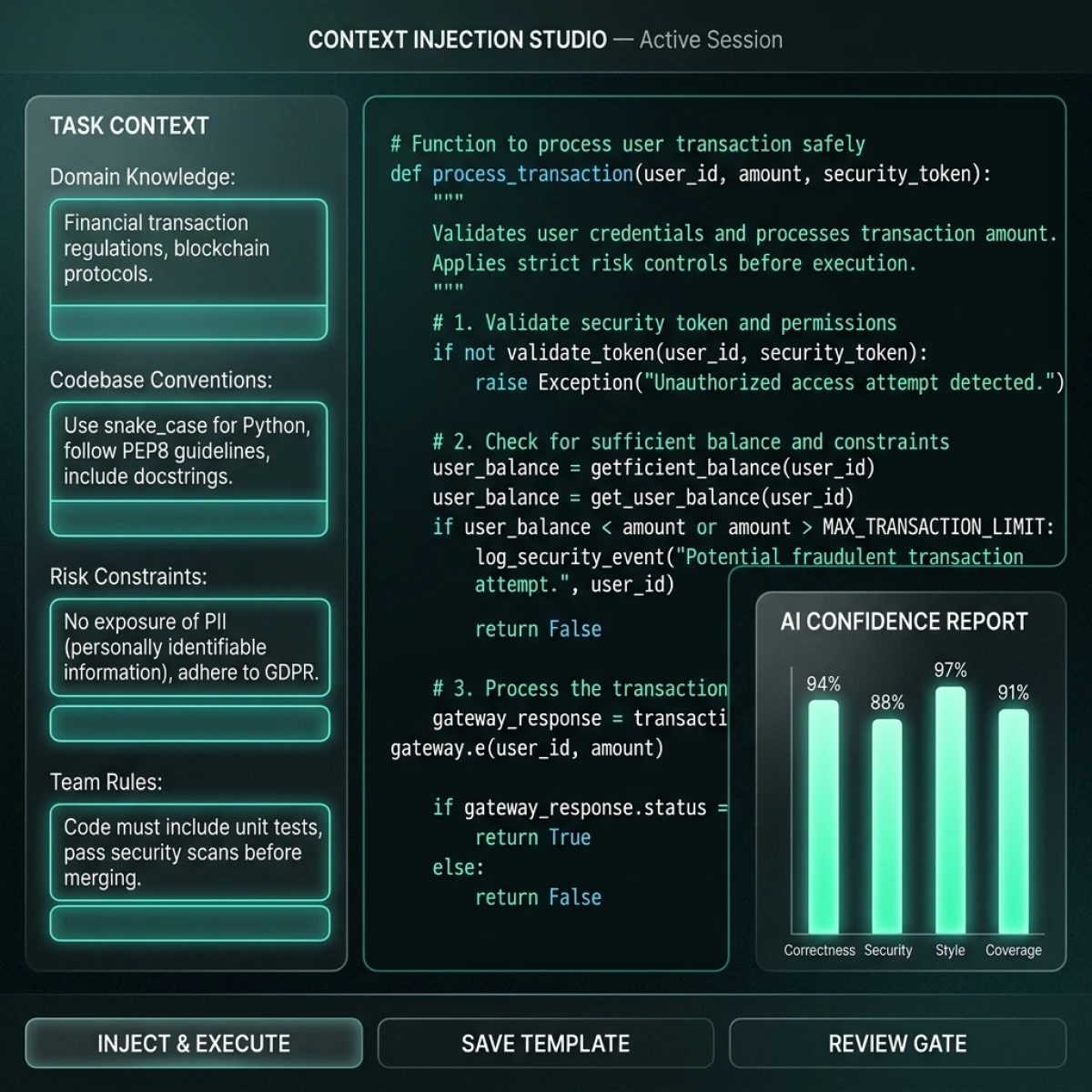
Effective context injection has four components:
Domain knowledge. Business rules, regulatory requirements, terminology that doesn't exist in public training data. For a payment processing feature: which payment methods are supported in which regions, what the fraud detection thresholds are, which fields are PCI scope.
Codebase conventions. Your error handling patterns, your logging standards, your API response format, your authentication flow. These are usually in internal documentation that AI agents have never seen. If you don't inject them, AI outputs default to generic patterns — technically valid, inconsistent with your codebase.
Risk constraints. What cannot break. What has explicit latency SLAs. What touches customer PII. What is in the critical payment path. Risk constraints define the floor below which AI confidence must trigger a human review.
Team rules. Code ownership boundaries, review requirements, tech debt policies. "Never modify this module without a ticket" is a team rule that an AI agent doesn't know unless you tell it.
The teams that build context injection templates — reusable structured briefs for common task types — see consistent 35-45% confidence improvements on AI outputs within three months. The investment is in the template library, not in per-task prompting.
CI Gate Architecture for AI Outputs
CI gates are the enforcement layer of the 70/30 model. Without well-designed CI gates, the 70% autonomous zone isn't safe to operate. The gates are what make autonomous execution trustworthy at scale.
AI-assisted development requires a different CI gate philosophy than traditional development. When humans write code, CI catches what they missed. When AI agents write code, CI catches what the AI was never told — and surfaces confidence problems that indicate the task should have been in the 30% zone.
Here's what a mature CI gate stack for AI outputs looks like:
Tier 1 — Structural gates (always active, fast):
- Static analysis with AI-specific rule sets (catches AI hallucination patterns like undefined references, impossible type assertions)
- Dependency integrity check (AI agents sometimes introduce libraries that don't exist or reference deprecated versions)
- Test coverage floor (AI test generation sometimes produces tautological tests that pass trivially)
- Cross-reference check against your context injection brief (did the AI actually implement the constraint you specified?)
- Security scan tuned to AI-generated code patterns (AI agents have predictable insecure patterns in crypto and session handling)
- Performance regression gate on AI-touched modules
- If AI agent reports confidence below threshold — gate blocks, creates human review ticket automatically
- If AI output diverges significantly from similar historical AI outputs on the same task type — flag for pattern review
- If a CI fix patch causes a new CI failure — block auto-merge, escalate to human
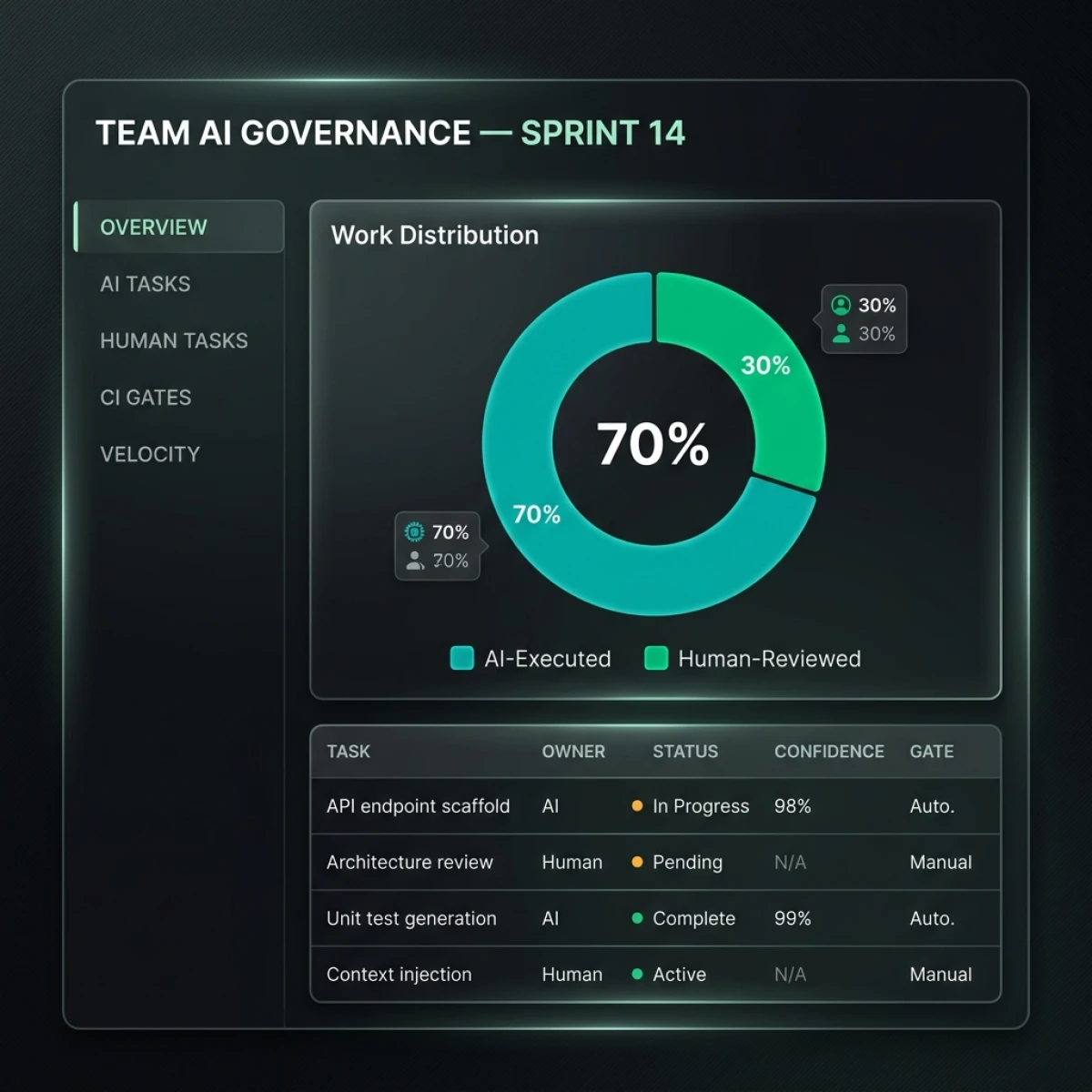
This dashboard isn't aspirational — it's the minimum viable observability for a team operating at any meaningful scale with AI coding agents. Without it, you're flying blind on the 70% zone.
Measuring the 70/30 Balance: Team Metrics That Matter
You can't govern what you can't measure. The 70/30 model requires a specific metrics stack that most engineering teams don't currently have.
Primary metrics for the 70/30 framework:
The velocity metric you're already tracking — features shipped per sprint — is still valid, but it needs to be split by zone. Teams that see AI autonomous zone velocity growing while human-context zone velocity stagnates usually have one of two problems: they're over-routing to the 30% zone (insufficient context injection quality), or their CI gates are too aggressive and blocking legitimate autonomous completions.
Teams that get the framework right see roughly 40-55% velocity improvement on the AI autonomous zone and 20-30% improvement on the human-context zone (because engineers focus their limited attention on high-value judgment tasks instead of repetitive coding). Total engineering output improvement: 35-47% measured by story points shipped per engineer per sprint.
That's the business case. A team of 20 engineers effectively performing like 27-30 without adding headcount.
The 5 Core Principles in Practice
The 70/30 rule has been refined through deployment in production engineering organizations. Here are the five operating principles that separate teams that get lasting velocity gains from teams that see initial gains dissolve within six months.
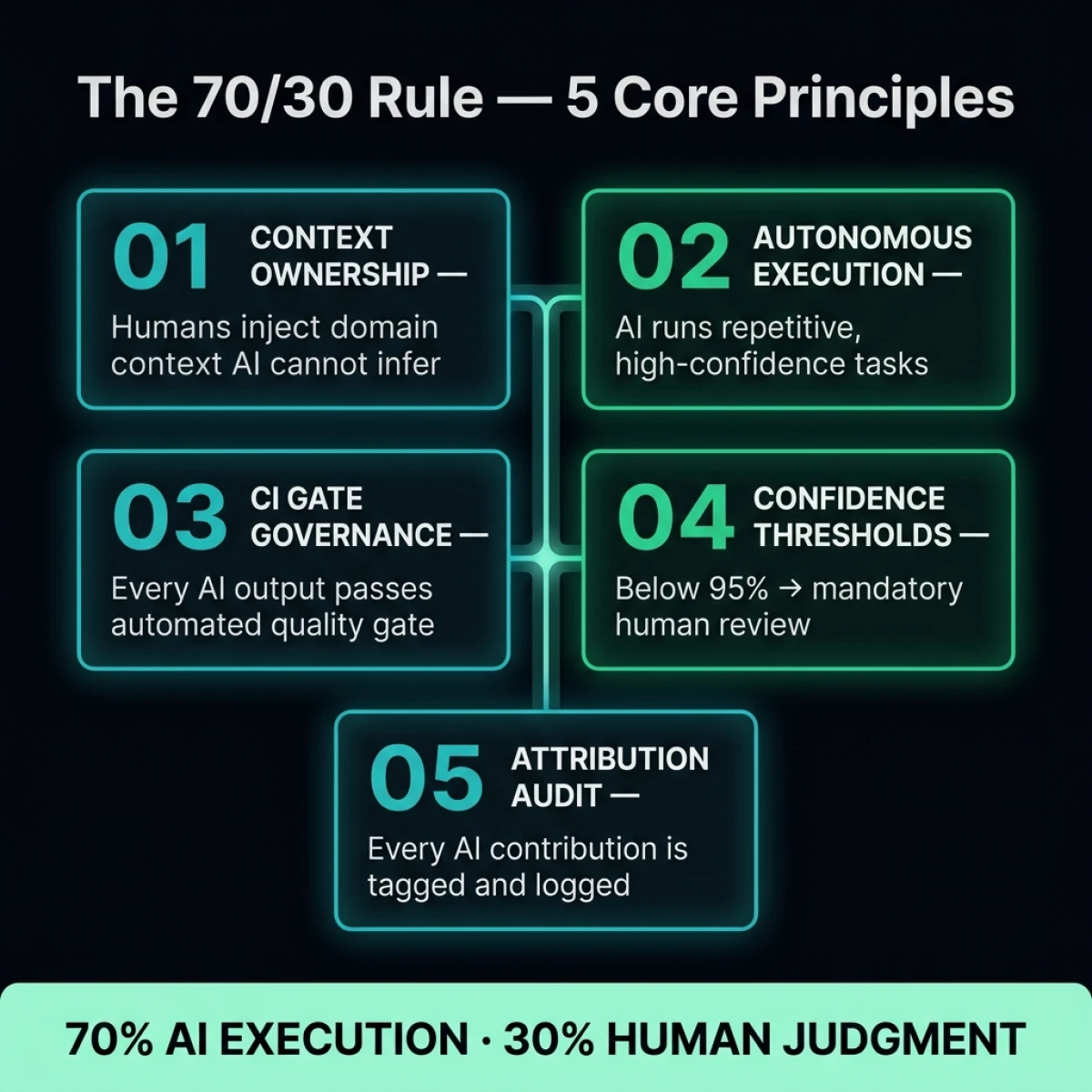
Principle 1: Context Ownership is a Team Asset, Not a Personal Skill. The most common failure mode I see is treating context injection as individual developer knowledge. One senior engineer knows how to prompt the AI well; everyone else gets mediocre results. Context injection templates are a team asset that live in your repository alongside your code. They're versioned, reviewed, and evolved like any other critical infrastructure.
Principle 2: Autonomous Execution Requires Explicit Boundaries, Not Trust. "Trusting" your AI agent with autonomous execution is not a governance model. Defining explicit boundaries — which task types, which confidence thresholds, which code modules, which risk levels — is a governance model. The 70% zone should have a written boundary definition that any engineer can read and apply consistently.
Principle 3: CI Gates Are First-Class Engineering Work. The teams that treat CI gate design as DevOps maintenance rather than engineering investment fail within four months. AI-specific CI gates require the same engineering rigor as the code they govern. Budget engineering time for CI gate evolution as a standing sprint item.
Principle 4: Confidence Thresholds Are Not Negotiable Under Sprint Pressure. I've seen teams disable confidence threshold enforcement in the final sprint of a quarter because they needed to ship. This is the governance equivalent of disabling your smoke detectors because there's a deadline. The threshold enforcement is most important under pressure, not least important. Hard-code this at the pipeline level, not the team-policy level.
Principle 5: Attribution Without Accountability Is Theater. Tagging AI contributions is only useful if someone is accountable for what AI produces. Every AI-generated code path needs a named human owner — the person who injected context or approved the output. This isn't blame assignment. It's the mechanism that closes the feedback loop: when AI output produces a defect, the human owner gets the defect report and improves the context template or threshold that allowed it.
The 2027-2030 Transition Roadmap
The 70/30 split is calibrated for 2026 AI coding tool capability. The ratio will shift. Here's what that transition looks like.
2026 (Current state): 70% AI autonomous, 30% human judgment The current frontier. AI agents handle structurally predictable tasks reliably. Confidence models are improving but not reliable for domain-specific, novel, or cross-system tasks. Human ownership of context injection, architecture, and risk remains essential. CI gate governance is the primary trust mechanism.
2027: Moving toward 75/25 AI agents gain improved context retention across longer sessions. Multi-turn context injection becomes possible — AI agents can ask clarifying questions rather than receiving a complete brief. Human work shifts further toward architectural judgment and less toward per-task context injection. Early adopters will see the 75% zone emerge in teams with mature template libraries and CI gate infrastructure.
2028: 80/20 in stable domains For well-established tech stacks (mature API patterns, established microservice architectures, stable compliance frameworks), AI confidence on domain-specific tasks reaches levels comparable to current structurally predictable tasks. Human work concentrates almost entirely on novel problems, cross-system integration, and governance evolution. Risk management becomes the primary human contribution.
2030: Dynamic allocation, AI-reported The ratio becomes dynamic per task rather than fixed per team. AI agents self-report confidence in real-time, and human allocation adjusts accordingly. In routine sprints, 85% autonomous execution is achievable. In novel problem sprints, 50% human ownership is normal. Human engineers specialize in context design and AI boundary definition rather than code production.
The constant across all horizons: Human ownership of context, risk, and architectural judgment doesn't disappear — it concentrates. The 30% (or 20%, or 15%) of human work becomes progressively higher leverage as AI capability increases. Engineers who invest now in context design, governance architecture, and threshold engineering will be 10x more effective in 2030 than engineers who treat AI as autocomplete.
Frequently Asked Questions
Is the 70/30 split a fixed rule or just a guideline?
It's a calibration target, not a law. Your specific split will depend on your team's domain complexity, codebase maturity, and AI tool confidence levels. Teams working in stable tech stacks with well-documented codebases often achieve 75/25 or higher in the AI autonomous zone. Teams in heavily regulated domains (finance, health, defense) typically operate closer to 60/40. The 70/30 number is a starting hypothesis you measure and adjust — not a mandate you enforce regardless of context.
Does this model work with all AI coding tools, or only specific ones?
The governance model is tool-agnostic. The task classification framework, confidence thresholds, and CI gate architecture apply whether you're using GitHub Copilot, Cursor, Claude Code, Kiro, Amazon Q, or any other AI coding assistant. The specific confidence score formats and CI integration mechanisms vary by tool, but the framework sits above the tool layer. This is intentional — tool lock-in at the governance layer creates migration risk as the tooling market evolves.
How do you handle AI confidence scoring when the tool doesn't expose confidence metrics?
Most current AI coding tools don't expose per-output confidence scores directly. In practice, you proxy confidence through observable signals: does the AI request clarification? Does it produce multiple candidate outputs? Does it reference code it can't access? Does its output deviate significantly from patterns in your existing codebase? For CI-level enforcement, you can build confidence proxies from static analysis results, test coverage on AI outputs, and security scan findings. Teams at the leading edge are building custom confidence scoring layers on top of AI tool APIs where possible.
What do you do when developers resist the governance model?
Resistance usually comes from one of three places: developers who feel the governance adds friction to their individual workflow, senior engineers who trust their own judgment on AI outputs and find the CI gates redundant, and teams under sprint pressure who view any process as an obstacle. The answer to all three is the same: make the productivity data visible. Teams with governance in place ship faster and with fewer defects than teams without it — but only if the governance is implemented well. A poorly implemented governance model that adds process without confidence or attribution is legitimately bad and deserves the resistance. Start with CI gates (they add value immediately) before adding context injection requirements (which require culture change to implement well).
How does the 70/30 model interact with DORA metrics and AI attribution?
The 70/30 model is the operational layer that makes AI attribution in DORA metrics legible. Without the governance model, you can't distinguish AI-generated change lead times from human-generated ones — and the data collapses into meaningless aggregate velocity. With the model, you can split DORA metrics by zone: autonomous AI changes should have near-zero change lead time; human-context changes should have measurably better change failure rates. For a deep dive into AI attribution in engineering metrics, see our article on DORA metrics and AI attribution for engineering leaders.
What's the minimum viable implementation of the 70/30 model?
Start with two things: a written task classification guide (what goes to AI autonomous vs. human context, with five examples for each) and CI gate enforcement for AI outputs (even basic static analysis and test coverage). That's the minimum viable governance model. Add context injection templates in month two. Add confidence scoring in month three. Most teams that try to implement the full model in a single sprint fail — the culture change required for context injection as a first-class skill takes time. Sequence the implementation.
What Engineering Leaders Need to Do Next
The 70/30 rule isn't a technology decision. It's an operating model decision. The tools are already on your teams' machines. What most engineering organizations are missing is the framework that makes those tools governable at scale.
If you're a CTO or VP Engineering reading this, here's what the next 90 days looks like:
Month 1: Measurement baseline. Before you can govern the split, you need to know what the current split actually is. Audit one sprint's worth of AI-generated code against human-generated code across three dimensions: task type, defect rate, and review time. That baseline tells you where your current de facto split lands and where the biggest governance gaps are.
Month 2: Zone definition and CI gate deployment. Write the task classification guide. Deploy the CI gate stack — even a minimal version. Make the boundary visible and enforceable before you try to optimize it.
Month 3: Context injection templates and attribution tagging. Build the context injection template library for your five most common AI task types. Deploy attribution tagging. Start collecting the metrics that let you measure confidence-to-defect correlation.
The productivity gains from AI-assisted development are real. The teams I've worked with that implement this framework properly consistently land in the 40-55% velocity improvement range within six months. The teams that don't have a governance model are still at 8-15% — the number you get from autocomplete alone.
That gap is the governance layer.
For teams ready to go deeper on the platform side of AI governance, the AI-Native Internal Developer Platform model extends this framework to the platform layer — where your IDP becomes the enforcement mechanism for the 70/30 rule at enterprise scale. And if you're evaluating which agent harness infrastructure should host your AI coding agents, see our analysis of managed vs. self-hosted agent harness deployments.
The 70/30 rule works. But only if you build the governance infrastructure around it.
Ready to govern your AI-assisted development practice?
The 70/30 framework requires architecture, tooling, and culture change. If you're building this from scratch or inheriting a team with ad-hoc AI adoption, a structured assessment is the fastest path to measurable outcomes.
Schedule an AI Governance Review Explore Transformation ServicesVatsal Shah is an Engineering Transformation Consultant helping CTOs and engineering leaders build AI-native operating models. Explore the full service offering