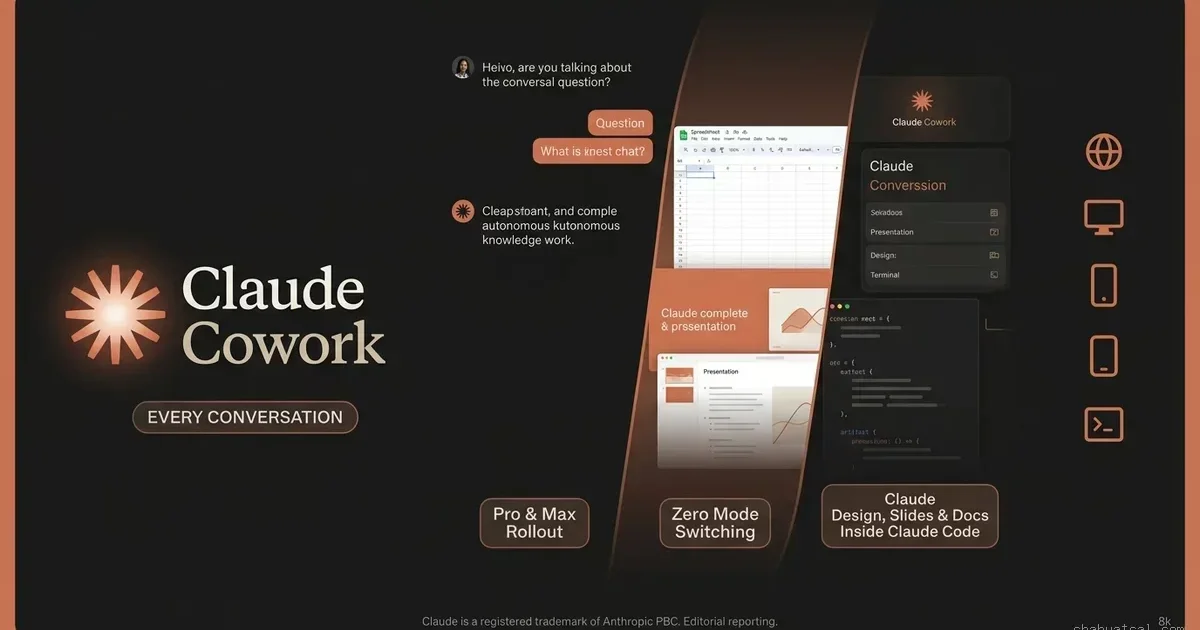
The Paradigm Shift: Why the AI Mode Picker Had to Die For the past three years, the user interfaces of frontier AI systems were plagued by an irritating design …
The Paradigm Shift: Why the AI Mode Picker Had to Die
For the past three years, the user interfaces of frontier AI systems were plagued by an irritating design compromise: the upfront mode selector.
When opening an AI client, users were confronted with a fork in the road:
- Do you want a fast, ephemeral conversational exchange?
- Do you want a deep, autonomous agentic task?
- Do you want a structured Project sandbox with pinned files?
- Do you want a Canvas/Artifact document editor?
+---------------------------------------------------------------------------------------------------+
|                            CLAUDE COWORK UNIFIED ARCHITECTURE PROFILE                             |
+----------------------------+----------------------------------------------------------------------+
| Feature Release            | Claude Cowork in Every Conversation                                  |
+----------------------------+----------------------------------------------------------------------+
| Release Date               | September 16, 2026                                                   |
+----------------------------+----------------------------------------------------------------------+
| Target Tiers               | Claude Pro & Claude Max (Gradual Rollout); Enterprise (Admin Beta)   |
+----------------------------+----------------------------------------------------------------------+
| Supported Surfaces         | Web (claude.ai), Desktop (macOS, Windows), Mobile (iOS, Android), CLI|
+----------------------------+----------------------------------------------------------------------+
| Primary UX Breakthrough    | Complete elimination of mode pickers; seamless dynamic escalation   |
+----------------------------+----------------------------------------------------------------------+
| Context Carry-Over         | Chats, Background Tasks, Projects, Connectors, and Custom Skills     |
+----------------------------+----------------------------------------------------------------------+
| Native Artifacts Added     | Claude Design (UI wireframes), Claude Slides, Claude Docs            |
+----------------------------+----------------------------------------------------------------------+
| Developer CLI Integration  | Claude Code terminal sessions render live hot-reloaded previews      |
+----------------------------+----------------------------------------------------------------------+
Anthropic’s September 16, 2026 update permanently dismantles this artificial division. By unifying Cowork capabilities directly into the core conversational engine, Claude treats conversational dialogue and autonomous execution as two ends of a single continuous spectrum.
Architectural Deep Dive: Mode Picker vs. Single Unified Thread
To understand the engineering mechanics behind this transition, consider how interaction states and memory persistence differ between legacy multi-mode silos and the unified 2026 architecture:
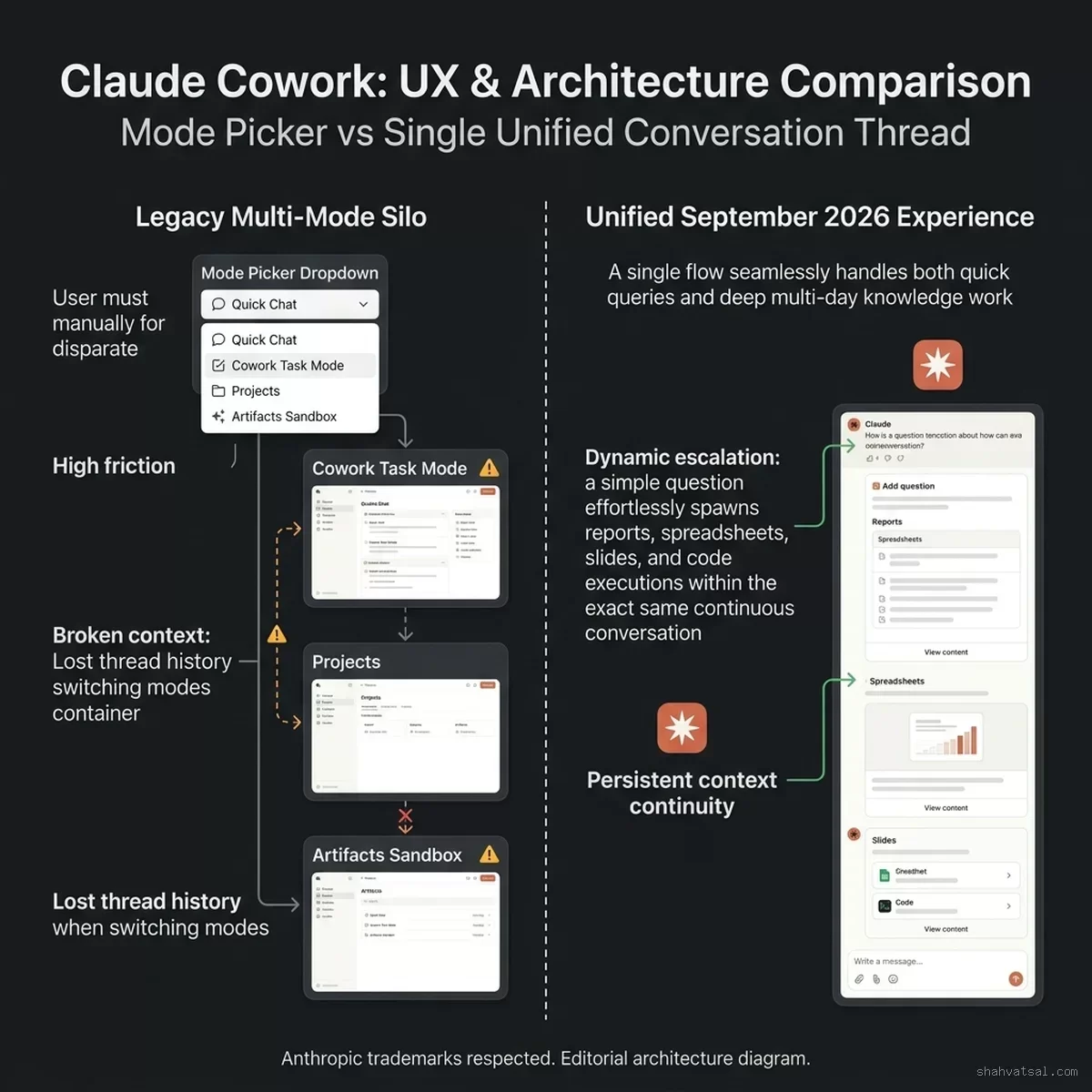
The Legacy Multi-Mode Silo (Pre-September 2026)
In earlier releases, conversational chat, task runners, and project sandboxes operated as distinct runtime containers:- Broken Thread Context: Selecting "Quick Chat" routed prompts to a low-latency inference path that lacked file-system scratchpads, tool invocation loops, and background scheduling.
- Context Loss on Escalation: If a user attempted to transition an ongoing conversation into a multi-step task, they hit a dead end. Exporting context was manual, lossy, and frustrating.
- Containerized Fragmentation: Artifacts, task outputs, and conversational replies lived in disconnected UI tabs, requiring constant context-switching.
The Unified September 2026 Experience
Under the new unified architecture, every conversation operates on an adaptive execution kernel:- Dynamic Task Escalation: A user can open a thread with a two-sentence greeting or clarification question. When subsequent instructions demand long-running research, dataset aggregation, or document synthesis, Claude automatically activates Cowork execution primitives without creating a new session.
- Dual-Speed Inference Pipeline: Simple queries resolve with instantaneous streaming responses. Complex commands spawn asynchronous sub-tasks that run in the background while the user continues asking parallel questions in the main thread.
- Embedded Interactive Panes: Spreadsheets, presentations, system design wireframes, and code diffs render alongside chat messages, hot-reloading in real time as the conversation progresses.
What Carries Over: The Unified Context Engine
A critical requirement of long-horizon enterprise knowledge work is ensuring that environmental state and corporate knowledge do not evaporate between tasks.
Anthropic’s unified context engine ensures that five fundamental capability pillars seamlessly carry over into any conversational thread:
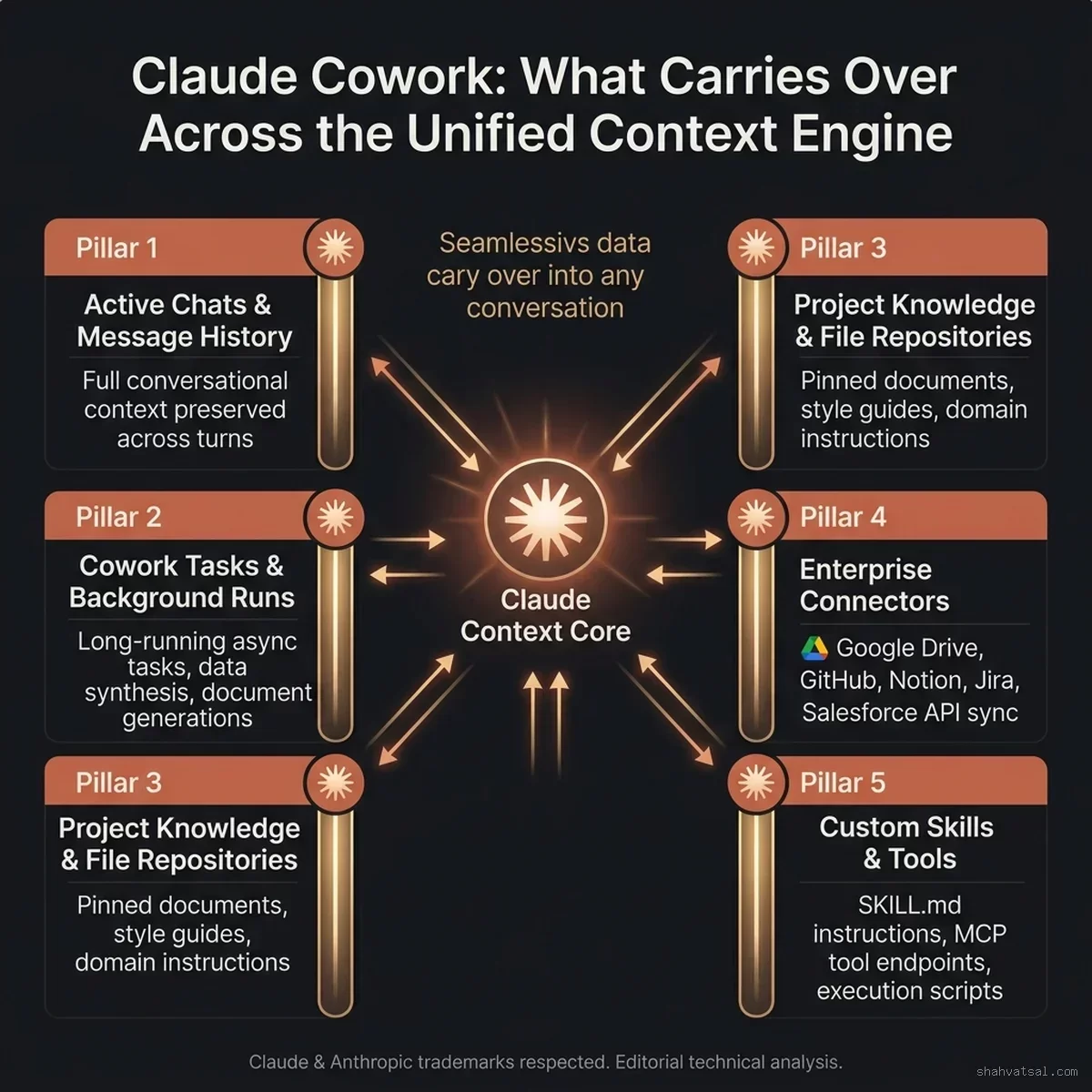
1. Active Chats & Message History
Conversational continuity is strictly preserved. When Claude spins up an autonomous background process—such as crawling a 200-page API documentation set—the user can continue conversing, clarifying constraints, or redirecting priorities in natural language without halting or restarting the underlying worker.2. Cowork Tasks & Background Runs
Long-running asynchronous processes—financial reconciliations, competitive matrix syntheses, or multi-repository dependency audits—persist across browser refreshes and device switches. A task initiated on a desktop browser can be reviewed, approved, or expanded from a smartphone during a commute.3. Project Knowledge & File Repositories
Pinned enterprise documents, architectural blueprints, corporate brand voice guidelines, and coding standards configured inside Claude Projects are universally accessible. The model treats project files not as static attachments, but as dynamic reference baselines for every prompt.4. Enterprise Connectors
Native integrations with enterprise SaaS platforms—including Google Drive, GitHub repositories, Notion workspaces, Jira issue trackers, and Salesforce CRM records—remain continuously synchronized. A single conversational prompt can query Jira sprint metrics, cross-reference GitHub pull request diffs, and generate an executive summary in Google Docs without leaving the thread.5. Custom Skills & Model Context Protocol (MCP) Tools
Workflows orchestrated viaSKILL.md instructions and Model Context Protocol (MCP) servers function natively. Whether invoking internal database query tools, terminal execution sandboxes, or specialized third-party APIs, skills execute predictably within the unified conversational loop.
The New Creative Suite: Claude Design, Slides, and Docs Everywhere
Concurrent with the single-thread Cowork rollout, Anthropic significantly upgraded its native generative artifact capabilities, officially integrating Claude Design, Claude Slides, and Claude Docs into all conversation surfaces:
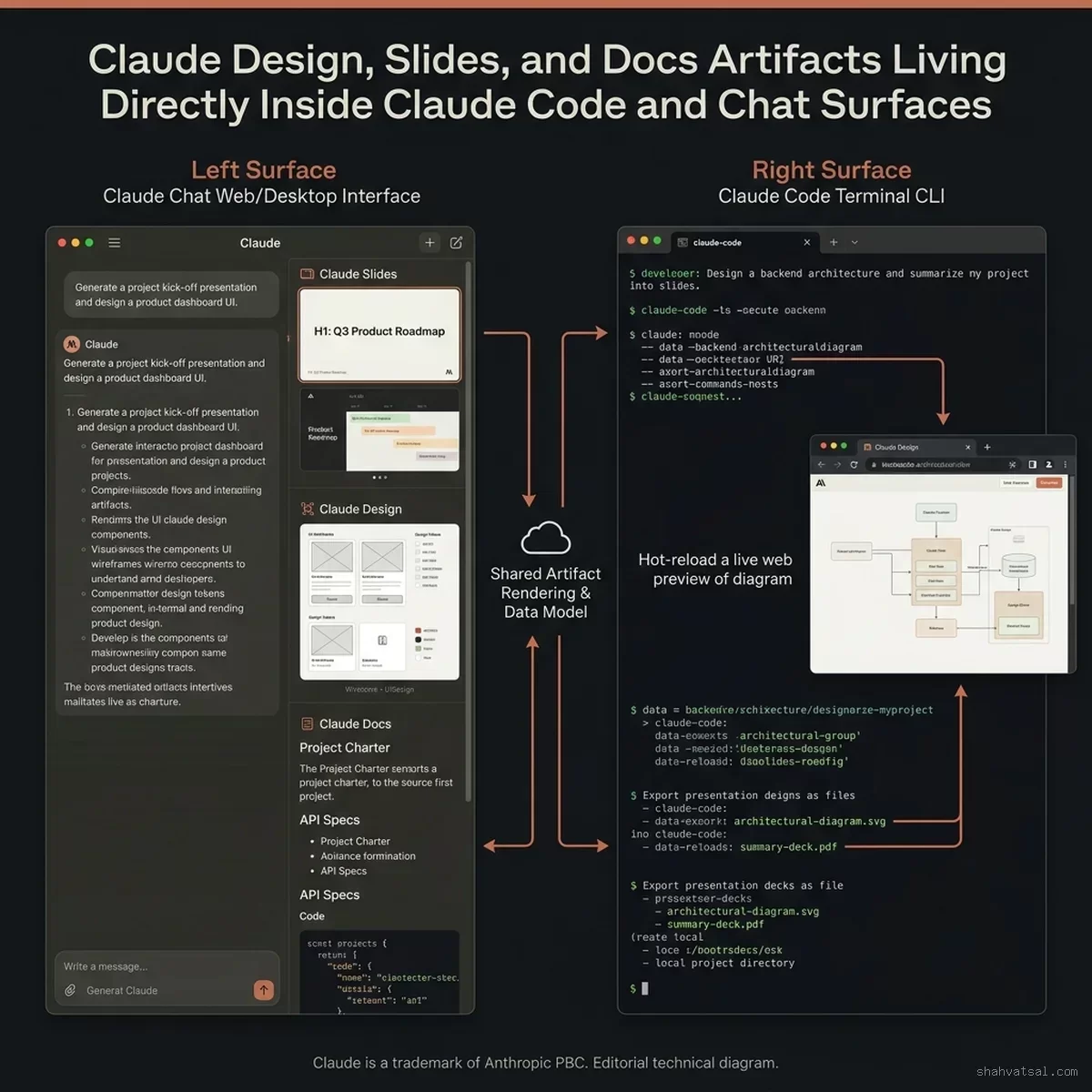
Claude Design: Component & Wireframe Synthesis
Users can instruct Claude to visually prototype responsive user interfaces, system architecture schematics, and interactive components. Claude outputs clean, standards-compliant HTML/CSS/Tailwind canvas artifacts with real-time interactive previews.Claude Slides: Presentation Decks as First-Class Artifacts
Rather than outputting plain bulleted lists for presentation outlines, Claude Slides generates multi-slide presentation decks equipped with structured layout grids, typographic hierarchy, data callouts, and clean export pathways to PDF and PowerPoint formats.Claude Docs: Polished Technical & Executive Documentation
Designed for complex deliverables—such as RFCs, system charters, project post-mortems, and customer battle cards—Claude Docs renders rich typographic documents with automatic table of contents generation, code syntax highlighting, and expandable executive summary widgets.Direct Integration Inside Claude Code Terminal CLI
For software engineers, the most impactful development is the native availability of these visual artifacts inside the Claude Code terminal interface:- While executing terminal-based development workflows (
claude-code), developers can request visual architectural diagrams or executive presentation summaries. - Claude Code spins up local ephemeral web preview servers, allowing engineers to view hot-reloaded Claude Design components and Claude Slides directly in their local browser.
- Deliverables can be exported with a single command into project repositories as standalone SVG, HTML, or Markdown files.
Subscription Tier Matrix & Enterprise Governance Controls
Because autonomous background tasks and rich document generation incur significant computational and token resources, Anthropic is rolling out these features under a tiered availability model:
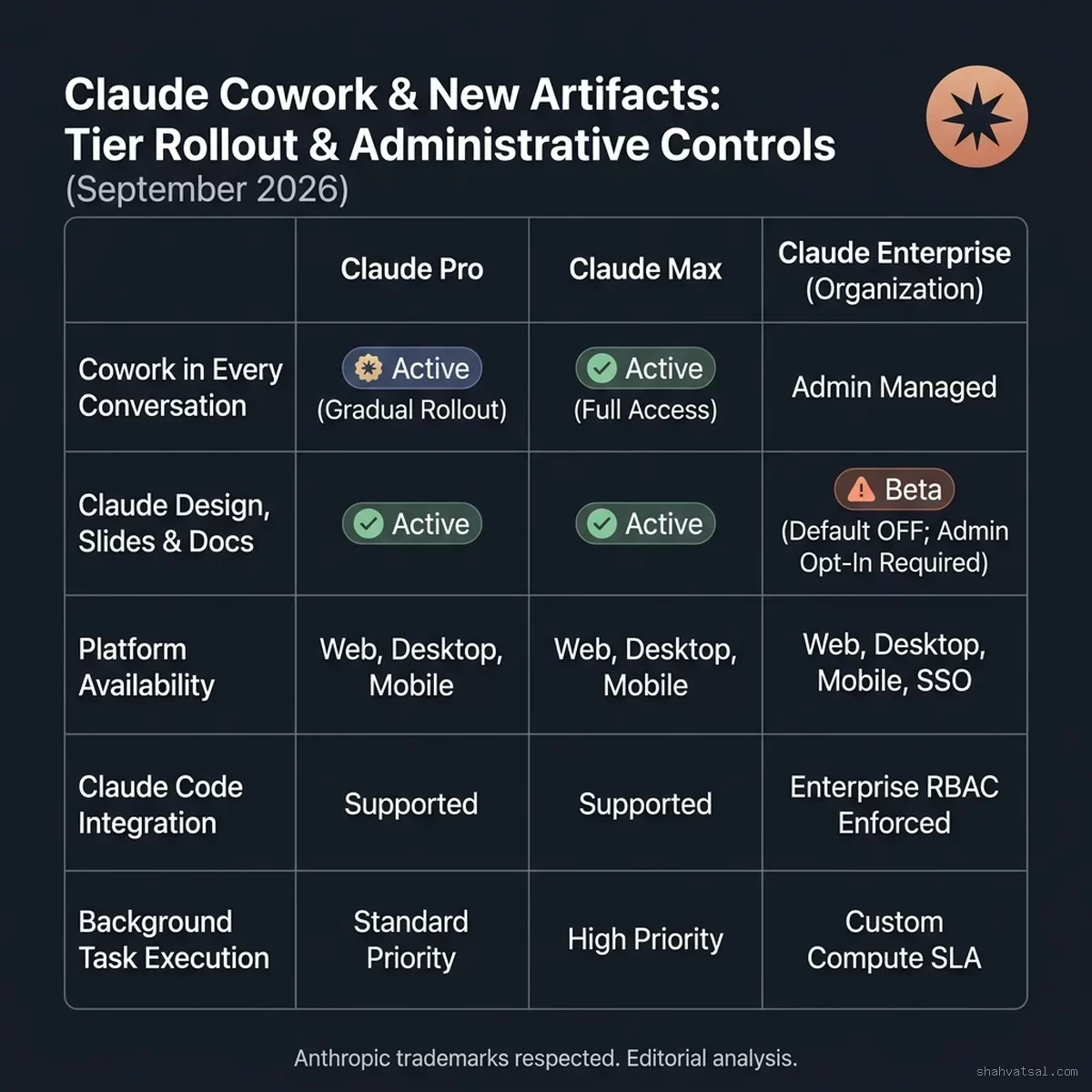
| Capability / Feature | Claude Pro ($20/mo) | Claude Max Tier | Claude Enterprise (Organizations) |
|---|---|---|---|
| Cowork in Every Conversation | Active (Gradual rollout starting Sep 16) | Active (Full immediate access) | Managed by Workspace Administrators |
| Claude Design, Slides & Docs | Active by default across all threads | Active by default with priority compute | Beta: Default OFF (Admin opt-in required) |
| Platform Availability | Web, macOS/Windows Desktop, Mobile | Web, Desktop, Mobile, Priority Bandwidth | Web, Desktop, Mobile, Enterprise SSO / SCIM |
| Claude Code CLI Integration | Supported with local web preview | Supported with expanded context limits | Supported with Enterprise RBAC and audit logging |
| Background Execution Priority | Standard async compute queue | High-priority compute allocation | Dedicated compute pools with guaranteed SLAs |
| Compliance & Data Retention | Standard consumer privacy terms | Standard consumer privacy terms | Zero-retention HIPAA / SOC 2 Type II compliance |
Why Enterprise Organizations Are Default-Off for New Artifacts
For IT security leads and Chief Information Security Officers (CISOs), Anthropic implemented strict governance defaults on Claude Enterprise accounts:- Administrative Opt-In: Claude Design, Slides, and Docs are categorized as enterprise beta features. Organization owners must navigate to the Admin Console under
Settings > Experimental Featuresto enable them. - Data Leakage Prevention: Enterprise security policies often restrict generative UI tools from executing arbitrary JavaScript or connecting to external CDNs. The admin toggle ensures that security teams can review data-flow boundaries before enabling the tools across thousands of corporate seats.
Chronological Disambiguation: Separating the 2026 Milestones
To ensure rigorous historical and technical accuracy, it is essential to disambiguate the September 16, 2026 release from earlier, distinct milestones in the Claude Cowork roadmap:
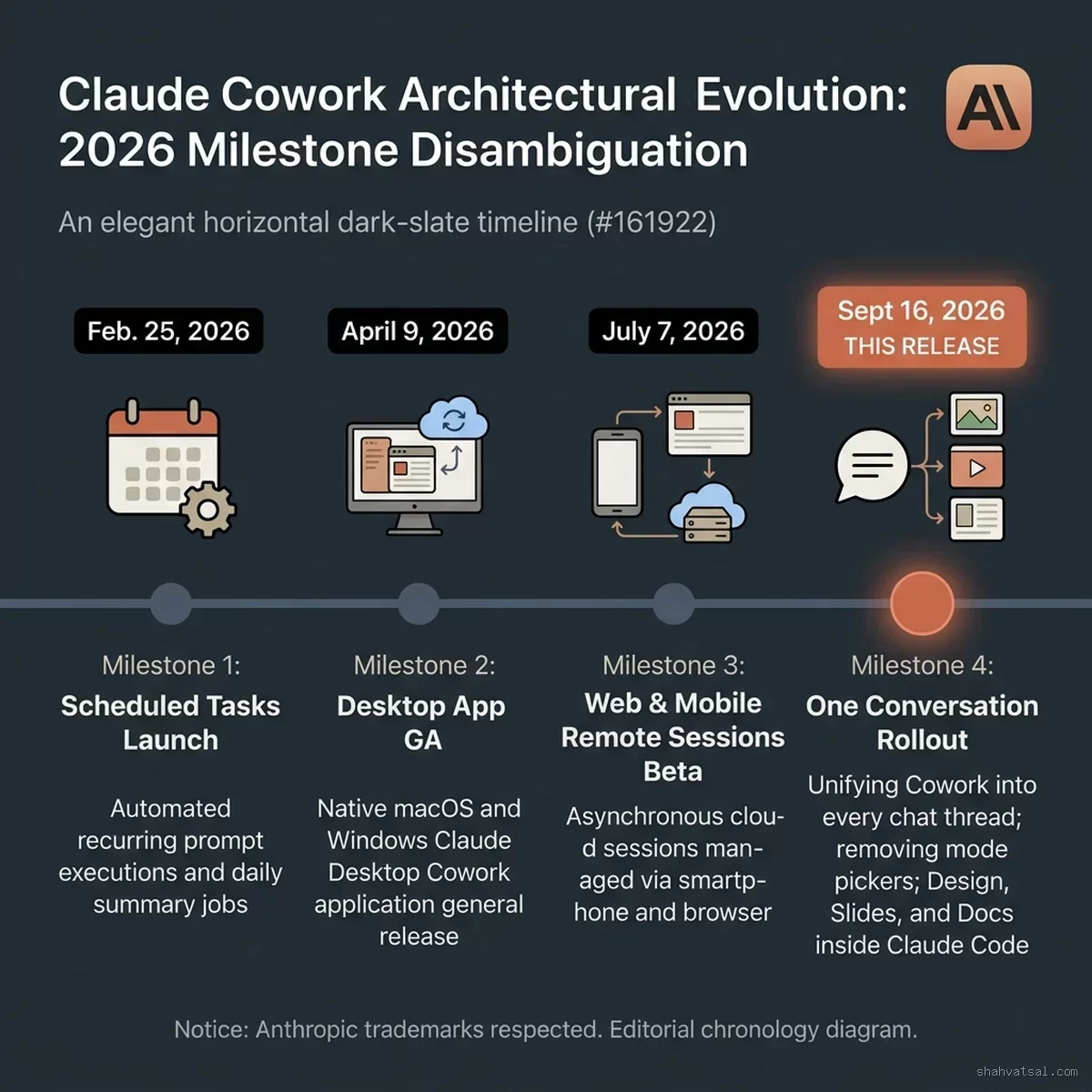
The progression unfolded across four distinct phases throughout 2026:
Milestone 1: Scheduled Tasks Launch (February 25, 2026)
- What Shipped: The ability to configure recurring, automated prompts (e.g., daily competitive intelligence briefings, weekly backlog summarization).
- Architecture: Cron-based cloud workers executing isolated, single-turn prompts on fixed schedules.
Milestone 2: Claude Desktop Application GA (April 9, 2026)
- What Shipped: Native desktop applications for macOS and Windows achieving General Availability (GA), introducing native file system integration and local screen context.
- Architecture: Dedicated client-side application wrapper with deep OS accessibility hooks.
Milestone 3: Web & Mobile Remote Sessions Beta (July 7, 2026)
- What Shipped: The ability to monitor, trigger, and pause long-running Cowork cloud sessions from mobile devices and web browsers while compute ran remotely.
- Architecture: Client-server separation decoupling UI display from persistent cloud execution containers.
Milestone 4: One Conversation Rollout (September 16, 2026 — THIS RELEASE)
- What Shipped: The complete unification of Cowork into every conversational thread, eliminating mode pickers entirely, and debuting Claude Design, Slides, and Docs natively inside chat and Claude Code.
- Architecture: Adaptive single-thread execution kernel dynamically escalating between conversational dialogue and autonomous multi-agent task execution.
Deduplication & Ecosystem Boundary Analysis
To prevent industry confusion within the developer tools and AI workspace ecosystem:
1. Distinct from Microsoft Copilot Cowork (#N44)
In early 2026, Microsoft introduced Copilot Cowork for M365, focusing on enterprise document drafting across Word, Excel, and Teams. Anthropic’s Claude Cowork is a developer- and knowledge-worker-centric environment deeply coupled with the Model Context Protocol (MCP), custom skills, and terminal engineering workflows.2. Distinct from Skills Files & SKILL.md Standards (T93)
While Claude Cowork leverages custom skills, the September 16 update is not a revision of theSKILL.md specification. Skills remain the underlying instruction format that Cowork executes within threads.
3. Distinct from the Claude Plugin Developer Directory (T129)
On September 25, 2026, Anthropic opened the Claude Plugin Directory developer portal, allowing third parties to submit and monetize plugins. That portal manages the distribution and review lifecycle of external extensions; Cowork is the native runtime engine that executes those tools.Practical Guide: Maximizing the Unified Claude Cowork Experience
For product managers, technical leads, and knowledge workers adopting the unified single-thread experience, the following best practices optimize output fidelity and project velocity:
1. Start Conversational, Then Escalate Naturally
Do not spend time over-engineering initial prompts. Begin by exploring problem parameters conversationally:"I need to prepare our Q4 cloud infrastructure review. Let's look at our AWS vs GCP spend across our Kubernetes clusters."Once the baseline numbers are discussed, issue the Cowork execution command in the same thread:
"Take the last three months of billing data from the attached CSV, compute our top five cost drivers, and generate a 6-slide Claude Slides deck summarizing recommendations for our VP of Engineering."2. Leverage Artifact Previews in Claude Code
When working in terminal environments, use Claude Code to scaffold visual documentation alongside source code:claude "Review our auth service architecture and generate a Claude Design visual schematic of our JWT refresh and session revocation flow."Claude Code will automatically compile the visual diagram and hot-reload a local browser preview, allowing engineers to validate system architecture before authoring implementation code.
3. Pin Living Documents in Claude Projects
Take advantage of context carry-over by pinning core architectural decision records (ADRs) and organizational coding standards inside Claude Projects. When initiating new Cowork tasks, reference pinned assets directly:"Refactor our API route handlers to comply with our pinned 'API-Standard-v2.md' specification. Generate a comprehensive Claude Doc tracking all modified endpoints."Legal Notices, Trademark Attribution & Regulatory Disclaimers
To maintain full corporate transparency, legal accuracy, and intellectual property attribution:
[!NOTE]
Corporate & Intellectual Property Disclaimers
1. Trademark Attribution: Claude, Claude Cowork, Claude Code, Anthropic, and the Claude sunburst mark are trademarks or registered trademarks of Anthropic PBC. All rights reserved.
2. Third-Party Trademarks: Google Drive, GitHub, Notion, Jira, Salesforce, Slack, macOS, Windows, iOS, Android, AWS, GCP, and other referenced technologies belong to their respective corporate trademark holders.
3. Release Notice & Availability: Feature rollouts described herein reflect official product release notes published by Anthropic PBC on September 16, 2026 (
support.claude.com/en/articles/12138966-release-notes). Enterprise account availability remains subject to administrative opt-in configurations.
4. Editorial Independence: This article constitutes independent technical reporting and software architecture analysis. No commercial sponsorship, early access payment, or corporate endorsement was provided by Anthropic PBC.
Strategic Guidance for Enterprise Technology Leaders
For Chief Technology Officers, VP of Product, and Enterprise Platform Architects evaluating Claude Cowork for organizational deployment:
- Conduct an Enterprise Admin Audit: If your organization utilizes Claude Enterprise, have workspace administrators review
Settings > Experimental Featuresto evaluate whether enabling Claude Design, Slides, and Docs aligns with internal data classification policies. - Consolidate Fragmented Toolchains: The ability of a single conversational thread to handle ideation, data synthesis, slide deck generation, and code authoring significantly reduces the need for disjointed point solutions across teams.
- Train Teams on Single-Thread Continuity: Encourage employees to abandon the habit of opening dozens of ephemeral, fragmented chat sessions. Keeping related work inside a continuous, project-linked thread dramatically improves model reasoning and organizational memory retention.