Why Fine-Tuning Is Back — and Bigger Than Ever What Is LLM Fine-Tuning? (And What It Isn't) The Decision Framework: Fine-Tune vs RAG vs Prompting vs Midtraining…
Why Fine-Tuning Is Back — and Bigger Than Ever
For a brief period in 2024, the AI industry convinced itself that fine-tuning was dead. "Just use better prompts," the argument went. "The frontier models are good enough." Then the compute bills arrived.
Running GPT-4o or Claude 3.5 Sonnet for millions of daily enterprise inferences costs between $15–$60 per million tokens. For a mid-sized financial services company processing 500 million tokens per day in document analysis workflows, that's $7,500–$30,000 per day — over $2.7M–$10.9M annually. Per single use case.
Fine-tuning changes this math entirely. A domain-tuned 8B model running on a single A100 GPU costs under $400 per month in inference. You get 95%+ of frontier accuracy on your specific task at 2–5% of the cost.
At the AI Engineer World's Fair 2026 in San Francisco — attended by more than 6,000 practitioners — fine-tuning was the dominant engineering track. Not because it's trendy. Because it works, and enterprise teams have the data and tooling maturity to do it right.
This is the LLM Fine-Tuning Renaissance. LoRA and QLoRA made it accessible. GRPO made it powerful for reasoning. Unsloth, Axolotl, TRL, Modal, and Predibase made it production-ready.
What Is LLM Fine-Tuning? (And What It Isn't)
Fine-tuning is not a magic fix for a bad base model. It's an amplifier — it takes a model that already "knows" how to follow language and amplifies its performance on a specific, bounded task.
What fine-tuning does well:
- Format Adherence: Teaching a model to always output structured JSON, YAML, or domain-specific XML schemas.
- Tone and Voice Alignment: Training compliance documentation bots to write in passive, formal regulatory prose.
- Domain Vocabulary Injection: Teaching a medical model 15,000 clinical abbreviations and ICD-10 codes that appear nowhere in pretraining.
- Reliability on Narrow Tasks: Reducing hallucination rates on constrained extraction tasks from 8–15% to below 0.5%.
- Inject real-time knowledge (use RAG for that).
- Replace a fundamentally weak base model.
- Solve ambiguous, poorly defined task requirements.
The Decision Framework: Fine-Tune vs RAG vs Prompting vs Midtraining
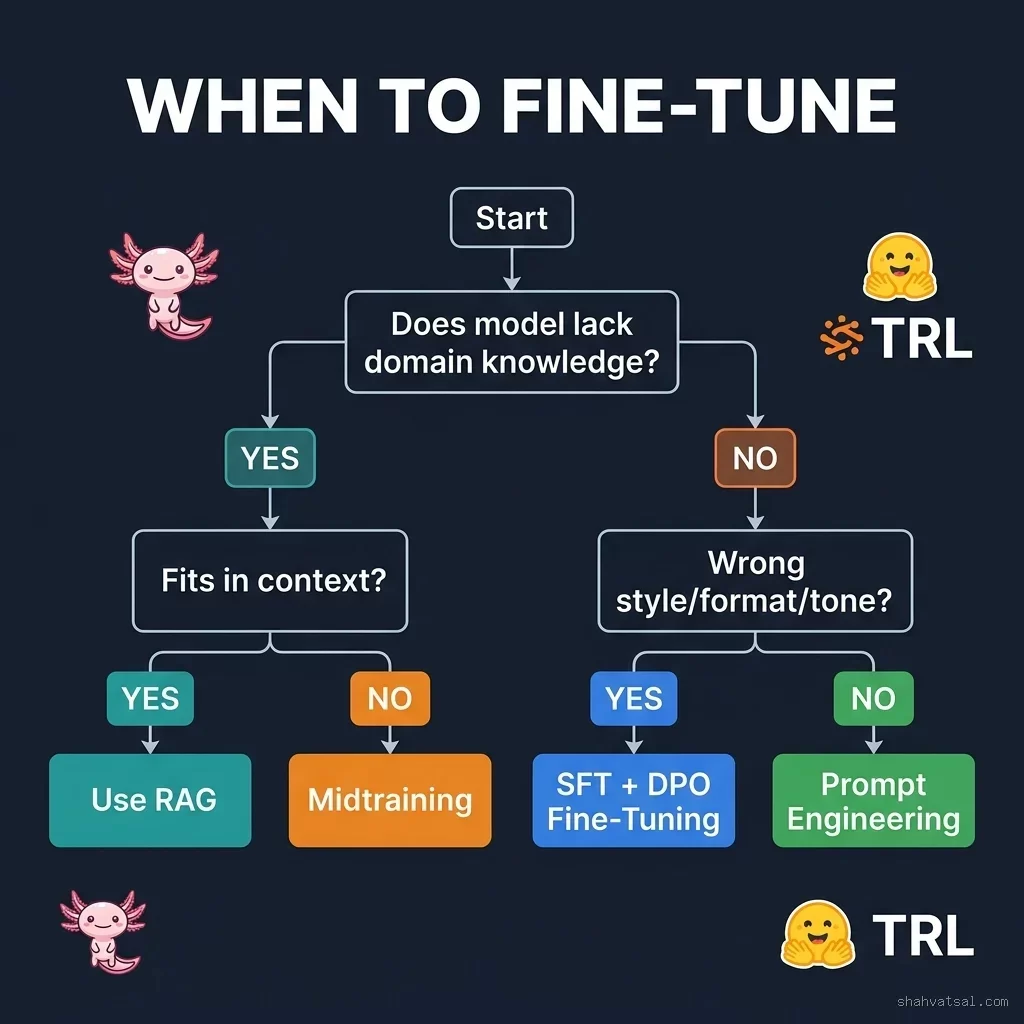
Before starting any training run, apply the Model Customization Hierarchy. This is harder than it looks — most teams skip this step and burn GPU budget fine-tuning models when better prompting would have solved the problem in a day.
When to Use Prompting
Use prompt engineering first. Always. It's fast, zero-cost, and reversible. If you can solve your task with a well-crafted system prompt and a few examples (few-shot), stop there. Prompting is underrated by teams eager to start "doing AI engineering."
When to Use RAG
When the information you need changes frequently (daily news, live pricing, updated regulations), embedding it into model weights via fine-tuning is the wrong approach. RAG retrieves fresh, authoritative context at inference time. It's ideal for knowledge-intensive tasks where freshness beats latency.
When to Use Fine-Tuning (SFT + DPO)
Fine-tune when:
- The model's output format is consistently wrong and prompting can't fix it.
- You need deterministic output structure (JSON schema, API response format).
- You want to reduce latency by eliminating multi-shot examples from every prompt (replacing them with baked-in model behavior).
- Task-specific reliability requirements exceed 99% and prompting fluctuates.
When to Use Continued Pretraining (Midtraining)
Midtraining is expensive and slow. Use it only when you need to teach the model vast new unstructured domain corpora — typically more than 10 billion tokens — that context windows cannot accommodate. Think: building a specialized medical foundation model from scratch using private clinical notes at scale.
LoRA, QLoRA, and Full Fine-Tuning: Architecture and Trade-offs
LoRA (Low-Rank Adaptation)
LoRA, introduced by Hu et al. at Microsoft, is the most important innovation in practical fine-tuning. Instead of updating all 70 billion parameters of a foundation model, LoRA injects small, trainable low-rank matrices into the model's attention layers. The math is elegant:
For a weight matrix $W \in \mathbb{R}^{d \times d}$, LoRA decomposes the update as:
$$W' = W + \Delta W = W + BA$$
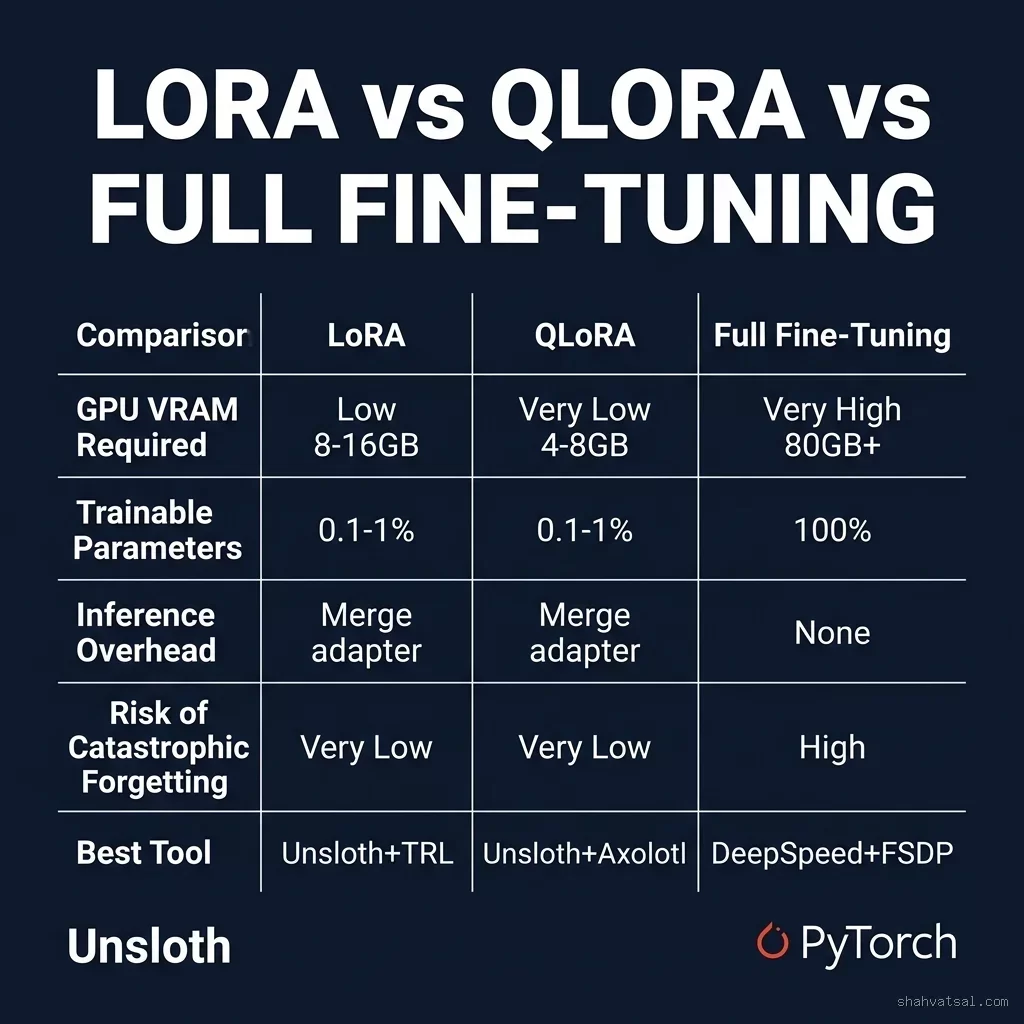
where $B \in \mathbb{R}^{d \times r}$ and $A \in \mathbb{R}^{r \times d}$, with rank $r \ll d$. Setting $r=16$ on a 7B model means training approximately 0.5% of the total parameters — while the original weights remain completely frozen.
The practical impact: you can fine-tune a 7B model with 8 hours of training on a single RTX 4090 (24GB VRAM) on consumer hardware. No datacenter required.
QLoRA (Quantized LoRA)
QLoRA, introduced by Dettmers et al., extends LoRA by additionally quantizing the frozen base model weights to 4-bit NormalFloat (NF4) during training. This reduces the base model's memory footprint by ~75%, allowing a 70B model to be fine-tuned on a single A100 80GB GPU.
Key QLoRA innovations:
- 4-bit NF4 quantization: Information-theoretically optimal for normally distributed model weights.
- Double quantization: Quantizes the quantization constants themselves for additional memory savings.
- Paged optimizers: Offloads optimizer states to CPU RAM during gradient spikes to prevent out-of-memory crashes.
Full Parameter Fine-Tuning
Full fine-tuning updates every single weight in the model. It's the highest-capacity approach and produces the best results when you have massive, high-quality datasets (>100K examples) and the GPU budget for it. In 2026, this typically requires DeepSpeed ZeRO-3 or FSDP (Fully Sharded Data Parallel) across 8+ A100/H100 GPUs for 70B+ models.
The realistic enterprise scenario: use LoRA or QLoRA for 95% of fine-tuning tasks. Reserve full fine-tuning for flagship domain model initiatives with dedicated ML infrastructure teams.
GRPO for Reasoning Agents: Beyond PPO and DPO
DeepSeek-R1's release in early 2025 sent shockwaves through the AI community — not just because of its reasoning performance, but because of what powered it: Group Relative Policy Optimization (GRPO).
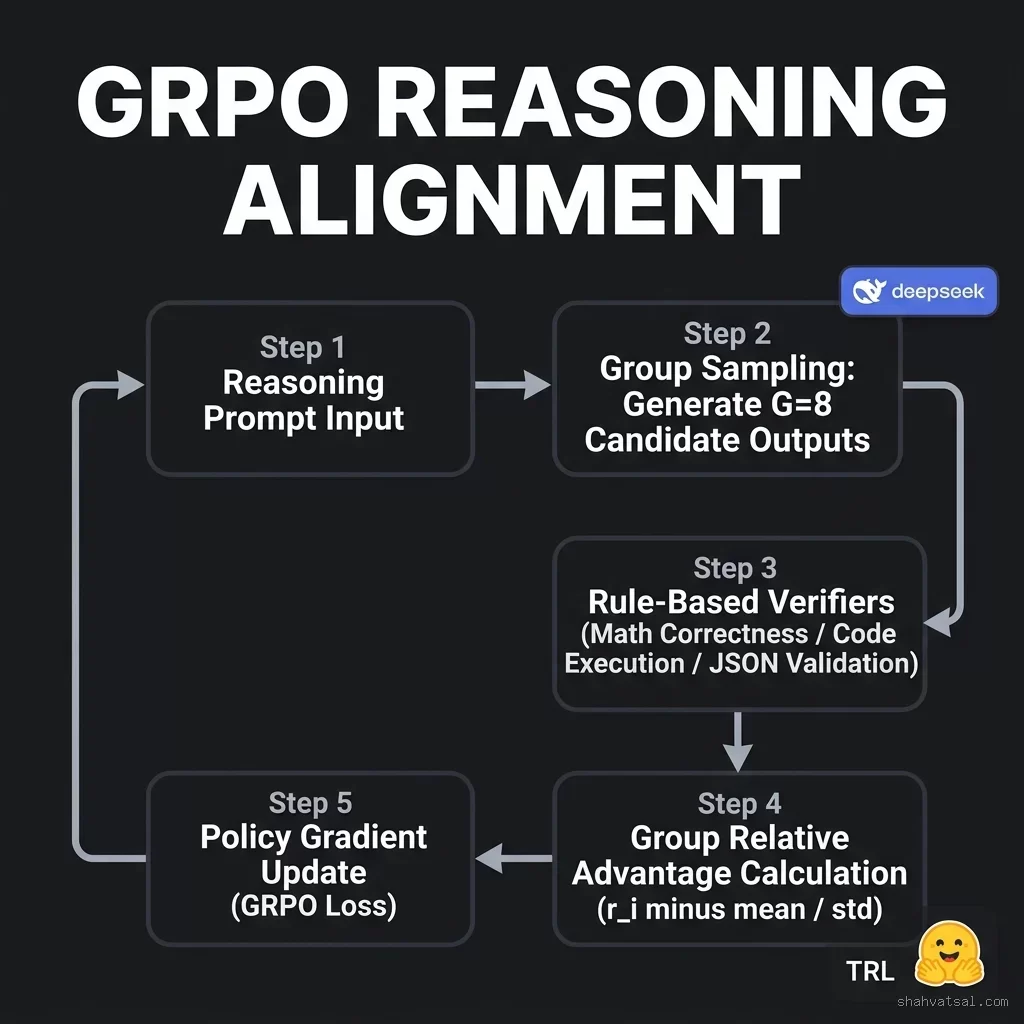
GRPO is a reinforcement learning algorithm designed specifically for training reasoning models. It's the alignment method behind DeepSeek-R1, Qwen-3-235B's reasoning capabilities, and a growing number of enterprise "thinking model" fine-tunes in 2026.
Why GRPO Wins for Reasoning
Traditional RLHF (PPO) requires four neural networks in VRAM simultaneously: Actor, Critic, Reference, and Value. The Critic (Value Model) alone adds 100% memory overhead. For a 70B model, that's 280GB+ VRAM just for training.
GRPO eliminates the Critic. Instead, for each prompt $x$, it generates a group of $G$ completions $\{o_1, o_2, \ldots, o_G\}$ and scores each with a rule-based verifier (e.g., a Python execution harness checking if the code runs, or a math checker verifying the final answer). The advantage of each output is computed relative to the group:
$$A_i = \frac{r_i - \text{mean}(\{r_1, \ldots, r_G\})}{\text{std}(\{r_1, \ldots, r_G\})}$$
This group-normalized advantage replaces the Critic entirely — with zero additional neural network overhead. GRPO requires only 1.5× model weights in VRAM vs PPO's 4×.
Practical GRPO Use Cases in 2026
- Mathematical Problem-Solving Agents: Reward function = final answer correctness. No human annotation required.
- Code Generation Agents: Reward function = code execution success + test suite pass rate.
- SQL Generation Agents: Reward function = SQL execution against test database + expected row count match.
- Structured Data Extraction: Reward function = JSON schema validation + field completeness score.
Domain-Specific Fine-Tuning: Healthcare, Legal, and Finance
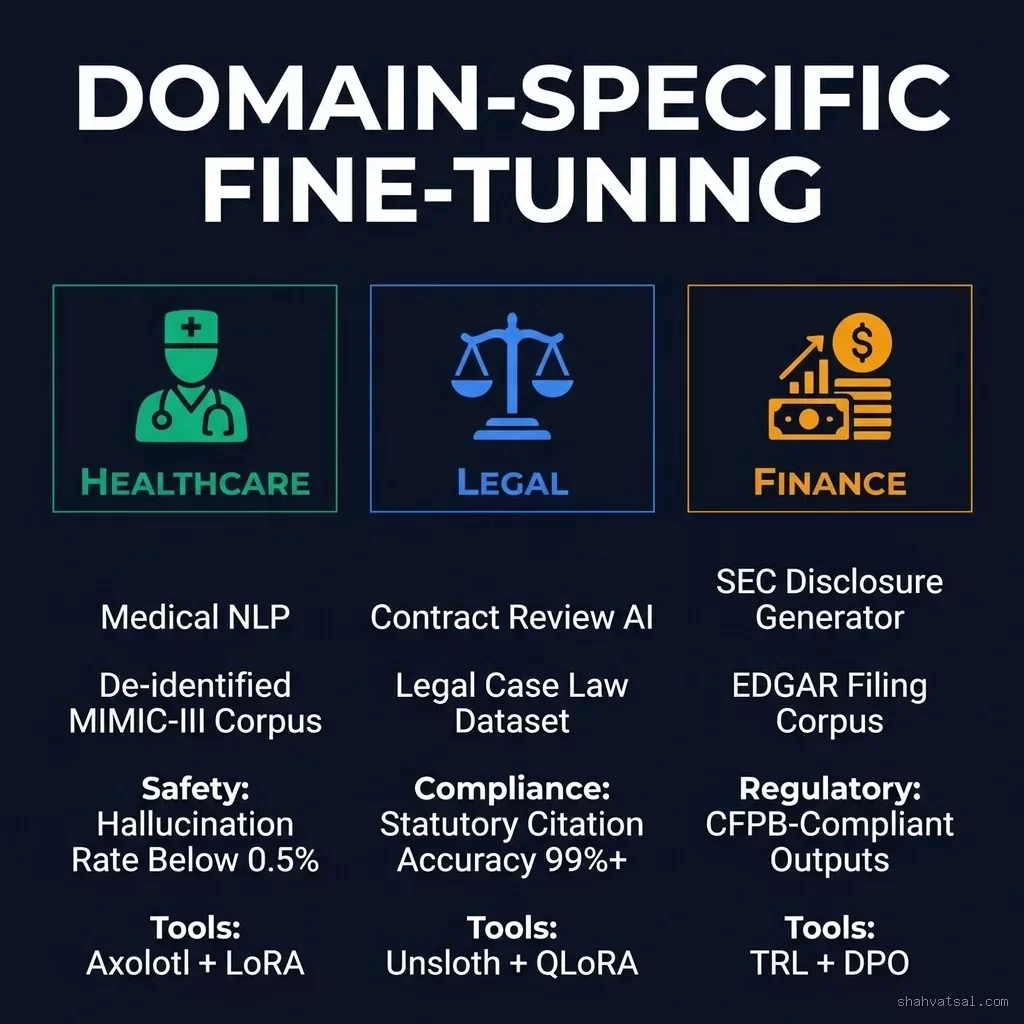
Generic fine-tuning gives generic results. The real enterprise value comes from domain-specific fine-tuning with validated, high-quality instruction datasets that encode the actual task requirements of regulated industries.
Healthcare: Medical NLP with Safety Constraints
Healthcare fine-tuning operates under strict safety and privacy requirements. You don't train on raw patient data — you train on de-identified corpora (MIMIC-III, PubMed full-text, clinical guidelines) formatted into instruction pairs.
The critical validation metric isn't accuracy — it's hallucination rate on clinical facts. A general-purpose model might produce a plausible-sounding drug interaction warning that's completely fabricated. An acceptable hallucination rate for clinical AI assistants is below 0.5% on drug dosage and contraindication tasks.
What works: Axolotl + LoRA on Llama-3.1-8B with a dual-stage training pipeline: (1) SFT on 50K medical Q&A pairs from MedQA and PubMedQA, then (2) DPO alignment using physician-reviewed preference pairs for safe response formulation.
Legal: Contract Analysis with Statutory Citation Accuracy
Legal AI requires the model to cite specific sections of legislation, contracts, or precedent — with zero tolerance for fabricated citations. A legal AI assistant that hallucinates a non-existent court ruling is a liability, not a tool.
Fine-tuning approach: Unsloth + QLoRA on Mistral-7B-v0.3 using a custom 30K-pair instruction dataset built from:
- Public legal briefs (PACER + CourtListener)
- SEC and EDGAR filing templates
- Manually curated statutory cross-reference pairs
Finance: SEC Disclosure Generation with Regulatory Compliance
SEC-regulated financial disclosures must use precise language that complies with Regulation FD, Rule 10b-5, and Item 303 of Regulation S-K. Generic language models frequently violate these constraints by including forward-looking statements without required safe-harbor language.
TRL + DPO fine-tuning on a curated EDGAR corpus, with a Constitutional AI critique layer checking every generated output against SEC disclosure rules before including it in the preference dataset.
Continuous Local Learning via Harness-Validated Traces
One of the most underexplored fine-tuning patterns in 2026 is continuous local learning — where your production AI agent automatically generates new training data from its own successful executions.
The pattern works like this:
- Production Agent Runs: A deployed fine-tuned agent processes real user tasks.
- Harness Validation: Each output passes through an automated test harness (schema validator, logic checker, human approval queue).
- Trace Collection: Approved traces (
- Nightly Micro-Fine-Tune: Every 24–48 hours, a lightweight LoRA adapter update runs on the accumulated approved traces using Unsloth + TRL.
- Adapter Hot-Swap: The updated LoRA adapter is hot-swapped into the production serving stack (Predibase or vLLM) with zero downtime.
Cost Analysis: Fine-Tune Once vs Frontier Model Inference at Scale
The economics of fine-tuning become compelling at scale. Here's a real-world cost comparison for a document classification pipeline processing 200 million tokens per day:
| Cost Vector | GPT-4o (Frontier API) | Fine-Tuned Llama-3.1-8B |
|---|---|---|
| Inference Cost (per day) | ~$3,000–$6,000 | ~$12–$25 (A100 amortized) |
| Inference Cost (annual) | $1.1M–$2.2M | $4,380–$9,125 |
| One-time Fine-Tuning Cost | $0 | $200–$800 (QLoRA training run) |
| Total Year-1 Cost | $1.1M–$2.2M | $4,580–$9,925 |
| Annual Savings (Year 2+) | — | $1.09M–$2.19M |
| Task Accuracy | Baseline (100%) | 92–98% (task-specific) |
The Modern Toolchain: Axolotl, Unsloth, TRL, Modal, and Predibase
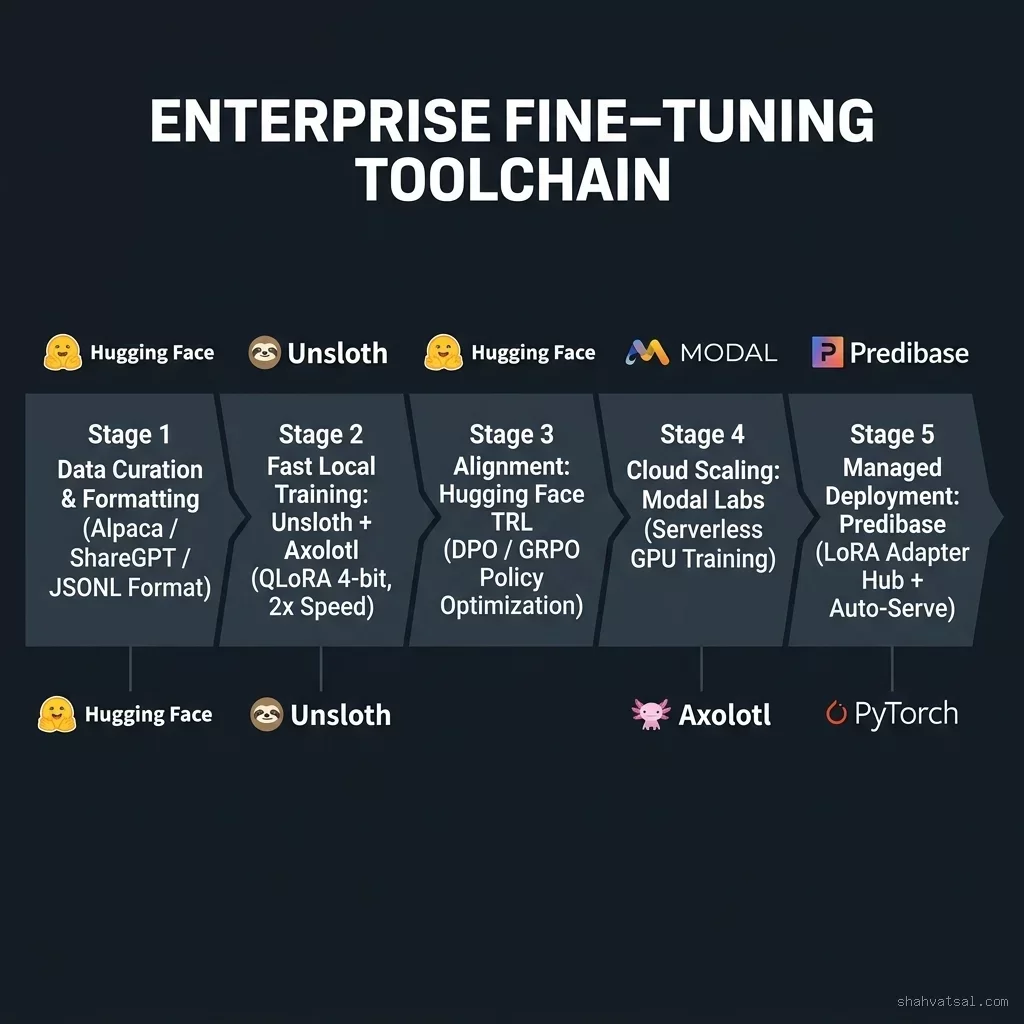
1. Axolotl — Configuration-Driven SFT
Axolotl is a YAML-based fine-tuning orchestration framework that wraps Hugging Face Transformers, PEFT, and TRL into a declarative configuration format. It handles dataset formatting (Alpaca, ShareGPT, JSONL), training loop setup, and distributed training configuration without requiring custom Python code.
Best for: teams running many fine-tuning experiments who want reproducible, config-driven workflows.
2. Unsloth — 2× Speed, 80% Less Memory
Unsloth's custom Triton GPU kernels rewrite the attention and gradient computation paths for LoRA/QLoRA training. In benchmarks on Llama-3.1-8B QLoRA, Unsloth achieves 2.4× training speed and 80% VRAM reduction compared to standard PEFT + Transformers.
Best for: resource-constrained environments (single GPU workstations), fast experimentation cycles.
3. Hugging Face TRL — Alignment at Production Quality
TRL (Transformer Reinforcement Learning) is the standard library for SFT, DPO, GRPO, and PPO alignment. Its SFTTrainer, DPOTrainer, and GRPOTrainer abstractions handle all the mathematical complexity of alignment algorithms with full peft and accelerate integration.
4. Modal Labs — Serverless GPU Training at Scale
Modal provides serverless GPU infrastructure that runs Python training functions in cloud containers with H100 GPUs on-demand. You define your training function in Python, decorate it with @modal.function(gpu="H100"), and Modal handles provisioning, scaling, and cost management. No YAML, no Kubernetes, no DevOps.
Best for: teams with bursty training needs who don't want to maintain GPU clusters.
5. Predibase — Managed LoRA Serving
Predibase is a managed ML platform built specifically for fine-tuned model deployment. It stores LoRA adapters in a centralized hub and serves them dynamically on top of shared base models — the same architecture pattern as turboloRA. This means 50+ domain-adapted models can run simultaneously on a single GPU cluster, each served via their LoRA adapter overlay.
Production Python Code: QLoRA Fine-Tuning with Unsloth + TRL
Complete production-ready Python script for QLoRA SFT using Unsloth and Hugging Face TRL:
from unsloth import FastLanguageModel
from trl import SFTTrainer, SFTConfig
from datasets import load_dataset
import torch

def run_qlora_sft(
    model_id: str = "unsloth/Meta-Llama-3.1-8B-Instruct-bnb-4bit",
    dataset_name: str = "philschmid/guanaco-sharegpt-style",
    output_dir: str = "./llama31_qlora_domain",
    max_seq_length: int = 2048,
    rank: int = 16,
    lora_alpha: int = 32,
    num_epochs: int = 1,
):
    """
    Production QLoRA Supervised Fine-Tuning using Unsloth + TRL.
    ~2x faster than standard PEFT, 80% less VRAM via 4-bit NF4 quantization.
    """
    print(f"[+] Loading 4-bit quantized model: {model_id}")

    # 1. Load 4-bit quantized model + tokenizer via Unsloth
    model, tokenizer = FastLanguageModel.from_pretrained(
        model_name=model_id,
        max_seq_length=max_seq_length,
        dtype=None,             # Auto-detect: bfloat16 on Ampere+, float16 on older GPUs
        load_in_4bit=True,      # QLoRA 4-bit NF4 quantization
    )

    # 2. Inject LoRA adapters via Unsloth get_peft_model
    model = FastLanguageModel.get_peft_model(
        model,
        r=rank,
        target_modules=["q_proj", "k_proj", "v_proj", "o_proj",
                        "gate_proj", "up_proj", "down_proj"],
        lora_alpha=lora_alpha,
        lora_dropout=0,          # Unsloth optimized: 0 dropout for speed
        bias="none",
        use_gradient_checkpointing="unsloth",  # Unsloth's custom checkpointing
        random_state=42,
        use_rslora=False,        # Rank-stabilized LoRA (set True for r>=64)
    )

    # 3. Load and prepare instruction dataset
    print(f"[+] Loading dataset: {dataset_name}")
    dataset = load_dataset(dataset_name, split="train")

    # 4. Configure SFT training hyperparameters
    sft_config = SFTConfig(
        output_dir=output_dir,
        per_device_train_batch_size=2,
        gradient_accumulation_steps=4,
        warmup_steps=5,
        num_train_epochs=num_epochs,
        learning_rate=2e-4,
        fp16=not torch.cuda.is_bf16_supported(),
        bf16=torch.cuda.is_bf16_supported(),
        logging_steps=1,
        optim="adamw_8bit",         # 8-bit AdamW for further memory savings
        weight_decay=0.01,
        lr_scheduler_type="linear",
        seed=42,
        max_seq_length=max_seq_length,
        dataset_text_field="text",
        packing=False,              # True for datasets with short sequences
    )

    # 5. Initialize SFT Trainer
    trainer = SFTTrainer(
        model=model,
        tokenizer=tokenizer,
        train_dataset=dataset,
        args=sft_config,
    )

    # 6. Train
    print("[+] Starting QLoRA SFT training...")
    trainer.train()

    # 7. Save LoRA adapter (not full model — adapter only is ~100MB)
    model.save_pretrained(f"{output_dir}/final_adapter")
    tokenizer.save_pretrained(f"{output_dir}/final_adapter")
    print(f"[SUCCESS] LoRA adapter saved to {output_dir}/final_adapter")

    # 8. Optionally merge adapter into base model for deployment
    # model.save_pretrained_merged(f"{output_dir}/merged", tokenizer, save_method="merged_16bit")

if __name__ == "__main__":
    run_qlora_sft()
Deep Analysis: Fine-Tuning Method Decision Matrix
| Method | Training Params | Min VRAM (7B model) | Forgetting Risk | Best Tool 2026 | Enterprise Use Case |
|---|---|---|---|---|---|
| LoRA | ~0.5% of total | 16 GB | Very Low | Unsloth + TRL | SFT + DPO for format, tone, domain |
| QLoRA | ~0.5% of total | 6–8 GB | Very Low | Unsloth + Axolotl | Consumer GPU fine-tuning, 70B models |
| Full Fine-Tuning | 100% of total | 140 GB+ (8×A100) | High | DeepSpeed ZeRO-3 / FSDP | Flagship domain models, 100K+ datasets |
| GRPO | LoRA or Full | 1.5× model weights | Low | TRL GRPOTrainer | Reasoning, math, code verification agents |
| Midtraining | 100% of total | 256 GB+ (multi-node) | Medium | Megatron-LM / NeMo | Proprietary domain foundation models only |
Pitfalls and Anti-Patterns
The thing most teams get wrong: they treat fine-tuning as a black box. They collect some data, run a training script, get a lower loss number, and declare success — without validating on the actual production task.
Anti-Pattern 1: Evaluating on Training Loss Instead of Task Accuracy Low training loss does not mean good task performance. Always maintain a held-out eval set and measure task-specific metrics (F1, hallucination rate, format compliance rate) — not just perplexity.
Anti-Pattern 2: Training on Too-Small Datasets Fine-tuning a 7B model on fewer than 500 examples produces unstable, overfitted adapters. In practice, 2,000–10,000 high-quality instruction pairs is the minimum viable dataset for robust LoRA fine-tuning.
Anti-Pattern 3: Skipping SFT and Going Straight to RLHF Reinforcement learning algorithms (PPO, GRPO) require the policy model to already understand instruction following. Applying GRPO to a raw base model produces incoherent outputs. SFT is always the mandatory first step.
Anti-Pattern 4: Forgetting to Validate Data Quality One of the most common failure modes: training on a dataset that contains 5–10% incorrectly formatted or factually wrong examples. The model will learn and replicate those errors with high confidence. Always audit your dataset before training.
2027–2030 Roadmap: The Future of Fine-Tuning
Fine-tuning is not static. Here's where the discipline is heading:
- 2027: Automated Dataset Generation Pipelines: Constitutional AI and synthetic data generation (using frontier models to generate instruction pairs) will replace manual data curation for most fine-tuning tasks. Practitioners will define task specifications; AI pipelines will generate the training data.
- 2027: Real-Time Adapter Personalization: Production systems will fine-tune lightweight personal LoRA adapters for individual users based on their interaction history, stored and served via Predibase-style adapter registries.
- 2028: Test-Time Fine-Tuning: Models will update adapter weights during inference on-the-fly — learning from each user session without full retraining loops.
- 2029: On-Device Fine-Tuning: Consumer devices (phones, laptops) will run localized micro-fine-tuning on user-specific data using efficient SLM architectures and 2-bit quantization.
- 2030: Autonomous Fine-Tuning Agents: Orchestration platforms will deploy autonomous agents that monitor production model performance, identify degradation patterns, curate corrective training data, and trigger fine-tuning runs — all without human intervention.
Key Takeaways
- Fine-tuning is economically dominant at scale: A domain-tuned 8B model costs 2–5% of GPT-4o inference for equivalent task-specific accuracy.
- Use the decision hierarchy first: Prompting → RAG → SFT → DPO → Midtraining. Most teams jump to fine-tuning when better prompting would have been sufficient.
- LoRA / QLoRA is the enterprise default: 0.5% of parameters trained, 80% VRAM reduction, negligible forgetting risk. Full fine-tuning reserved for flagship domain model initiatives only.
- GRPO unlocks reasoning alignment without a Critic model: 1.5× memory footprint vs PPO's 4×, with rule-based verifiers replacing learned reward models.
- Unsloth + TRL is the fastest path to production: 2× training speed on a single GPU, with full SFT, DPO, and GRPO support.
- Validate on task metrics, not loss: Low training loss does not guarantee good real-world performance. Maintain rigorous held-out eval sets.
FAQ
About the Author
Vatsal Shah is a technology leader, AI systems architect, and ML engineering advisor specializing in enterprise LLM deployment, fine-tuning pipelines, and scalable AI infrastructure. He has led post-training and alignment engineering initiatives across regulated industries including healthcare, legal, and financial services. Read more at shahvatsal.com.
Conclusion & CTA
The LLM Fine-Tuning Renaissance is real, and it's delivering results. LoRA and QLoRA have made parameter-efficient fine-tuning accessible on a single GPU. GRPO has unlocked reinforcement learning for reasoning agents without the infrastructure overhead of PPO. And the toolchain — Axolotl, Unsloth, TRL, Modal, Predibase — has matured to the point where a two-person ML engineering team can run production-grade fine-tuning pipelines end to end.
The question isn't whether to fine-tune. It's whether your team has the domain data, validation infrastructure, and toolchain expertise to do it right.
Ready to build domain-specific fine-tuning pipelines for your production LLMs? Schedule an ML Engineering Strategy Review →