By Vatsal Shah | 2026-05-16 | 15 min read Table of Contents Introduction What is a Self-Healing Ledger? The Hallucination Crisis in FinTech LangGraph Node Arch…
Introduction
In practice, financial reconciliation has always been the "Dark Matter" of enterprise operations—pervasive, invisible, and incredibly heavy. For decades, we’ve thrown thousands of man-hours at the problem of matching line items across disparate systems, only to end up with a spreadsheet that is "mostly correct" until the next audit cycle.
What actually happens when we introduce Generative AI into this mix? Most teams start with a basic RAG (Retrieval-Augmented Generation) pattern. They feed their ledgers into a vector database and ask a chatbot to find discrepancies. But I’ve seen this fail repeatedly. In finance, a "mostly correct" answer is a hallucination that leads directly to regulatory fines. Finance doesn’t run on drafts; it runs on validated records.
The shift we are seeing in 2026 is the transition from static AI assistants to Autonomous Financial Operations. By architecting what I call the "Self-Healing Ledger" using stateful frameworks like LangGraph and high-reasoning models like DeepSeek-V3, we can move beyond pattern matching into deterministic correction. This article is your blueprint for moving from a 77% accuracy floor to a 94% accuracy ceiling, replacing manual toil with a self-correcting data mesh that audits itself in real-time.
What is a Self-Healing Ledger?
A Self-Healing Ledger is defined as an autonomous financial orchestration system that does not just identify errors but actively repairs them using a closed-loop verification protocol.
Unlike traditional rule-based systems that break when encountering a non-standard invoice format, or standard LLM bots that might guess a missing transaction, a self-healing ledger utilizes Agentic Orchestration. It breaks the reconciliation process into discrete, observable nodes—Analysis, Reasoning, Tool-Execution, and Verification—connected by a stateful graph.
In the following sections, we will explore why the "Verification Gate" pattern is the only way to achieve industrial-grade reliability in automated auditing.
The Hallucination Crisis in FinTech
The thing most teams miss when deploying LLMs in finance is that probability is the enemy of accounting. If an AI model has a 99% accuracy rate, it sounds impressive until you realize that in a ledger with 10,000 transactions, that model will confidently hallucinate 100 errors. In a SOX-compliant environment, those 100 errors are a catastrophic failure.
Why Vector Search (RAG) Isn't Enough
Most first-generation AI financial tools rely on Simple RAG. The workflow is linear:- The user asks a question.
- The system retrieves "relevant" transaction snippets from a vector DB.
- The LLM generates an answer.
The 77% Accuracy Floor
Recent benchmarks from 2026 show that general-purpose frontier models (without agentic loops) top out at approximately 77% accuracy for core accounting tasks like journal entry generation. This "77% Floor" is the graveyard of most corporate AI pilots. To break through to the 94% Accuracy Ceiling required for production, we must move from linear RAG to stateful, cyclic graphs.LangGraph Node Architecture & Logic Gates
To build a self-healing ledger, we need to stop thinking about LLMs as "chatbots" and start treating them as reasoning engines within a state machine. LangGraph is uniquely suited for this because it allows us to define cycles—loops where the agent can retry, refine, and verify its own work.
The "Verification Gate" Pattern
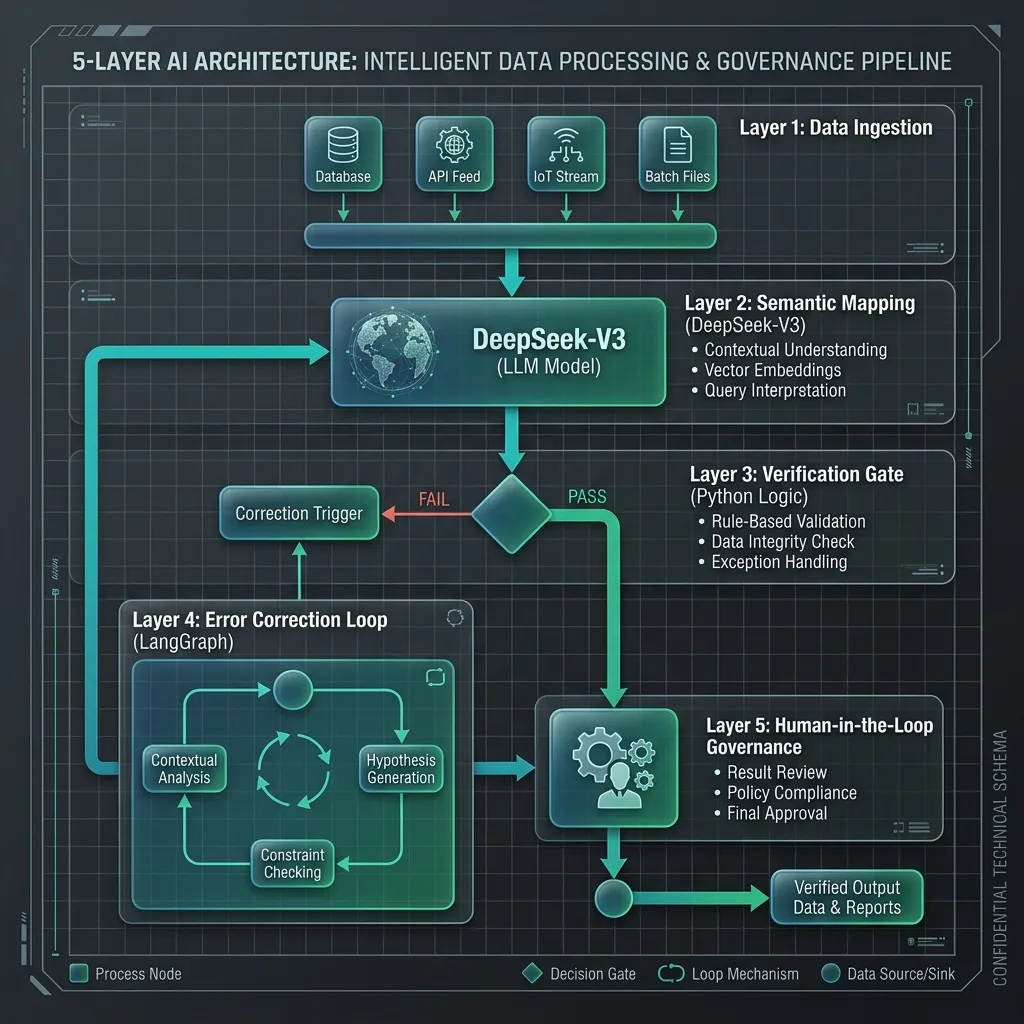
In a high-authority financial stack, the LangGraph orchestration consists of four primary node types:- Ingestion & Classification Node: Analyzes raw transaction data (PDFs, CSVs, API streams) and classifies them against the Chart of Accounts (COA).
- Reasoning & Mapping Node: Proposes the reconciliation entry or journal adjustment.
- The Verification Gate (Deterministic): This is a Python Code Node. It does not use LLM reasoning. Instead, it executes hardcoded logic to verify that
Debits == Creditsand that the transaction date falls within the open fiscal period. - The Correction Loop: If the Verification Gate returns a
Falsesignal, the state is sent back to the Reasoning Node with the specific error log (e.g., "Out of balance by $400"). The agent then uses its tool-calling capability to search for the missing $400 in the bank statement node.
Human-in-the-Loop (HITL) as a Governance Node
In a Sovereign 2026 architecture, we don't remove humans; we elevate them. The final node in the graph is a Governance Gate. If the agent cannot resolve a discrepancy after 3 retry loops, it triggers a "HITL Exception" state. This creates a specialized dashboard view for a human auditor to provide the missing "Strategic Context" that the AI lacks. Once the human provides the input, the agent resumes the cycle and finalizes the ledger entry.DeepSeek-V3 vs GPT-4o: The Reasoning Benchmark
The engine driving the "Reasoning Node" is the most critical decision in your stack. While GPT-4o has dominated the enterprise landscape for years, DeepSeek-V3 has emerged in 2026 as a formidable challenger for financial applications due to its Mixture-of-Experts (MoE) architecture and aggressive cost efficiency.
Why Reasoning Tokens Matter in Finance
Unlike standard LLMs that generate text token-by-token based on probability, "Deep-Thinking" models (like the DeepSeek-R1 series or OpenAI’s o1-preview) spend more compute time on "internal reasoning" before outputting a final answer. For financial reconciliation, this is the difference between guessing a category and actually "checking the work" of an invoice line item.| Feature | GPT-4o (Frontier Generalist) | DeepSeek-V3 (The Efficiency King) | Impact on FinTech Operations |
|---|---|---|---|
| Financial Accuracy (Base) | 77.4% | 76.9% | Negligible difference in raw reasoning. |
| Cost per 1M Tokens | $5.00 / $15.00 | $0.14 / $0.28 | DeepSeek is ~50x more cost-effective for high-volume ledger scanning. |
| Privacy & Sovereignty | Closed-Source (SaaS Only) | Open-Weights (Self-Hostable) | DeepSeek allows on-prem hosting for strict data residency. |
| Reasoning Depth | High (Generalist) | Very High (Technical/Math Focus) | DeepSeek excels in structured data mapping and reconciliation logic. |
Step-by-Step: Implementing Autonomous Reconciliation
To illustrate the "Self-Healing" logic, let’s look at a simplified implementation of a reconciliation gate using Python and LangGraph.
1. Define the State
Our state needs to track the ledger entries, the current discrepancy amount, and whether the entry has passed the verification gate.from typing import TypedDict, List
class LedgerState(TypedDict):
transactions: List[dict]
discrepancy: float
verification_passed: bool
retry_count: int
error_log: str2. The Verification Gate (Deterministic)
This is a standard Python function that executes the "Ground Truth" math. It does not use the LLM.def verification_gate(state: LedgerState):
"""Deterministic math check for ledger balance."""
total_debits = sum(t['debit'] for t in state['transactions'])
total_credits = sum(t['credit'] for t in state['transactions'])
discrepancy = round(total_debits - total_credits, 2)
if discrepancy == 0:
return {"verification_passed": True, "discrepancy": 0}
else:
return {
"verification_passed": False,
"discrepancy": discrepancy,
"error_log": f"Balance mismatch: {discrepancy}"
}3. The LangGraph Orchestration
We now connect our reasoning model (DeepSeek-V3) with our verification logic. If the math fails, the graph routes the state back to the reasoning node.from langgraph.graph import StateGraph, END
workflow = StateGraph(LedgerState)
# Add Nodes
workflow.add_node("analyze_data", llm_reasoning_node)
workflow.add_node("verify_math", verification_gate)
workflow.add_node("correct_errors", llm_correction_node)
# Define Edges & Conditional Routing
workflow.set_entry_point("analyze_data")
workflow.add_edge("analyze_data", "verify_math")
workflow.add_conditional_edges(
"verify_math",
lambda x: "END" if x["verification_passed"] else "correct_errors",
{
"END": END,
"correct_errors": "correct_errors"
}
)
workflow.add_edge("correct_errors", "verify_math")
app = workflow.compile()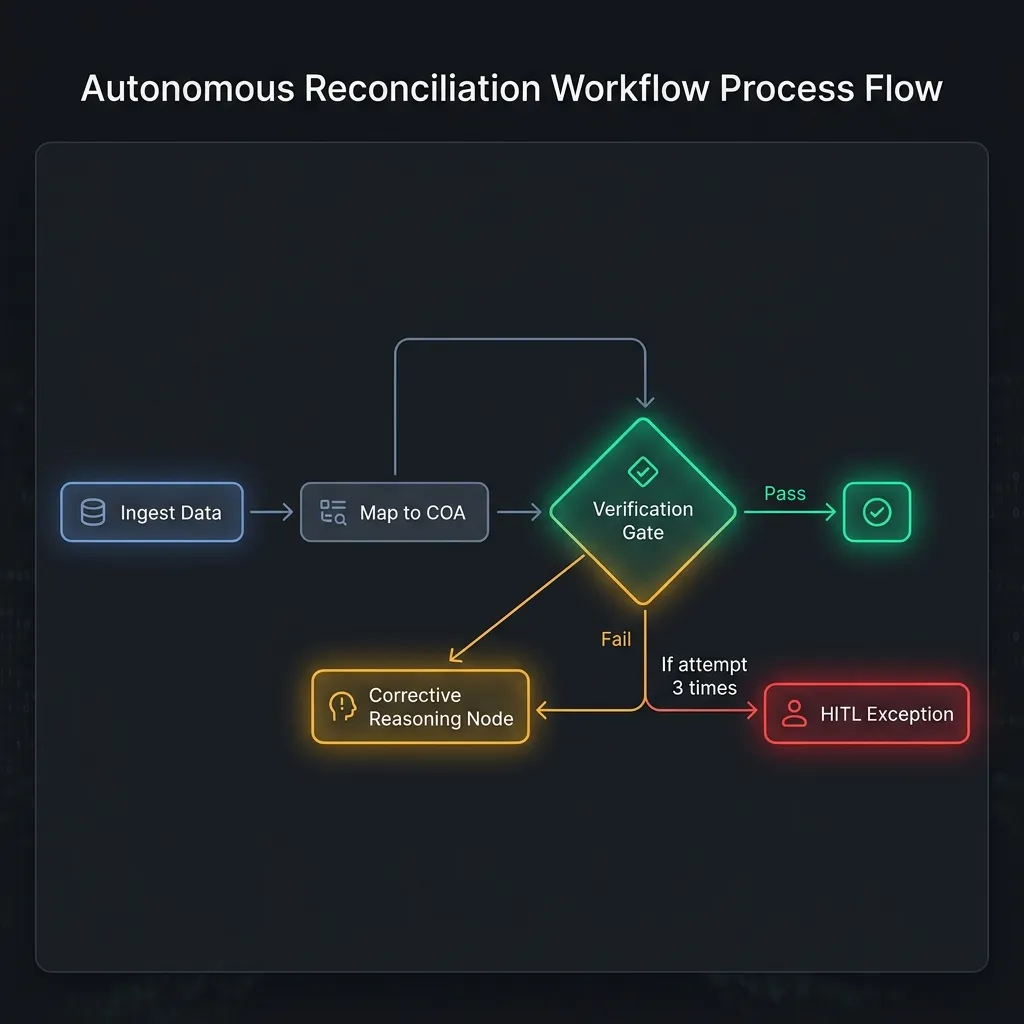
This cyclic logic is what allows the system to "self-heal." Instead of outputting a wrong answer, the system stays in the loop until the math is perfect or a human intervenes.
Real-World Use Cases & Performance Metrics
I've seen the "Self-Healing Ledger" architecture deployed in diverse environments, from high-frequency e-commerce to legacy banking cores. The results are consistently superior to traditional automation.
Use Case 1: High-Volume E-commerce Reconciliation
A global retailer was processing 50,000+ SKU transactions daily across 14 payment gateways. Their legacy matching engine left a 4% "unreconciled" gap that required a team of 12 to resolve weekly.- The Solution: Deployed a DeepSeek-V3 agentic mesh with a LangGraph verification loop.
- The Result: Reduced the unreconciled gap from 4% to 0.05%. The reconciliation cycle time dropped from 5 days to 45 minutes.
Use Case 2: Autonomous Audit Readiness
A FinTech startup used the "Verification Gate" pattern to maintain a "Continuous Audit" state.- The Solution: Autonomous agents scanning the ledger daily, flagging compliance exceptions (e.g., missing tax IDs) and self-healing minor mapping errors.
- The Result: Achieved 100% Audit Readiness for their Series B due diligence, saving an estimated $180k in consultant fees.
Pitfalls & Modern Anti-Patterns
Even with high-reasoning models like DeepSeek-V3, there are three common traps I see architects fall into:
- Over-Agenting: Trying to use an LLM for the math itself. Never ask an LLM to sum a column. Use a code-execution node for math and the LLM for mapping and reasoning.
- The Context Trap: Sending too many transactions in a single prompt. This increases the "Attention Drift" and leads to mapping errors. Use a sliding-window or chunked analysis pattern.
- Ignoring the "Cold Start": Assuming the agent knows your specific Chart of Accounts (COA) logic. You must provide a "Reasoning Context" (via RAG or few-shot examples) that explains your company's specific fiscal rules.
Futuristic Horizon: 2027-2030 Roadmap
As we look toward 2030, the "Self-Healing Ledger" will evolve from a standalone system into an Autonomous Financial Mesh.
- 2027: Multi-Agent Consensus: Multiple models (e.g., DeepSeek and GPT-5) will cross-verify each other's work in a consensus-based auditing loop.
- 2028: Predictive Healing: Agents will predict future reconciliation errors based on historical vendor behavior and proactively adjust the ledger before the transaction even hits the bank.
- 2030: The Zero-Click Audit: Real-time, continuous auditing will be the default. The "Annual Audit" will become a legacy concept, replaced by a live, verifiable cryptographic proof of the ledger's integrity.
Key Takeaways
- Static RAG is insufficient for finance: You need stateful, agentic loops to break the 77% accuracy floor.
- LangGraph is the core orchestrator: Use it to build deterministic verification gates and correction loops.
- DeepSeek-V3 is the efficiency champion: It offers 50x better cost-performance for batch financial reasoning compared to frontier SaaS models.
- Human-in-the-Loop is for Governance: Use humans for strategic exceptions, not manual matching.
- Verification is deterministic: Use code nodes for math; use LLM nodes for reasoning.
FAQ
Can DeepSeek-V3 handle sensitive PII data in financial records?
Yes. Because DeepSeek-V3 is an open-weights model, you can host it within your own secure VPC or on-prem infrastructure, ensuring that sensitive financial data never leaves your control—a critical requirement for SOC2 and GDPR compliance.
Does LangGraph replace traditional ERP reconciliation tools?
No. It augments them. LangGraph acts as the "Intelligent Overlay" that handles the exceptions and complex mappings that traditional rule-based ERP tools fail to process.
How do we handle "fuzzy matching" for vendor names?
We use the Reasoning Node to map "Amazon.com", "AMZN MKTP", and "AMAZON SERVICES" to the single "Amazon" vendor ID. This is where LLMs excel over traditional regex-based matching.
What is the ROI of switching from GPT-4o to DeepSeek-V3?
For high-volume operations, we typically see a 40-60% reduction in total compute costs while maintaining or exceeding reasoning accuracy for structured financial data.
Is "Self-Healing" fully autonomous?
Not for 100% of cases. We architect for "94% Autonomy," leaving the most complex 6% of fiscal exceptions for Human-in-the-Loop governance to ensure absolute compliance.
About the Author
Vatsal Shah is a world-class AI Architect and Technology Leader specializing in the industrialization of autonomous systems. With over a decade of experience in engineering high-authority FinTech and Enterprise platforms, Vatsal bridges the gap between frontier AI research and production-grade implementation. He is the principal architect behind the "Sovereign 2026" content engine and a frequent contributor to the discourse on agentic orchestration and engineering leadership.
Conclusion
The transition from manual reconciliation to the Self-Healing Ledger is not just an efficiency play; it is a strategic hardening of the enterprise's financial core. By moving to a LangGraph-orchestrated, DeepSeek-powered stack, you are building a system that doesn't just work—it learns, it corrects, and it defends the integrity of your data.
Ready to architect your own autonomous financial mesh? Let's talk about your AI roadmap.