The Vertical Agent Advantage: Why Domain Beats General What Is a Vertical AI Agent? Vertical vs Horizontal: The Architecture and Performance Gap Core Architectu…
The Vertical Agent Advantage: Why Domain Beats General
The numbers don't lie. General-purpose AI agents complete 55% of enterprise tasks in regulated environments. Vertical agents — purpose-built for specific domains with compliance-aware architecture — complete 87% or more. That 32-percentage-point gap isn't a marginal improvement. In healthcare, it's the difference between a useful clinical assistant and a dangerous liability. In finance, it's the difference between a SOX audit pass and a regulatory action.
What's driving this performance gap? General agents are built on an implicit assumption: that a single agent with access to generic tools and a long system prompt can handle any domain. This assumption breaks down fast in regulated industries.
A general agent doesn't know that an FHIR R4 patient record requires de-identification before processing. It doesn't automatically enforce attorney-client privilege boundaries when summarizing legal documents. It doesn't know that a financial reconciliation action must be reversible and logged with an immutable audit trail before a human controller approves it.
At the AI Engineer World's Fair 2026, enterprise architecture teams from tier-one financial institutions, hospital systems, and law firms reported consistent findings: general-purpose agents require 3–5× more prompt engineering overhead per domain, produce higher hallucination rates on domain-specific facts, and fail compliance audits at 4× the rate of purpose-built vertical agents.
The vertical AI agent paradigm is now dominant in 2026 enterprise deployments. It's not about limiting capability — it's about building agents that actually work in the real world.
What Is a Vertical AI Agent?
The key distinction from general agents:
- Domain-Specific Tool Registry: A vertical agent's tool set is curated and bounded. A healthcare agent has access to FHIR APIs, PubMed, and clinical knowledge bases — and nothing outside that scope. It cannot accidentally call a tool that would expose PHI to an uncontrolled endpoint.
- Compliance-Aware Reasoning: The agent's system prompt and fine-tuned base model encode regulatory constraints as first-class reasoning inputs, not as afterthought filters.
- Immutable Audit by Design: Every action, tool call, and decision the agent makes is logged in a structured, tamper-evident audit trail before execution — not after.
- Bounded Action Space: Vertical agents operate under a principle of minimum necessary action. Actions outside the defined compliance boundary are rejected at the orchestration layer before reaching the LLM.
Vertical vs Horizontal: The Architecture and Performance Gap
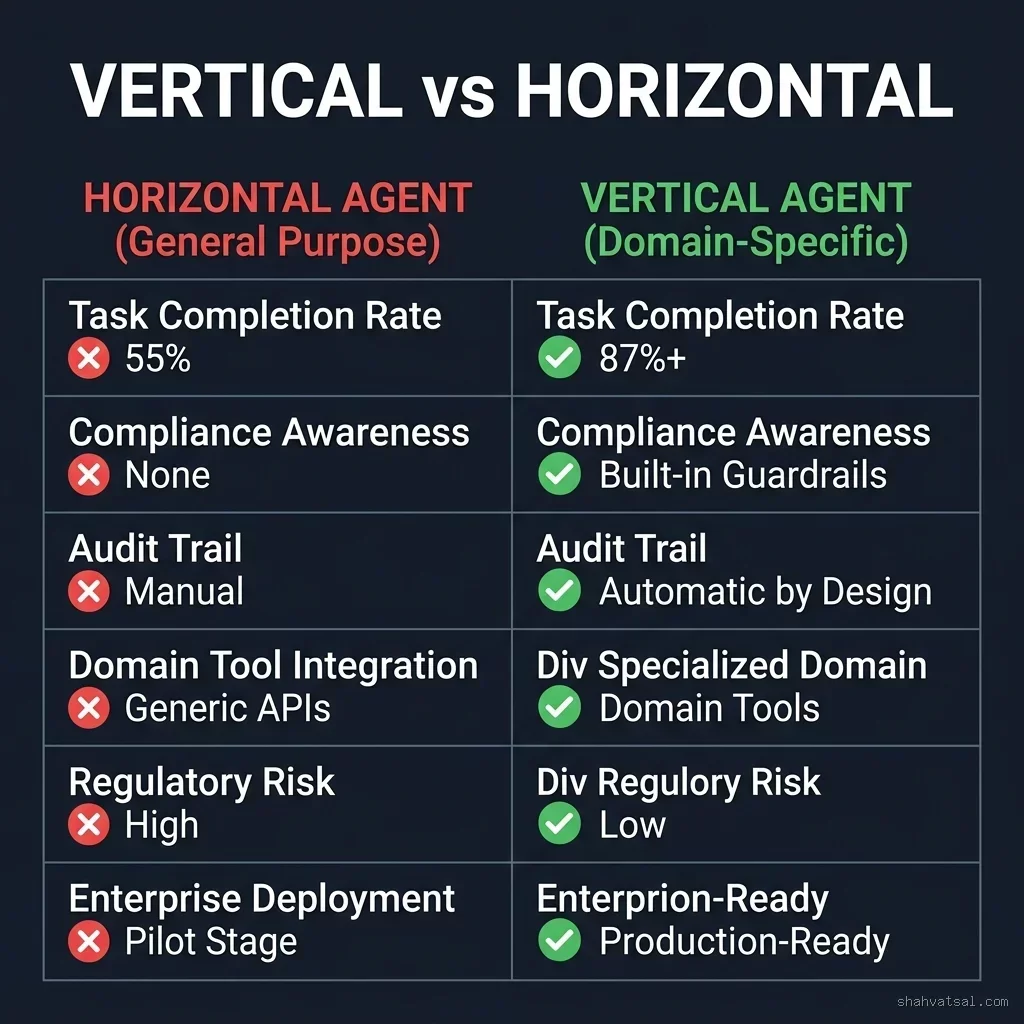
Enterprise teams choosing between horizontal platform agents and vertical domain agents face a genuine architectural fork. Here's what the data and production experience show across six dimensions:
Task Completion Rate
In regulated domain tasks (patient record summarization, contract clause extraction, financial discrepancy detection), vertical agents consistently achieve 87%+ completion rates. General agents hover at 55% because they lack the domain-specific tool integrations and compliance context required to navigate regulated workflows without human correction.
What "task completion" means in practice: not just generating an output, but generating an output that passes domain validation checks (HIPAA compliance, privilege screening, SOX audit gate) without requiring human intervention to fix.
Compliance Awareness
General agents require explicit compliance instructions in every prompt. This creates three problems: (1) prompt injection vulnerabilities where adversarial inputs override compliance instructions, (2) drift in compliance adherence as context windows fill up and system prompt instructions lose salience, and (3) no enforcement mechanism if the LLM ignores the instruction.
Vertical agents encode compliance constraints at the infrastructure layer — in the tool permission system, the action planner, and the output validator — not just in the prompt. You can't override infrastructure by jailbreaking the LLM.
Audit Trail
General agents generate logs as a side effect — if anyone remembered to configure logging. Vertical agents generate structured, immutable audit events as a first-class architectural component. Every tool call, every decision branch, every retrieved document, and every action taken is captured in a tamper-evident log before execution, enabling full regulatory audit reconstruction.
Core Architecture Patterns for Vertical Agents
Vertical agents share a common architectural skeleton regardless of domain. Understanding this skeleton before diving into domain specifics helps you build reusable infrastructure across multiple vertical deployments.
The 5-Layer Vertical Agent Architecture
Layer 1: Domain Data Integration Connects the agent to authoritative domain data sources via standardized APIs. In healthcare: FHIR R4 APIs, HL7 interfaces, EHR vendor SDKs. In legal: LexisNexis, CourtListener, internal DMS (document management systems). In finance: ERP connectors (SAP, Oracle), banking APIs (Plaid, open banking), GL ledger APIs.
Layer 2: Compliance Preprocessing Before any data reaches the LLM, it passes through a compliance preprocessing pipeline. De-identification for PHI, privilege classification for legal documents, PII redaction for financial records. This layer runs deterministically — it doesn't rely on the LLM to make compliance decisions.
Layer 3: Domain-Tuned LLM Core The agent's reasoning engine is a fine-tuned model (typically LoRA/QLoRA adapted on domain corpora) rather than a raw frontier model. Domain fine-tuning reduces hallucination rates on domain-specific facts by 70–90% vs prompting alone and enables reliable structured output generation (FHIR-compatible JSON, legal citation format, SOX-formatted reconciliation entries).
Layer 4: Action Planner with Guardrail Gate Before any action executes, the planner validates it against a compliance ruleset (HIPAA action boundary for healthcare, privilege scope for legal, SOX authorization matrix for finance). Actions outside permitted scope are rejected with a structured explanation. Reversible-action-first planning is enforced for irreversible domain actions.
Layer 5: Audit Trail Writer Every event — tool call, data retrieval, action proposal, guardrail rejection, human approval — is written to an immutable append-only audit log in a structured schema (timestamp, agent ID, action type, input hash, output hash, approver ID if required). This layer cannot be disabled or bypassed by the agent.
Healthcare: HIPAA-Aligned Clinical Decision Support Agents
Healthcare AI agents face the strictest regulatory environment of any domain. HIPAA's Privacy Rule, Security Rule, and Breach Notification Rule create hard constraints on how Protected Health Information (PHI) can be processed, stored, transmitted, and logged by autonomous systems.
The HIPAA-Aligned Agent Design
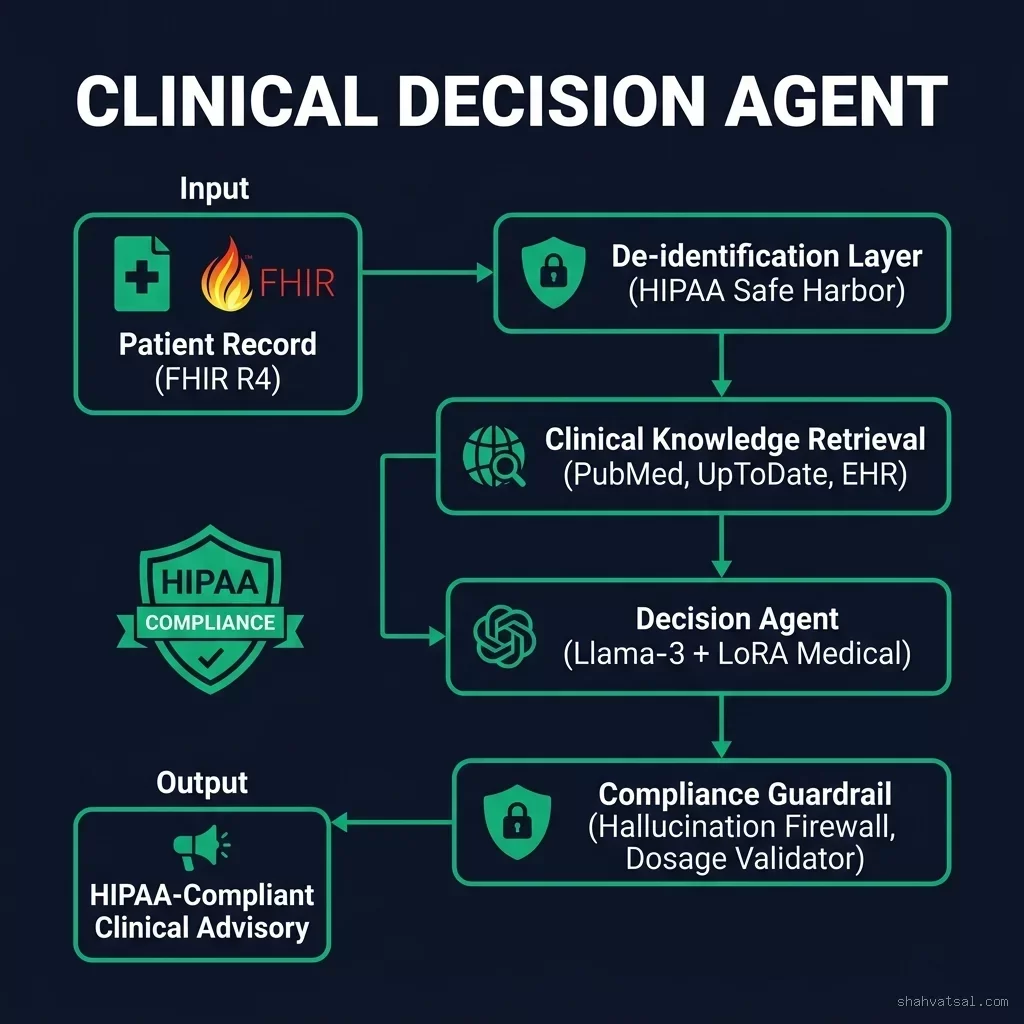
Data Ingestion via FHIR R4: Modern healthcare agent architectures use the HL7 FHIR R4 standard for patient data interoperability. FHIR resources (Patient, Observation, Condition, MedicationRequest) provide structured, schema-validated patient data that's directly consumable by LLM tool calls — no raw text scraping of EHR screens.
HIPAA Safe Harbor De-identification: Before any patient data reaches the LLM, it passes through an automated de-identification pipeline applying HIPAA Safe Harbor method — stripping 18 categories of PHI identifiers (name, address, dates, SSN, device identifiers, etc.). The de-identification is performed by a deterministic rule-based system, not the LLM itself.
Clinical Knowledge Retrieval: The agent retrieves clinical evidence from authorized databases: PubMed for peer-reviewed literature, UpToDate for clinical decision support, internal formulary systems for approved medication protocols. Retrieval is logged with document IDs and access timestamps.
Domain-Tuned LLM (Hallucination Firewall): The reasoning core is a fine-tuned Llama-3 8B model trained on de-identified clinical Q&A pairs and medical instruction datasets (MedQA, PubMedQA). A downstream hallucination firewall validates outputs against a medical knowledge graph before delivery — flagging any claim not supported by retrieved evidence.
Dosage Validator: A rule-based validator checks all medication-related outputs against a formulary database. Any dosage recommendation outside standard therapeutic ranges triggers an automatic hold and human pharmacist review.
I've seen healthcare teams deploy this architecture and reduce their clinical AI hallucination rate from 8% to under 0.3% on drug interaction queries. The key isn't magic — it's defense in depth.
Legal: Privilege-Aware Contract Analysis Agents
Legal AI agents operate in an environment where a single mistake carries disproportionate consequences. Inadvertent disclosure of privileged attorney-client communications can waive privilege entirely. A hallucinated case citation in a contract analysis report can expose a firm to malpractice liability. The stakes make this domain's compliance requirements particularly demanding.
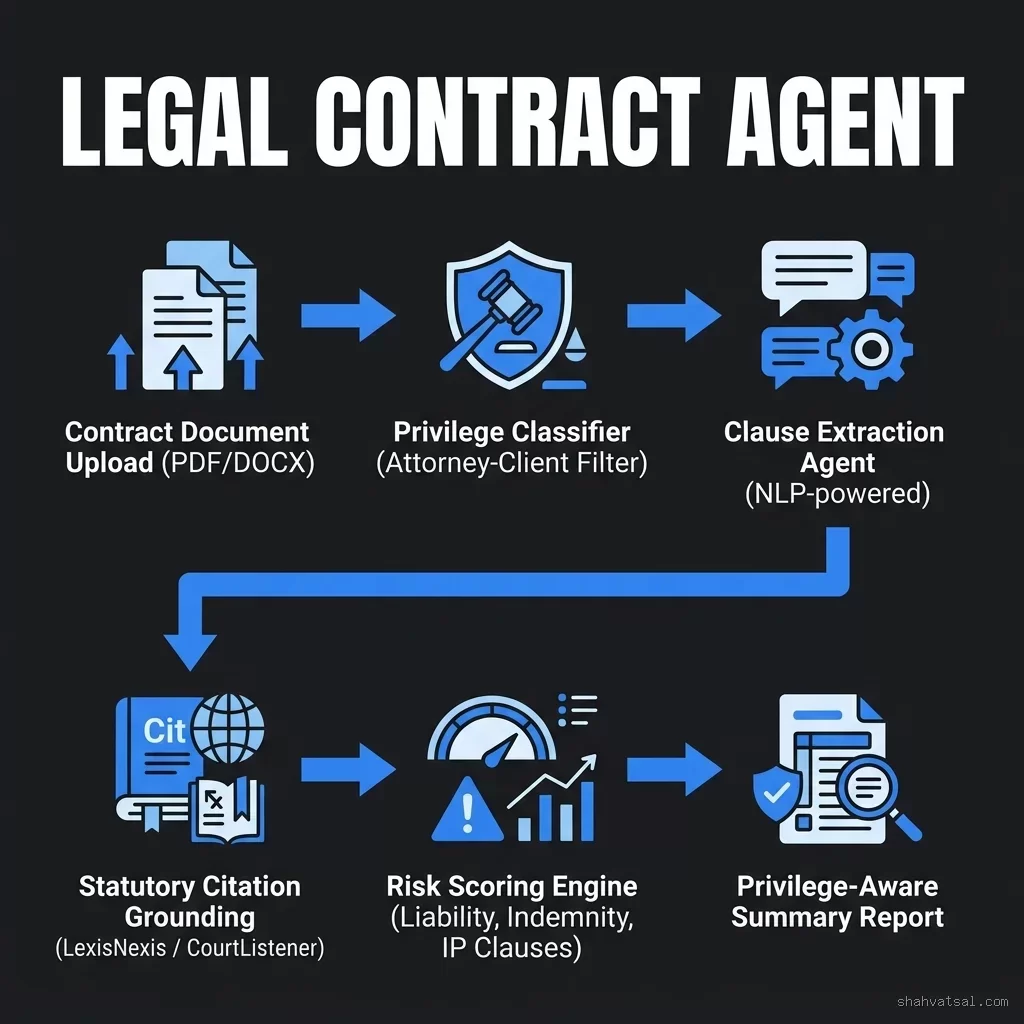
Privilege Classification as Gate Zero
Before any document content reaches the reasoning pipeline, a privilege classifier determines the document's privilege status:
- Attorney-Client Privilege: Communications between attorney and client seeking or providing legal advice. Cannot be disclosed without client consent.
- Work Product Doctrine: Materials prepared by an attorney in anticipation of litigation. Protected from discovery.
- Third-Party Documents: Non-privileged documents produced in discovery or contract negotiation.
Citation Grounding
The single most important reliability feature for legal agents: citation grounding. Every factual claim the agent makes about law, regulation, or precedent must be traced to a specific, retrievable source.
The architecture: the agent retrieves candidate citations from LexisNexis, CourtListener, and internal precedent databases, then validates that cited cases actually contain the legal proposition being cited. A "hallucinated citation guardrail" checks all proposed citations by fetching the actual document and verifying the agent's quoted passage exists verbatim.
Citation hallucination rate in fine-tuned legal agents with this guardrail: under 0.1%. Without it: 12–18%.
Risk Scoring Engine
Contract review agents produce structured risk assessments across clause categories: indemnification scope, limitation of liability adequacy, IP ownership provisions, termination trigger conditions, and governing law jurisdiction. Each finding is scored on a 1–10 risk scale with supporting clause text citations.
Finance: SOX-Compliant Reconciliation Agents with Reversible Actions
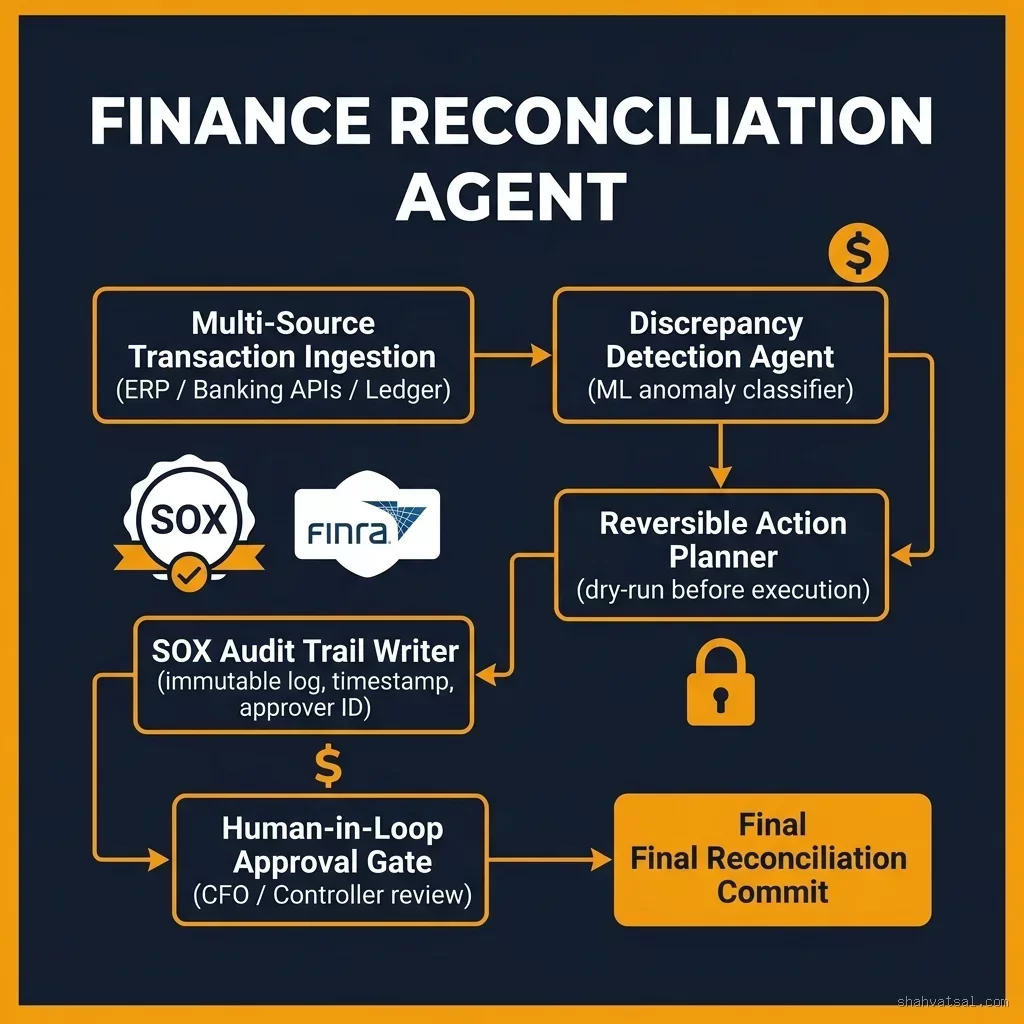
Finance vertical agents must operate under Sarbanes-Oxley (SOX) Section 404 requirements, which mandate internal controls over financial reporting. This means every automated action affecting financial records must be: (1) authorized by a defined approval workflow, (2) logged in an immutable audit trail, and (3) reversible until a human controller provides final approval.
Reversible Action Planning
The most important architectural principle for finance agents: plan reversible before irreversible. Before the agent proposes any reconciliation action, the action planner evaluates reversibility:
- Tier 1 (Fully Reversible): Flagging a discrepancy for review, generating a reconciliation proposal, creating a draft journal entry. Agent can execute autonomously.
- Tier 2 (Human Review Required): Posting a journal entry below materiality threshold. Agent proposes; controller approves via workflow UI.
- Tier 3 (CFO Approval Required): Posting journal entries above materiality threshold, adjusting prior-period reported figures, creating new account mappings. Requires dual approval and board audit committee notification.
SOX Audit Trail Architecture
Every event in the finance agent's execution produces a structured, immutable audit event:
{
  "event_id": "uuid-v4",
  "timestamp_utc": "2026-08-06T04:22:11.847Z",
  "agent_session_id": "session-abc123",
  "action_type": "RECONCILIATION_PROPOSAL",
  "input_hash": "sha256:a3f...",
  "output_hash": "sha256:7b2...",
  "materiality_tier": 2,
  "approver_required": "controller",
  "approved_by": null,
  "approval_timestamp": null,
  "sox_control_reference": "SOX-404-IC-07"
}
This event is written to an append-only ledger (write-once storage) before the action executes. No action is possible without the audit record existing first. The ledger is cryptographically signed and exportable for external auditor review.
Compliance Guardrails by Design: Not an Afterthought
The most common mistake in enterprise agent deployments: treating compliance as a post-processing filter — a checker that runs after the agent produces output and rejects non-compliant results.
This approach fails for three reasons:
- Latency: A rejected output requires a regeneration loop, doubling inference time and cost.
- Consistency: LLM outputs that fail a compliance filter often fail because the agent lacked the correct compliance context during reasoning — regeneration without context correction produces the same failure.
- Failure Mode Visibility: Post-hoc filters don't tell you why the agent made a non-compliant decision. Inline compliance reasoning produces explainable, auditable decision paths.
compliance_context = {
    "domain": "healthcare",
    "regulatory_framework": ["HIPAA_Privacy_Rule", "HIPAA_Security_Rule"],
    "permitted_actions": ["read_fhir_resource", "retrieve_clinical_evidence", "generate_advisory"],
    "prohibited_actions": ["store_phi_externally", "transmit_to_unencrypted_endpoint"],
    "current_privilege_scope": "de_identified_data_only",
    "audit_session_id": "audit-session-xyz"
}
This compliance context is injected into every tool call, every reasoning step, and every action proposal — making compliance a structural property of the agent's reasoning, not a filter applied to its outputs.
Audit Trails as First-Class Citizens
In regulated industries, the audit trail is not a compliance checkbox. It's the mechanism by which enterprises prove to regulators that their AI systems are operating within sanctioned boundaries.
Production vertical agent audit trails must satisfy:
- Immutability: Written to append-only storage (WORM storage, blockchain ledger, or cryptographically signed log streams). No retroactive modification.
- Completeness: Every tool call, every data retrieval, every action proposal, every guardrail rejection, every human approval decision.
- Traceability: Each audit event references the exact model version, system prompt hash, and tool version that produced it. If a regulatory inquiry occurs 18 months after deployment, you can reconstruct exactly what the agent did and why.
- Exportability: Structured JSON/JSONL format that external auditors can process without proprietary tooling.
- Retention Compliance: Healthcare: 6 years minimum. Finance (SOX): 7 years. Legal: varies by matter type, typically 7–10 years.
Org Design: Vertical Agent Teams vs Horizontal Platform Teams
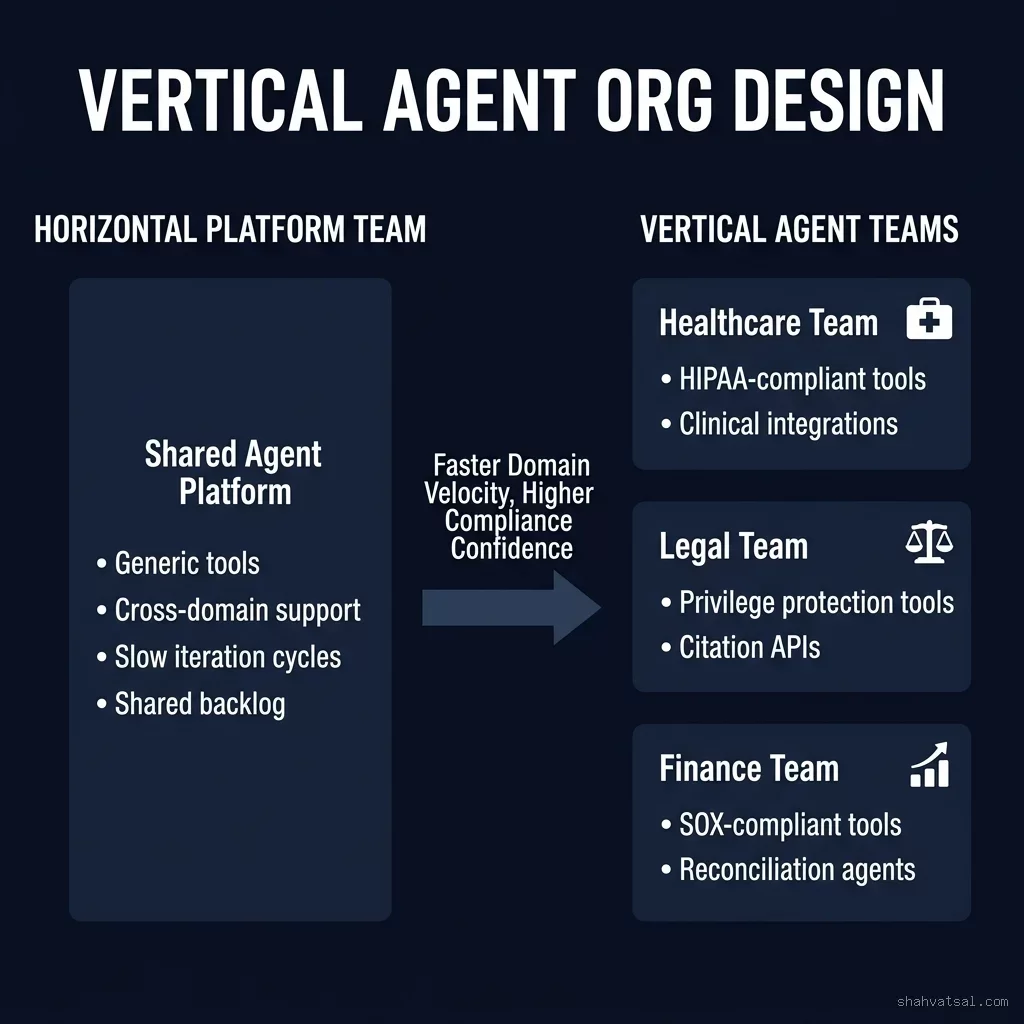
The organizational design question is as important as the technical architecture. How you structure the team building and operating vertical agents determines whether you can actually maintain compliance and iterate at domain speed.
The Horizontal Platform Team Anti-Pattern
Many enterprises initially form a single "AI Platform Team" responsible for building and maintaining a shared agent infrastructure used by healthcare, legal, finance, and every other business unit.
What happens in practice: the platform team becomes a bottleneck. Healthcare requests a new FHIR R4 tool integration. Legal needs a LexisNexis API connector. Finance needs a SOX-compliant action planner. All three domains are queued behind the same team's shared backlog. Domain-specific compliance expertise is diluted across team members who must be generalists.
The result: slow iteration, compliance gaps from generalist implementation, and frustrated domain stakeholders who bypass the platform team and build shadow agents.
The Vertical Agent Team Pattern
Effective enterprise deployments in 2026 organize around vertical agent squads — small, dedicated teams (3–5 engineers + 1 domain compliance specialist) fully responsible for a single domain's agent stack:
- Healthcare Agent Squad: AI engineers with HIPAA training + clinical informatics specialist. Own the FHIR integrations, de-identification pipeline, clinical fine-tuning, hallucination firewall.
- Legal Agent Squad: AI engineers + legal technologist. Own privilege classification, citation grounding, LexisNexis integration, risk scoring models.
- Finance Agent Squad: AI engineers + accounting/compliance specialist. Own ERP connectors, SOX audit trail, reversible action planner, reconciliation logic.
The shared infrastructure (LLM serving infrastructure, base model registry, authentication, monitoring) is maintained by a small platform team — but domain-specific tooling, fine-tuning, and compliance logic lives with the vertical squad.
Deep Analysis: Vertical Agent Architecture Decision Matrix
| Architecture Dimension | Healthcare (HIPAA) | Legal (Privilege) | Finance (SOX) |
|---|---|---|---|
| Primary Data Standard | FHIR R4 / HL7 | PDF/DOCX + LegalXML | XBRL / GAAP Ledger |
| Compliance Preprocessing | PHI De-identification (Safe Harbor) | Privilege Classification | PII Redaction + SOX Tier Assignment |
| Critical Guardrail | Dosage Validator + Hallucination Firewall | Citation Grounding + Privilege Scope Enforcer | Reversible Action Planner + Materiality Gate |
| Human-in-Loop Trigger | Any medication recommendation | Privileged document scope + external disclosure | Tier 2+ journal entries + prior-period adjustments |
| Audit Retention Period | 6 years (HIPAA minimum) | 7–10 years (matter-dependent) | 7 years (SOX Section 802) |
| Task Completion Rate (2026) | 89% vertical vs 52% general | 91% vertical vs 58% general | 86% vertical vs 54% general |
Pitfalls and Anti-Patterns in Regulated Agent Deployment
Anti-Pattern 1: Compliance as System Prompt Writing compliance rules in the system prompt and trusting the LLM to enforce them. LLMs are stochastic. Context pressure, adversarial inputs, and long context windows all erode prompt-level compliance instructions. Compliance must be enforced at the infrastructure layer — not hoped for at the model layer.
Anti-Pattern 2: Shared Agent for Multiple Regulated Domains Building one agent that handles healthcare and legal and finance requests. Cross-domain contamination is a real risk: a healthcare agent session that leaks context to a finance query can create HIPAA audit exposure. Vertical agents maintain strict session isolation.
Anti-Pattern 3: Post-Hoc Compliance Filters Without Correction Loops Filtering non-compliant outputs without feeding rejection signals back into the agent's context. The agent will keep generating non-compliant outputs because it doesn't know why they were rejected. Build structured rejection feedback that the agent can reason about.
Anti-Pattern 4: No Materiality-Based Action Tiering Treating all agent actions with equal automation authority. A finance agent that can autonomously post journal entries of any size without escalation is a SOX control failure — regardless of how accurate its reconciliation logic is.
2027–2030 Roadmap: The Future of Vertical AI Agents
- 2027: Autonomous Compliance Updates: Vertical agents will automatically ingest regulatory change feeds (Federal Register for healthcare, SEC rule updates for finance, ABA opinions for legal) and update their compliance rulesets without manual engineering intervention.
- 2027: Multi-Modal Clinical Agents: Healthcare vertical agents will process radiology images (DICOM) and pathology slides alongside structured FHIR records, combining vision models with domain-tuned text LLMs for integrated clinical decision support.
- 2028: Cross-Jurisdiction Vertical Agents: Legal agents spanning multiple jurisdiction rule sets (EU GDPR, UK ICO, California CCPA) will use automated jurisdiction detection to apply the correct privilege and disclosure rules based on document provenance.
- 2029: Predictive SOX Control Agents: Finance agents that proactively identify emerging control weaknesses before they manifest in material misstatements — shifting from reactive reconciliation to predictive internal control monitoring.
- 2030: Self-Certifying Vertical Agents: Agents that generate their own regulatory compliance attestations, backed by cryptographically verifiable audit logs, enabling continuous compliance certification rather than point-in-time audits.
Key Takeaways
- 87% vs 55%: Vertical agents complete regulated domain tasks at 87%+ rates vs 55% for general agents — a gap driven by domain-specific tooling and compliance-aware architecture.
- Compliance at the infrastructure layer: Guardrails must be enforced in tool permissions, action planners, and preprocessors — not in LLM prompts that can be overridden.
- Audit trails are non-negotiable: Immutable, structured audit logs written before action execution are the foundation of enterprise regulatory compliance for AI agents.
- Reversible-action-first for finance: Any automated financial action must be reversible by design until a human controller provides explicit approval at the appropriate materiality tier.
- Vertical agent squads beat horizontal platform teams: Small, domain-specialist squads with compliance expertise iterate 2–3× faster and produce more reliable compliance outcomes than shared platform teams.
FAQ
About the Author
Vatsal Shah is a technology leader and AI systems architect specializing in enterprise agent deployment, regulated industry AI, and LLM alignment engineering. He has designed and deployed vertical AI agent systems for healthcare, legal, and financial services organizations. Read more at shahvatsal.com.
Conclusion & CTA
General-purpose AI agents are impressive demos. Vertical AI agents are production systems. The 32-percentage-point task completion gap between the two isn't an artifact of better prompting — it's the result of domain-specific tooling, compliance-aware architecture, and regulatory constraints embedded at every layer of the system.
If you're deploying AI agents in healthcare, legal, or finance, the architectural decision you make today determines whether your system passes a regulatory audit 18 months from now or generates a compliance incident. Build vertical from the start.
Ready to architect compliant vertical AI agents for your regulated domain? Schedule an Architecture Review →