Agents as the New Identity Class What is Zero-Trust IAM for AI Agents? (Featured Snippet) Why Zero-Trust Security Matters in 2026 Per-Agent Service Accounts vs.…
Agents as the New Identity Class
In traditional cloud security, we have two primary identity classes: human users and static workloads (microservices, cron jobs, serverless functions).
But in 2026, a third identity class has emerged: autonomous AI agents.
AI agents do not behave like traditional microservices. A microservice has static code paths, executing deterministic SQL queries or calling predefined endpoints. An agent is dynamic. It parses natural language prompts, creates planning loops, and dynamically selects which tools to call depending on the user’s intent.
If you configure your agent using a single master service account with generic permissions to "read/write database" and "call internal APIs," you have built a massive security vulnerability. An LLM-as-orchestrator can easily be manipulated via prompt injection or trajectory hijacking to call tools it shouldn't access, or extract data outside its scope.
As I analyzed in my guide on surviving shadow AI and corporate governance, you cannot control an agentic system simply by auditing user access. You must secure the agent's identity itself. We must treat every AI agent as an independent employee. This means giving them unique identities, applying least-privilege permissions, auditing every single action, and federating their credentials across cloud boundaries.
I have seen numerous enterprise agent projects fail this basic test. Developers, in a rush to hit launch deadlines, bake static developer API keys directly into their orchestration environments. When the agent is exposed to the public internet, it becomes a proxy for arbitrary API execution. By shifting our perspective to view the agent as an active, dynamic persona, we can apply established Zero-Trust Architecture (ZTA) principles directly to model execution.
What is Zero-Trust IAM for AI Agents?
Zero-trust IAM for AI agents is a security architecture that enforces continuous authentication, least-privilege authorization, and cryptographic separation for autonomous LLM systems. It eliminates long-lived credentials, maps agent execution context to scoped workload identity roles, and validates tool parameters at runtime to prevent prompt-injection attacks.
In a zero-trust model:
- No agent is trusted based on network location (e.g., "running on internal VPC").
- Every tool invocation requires a short-lived, dynamically scoped access token.
- Trust is negotiated continuously using OpenID Connect (OIDC) federation and mutual TLS.
Why Zero-Trust Security Matters in 2026
Enterprise security posture in 2026 is defined by agentic integration. We are past the phase of simple chat UIs. Today, companies are deploying agents that read emails, modify CRM pipelines, manage cloud resources, and process customer invoices.
Three factors make zero-trust agentic security critical:
First, prompt injection is now a direct path to data theft. Attackers no longer need to break database firewalls. If they can inject malicious instructions into an agent’s input (such as an email or support ticket), they can trick the agent into using its legitimate tools to export database records, delete buckets, or send unauthorized emails.
Second, the sprawl of Model Context Protocol (MCP) servers. As teams deploy internal tool catalogs (like those outlined in our MCP enterprise registry guide), managing credentials across dozens of micro-servers becomes a nightmare. If each server relies on hardcoded keys, a single leak compromises the entire network.
Third, the deployment of agent services across multiple clouds. Organizations are running LLMs on Azure (using Azure AI Foundry, as detailed in our Entra ID governance guide), data platforms on GCP, and compute workloads on AWS. Federating agent identities across these clouds securely requires standard OIDC federation trust chains.
Without a unified identity verification framework, these cross-cloud pipelines quickly degenerate into a mesh of static, long-lived access keys passed via environment variables. If a single key is leaked or cached in an LLM’s execution history, the entire multi-cloud perimeter is compromised.
Per-Agent Service Accounts vs. Shared Keys
The oldest anti-pattern in MLOps is using a single "AI-Orchestrator-Service-Account" for all agent systems.
If your customer support agent, finance reconciliation agent, and dev DevOps agent all share the same service account, your blast radius is massive. If the customer support agent is compromised via a malicious user prompt, the attacker can use the shared context to read finance records or alter production code repositories.
The solution is simple: One agent = One service account.
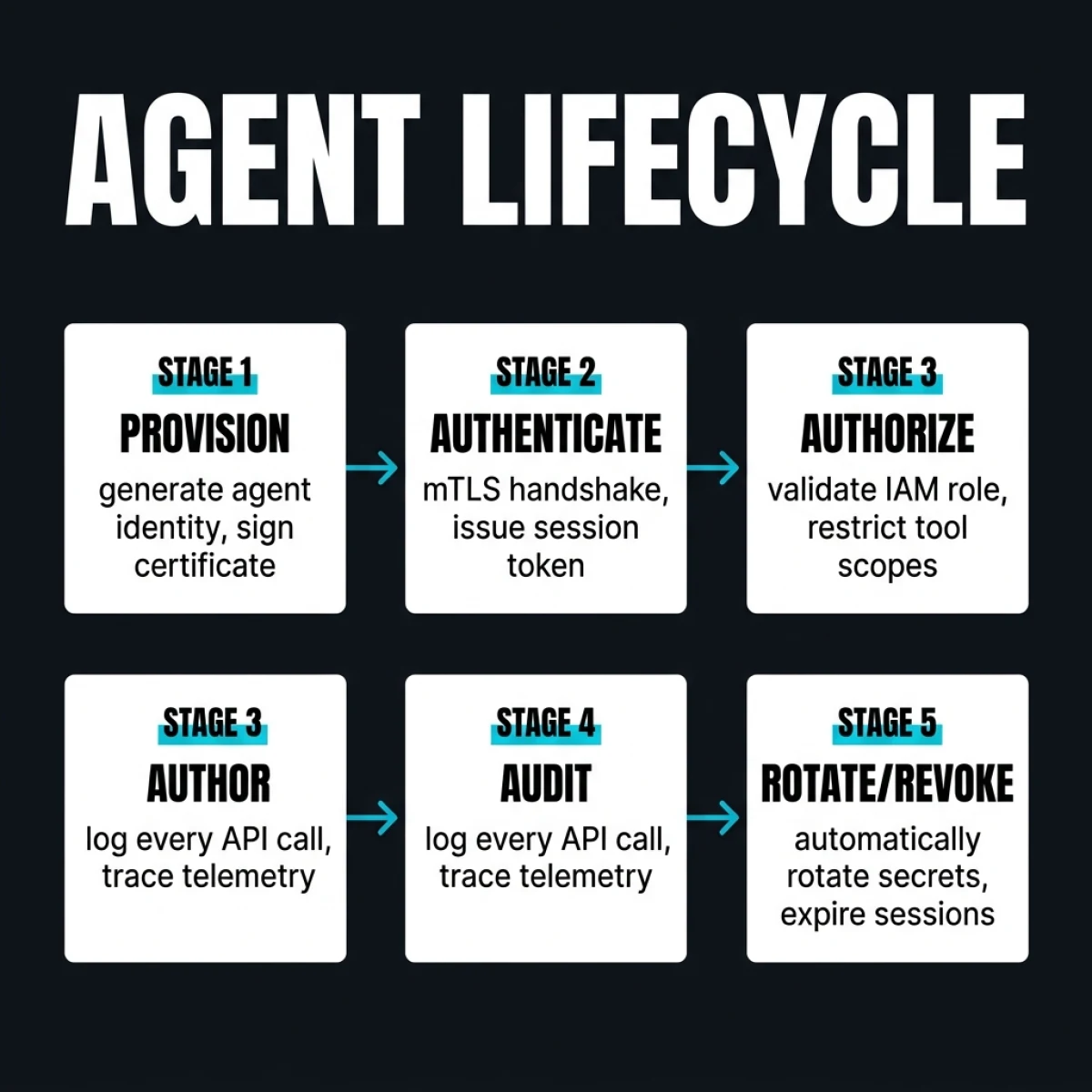
Every distinct agent system must be provisioned with its own unique IAM identity (e.g., an AWS IAM Role, GCP Service Account, or Azure Managed Identity). This isolation ensures:
- Blast Radius Isolation: A compromise in one agent cannot leak credentials for another.
- Granular Audit Trails: Cloud logging (CloudTrail, Stackdriver) captures exactly which agent modified a database record or deleted a bucket.
- Dynamic Revocation: You can instantly disable an agent’s identity in the cloud console without impacting other business workflows.
Concrete Example: AWS IAM Role Policy for a Support Agent
To implement least privilege for an agent, its IAM role policy must restrict access to only the specific resources it needs. For example, a customer support agent should only be able to read from a specific S3 bucket and invoke a dedicated Bedrock model, with no access to delete operations:
{
  "Version": "2012-10-17",
  "Statement": [
    {
      "Sid": "BedrockModelInvocation",
      "Effect": "Allow",
      "Action": [
        "bedrock:InvokeModel",
        "bedrock:InvokeModelWithResponseStream"
      ],
      "Resource": "arn:aws:bedrock:us-east-1::foundation-model/anthropic.claude-3-5-sonnet-v2:0"
    },
    {
      "Sid": "SupportS3ReadAccess",
      "Effect": "Allow",
      "Action": [
        "s3:GetObject",
        "s3:ListBucket"
      ],
      "Resource": [
        "arn:aws:s3:::enterprise-customer-support-docs",
        "arn:aws:s3:::enterprise-customer-support-docs/*"
      ]
    }
  ]
}
By explicitly listing resource ARNs and narrowing the permitted actions, we prevent the agent from being hijacked to scan other buckets or invoke unapproved, expensive models.
Tool Scopes: Dynamic OAuth and Short-Lived Tokens
When an agent needs to invoke a tool, it should not pass its primary cloud identity credentials. Instead, it must exchange its workload identity for a short-lived, scope-limited token specifically for that tool.
This process mirrors the OAuth 2.0 delegation flow:
- Request: The agent requests a token from the identity service, specifying the tool it needs to call (e.g.,
Jira-Write). - Authorize: The identity service verifies the agent’s permission boundary.
- Issue: The identity service issues a JWT token with a 5-minute TTL, scoped strictly to the target tool.
- Invoke: The agent calls the tool gateway with the token.
- Verify: The gateway validates the token scope before routing the request.
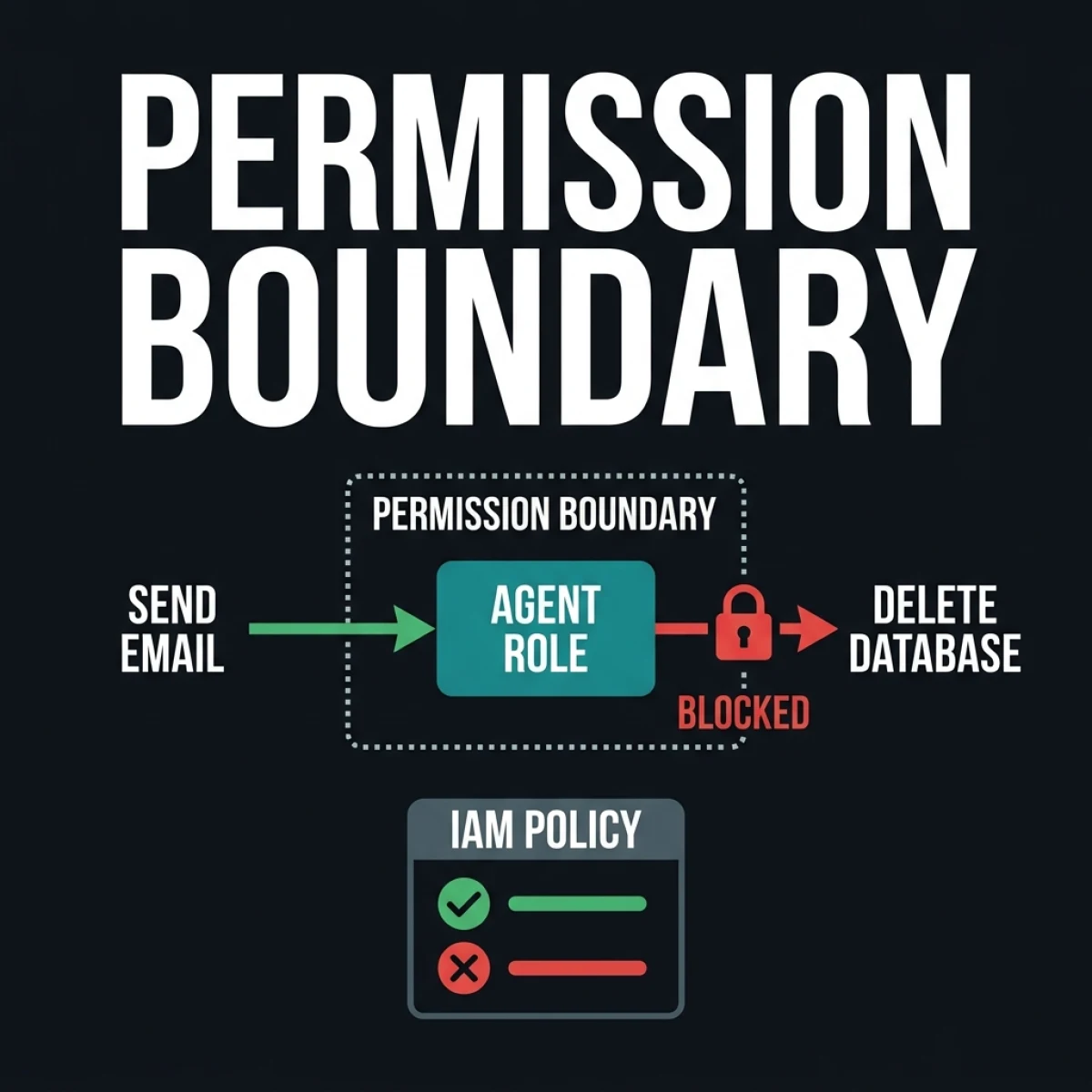
Here is a Python example of how to implement dynamic token exchange and tool scope validation using FastAPI and JWTs:
# python: dynamic tool token validation gateway
import time
from fastapi import FastAPI, Depends, HTTPException, status
from fastapi.security import HTTPBearer, HTTPAuthorizationCredentials
import jwt

app = FastAPI()
security = HTTPBearer()

# Configuration
SECRET_KEY = "enterprise-secure-vault-key"
ALGORITHM = "HS256"

def verify_tool_scope(required_scope: str):
    """Dependency validator for specific tool scopes."""
    def dependency(credentials: HTTPAuthorizationCredentials = Depends(security)):
        token = credentials.credentials
        try:
            payload = jwt.decode(token, SECRET_KEY, algorithms=[ALGORITHM])
            scopes = payload.get("scopes", [])
            tenant_id = payload.get("tenant_id")

            # Check expiration
            if payload.get("exp", 0) < time.time():
                raise HTTPException(
                    status_code=status.HTTP_401_UNAUTHORIZED,
                    detail="Token has expired"
                )

            # Verify scope
            if required_scope not in scopes:
                raise HTTPException(
                    status_code=status.HTTP_403_FORBIDDEN,
                    detail=f"Missing required scope: {required_scope}"
                )
            return {"tenant_id": tenant_id, "agent_id": payload.get("sub")}

        except jwt.PyJWTError:
            raise HTTPException(
                status_code=status.HTTP_401_UNAUTHORIZED,
                detail="Invalid access token"
            )
    return dependency

@app.post("/tools/jira/create-issue")
async def create_jira_issue(
    payload: dict,
    auth_context: dict = Depends(verify_tool_scope("jira:write"))
):
    """Jira tool endpoint protected by scoped OAuth token."""
    # Process Jira ticket creation safely
    agent_id = auth_context["agent_id"]
    print(f"Agent {agent_id} authorized to create issue")
    return {"status": "success", "ticket_id": "JIRA-89632"}
In addition to Python, TypeScript is widely used in agent environments. Below is a Node.js implementation showing how an agent orchestrator requests a short-lived token from a secure Key Vault, ensuring that credentials are never written to disk or logged:
// typescript: secure token retrieval from azure key vault
import { DefaultAzureCredential } from "@azure/identity";
import { SecretClient } from "@azure/keyvault-secrets";
import axios from "axios";

const vaultName = "ent-agent-keyvault";
const url = `https://${vaultName}.vault.azure.net`;

async function getToolToken(toolName: string): Promise<string> {
  const credential = new DefaultAzureCredential();
  const client = new SecretClient(url, credential);

  // Retrieve the client secret for token exchange
  const clientSecret = await client.getSecret("agent-sts-client-secret");

  // Exchange credentials for a tool-scoped, short-lived JWT
  const response = await axios.post("https://auth.enterprise.ai/oauth/token", {
    grant_type: "client_credentials",
    client_id: "agent-orchestrator-prod",
    client_secret: clientSecret.value,
    audience: `https://api.enterprise.ai/tools/${toolName}`,
    scope: `${toolName}:execute`
  });

  return response.data.access_token;
}
Cross-Cloud Identity Federation
In a multi-cloud enterprise architecture, your AI agent might run on an Azure VM, its vector database might reside in GCP BigQuery, and its execution tools might run on AWS ECS.
How do you secure this agent without baking AWS and GCP keys into the Azure VM?
Workload Identity Federation using OpenID Connect (OIDC).
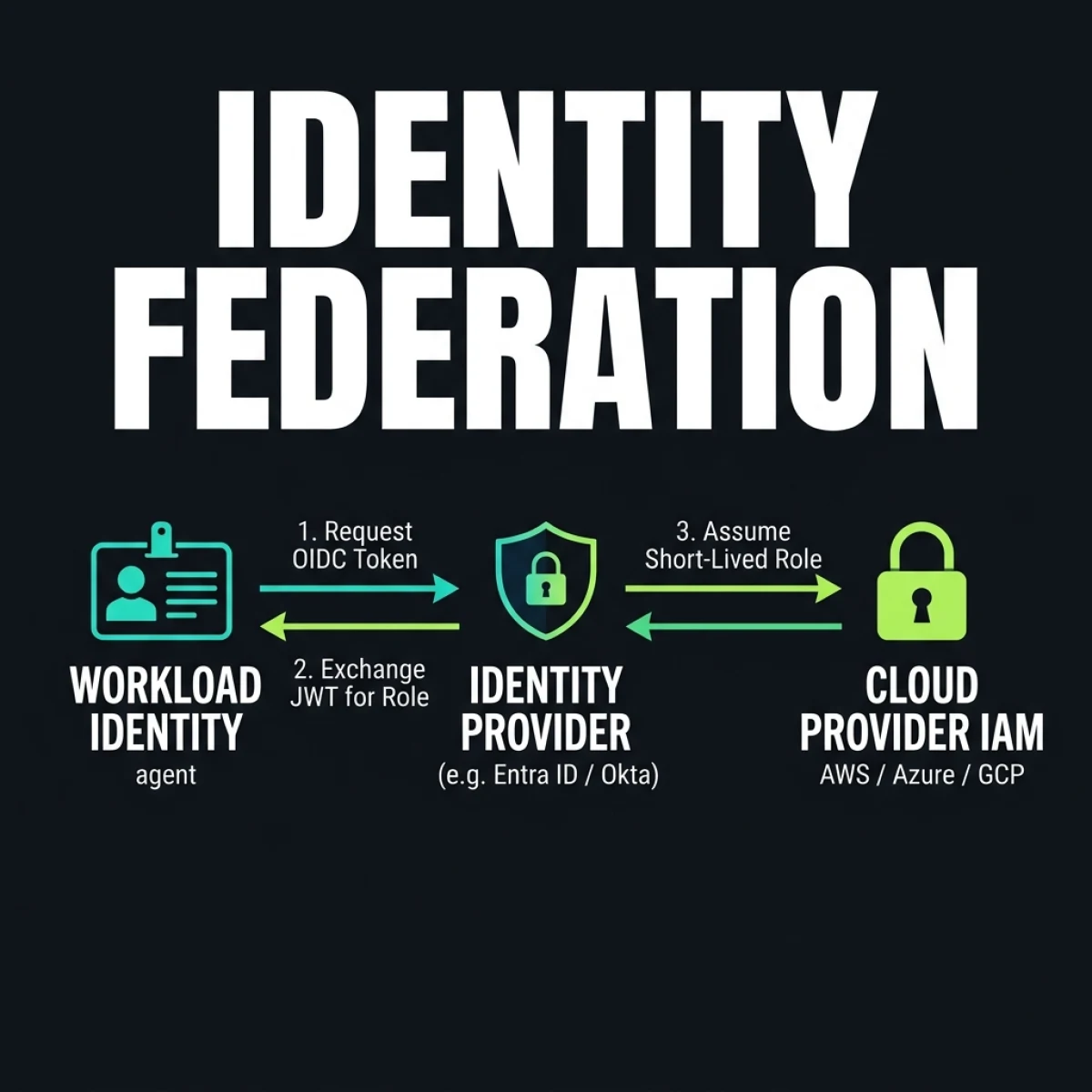
The trust chain flow is fully standard:
- Azure VM identity: The Azure agent requests a signed OIDC token from Azure AD (Entra ID) using its local managed identity.
- AWS trust configuration: In AWS IAM, you establish an Identity Provider configuration that trusts your Entra ID tenant as a token issuer.
- Role assumption: The Azure agent presents its Entra ID token to the AWS Security Token Service (STS) via the
AssumeRoleWithWebIdentitycall. - Token exchange: AWS STS validates the Entra ID signature, matches the claim rules (e.g., verifying the token's subject maps to your support agent), and issues temporary AWS access credentials (valid for 1 hour).
- Access: The agent accesses AWS resources (like S3 buckets or Bedrock models) using these temporary keys.
The AWS Trust Policy Configuration
To enable this cross-cloud exchange, the AWS IAM role must contain a trust policy (AssumeRolePolicyDocument) that defines the OpenID Connect parameters. Here is the exact JSON template:
{
  "Version": "2012-10-17",
  "Statement": [
    {
      "Effect": "Allow",
      "Principal": {
        "Federated": "arn:aws:iam::123456789012:oidc-provider/sts.windows.net/YOUR-ENTRA-TENANT-ID/"
      },
      "Action": "sts:AssumeRoleWithWebIdentity",
      "Condition": {
        "StringEquals": {
          "sts.windows.net/YOUR-ENTRA-TENANT-ID/:aud": "api://azure-agent-orchestrator",
          "sts.windows.net/YOUR-ENTRA-TENANT-ID/:sub": "system:serviceaccount:agent-namespace:support-agent"
        }
      }
    }
  ]
}
This configuration ensures that only the specific Entra ID managed identity mapped to the support-agent service account can assume this AWS role. No other identity inside the Azure tenant can gain access, ensuring absolute isolation.
Traditional Application IAM vs. Agentic IAM
| Criterion | Traditional Workload IAM | AI Agentic IAM (2026 Zero-Trust) |
|---|---|---|
| Identity Mapping | Maps to static compute resources (VM, container, pod) | Maps to dynamic agents, executors, and orchestrators |
| Access Privilege | Static role with permanent database/API access rights | Least-privilege role with dynamic scopes per tool run |
| Credential Lifespan | Long-lived keys (months/years) or default role tokens | Short-lived session-scoped tokens (5–15 min TTL) |
| Authorization Boundary | Network perimeter + static resource policy rules | Granular tool scopes + natural language prompt checks |
| Audit Logging | System access logs (IP, service account, action) | Detailed execution trace logs (prompt, agent steps, outputs) |
| Federation Model | Static OIDC config between clouds | Dynamic workload identity federation per execution session |
| Prompt Injection Protection | None (out of scope for traditional IAM) | Runtime input verification and role scoping boundaries |
| Best For | Standard microservices and backend databases | Autonomous AI agents and dynamic tool orchestrations |
The key takeaway is that agentic IAM requires dynamic, runtime visibility. A traditional role cannot adapt to an agent changing its execution path dynamically. You must enforce the boundaries at the tool gateway layer.
Blast Radius Containment and Micro-Segmentation
In cloud security, micro-segmentation is the practice of dividing a network into small, isolated security segments to contain breaches. For AI agents, we apply this concept at the tool level.
Micro-Segmenting Tool Connections
If an agent is compromised, you want to limit the attacker’s access. If the agent's database tool is separate from its file-system tool, compromising the database connection should not give access to the file system.
To enforce this:
- Run each tool server in an isolated container or serverless function with its own unique network security group.
- Enforce mTLS between the agent gateway and each tool server.
- Limit database access to specific views or stored procedures rather than raw table access. If the agent only needs to read customer history, do not grant it
SELECT * FROM customers— create a view likevw_customer_history_readand limit the service role to it.
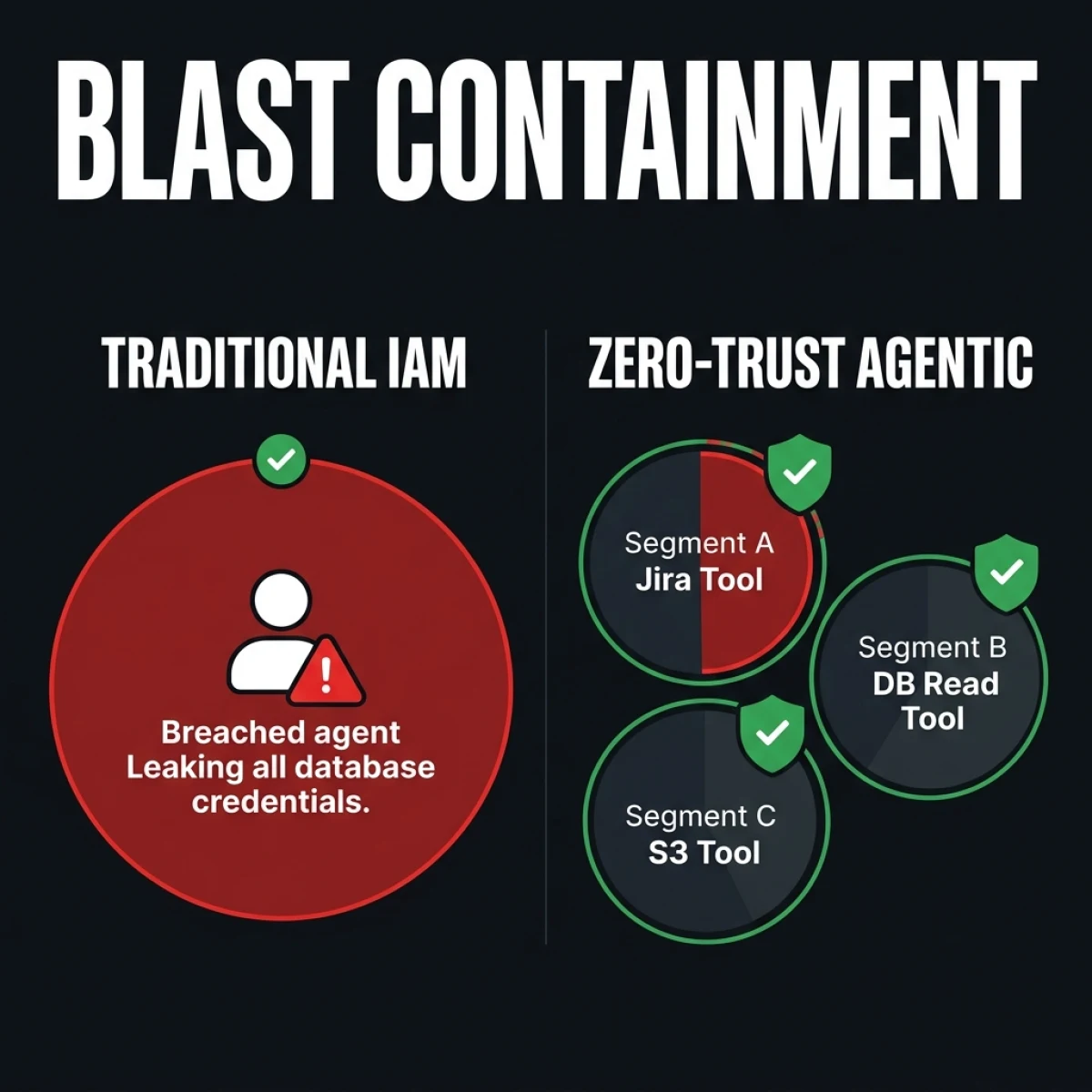
By segmenting connections and resources, you make it extremely hard for attackers to escalate privileges even if they compromise the agent's base prompt.
Furthermore, we must implement dynamic session isolation. When an agent runs a multi-step task, a unique database role should be generated dynamically for the session duration and immediately dropped upon task completion or timeout.
Here is a SQL example of how to implement dynamic role management on PostgreSQL to isolate read access per agent execution session:
-- pgsql: dynamic agent session role provisioning
CREATE OR REPLACE FUNCTION setup_agent_session_role(p_agent_id VARCHAR)
RETURNS VOID AS $$
BEGIN
    -- Create temporary database role limited to current transaction
    EXECUTE 'CREATE ROLE ' || quote_ident(p_agent_id) || ' WITH NOLOGIN';
    EXECUTE 'GRANT USAGE ON SCHEMA support TO ' || quote_ident(p_agent_id);
    EXECUTE 'GRANT SELECT ON support.vw_customer_history TO ' || quote_ident(p_agent_id);

    -- Restrict execution contexts
    EXECUTE 'SET ROLE ' || quote_ident(p_agent_id);
END;
$$ LANGUAGE plpgsql SECURITY DEFINER;
Invoking this at the start of the agent transaction restricts the connection's queries to vw_customer_history and drops the temporary role at commit time, guaranteeing that any SQL injection attempt remains blocked from writing or reading other tables.
Monday Morning: Your 3-Step Action Plan
You don't need a full cross-cloud OIDC federation setup to secure your agents today. Start with these three steps on Monday morning:
Step 1: Audit all credentials stored in your agent codebases.
- Scan your repositories for hardcoded AWS keys, database passwords, or third-party API keys (e.g., Slack, GitHub, Jira tokens).
- Move all secrets to a secure manager (AWS Secrets Manager, HashiCorp Vault, Azure Key Vault).
- Enforce a rule that no agent repository can contain plain-text keys.
- If you have multiple agents sharing a single service account, create unique IAM roles or service accounts for each agent today.
- Limit each role's permission policy to only the resources it absolutely needs to access.
- Update your environment variables to map each agent system to its respective isolated account.
- Ensure every tool invocation is logged to a structured, centralized log destination (like CloudWatch or Elasticsearch).
- Log the agent ID, the tool called, the parameters passed, the calling user context, and the tool return status.
- Set up alerts for any tool calls that exceed normal rate limits or access restricted resources.
2027–2030 Roadmap: ZTA Maturity for AI Agents
The zero-trust security landscape for AI agents is moving from basic IAM config to dynamic, behavior-based trust validation.
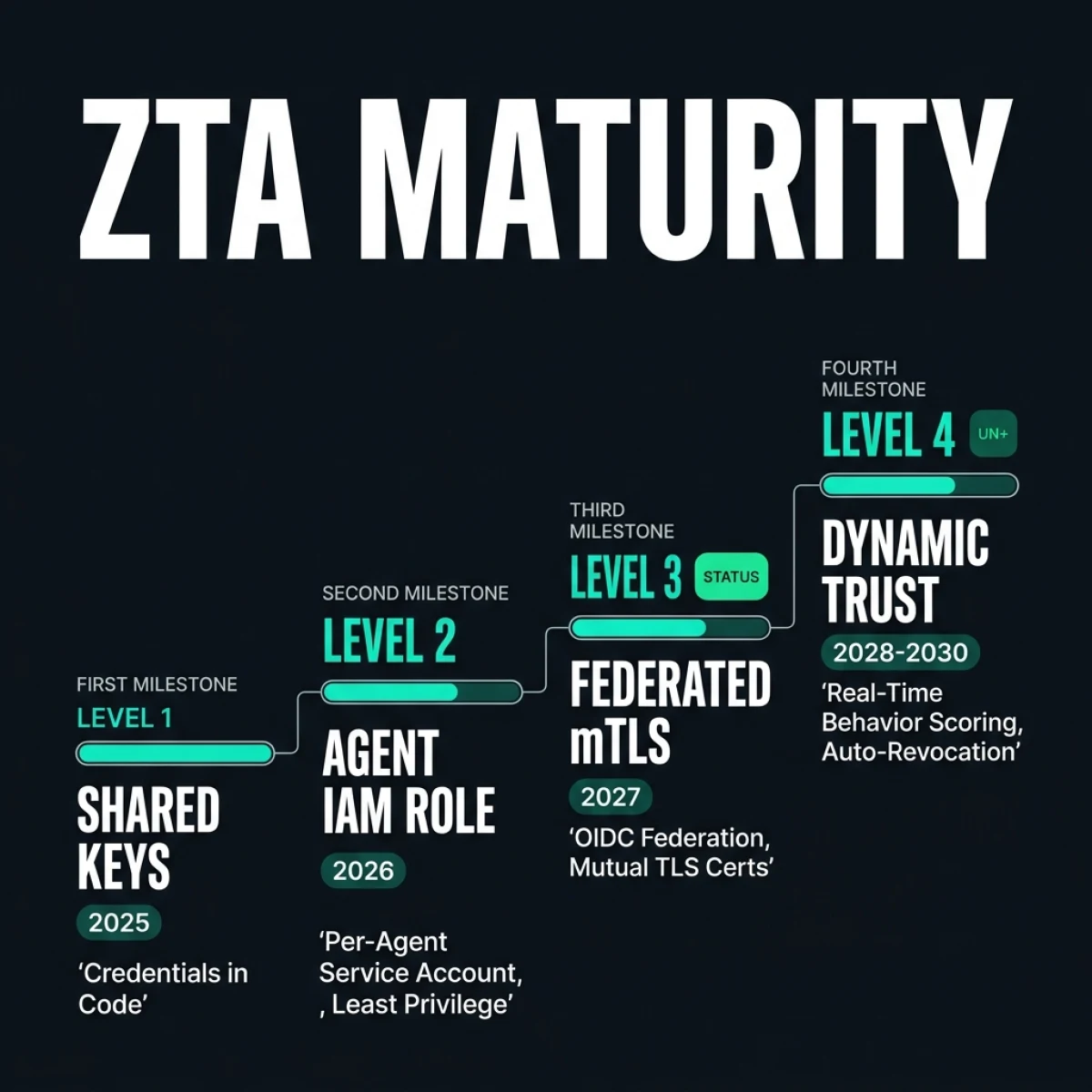
Here is the maturity roadmap for the next five years:
Level 1: Shared Keys (2025)
- Attributes: Long-lived keys in config files, shared master service accounts, zero tool scope validation, public network access to tool servers.
- Result: High compromise risk, zero audit visibility, prompt injection leads to complete data leaks.
Level 2: Isolated Agent Roles (2026 - Now)
- Attributes: Per-agent service accounts, short-lived session tokens, tool-level permission boundaries, gateway-level schema validation.
- Result: Limited blast radius, clear audit logs, prompt injection blocked at parameter boundaries.
Level 3: Federated mTLS (2027)
- Attributes: Multi-cloud OIDC identity federation, mutual TLS certification between agents and tool servers, dynamic token exchange on every tool run.
- Result: Complete removal of static credentials, secure cross-cloud workloads, verified cryptographic trust chains.
Level 4: Dynamic Behavior Trust (2028 - 2030)
- Attributes: Real-time behavior scoring for agents. If an agent calls tools in a sequence that deviates from its typical pattern or attempts to export an unusual volume of data, the ZTA controller automatically revokes its token and triggers an incident alert.
- Result: Adaptive agent security that blocks compromised behaviors dynamically, relying on human approval only for high-risk policy changes.
Key Takeaways
- AI agents are a new identity class. Do not treat them like traditional static microservices; secure them with unique, dedicated identities.
- Eliminate shared service accounts. Set up unique, dedicated IAM roles for every distinct agent to isolate your blast radius.
- Enforce least-privilege tool scopes. Validate tool access using short-lived tokens and verify parameters at the gateway before routing.
- Leverage OIDC identity federation. Use workload identity federation to securely authenticate agents across multi-cloud environments without static keys.
- Micro-segment tool connections. Run tool servers in isolated environments and restrict database access using dedicated read views.
- Audit every tool invocation. Keep structured logs of all agent actions, parameters, and outputs to build clean audit trails.
FAQ
How do we handle authentication when an agent calls third-party SaaS APIs?
Never store third-party API keys (like Slack or GitHub tokens) in the agent's code. Use your cloud secrets manager to store them securely. Grant the agent's IAM role permission to read only its respective keys. When the agent runs, it retrieves the secret dynamically from the vault, uses it to make the API call, and discards it from memory. For team collaboration tools, configure OAuth delegation so the agent acts on behalf of the user using user-scoped refresh tokens.
What is workload identity federation, and does it require custom coding?
No, workload identity federation is a built-in feature of major cloud providers (AWS, Azure, GCP). It allows you to configure your cloud provider's IAM service to trust external OIDC token issuers (like Entra ID, GitHub Actions, or Okta). You configure the trust relationship in the cloud console, and your agent client uses standard SDK calls to exchange native tokens for temporary cloud credentials.
How do we prevent an agent from leaking its system prompts to users?
This is a prompt extraction vulnerability. While IAM cannot block the model from printing text in a chat window, you can use output guardrails (like Llama Guard or custom regex validation at your gateway) to scan agent outputs for system variables or prompt instructions before they reach the user.
Can we use traditional network firewalls to secure agent tool connections?
Yes, but only as a secondary layer. Traditional network firewalls (like IP blocklists and VPC security groups) are useful for restricting traffic between your orchestrator and tool servers, but they cannot validate the content of the request or the identity of the calling agent. You must combine network firewalls with token validation and schema checks to achieve a real zero-trust posture.
How do we log agent trajectories without bloat?
Log structured traces using OpenTelemetry standards. Each run gets a parent trace_id, and each tool invocation gets a child span_id. Store the trace metadata (agent, tool, latency, token count, success status) in your search index, and archive the heavy payloads (raw prompts, tool returns) to cold storage (like S3 Glacier) with a 30-day lifecycle policy to keep database costs manageable.
What regulatory compliance frameworks address agent security?
While traditional compliance frameworks (SOC 2, ISO 27001) do not explicitly mention AI agents yet, their core directives (least-privilege access, encryption of data in transit, detailed audit trails) apply directly. Additionally, standards like NIST's Zero Trust Architecture (SP 800-207) and the OWASP Top 10 for LLMs provide clear guardrails that corporate audit teams use to evaluate agent deployments.