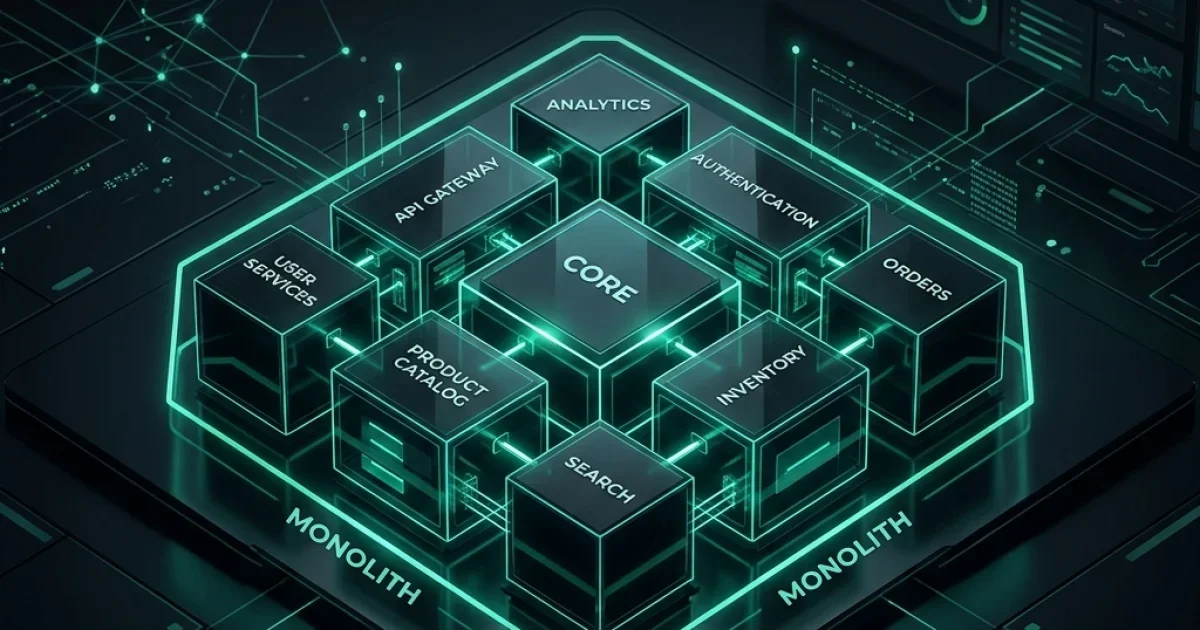
For the past decade, microservices have been the default architectural choice for scaling enterprise software systems. By decomposing large, complex codebases i…
For the past decade, microservices have been the default architectural choice for scaling enterprise software systems. By decomposing large, complex codebases into tiny, independently deployable services, organizations achieved organizational autonomy, decoupled deployments, and elastic scalability.
However, the rise of agentic AI workloads has exposed a severe bottleneck in this distributed paradigm. AI agents do not operate like standard CRUD applications. A typical REST request moves through a linear path: gateway to service, service to database, database back to gateway. In contrast, an AI agent operates as an iterative feedback loop. To solve a single user task, an agent might run dozens of model calls, retrieve chunks from vector databases, fetch user records, query system logs, and validate outcomes.
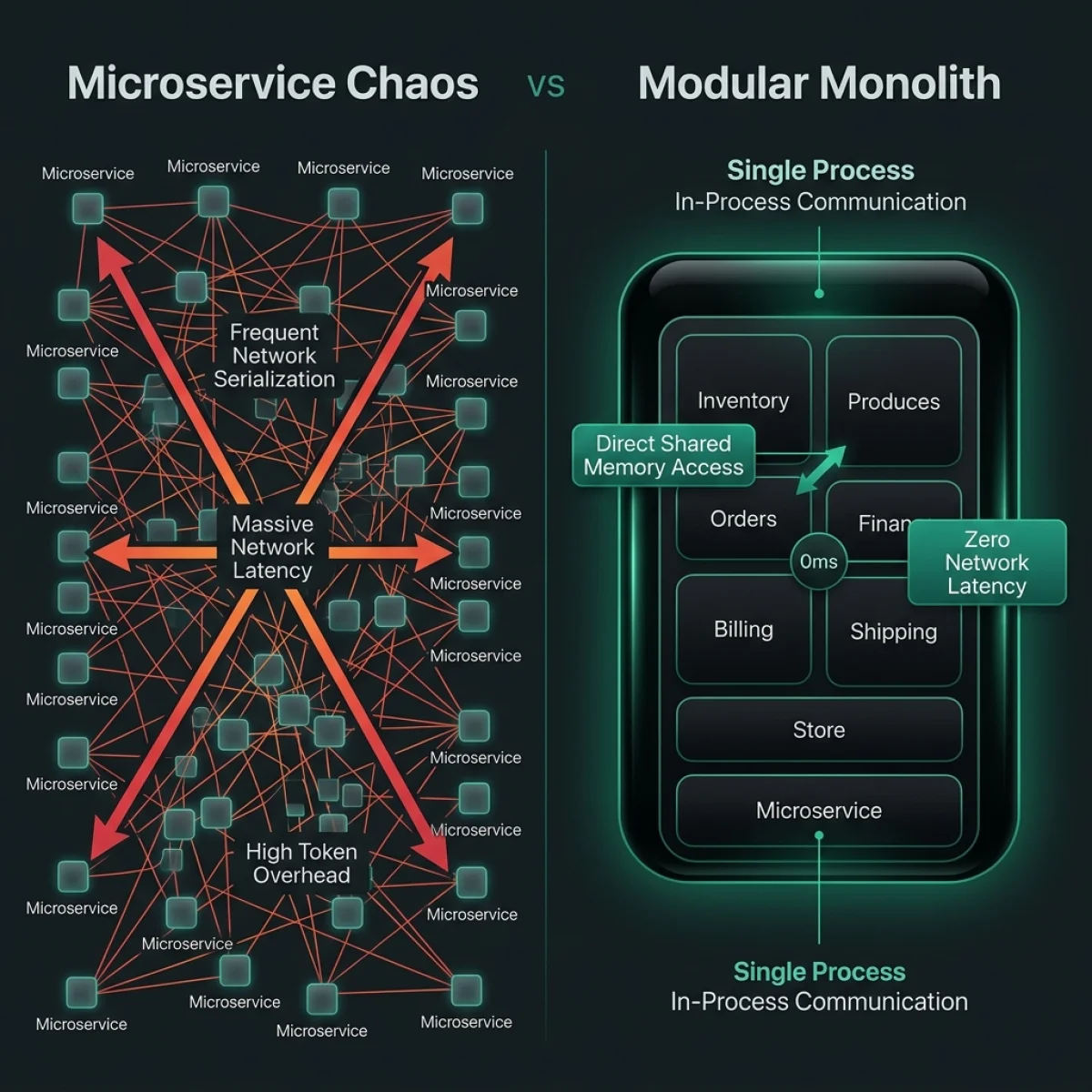
When these operations are scattered across a network of 50 microservices, the system incurs a heavy performance cost. We call this the AI Context Tax. In a microservices architecture, every step in the agent's reasoning chain must serialize context into JSON or Protobuf, transmit it over HTTP/gRPC, and deserialize it on the receiving service.
This process leads to:
- Serialization Overhead: Converting massive token payloads and embedding arrays between formats wastes CPU cycles.
- Network Hop Latency: Adding 10ms to 50ms of network latency per hop quickly adds up over 30 iterative agent steps, resulting in slow user experiences.
- Data Fragmentation: The agent cannot access the entire system's state in memory, forcing it to make repetitive network requests to rebuild context.
Let us compare the architectural transition:
To understand why microservices inflate your AI budget, we must analyze the mathematics of a distributed agentic workflow. Naive distributed architectures view network hops as negligible. However, when an LLM agent orchestrates multi-step processes, network latencies compound exponentially.
The Math of Network Latency in Iterative Loops
Suppose an autonomous agent needs to solve a transaction discrepancy. It runs an iterative loop containing $N$ reasoning steps. At each step, the agent must query:- A user account service to check status.
- A ledger service to verify balances.
- An anomaly detection service to score risks.
$$T_{\text{total}} = \sum_{i=1}^{N} \left( T_{\text{inference}, i} + \sum_{j=1}^{M} (T_{\text{network}, j} + T_{\text{serialize}, j}) \right)$$
Where:
- $N$ is the number of agent reasoning iterations (e.g., $N=15$).
- $M$ is the number of service hops per iteration (e.g., $M=3$).
- $T_{\text{network}}$ is the average round-trip network latency (e.g., $15\text{ms}$).
- $T_{\text{serialize}}$ is the CPU time spent on JSON/Protobuf parsing (e.g., $5\text{ms}$).
$$\text{Overhead} = 15 \times 3 \times (15\text{ms} + 5\text{ms}) = 900\text{ms}$$
Nearly a full second is wasted just moving bytes over the network! In a modular monolith, where communication happens via direct, in-process function calls, $T_{\text{network}}$ and $T_{\text{serialize}}$ drop to near zero ($\le 0.1\text{ms}$). The overhead decreases from 900ms to less than 5ms, making the system run significantly faster.
When we zoom in on these hops, we see that they are subject to TCP Congestion Control and TCP Head-of-Line Blocking. Because microservices communicate over TCP sockets, any dropped packet on a congested virtual switch in your Kubernetes cluster stalls the entire agent reasoning step. The agent planner must pause its reasoning loop, waiting for the TCP stack to retransmit the missing packet. This variability makes it impossible to guarantee consistent latency profiles for user-facing agent systems.
The Serialization and Deserialization Bottleneck
AI context payloads are large. A single prompt context can contain system state files, schema mappings, and chat history totaling 50,000 tokens (approx. 200KB of text). Serializing and deserializing this string across multiple HTTP boundaries consumes substantial CPU power.Let us inspect the lifecycle of a single string payload moving across a microservices network:
- JSON Serialization: The source service parses its in-memory JavaScript object graph, converting it into a UTF-8 JSON string. This operation blocks the single-threaded Node.js event loop.
- Buffer Allocation: The runtime allocates memory buffers to prepare the HTTP request payload.
- Socket Write: The buffer is written to the TCP socket, moving through the host operating system's kernel space.
- Network Transport: The packet moves across virtual switches and routers in your cloud cluster.
- Kernel Ingest: The destination OS reads packets from the network interface card into kernel space.
- JSON Deserialization: The destination Node.js process parses the string buffer back into an in-memory object graph, blocking its event loop.
Context Fragmentation and the State Sync Nightmare
Beyond performance, microservices create a cognitive challenge for agents. In a microservices mesh, no single service has access to the global system state. Instead, state is fragmented across isolated databases.If an agent needs to reason about a transaction anomaly, it cannot run a query that spans both the ledger and user databases directly. Instead, it must invoke separate APIs to fetch fragments of data, perform in-process joins, and compile the context manually. This fragmentation results in:
- Repetitive Queries: The agent makes duplicate calls to the same services to fetch overlapping data.
- State Inconsistency: By the time the agent queries the ledger service, the user state on the user service may have changed, leading to inconsistent context.
- Stale Context: The agent reasons using snapshot data that does not reflect real-time changes.
The Intelligent Monolith Architecture Blueprint
An Intelligent Modular Monolith is not a chaotic, tangled codebase. It maintains the same logical separation of concerns as microservices, but packages them into a single deployable artifact.
The architecture consists of three core components:
- Logical Modules: Isolated domain packages (e.g.,
user-module,payment-module,agent-orchestrator) that interact through defined public interfaces. - In-Memory Broker: A lightweight, compile-time routing layer that routes calls between modules using memory pointers, preventing network serialization.
- Shared Memory Context (Node v26 SharedArrayBuffer): A shared memory space that lets multiple thread workers access agent context pools without copying data.
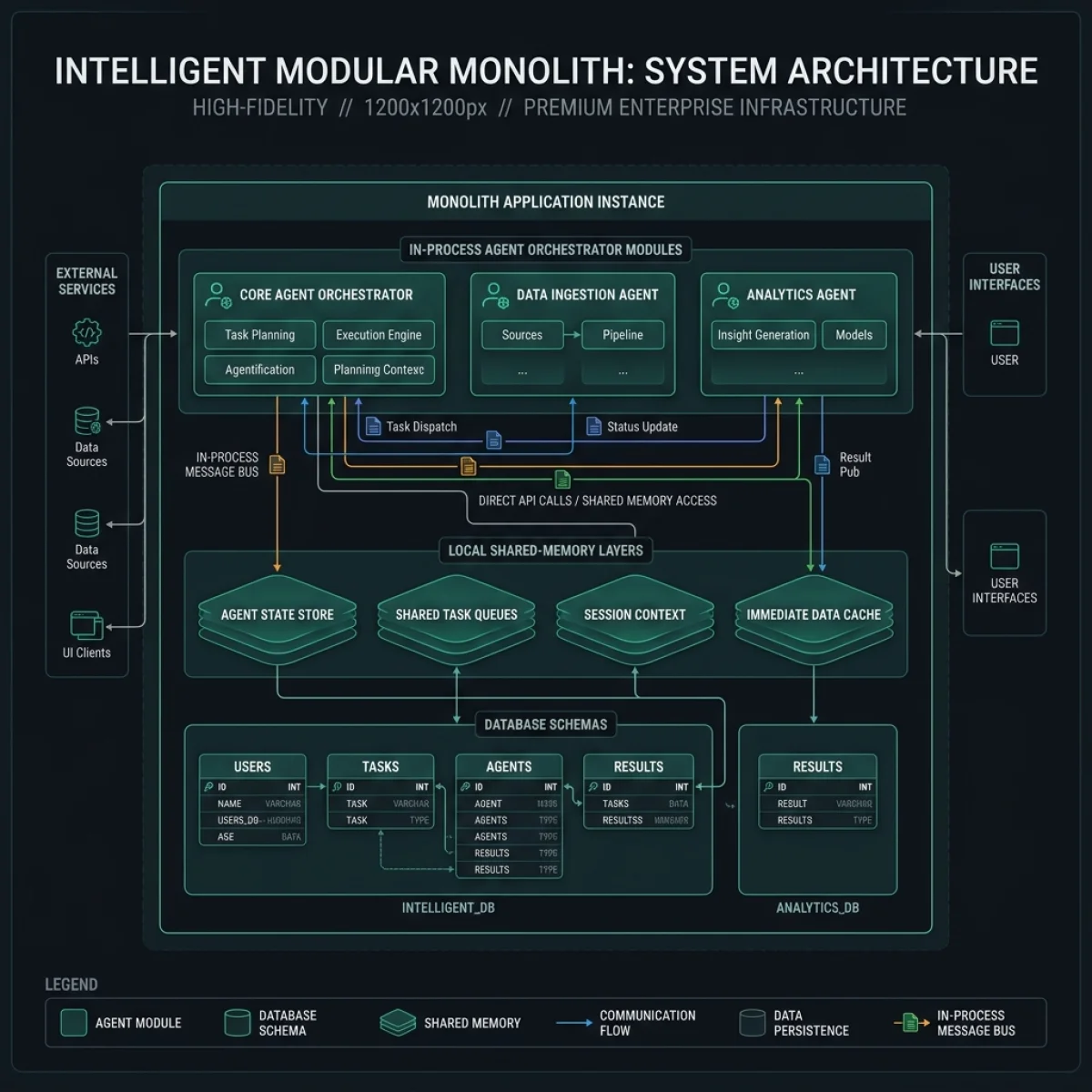
By running modules in a single process, you eliminate the need for API gateways, message queues, and service meshes for internal communication, simplifying your operational footprint.
In-Memory Communication and Code Routing
How do modules communicate in a modular monolith without creating tight coupling? The answer lies in Interface-Based In-Memory Routing.
Instead of importing classes directly from other modules, modules publish their interfaces to a central, in-process broker. When the agent-orchestrator module needs to fetch ledger data, it requests the ledger service from the broker. The broker returns the service instance, and the orchestrator calls the method directly.
Let us visualize this in-memory routing flow:
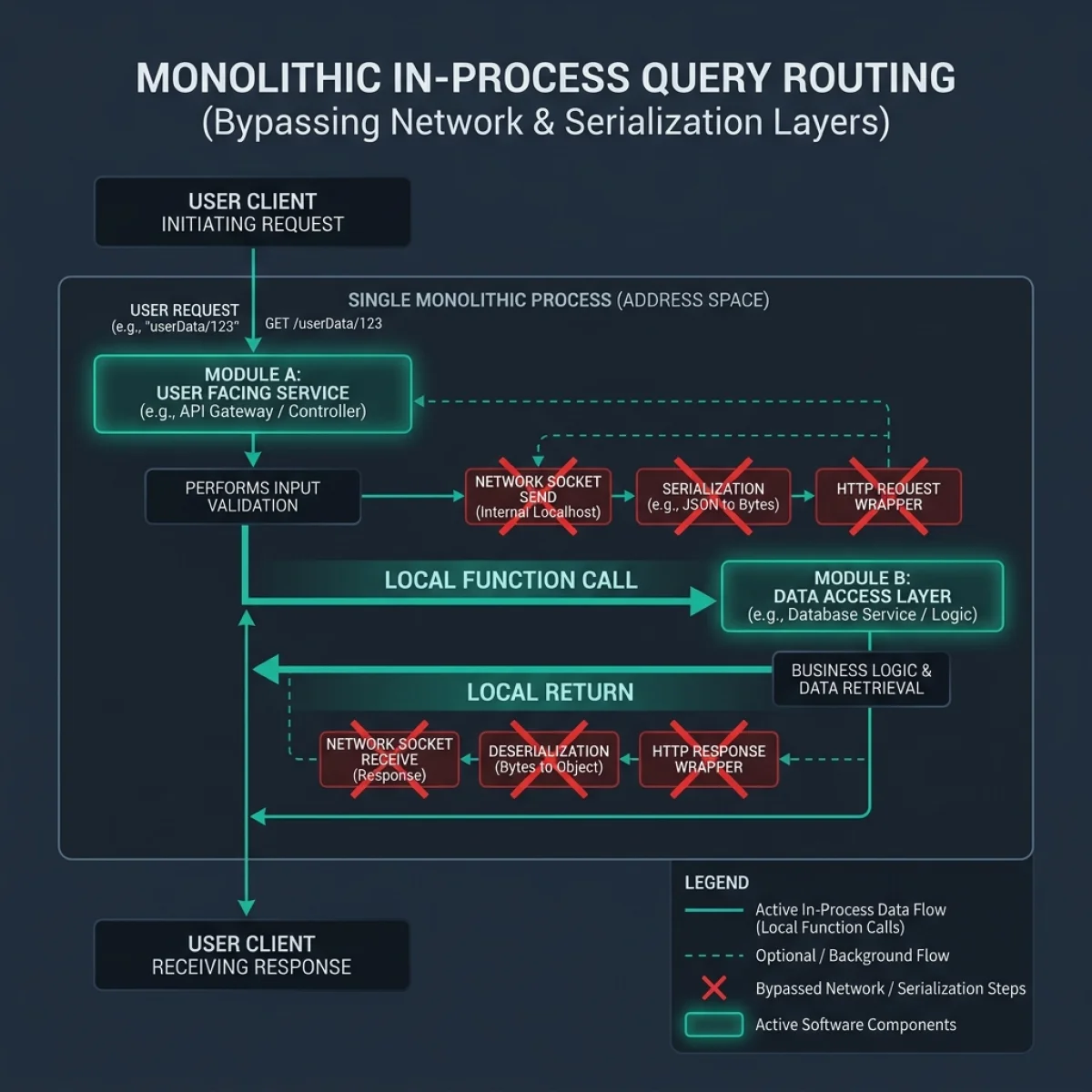
Because there are no network hops, the compiler can optimize these calls. If the compiler detects that a method call has no side effects, it can inline the function, reducing execution overhead to CPU clock cycles.
Node.js v26 Multi-Threading & Concurrency for Agent Squads
A common argument against monoliths in runtimes like Node.js is the single-threaded nature of the event loop. If an agent performs heavy CPU-bound tasks, such as running local inference, tokenization, or vector math, it can saturate the V8 main thread. This blocks the event loop, causing high latency for all other incoming user requests.
Node.js v26 solves this through improved support for Worker Threads, Isolated Contexts, and Shared Memory primitives.
The Worker Thread Pool and V8 Isolate Architecture
Unlike traditional process spawning (which creates entirely new OS processes with 30MB+ of overhead each), Node.js v26 Worker Threads run separate V8 isolates inside the same process space. Each isolate contains its own heap, call stack, and event loop, but shares the process's native file descriptors and network sockets.In an Intelligent Monolith, we dedicate a pool of Worker Threads specifically to agent solver routines:
- Event Loop Isolation: The main HTTP server thread receives public requests and immediately delegates reasoning workloads to the agent worker pool. The main event loop remains free to serve incoming connections with sub-millisecond response times.
- Dynamic Thread Scaling: The thread pool auto-adjusts its size based on CPU core availability and core load, preventing thread thrashing.
Zero-Copy Shared Memory Context (SharedArrayBuffer)
In older Node.js versions, passing data between threads required usingpostMessage(). Under the hood, this executes the Structured Clone Algorithm, which serializes the object, copies it across thread boundaries, and deserializes it in the destination worker. For an agent context containing hundreds of pages of logs or API outputs, this copy tax consumes hundreds of milliseconds.
Node.js v26 optimizes this with SharedArrayBuffer. Multiple threads can map their memory pointers to the same raw bytes in physical RAM.
Let us inspect the coordination of a multi-agent squad using shared memory:
- Thread 1 (Planner Isolate): Writes the agent's high-level task plan to the
SharedArrayBufferbuffer. - Thread 2 (Search Retriever Isolate): Reads the plan directly from the buffer, queries local SQLite databases, and writes the retrieved context back to the same buffer.
- Thread 3 (Validator Isolate): Scans the buffer to verify formatting, check token limits, and run syntax checks in parallel.
Lock-Free Synchronization via Atomics
Because multiple threads are reading and writing to the same memory segment, you run the risk of race conditions and write collisions. To resolve this, Node.js v26 exposes theAtomics namespace, providing lock-free thread synchronization:
- Atomic Operations:
Atomics.add(),Atomics.sub(), andAtomics.compareExchange()ensure that integers in the shared memory (like lock states or counters) are updated in a single CPU instruction, preventing dirty writes. - Wait and Notify: Threads can yield their CPU slots by calling
Atomics.wait(), resuming only when another thread callsAtomics.notify(). This avoids CPU-wasting polling loops.
// Worker thread waiting lock-free for context updates
const int32View = new Int32Array(sharedBuffer);
// Pause execution until index 0 is updated to 1
Atomics.wait(int32View, 0, 0);
// Wake up and read the new context from shared memory...
By leveraging this low-level architecture, a modular monolith achieves thread-safe concurrency that rivals C++ or Rust, with the developer-friendly syntax of JavaScript.
Node.js v26 In-Memory Broker Code
To demonstrate how to implement in-process routing in Node.js v26, let us inspect a complete, production-grade class InProcessAgentBroker. This class manages module registration, handles dependency injection, and routes calls using direct memory pointers.
/**
 * InProcessAgentBroker
 * Production-ready in-memory service registry and dispatcher.
 * Eliminates HTTP/gRPC serialization overhead for modular monoliths.
 */
class InProcessAgentBroker {
    constructor() {
        this.services = new Map();
        this.telemetryLogs = [];
        this.activeTransactions = 0;
    }

    /**
     * Registers a service module interface with the broker.
     * @param {string} serviceName - Unique identifier for the service.
     * @param {Object} serviceInstance - The instantiated class implementing the service.
     */
    registerService(serviceName, serviceInstance) {
        if (this.services.has(serviceName)) {
            throw new Error(`Service ${serviceName} is already registered.`);
        }
        this.services.set(serviceName, serviceInstance);
        this.logTelemetry("service_registered", { serviceName });
    }

    /**
     * Resolves a registered service interface.
     * @param {string} serviceName - Name of the service to resolve.
     * @returns {Object} The service instance pointer.
     */
    resolveService(serviceName) {
        const service = this.services.get(serviceName);
        if (!service) {
            throw new Error(`Service ${serviceName} not found in registry.`);
        }
        return service;
    }

    /**
     * Executes a module-to-module service method in-process with telemetry tracing.
     * @param {string} serviceName - Target service identifier.
     * @param {string} methodName - Method to invoke.
     * @param {Array} args - Arguments to pass to the method.
     * @returns {Promise<any>} The result of the method invocation.
     */
    async call(serviceName, methodName, args = []) {
        const service = this.resolveService(serviceName);
        if (typeof service[methodName] !== 'function') {
            throw new Error(`Method ${methodName} does not exist on service ${serviceName}.`);
        }

        const txId = Math.random().toString(36).substring(2, 9);
        const startTime = performance.now();
        this.activeTransactions++;

        this.logTelemetry("invocation_start", { txId, serviceName, methodName, arguments_count: args.length });

        try {
            // Direct in-process invocation - no network sockets, zero serialization!
            const result = await service[methodName](...args);
            const durationMs = performance.now() - startTime;

            this.logTelemetry("invocation_success", { txId, serviceName, methodName, durationMs });
            return result;
        } catch (error) {
            const durationMs = performance.now() - startTime;
            this.logTelemetry("invocation_failure", { txId, serviceName, methodName, durationMs, error: error.message });
            throw error;
        } finally {
            this.activeTransactions--;
        }
    }

    /**
     * Records execution telemetry logs for system audits and performance profiling.
     */
    logTelemetry(event, details) {
        const entry = {
            event,
            timestamp: new Date().toISOString(),
            details
        };
        this.telemetryLogs.push(entry);
        console.log(`[MONOLITH-BROKER][${event.toUpperCase()}]`, JSON.stringify(details));
    }
}

// Example usage demonstration
(async () => {
    // 1. Define Module A: Ledger Service
    class LedgerService {
        async getBalance(accountId) {
            // Simulate lightweight database lookup
            return { accountId, balance: 14205.50, currency: "USD" };
        }
    }

    // 2. Define Module B: Agent Orchestrator
    class AgentOrchestrator {
        constructor(broker) {
            this.broker = broker;
        }

        async runReconciliation(accountId) {
            // Orchestrator calls Ledger service dynamically via the in-process broker
            const ledgerData = await this.broker.call("LedgerService", "getBalance", [accountId]);

            return {
                status: "success",
                accountId: ledgerData.accountId,
                reconciled_balance: ledgerData.balance,
                latency: "0ms (in-process lookup)"
            };
        }
    }

    // Initialize broker and services
    const broker = new InProcessAgentBroker();
    const ledger = new LedgerService();
    const orchestrator = new AgentOrchestrator(broker);

    broker.registerService("LedgerService", ledger);
    broker.registerService("AgentOrchestrator", orchestrator);

    // Run reconciliation loop
    console.log("Starting in-process agent execution test...");
    const result = await broker.call("AgentOrchestrator", "runReconciliation", ["acc_9901"]);

    console.log("RECONCILIATION RESULT:\n", JSON.stringify(result, null, 2));
})();
Sequence of In-Process Context Resolution
In an Intelligent Monolith, the context resolution process is simplified. Because there are no network boundaries, we can trace the execution flow through a single, continuous call stack.
Let us trace a user request as it moves through the system modules:
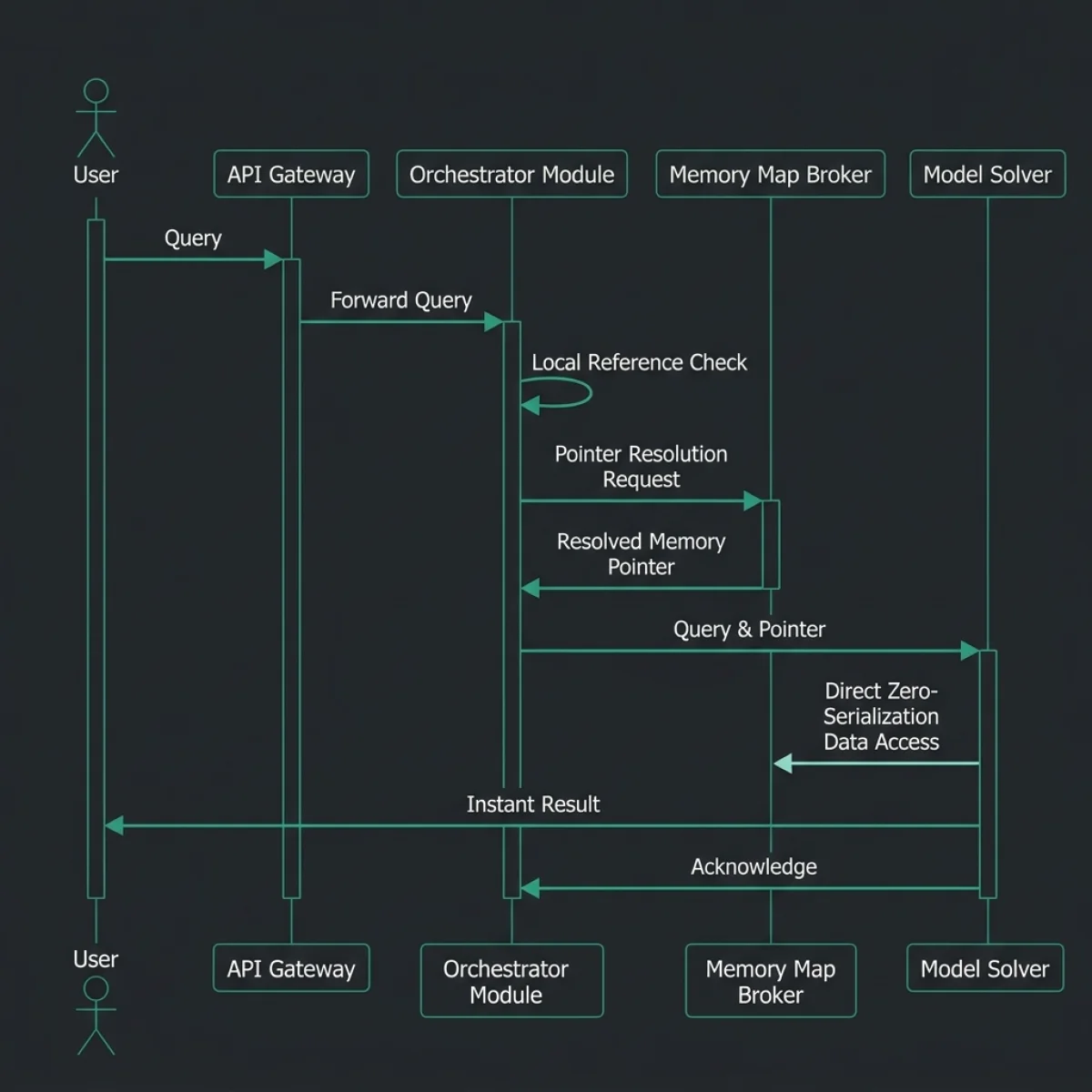
In this sequence, the memory broker handles references to the shared data pool. This allows modules to query data without copying it, preserving your system's memory footprint under heavy loads.
Service Extraction Gates & Monolith Governance
Service Extraction Gates & Monolith Governance
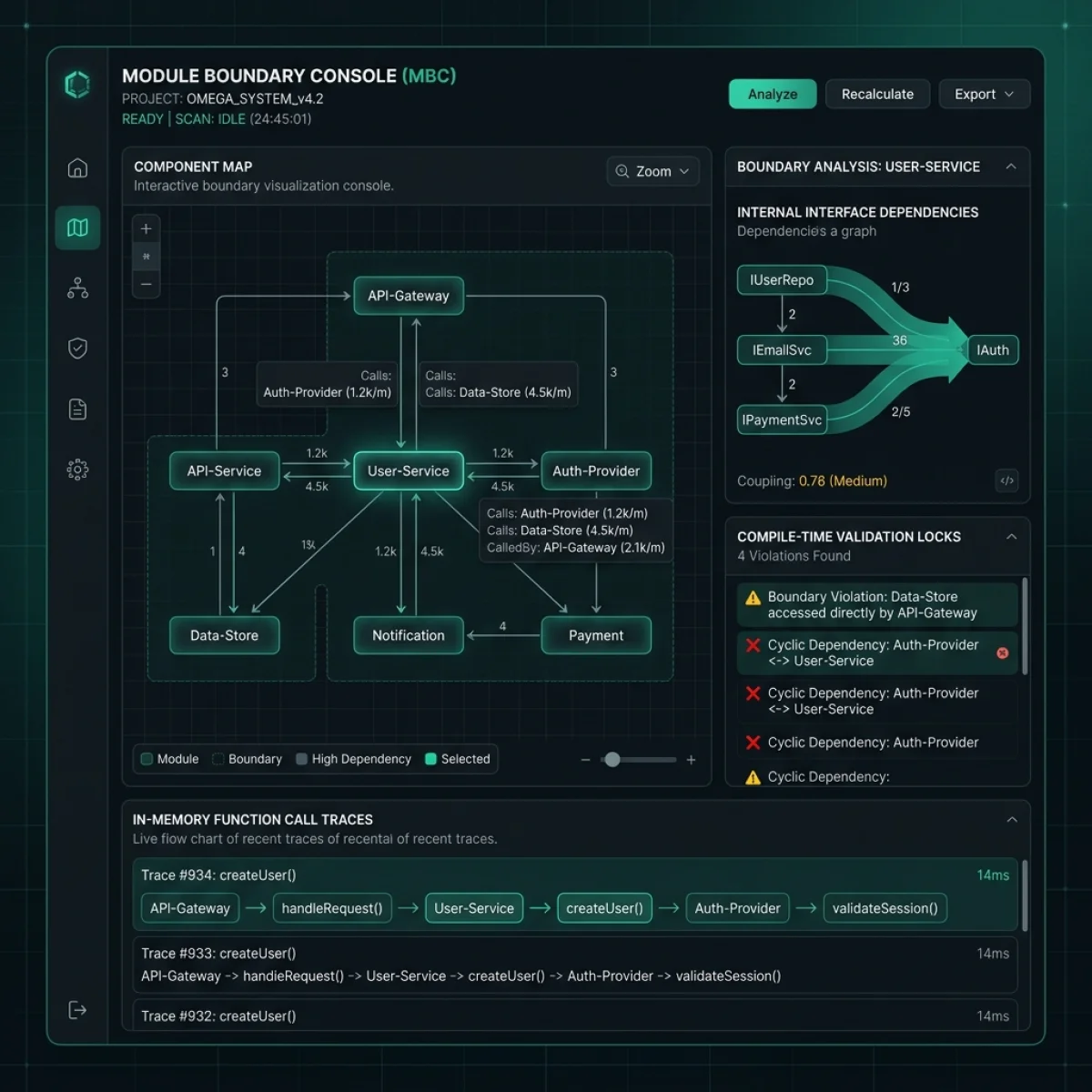
While modular monoliths offer performance benefits, they can degrade into a "spaghetti codebase" if developers import classes across modules directly instead of using the memory broker. This bypasses the modular boundary, creating coupling that makes future services extraction difficult.
To prevent this decay, platform engineering teams must enforce strict Service Extraction Gates at compile-time, commit-time, and run-time.
1. AST-Based Static Dependency Enforcements
We use static analysis to enforce import boundaries. Rather than scanning text files manually, our CI pipelines parse files into Abstract Syntax Trees (ASTs) using tools likedependency-cruiser or custom ESLint rules (such as eslint-plugin-import).
Here is a standard configuration mapping our allowed dependencies:
{
  "forbidden": [
    {
      "name": "no-private-cross-imports",
      "severity": "error",
      "comment": "Prevent direct imports of another module's private internal implementations.",
      "from": { "path": "^app/modules/([^/]+)/" },
      "to": {
        "path": "^app/modules/([^/]+)/",
        "pathNot": [
          "^app/modules/$1/",
          "^app/modules/([^/]+)/public-api\\.js$"
        ]
      }
    }
  ]
}
This rule ensures that a file in payment-module can only import code from user-module if it references the explicit public API gateway interface (user-module/public-api.js). Any attempt to import internal classes or sub-directories (e.g., user-module/private/database-connector.js) triggers an error and blocks the commit.
2. Runtime Interface Proxying
To harden these boundaries, the memory broker can wrap returned service instances in a JavaScript Proxy. The Proxy interceptor validates the caller's context:- Caller Verification: Checks the stack trace to confirm the invoking function resides within a registered module.
- Payload Validation: Ensures arguments passed to the interface conform to predefined JSON schemas or TypeScript types, preventing dirty data injection.
- Performance Profiling: Logs call latency, tracking memory overhead and call frequency across module boundaries.
3. Service Contract Integration Testing
Every public module API must publish a contract mock interface. The consuming module runs unit tests against these mocks. If a module owner updates a public method schema, the breaking change is caught immediately during local testing before merging, keeping the system stable.Let us inspect a mockup of the module boundary visualization tool:
FinOps Analysis: Network Fees vs Local Inference Budgets
To justify migrating from microservices to a modular monolith, platform teams can run financial comparisons. The financial benefits of modular monoliths are particularly evident in the latency profiles of high-volume transactions, but the billing improvements are even more dramatic.
1. The Hidden Cloud Data Transfer Tax
In a microservices architecture running on cloud providers like AWS, GCP, or Azure, data transfer is rarely free. When services reside in different availability zones (AZs) for high availability, cross-AZ traffic is billed at standard rates (e.g., $0.01 per GB in each direction). For a chat session with 100,000 tokens of context, that is approx. 400KB of payload.Let us compute the monthly data transfer cost for an enterprise system handling 5 million agent operations daily, where each operation averages 4 cross-service hops:
$$\text{Data Volume} = 5,000,000 \times 4 \times 400\text{KB} = 8,000\text{GB} = 8\text{TB per day}$$
At $0.02 per GB for cross-AZ round-trips, this totals:
$$\text{Daily Cost} = 8,000 \times \$0.02 = \$160\text{ per day} = \$4,800\text{ per month}$$
Nearly $5,000 a month is wasted purely on internal data transfer network charges! By running the services in a single process inside a modular monolith, this data transfer happens in-process within local RAM, incurring exactly $0.00 in cloud data transfer fees.
2. NAT Gateway and Load Balancer Surcharges
When microservices call external LLM APIs (like OpenAI or Anthropic) or search engines (like Perplexity), they route requests through NAT Gateways and API Load Balancers. Cloud providers bill not only for the gateway instance itself but also run a data processing fee (e.g., $0.045 per GB processed by AWS NAT Gateway).By consolidating your agent orchestrator, search sdk, and database connector into a single process node, you reduce the number of redundant NAT gateway crossings, lowering gateway throughput fees.
3. CPU Core Density Optimization
Because microservices must run their own runtime engines, web servers, and logging agents, they carry high baseline memory and CPU overhead. Spawning 50 separate Node.js containers requires 50 copies of the V8 engine, consuming substantial idle RAM.Consolidating these services into a single modular monolith allows the OS to share connection pools, cache memory, and CPU threads efficiently. This increases resource density, allowing you to run the same business logic on smaller server instances.
Let us inspect the telemetry data comparing transaction response profiles:

At scale, the microservices architecture shows high latency due to network congestion and queue overhead, while the modular monolith maintains sub-millisecond response times.
Let us compare the operational cost factors:
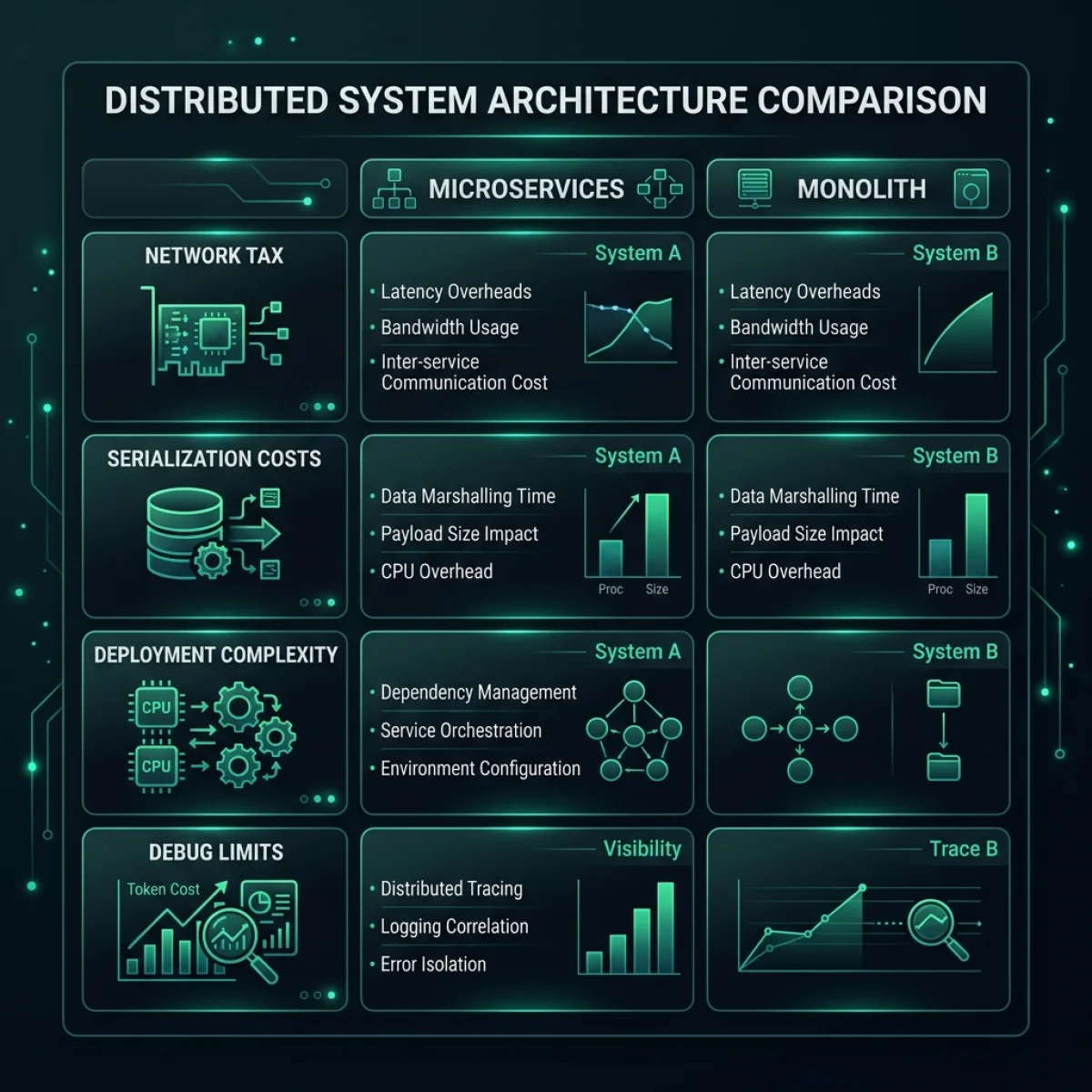
Let us summarize the operational trade-offs of both options:
| Cost / Performance Dimension | Microservices Architecture | Modular Monolith (Node v26) |
|---|---|---|
| Network Fee overhead | High (gRPC/HTTP payload traffic) | Zero ($0.00 internal routing) |
| CPU Serialization Tax | 15–25% CPU cycles spent on JSON | Zero (Direct memory pointers) |
| Telemetry Complexity | High (Requires distributed trace IDs) | Low (Single process call stack) |
| Cold-Start Latency | High (Container bootstrap times) | Low (Single application process) |
| Local Inference Speed | Bottlenecked by data transport | Optimized (SharedArrayBuffer) |
Checklist for Engineering Teams: Migrating from Microservices
If you are planning to migrate your agent workflows from microservices to a modular monolith, use this phased migration plan:
Phase 1: Define Module Boundaries
- [ ] Group related microservices into logical directory modules in a single repository.
- [ ] Wrap each module's public methods in a clear service interface class.
- [ ] Set up linting rules to prevent direct imports between modules.
Phase 2: Implement the In-Memory Broker
- [ ] Register all service interfaces with an in-process memory broker.
- [ ] Update call sites to use the broker instead of HTTP clients.
- [ ] Run automated tests to verify that business logic remains unchanged.
Phase 3: Optimize for Node.js v26
- [ ] Move CPU-heavy agent tasks into Worker Threads.
- [ ] Configure
SharedArrayBufferto share context pools between worker threads. - [ ] Monitor CPU and memory utilization to verify performance gains.
Frequently Asked Questions (FAQ)
Q1: Does a modular monolith mean we lose independent deployment?
Yes, you deploy the modular monolith as a single compiled or packaged application process. While this means you lose the ability to deploy individual functions independently (as you would in a serverless or microservice architecture), the operational benefits are massive. You no longer have to manage Kubernetes ingress controller rules, complex service meshes, API gateway routing protocols, or Helm configuration charts for minor changes. Furthermore, by enforcing strict module boundaries in your codebase, multiple development teams can work inside their designated module directories and run automated unit tests independently without stepping on each other's code.Q2: How does Node.js v26 prevent thread blocking under high CPU load?
Node.js v26 leverages Worker Threads to isolate CPU-intensive agent solver workflows from the main event loop thread that handles incoming HTTP client requests. Each worker thread runs a completely separate V8 isolate instance. When a request comes in, the main thread schedules the execution job to the agent worker pool and resumes listening to the network socket immediately. This architecture ensures your server remains highly responsive and avoids event-loop starvation even when agents are running local tokenization, regex-based context cleanups, or mathematical scoring algorithms.Q3: What is the recommended size and boundary rule for a modular monolith?
A modular monolith can comfortably scale to hundreds of logical modules. The core guideline is that modules should reflect business domains (Domain-Driven Design) rather than arbitrary code divisions. If a specific module grows to require unique hardware configurations (such as intensive GPU computing or specialized Python libraries like NumPy), you can extract that single module into an external microservice while keeping the core business logic and database modules inside the modular monolith.Q4: How do we debug in-process communication compared to distributed systems?
Debugging microservices requires complex distributed tracing tools like Jaeger, OpenTelemetry, and correlation ID injection across every network request. In a modular monolith, because all calls run within a single process space, you can trace execution paths using standard Node.js debugging tools and inspect variables directly in local call stacks. You can set standard IDE breakpoints, step into module interface methods, and view complete trace history with zero external infrastructure overhead.Q5: Can we share database connections across modules?
To preserve modularity, modules should never run direct cross-schema queries or joins in SQL. Each module must own its logical database schema tables. While modules can share a physical connection pool configuration for database resources, they should interact with other modules' data exclusively through public API interfaces resolved by the broker. This approach maintains data isolation and ensures that if you decide to extract a module into a standalone microservice in the future, you can migrate its schema without rewriting other modules' database scripts.Q6: How do we prevent data corruption and race conditions in SharedArrayBuffer?
Managing shared memory in JavaScript requires strict coordination using theAtomics namespace. You should never write raw bytes to a SharedArrayBuffer from multiple threads simultaneously. Instead, use atomic locking variables. For example, before a worker thread writes to the shared context, it must check and set an atomic spin-lock using Atomics.compareExchange(). This prevents write collisions and ensures that context updates remain thread-safe and consistent across all execution threads.
References & Industry Standards
- Node.js v26 Release Notes: Worker Threads, SharedArrayBuffer, and V8 performance improvements. nodejs.org
- Modular Monolith Architecture: Principles of Domain-Driven Design and modular boundary enforcement. martinfowler.com
- OWASP LLM Security guidelines: Securing in-process execution gates. owasp.org
- FinOps Cloud Billing Standards: Measuring network egress costs in distributed architectures. finops.org
Structured Metadata Schema (JSON-LD)
{
  "@context": "https://schema.org",
  "@type": "BlogPosting",
  "mainEntityOfPage": {
    "@type": "WebPage",
    "@id": "https://agiletechguru.com/blog/intelligent-modular-monolith-node-v26-ai-inference"
  },
  "headline": "The Intelligent Monolith — Why Microservices Are Taxing Your AI Inference Budget (Node v26 Edition)",
  "description": "Discover why microservices inflate AI inference budgets. Learn how modular monoliths on Node v26 eliminate network hop tax and serialize token contexts.",
  "image": "https://agiletechguru.com/uploads/content/blog/intelligent-modular-monolith-node-v26-ai-inference/banner.webp",
  "author": {
    "@type": "Person",
    "name": "Vatsal Shah",
    "url": "https://shahvatsal.com"
  },
  "publisher": {
    "@type": "Organization",
    "name": "Agile Tech Guru",
    "logo": {
      "@type": "ImageObject",
      "url": "https://agiletechguru.com/assets/images/logo.png"
    }
  },
  "datePublished": "2026-07-16T00:00:00+05:30",
  "dateModified": "2026-07-16T00:00:00+05:30"
}