Managed agents ship Tuesday. Self-hosted agents ship architecture. Pick wrong and portability becomes a fantasy slide. Here is how to evaluate the TCO, compliance, and coupling.
- The Architectural Crossroads: Instant SaaS vs. Portable Infrastructure
- The Four Core Decision Signals
- Economics at Scale: The TCO Crossover Model
- The Hybrid Agent Harness: Decoupling Control from Execution
- The Multi-Provider Model Routing Implementation
- Compliance, Memory Ownership, and Data Sovereignty
- The Vendor Coupling Risk Register and Procurement Checklist
- When to Buy (Managed) vs. When to Build (Self-Hosted)
- Frequently Asked Questions (FAQ)
- References & Authoritative Standards
The race to deploy autonomous AI agents inside the enterprise has sparked a quiet civil war within engineering leadership. Product managers, eager to hit quarterly release dates, advocate for managed SaaS platforms (such as OpenAI Assistants API, Microsoft Copilot Studio, or Anthropic Console). These platforms offer instant onboarding, hosted vector stores, and automated session thread management. Product teams can ship a functional agent script by Tuesday afternoon.
Platform architects and CISOs, on the other hand, raise red flags. They look at the proprietary APIs, the opaque pricing structures, and the external data transfers, and they see a massive architecture trap. They argue for a custom, self-hosted agent harness built on top of open frameworks (like LangGraph, Backstage, and local WebAssembly microVMs).
The choice between managed vs self-hosted agents is not simply a debate about hosting: it is a fundamental architectural decision that determines who owns your enterprise intellectual property, how you scale under heavy load, and how tightly your code is coupled to specific model vendors.
Choosing the wrong model leaves the enterprise vulnerable to high operational costs, vendor vendor coupling agent platform traps, and security compliance failures. To make an objective choice, engineering leaders must move past the marketing decks and evaluate the underlying infrastructure mechanics.
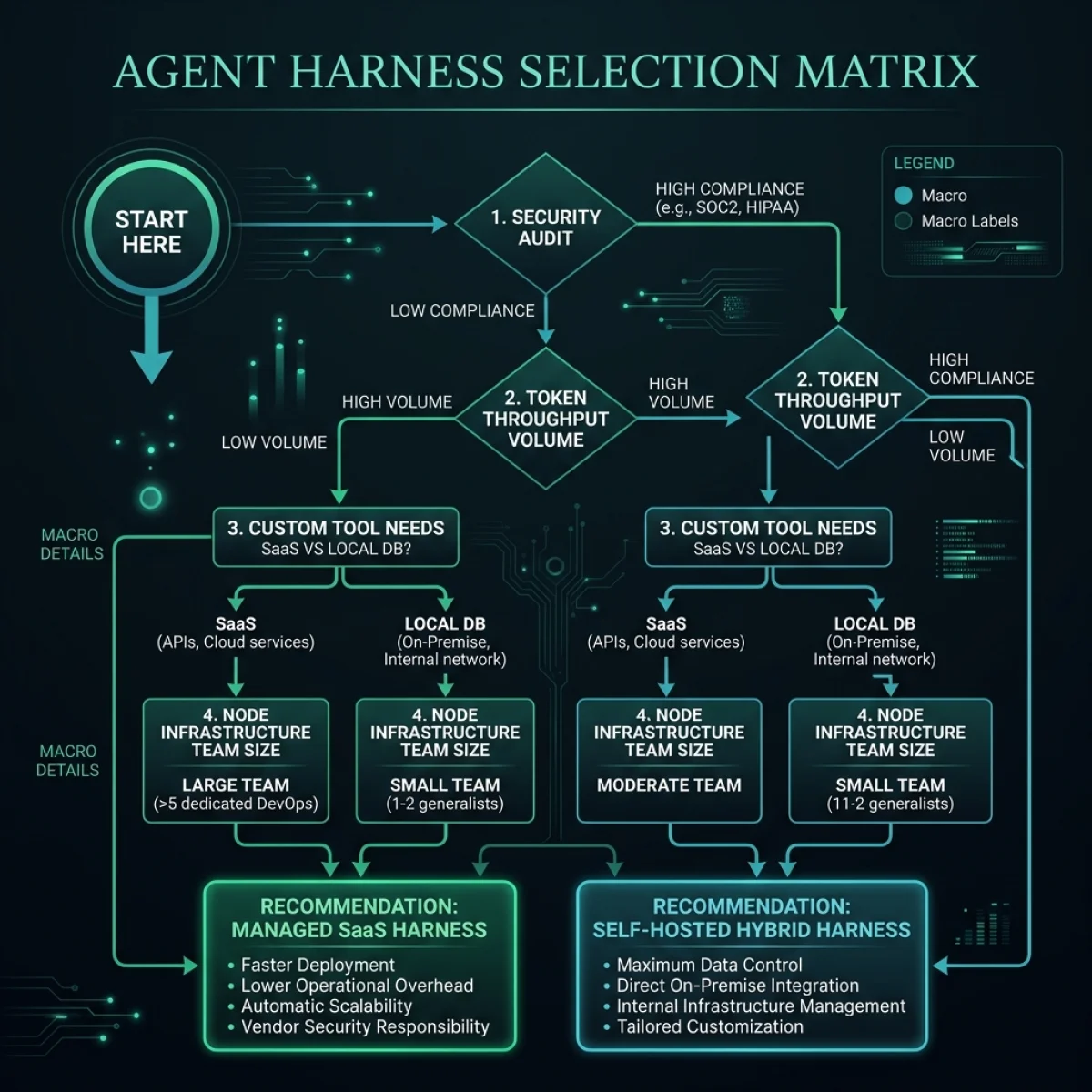
Before committing to an agentic platform design, engineering teams must evaluate their workloads against four primary selection signals:
1. Compliance Boundaries
Does your agent interact with personally identifiable information (PII), medical records (HIPAA), or financial logs (PCI-DSS)? Managed SaaS platforms process execution traces on external servers. Even with data processing agreements (DPAs), auditing the memory buffer of a model running on a third-party host is practically impossible.A self-hosted harness runs all prompt assembly, tool execution, and local database queries inside your enterprise virtual private cloud (VPC), satisfying strict data protection mandates.
2. Memory & Context Ownership
Where do conversation histories, vector databases, and long-term memory buffers reside? In a managed environment, memory is stored within the vendor's database. If you decide to migrate from one provider to another, extracting this context history in a clean, portable format is incredibly difficult.In a self-hosted harness, you maintain absolute memory ownership agents control, storing context blocks in local databases (such as PostgreSQL with pgvector) that remain independent of model providers.
3. Model Provider Lock-in Tolerance
Are you willing to couple your application logic to a single model provider's API structure? Managed engines often use proprietary extensions (e.g., OpenAI's assistant tool schemas). Migrating these agents to run on DeepSeek, Anthropic, or local open-source models requires rebuilding the entire orchestration layer.A self-hosted harness acts as an abstraction proxy, translating standard templates into provider-specific formats dynamically.
4. Outbound Token Scale
At small test scales, managed wrappers are highly cost-effective. But as agent swarms begin executing hundreds of thousands of daily loops—querying APIs, checking codebases, and monitoring logs—the cost of managed platform wrapping fees (per-session rates, proprietary storage fees, and premium API markup) becomes unsustainable.Let us inspect the decision matrix flowchart:
Economics at Scale: The TCO Crossover Model
To justify the engineering resource investment required to build and maintain a self-hosted harness, leaders must analyze the Total Cost of Ownership (TCO) crossover point.
Let us evaluate the cost variables of both approaches.
Managed SaaS TCO Formula
The cost of running agents on a managed cloud platform is defined by model input/output token fees plus platform-specific wrapping surcharges:$$TCO_{Managed} = \sum (Tokens_{in} \times P_{in} + Tokens_{out} \times P_{out}) + N_{sessions} \times S_{session} + C_{storage} \times V_{GB}$$
Where:
- $P_{in}$ and $P_{out}$ are the vendor's model API rates.
- $S_{session}$ is the platform-specific overhead charge per conversation session (e.g. OpenAI's Assistant thread storage and file search fees).
- $C_{storage}$ is the vector search indexing cost per gigabyte ($V_{GB}$).
Self-Hosted / Hybrid TCO Formula
Building a custom harness involves direct compute infrastructure costs and platform team maintenance overhead, but eliminates platform-specific session markups:$$TCO_{Self-Hosted} = \sum (Tokens_{in} \times M_{in} + Tokens_{out} \times M_{out}) + H_{compute} + R_{engineers} \times FTE_{salary}$$
Where:
- $M_{in}$ and $M_{out}$ are wholesale model API rates (often heavily discounted via custom enterprise agreements or hosted open-source models).
- $H_{compute}$ is the server infrastructure cost (e.g. AWS EC2 instances, PostgreSQL databases, and local Kubernetes clusters).
- $R_{engineers}$ is the percentage of full-time platform engineers ($FTE_{salary}$) required to maintain the harness.
TCO Break-Even Analysis
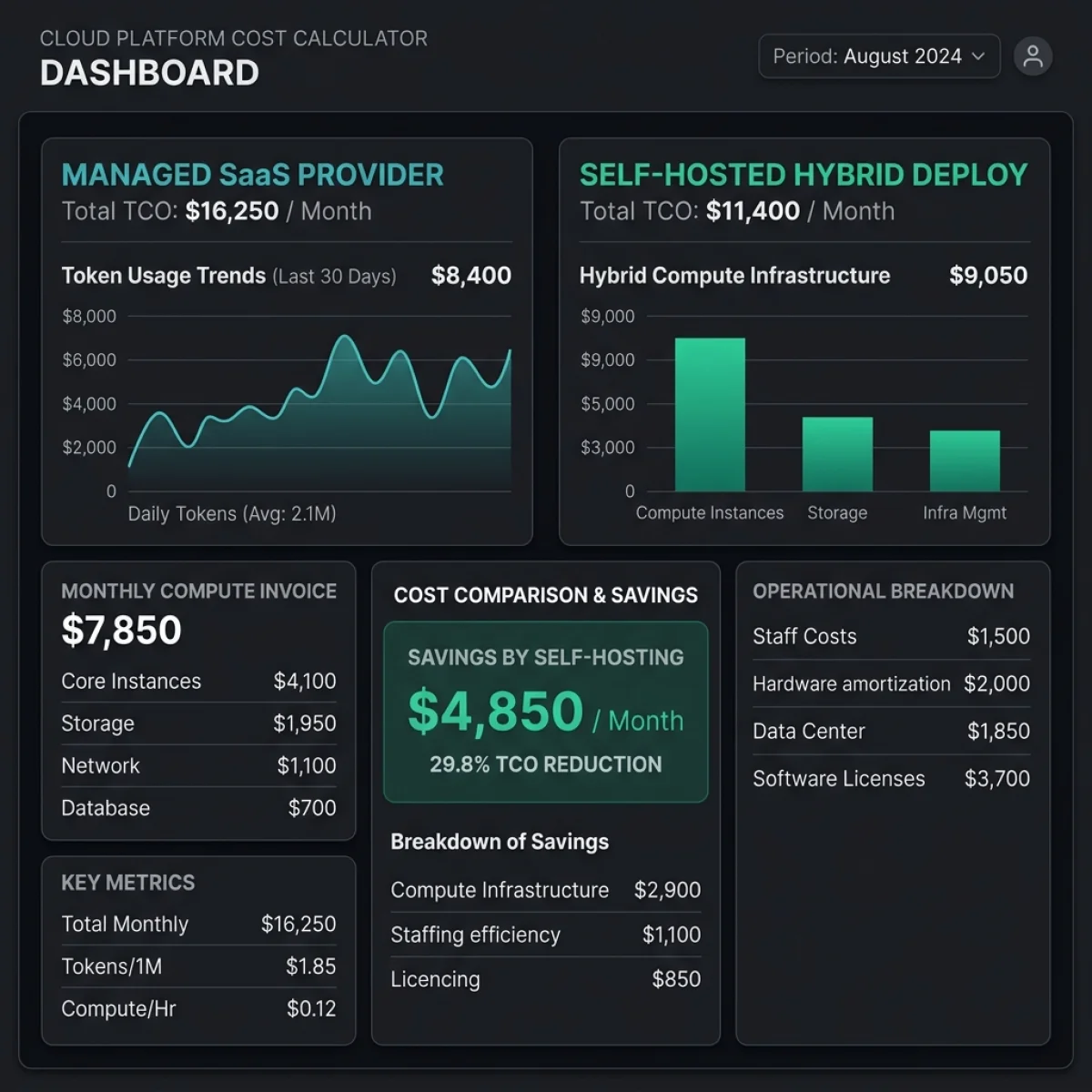
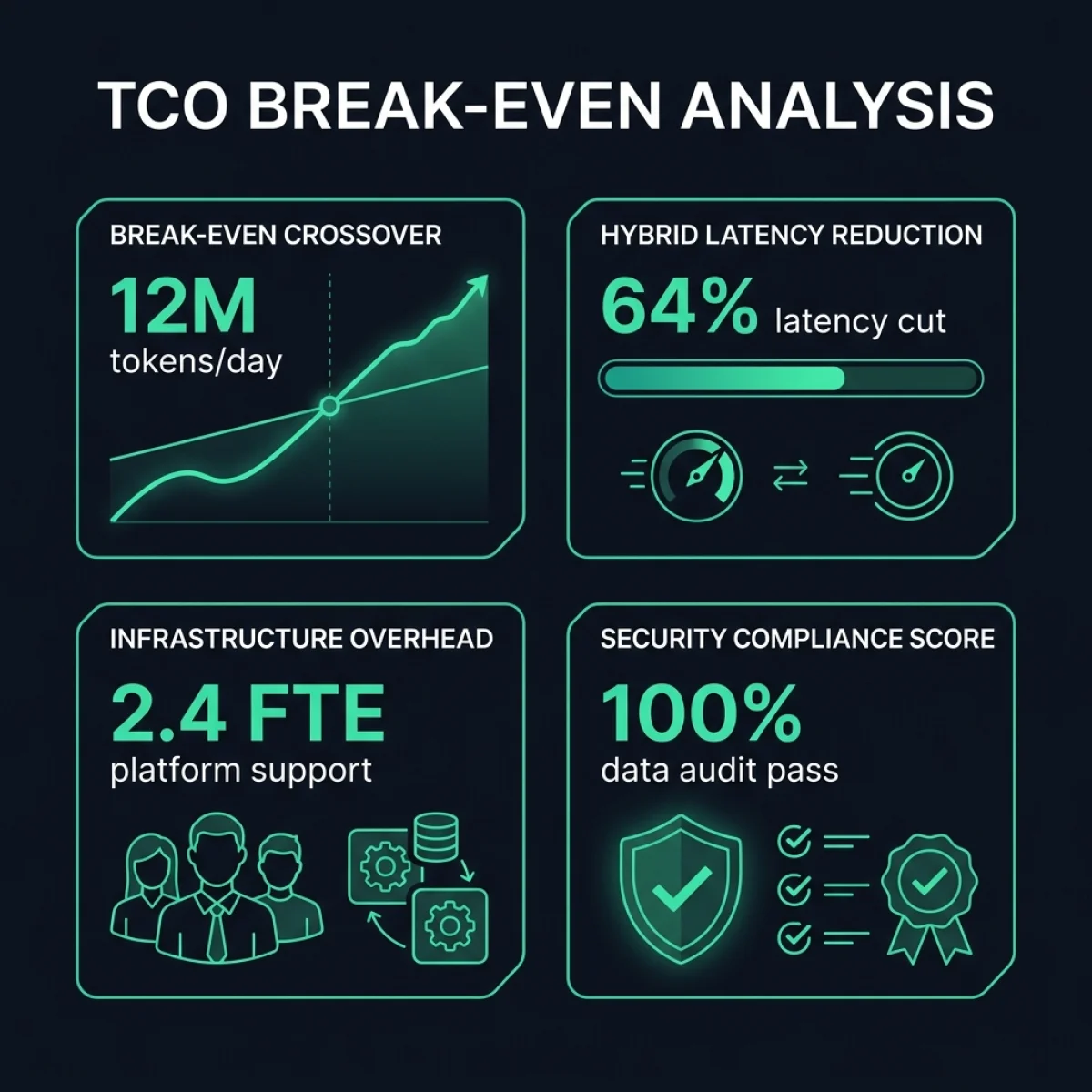
At small query scales, the engineering salary overhead makes self-hosting expensive. However, as query volumes cross 12 million tokens per day, the proprietary session fees and storage markups of managed SaaS solutions grow exponentially, while the engineering maintenance cost of a self-hosted harness remains flat.Let us inspect the comparative breakdown:
| Cost Element | Managed SaaS Platform | Self-Hosted Hybrid Harness |
|---|---|---|
| API Markup | 15% to 30% premium overhead on raw token fees | 0% markup (direct wholesale API calls) |
| Context Storage | Monthly subscription or pay-per-GB vector indexing fee | Low-cost local block storage (PostgreSQL/pgvector) |
| Platform Maintenance | Low (managed by cloud vendor) | High (requires 1–2 dedicated platform FTEs) |
| Break-Even Crossover | Highly efficient below 10M tokens/day | Highly efficient above 12M tokens/day |
Let us inspect a mockup of the cost analysis dashboard:
The Hybrid Agent Harness: Decoupling Control from Execution
For many enterprise deployments, the ideal architecture is not a pure choice between SaaS or local infrastructure, but a hybrid agent harness.
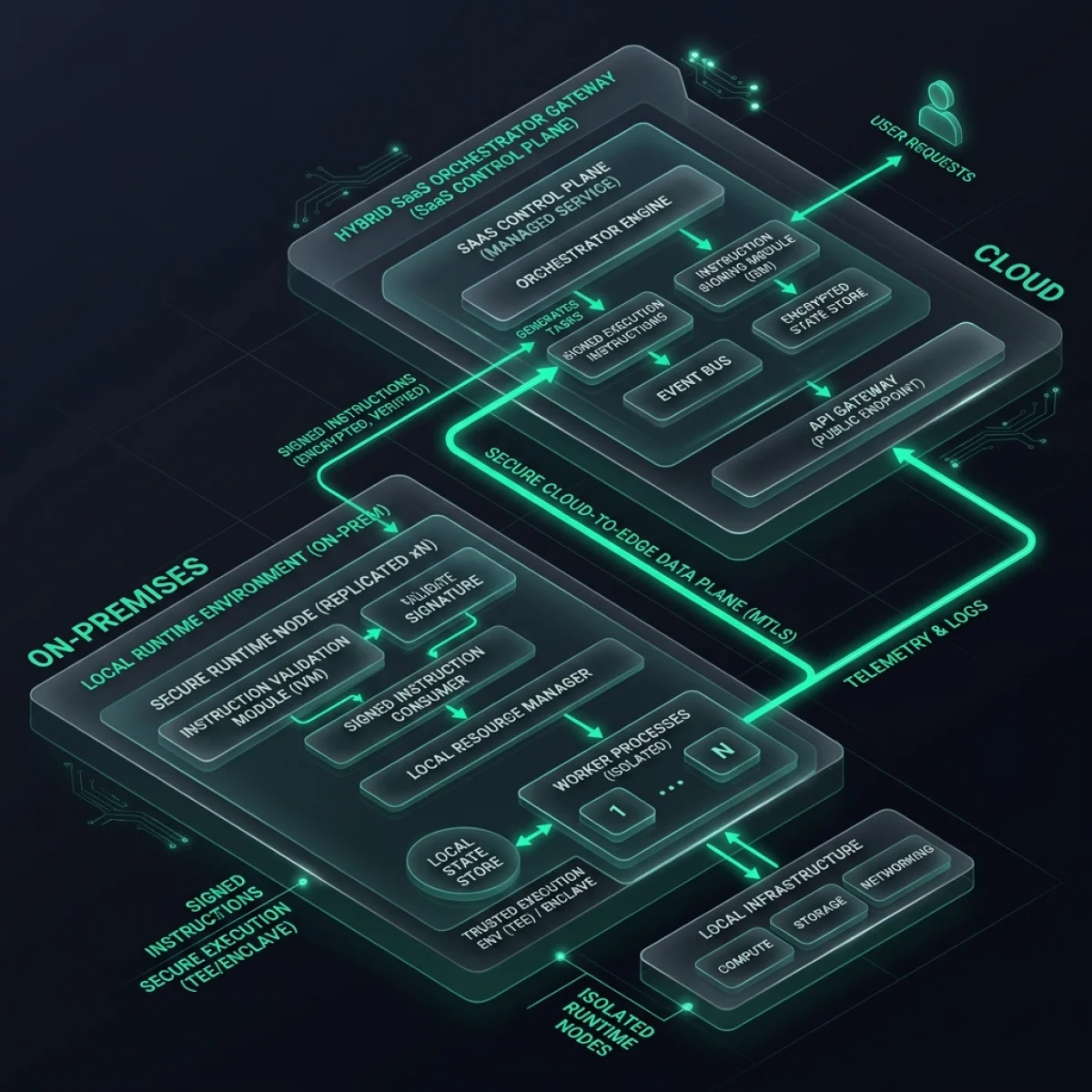
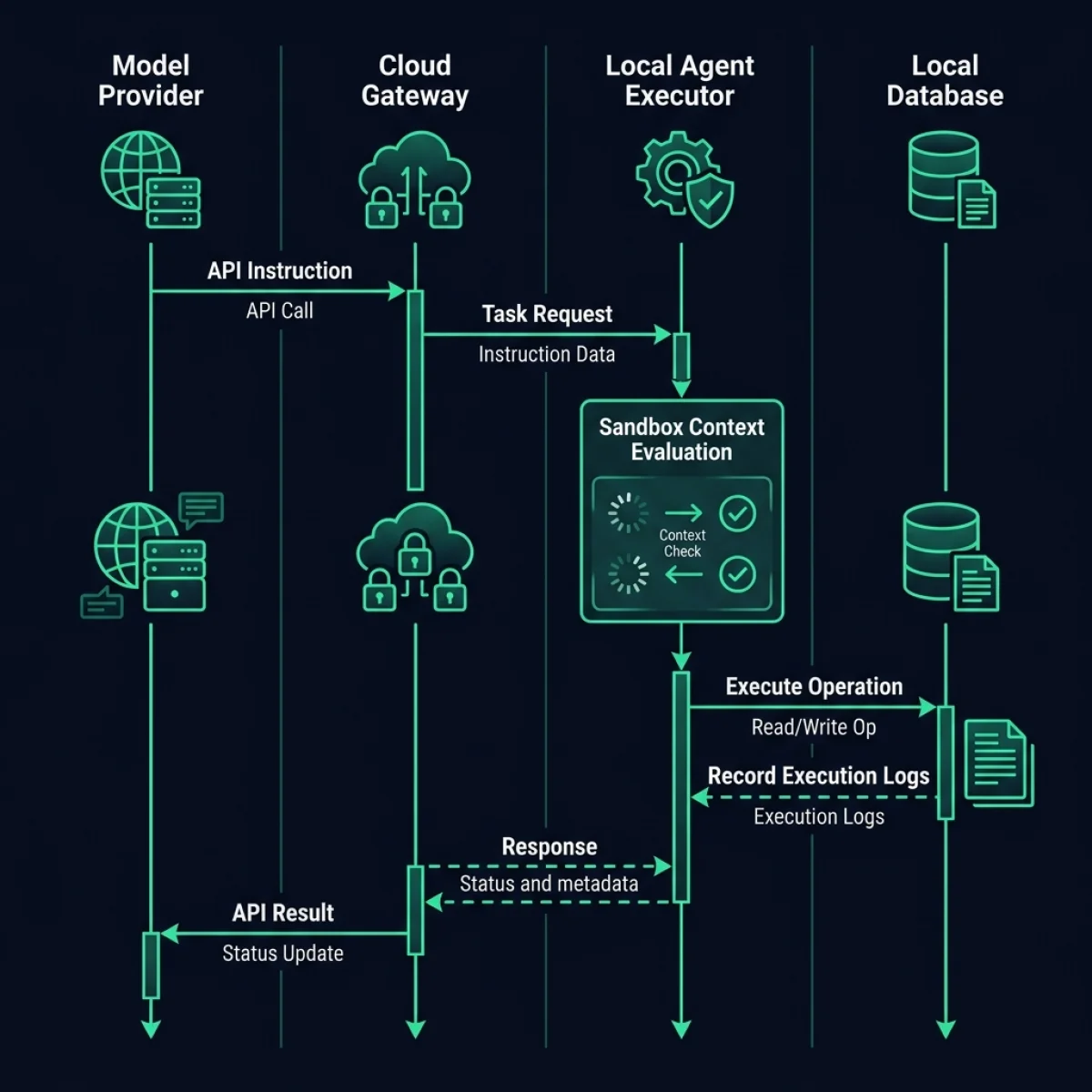
In a hybrid model, the orchestration control plane (prompt planning, model evaluation, and token routing) is managed via secure cloud gateways. However, the execution runtime (running tools, querying local databases, and executing shell scripts) is kept strictly inside local, sandboxed microVMs on-premises.
- Cloud Control Plane: The model gateway handles routing, fallback strategies, and prompt enrichment. It does not store application context or PII.
- Local Execution Node: Ephemeral local sandboxes receive abstract instructions from the gateway, execute the necessary code locally against internal databases, and return only sanitized metadata results back to the control plane.
- Network Boundary: Secure, unidirectional outbound tunnels prevent external systems from initiating connections to local execution nodes.
Let us inspect the system architecture diagram of this hybrid setup:
The Multi-Provider Model Routing Implementation
A critical feature of a self-hosted harness is the ability to route requests dynamically across multiple model providers. This protects the enterprise from API outages, allows load balancing to reduce latency, and prevents vendor lock-in.
Below is a production-grade Node.js implementation of a multi-provider router. It intercepts agent prompt payloads and attempts to call the primary model (e.g. Claude). If the provider returns a rate-limit or timeout error, it automatically falls back to an alternative model (e.g. GPT-4 or a local DeepSeek model):
/**
 * Multi-Provider Model Routing Engine (Sovereign Harness)
 * Standardizes outbound requests and handles dynamic fallbacks.
 */

const axios = require('axios');

class ModelRoutingEngine {
  constructor(config) {
    this.primaryProvider = config.primary;   // e.g. 'anthropic'
    this.fallbackProvider = config.fallback; // e.g. 'openai'
    this.providers = config.providers;       // API endpoint/key config
  }

  async generateText(prompt, systemPrompt = '') {
    console.log(`[ROUTER] Attempting generation with primary provider: ${this.primaryProvider}`);

    try {
      return await this._callProvider(this.primaryProvider, prompt, systemPrompt);
    } catch (error) {
      console.warn(`[ROUTER] Primary provider failed! Error: ${error.message}. Initiating fallback...`);
      return await this._callProvider(this.fallbackProvider, prompt, systemPrompt);
    }
  }

  async _callProvider(providerName, prompt, systemPrompt) {
    const providerConfig = this.providers[providerName];
    if (!providerConfig) {
      throw new Error(`Provider configuration not found: ${providerName}`);
    }

    const startTime = Date.now();
    let response;

    if (providerName === 'anthropic') {
      response = await axios.post(
        providerConfig.endpoint,
        {
          model: providerConfig.model,
          max_tokens: 1024,
          system: systemPrompt,
          messages: [{ role: 'user', content: prompt }]
        },
        {
          headers: {
            'x-api-key': providerConfig.apiKey,
            'anthropic-version': '2023-06-01',
            'Content-Type': 'application/json'
          },
          timeout: 8000 // 8-second limit
        }
      );

      console.log(`[ROUTER] Anthropic response received in ${Date.now() - startTime}ms`);
      return response.data.content[0].text;

    } else if (providerName === 'openai') {
      response = await axios.post(
        providerConfig.endpoint,
        {
          model: providerConfig.model,
          messages: [
            { role: 'system', content: systemPrompt },
            { role: 'user', content: prompt }
          ]
        },
        {
          headers: {
            'Authorization': `Bearer ${providerConfig.apiKey}`,
            'Content-Type': 'application/json'
          },
          timeout: 8000
        }
      );

      console.log(`[ROUTER] OpenAI response received in ${Date.now() - startTime}ms`);
      return response.data.choices[0].message.content;

    } else {
      throw new Error(`Unsupported provider: ${providerName}`);
    }
  }
}

// Mock test harness
async function runTest() {
  const router = new ModelRoutingEngine({
    primary: 'anthropic',
    fallback: 'openai',
    providers: {
      anthropic: {
        model: 'claude-3-5-sonnet-20241022',
        endpoint: 'https://api.anthropic.com/v1/messages',
        apiKey: 'mock_invalid_key_to_force_fallback'
      },
      openai: {
        model: 'gpt-4o',
        endpoint: 'https://api.openai.com/v1/chat/completions',
        apiKey: process.env.OPENAI_API_KEY || 'sk-proj-mock-key'
      }
    }
  });

  const prompt = "Explain database connection pooling in 10 words.";
  const system = "You are a concise technical assistant.";

  try {
    const result = await router.generateText(prompt, system);
    console.log(`[ROUTER RESULT] Output: "${result}"`);
  } catch (err) {
    console.error(`[ROUTER ERROR] Both routes failed: ${err.message}`);
  }
}

module.exports = { ModelRoutingEngine, runTest };
By abstracting API structures behind this routing class, platform engineers prevent their codebase from becoming dependent on a single model provider's proprietary SDK, keeping the entire agent mesh portable and resilient.
Latency-Aware Health Checking and Failover Routing
To scale this routing engine inside a high-throughput enterprise environment, the harness must proactively check provider health and prioritize endpoints based on historical response latency. Below is an advanced helper class that runs async health probes to dynamically rank active providers:
class ProviderHealthMonitor {
  constructor(providers) {
    this.providers = providers; // Map of provider names to config
    this.healthStatuses = new Map();
  }

  async monitorHealth() {
    console.log('[MONITOR] Initiating provider health scans...');

    for (const [name, config] of Object.entries(this.providers)) {
      const startTime = Date.now();
      try {
        // Run a lightweight health check token generation request
        await axios.post(config.endpoint, config.healthPayload, {
          headers: config.headers,
          timeout: 3000 // Tight timeout for health probes
        });

        const latency = Date.now() - startTime;
        this.healthStatuses.set(name, { status: 'healthy', latency });
        console.log(`[MONITOR] Provider ${name} is HEALTHY (Latency: ${latency}ms)`);
      } catch (err) {
        this.healthStatuses.set(name, { status: 'unhealthy', latency: Infinity });
        console.warn(`[MONITOR] Provider ${name} is UNHEALTHY! Error: ${err.message}`);
      }
    }
  }

  getBestProvider() {
    let bestProvider = null;
    let lowestLatency = Infinity;

    for (const [name, data] of this.healthStatuses.entries()) {
      if (data.status === 'healthy' && data.latency < lowestLatency) {
        lowestLatency = data.latency;
        bestProvider = name;
      }
    }

    return bestProvider || Object.keys(this.providers)[0];
  }
}
Let us inspect the sequence flowchart of this routing mechanism:
Compliance, Memory Ownership, and Data Sovereignty
As data protection regulations evolve globally (including the EU AI Act and state-level privacy statutes), the path of least resistance for compliance is clear: data sovereignty.
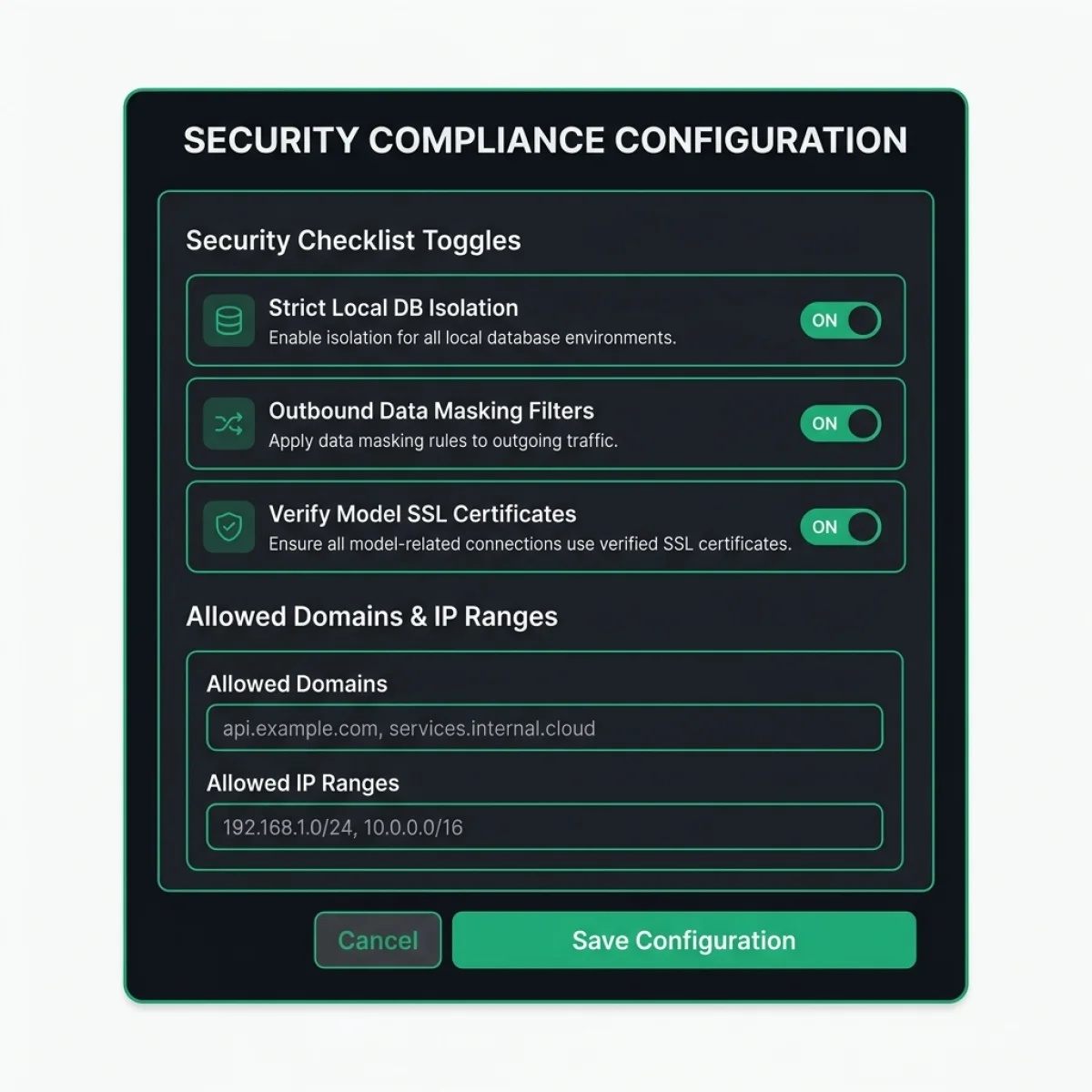
- PII Masking: A self-hosted harness intercepts outgoing model payloads and runs regex-based anonymization scripts before tokens leave the enterprise network boundary. Managed platforms process data raw, putting the burden of compliance entirely on your frontend logic.
- Trace Accountability: Every loop execution, file scan, or database read must be signed by the harness's local cryptographic key and logged to an immutable local ledger. This allows security audits to trace agent actions back to the human operator who authorized the request.
- Context Isolation: When agents run multiple isolated sessions for different client tenants, sharing a single cloud-hosted vector space introduces cross-tenant leakage risks. A self-hosted harness dynamically spins up separate schema boundaries inside a local database, guaranteeing absolute data isolation.
Cryptographically Signed Telemetry: The Audit Trace Format
To ensure that trace logs cannot be modified by compromised agents, the self-hosted harness wraps every tool interaction in a structured payload, signs it using an internal GPG key, and writes it directly to the immutable database. Below is the JSON schema of a verified audit trace:
{
  "trace_id": "tr_90y_86d3at_88921102",
  "timestamp": "2026-07-15T10:15:30Z",
  "initiator_id": "usr_vatsal_shah_296470520",
  "agent_metadata": {
    "agent_id": "security-auditor-agent",
    "version": "1.3.0.0",
    "code_commit": "sha256_af81e2890"
  },
  "execution_payload": {
    "tool_name": "scan_directory_files",
    "arguments": {
      "target_path": "/var/www/agiletech/config"
    },
    "result_digest": "sha256_e3b0c44298fc1c149afbf4c8996fb92427ae41e4649b934ca495991b7852b855"
  },
  "security_signature": {
    "algorithm": "RSASSA-PSS",
    "public_key_fingerprint": "8F9C2B7A1E4D6F83",
    "signature_hash": "base64_sig_bytes_abc123..."
  }
}
Let us inspect how these configurations are managed inside the platform security interface:
The Vendor Coupling Risk Register and Procurement Checklist
To support procurement, compliance, and legal risk management teams, engineering leaders should evaluate platform architectures against a standardized Vendor Coupling Risk Register. This register maps the primary operational failures that can occur when depending on third-party SaaS providers and weighs them against the self-hosted deployment alternatives:
+-------------------------------------------------------------------------+
|                    VENDOR COUPLING RISK REGISTER                        |
+-------------------------------------------------------------------------+
| Risk ID | Description                | Managed SaaS | Self-Hosted / Hybrid|
+---------+----------------------------+--------------+---------------------+
| VC-001  | Proprietary API Lock-In    | HIGH         | LOW                 |
|         | (Assistant schemas)        |              |                     |
+---------+----------------------------+--------------+---------------------+
| VC-002  | Outbound Data Leakage      | HIGH         | LOW                 |
|         | (PII processed externally) |              |                     |
+---------+----------------------------+--------------+---------------------+
| VC-003  | Token Inflation Costs      | HIGH         | LOW                 |
|         | (No local caching controls)|              |                     |
+---------+----------------------------+--------------+---------------------+
| VC-004  | Schema Drift Outages       | MEDIUM       | LOW                 |
|         | (Third-party updates)      |              |                     |
+-------------------------------------------------------------------------+
Architectural Risk Mitigation Protocols
To mitigate the risks outlined in the Vendor Coupling Risk Register, platform engineering teams must deploy active infrastructure controls:
- Mitigation for VC-001 (Proprietary API Lock-In): Build a local abstraction middleware wrapper (like the
ModelRoutingEnginedetailed in this guide). All agent modules must consume this local proxy client rather than direct provider SDKs. - Mitigation for VC-002 (Outbound Data Leakage): Route all outbound API model traffic through an internal security firewall proxy. This proxy runs automated Regex entity extraction to mask PII (such as emails, API keys, and phone numbers) before sending tokens to third-party endpoints.
- Mitigation for VC-003 (Token Inflation Costs): Deploy an internal Redis cache layer behind the Model Gateway. When agents make duplicate read-only requests, serve cached context strings directly, preventing redundant model provider token charges.
- Mitigation for VC-004 (Schema Drift Outages): Implement automated schema signatures verification. The platform gateway runs validation assertions against the schemas returned by external providers, dropping connections if critical parameters are modified without version updates.
The Procurement Checklist
When auditing an agentic platform provider, verify the following five controls before signing:- [ ] Control 1: Data Retention Baseline: Does the vendor store prompt or trace histories on their servers for longer than 30 days?
- [ ] Control 2: Multi-Model Portability: Can the agent schemas be exported and run on alternative provider endpoints without rewriting logic?
- [ ] Control 3: Edge Sandbox Compatibility: Does the harness execute third-party code packages inside secure local runtimes (e.g. WASI sandboxes)?
- [ ] Control 4: Rate-Limit Caching: Does the platform provide integrated token caching to prevent redundant API queries?
- [ ] Control 5: Cryptographic Logs: Are execution logs signed and stored in standard OpenTelemetry formats?
When to Buy (Managed) vs. When to Build (Self-Hosted)
To finalize your architecture plan, engineering leadership must align their deployment model with their team's skills, operational budgets, and compliance constraints. The choice between buying a managed SaaS agent harness and building a self-hosted or hybrid harness depends on your organizational profile:
Choose Managed SaaS If:
- Fast Prototyping Required: Your primary business driver is immediate speed-to-market. You are validating a user interface or feature concept with a customer focus group and need to launch an MVP within days.
- Limited Engineering Resources: Your startup or product team does not have dedicated infrastructure, DevSecOps, or platform engineering resources to manage PostgreSQL clusters, Docker sandboxes, and GPG signing gateways.
- Low Operational Risk: Your agent does not interact with core production databases, handle customer PII, or execute privileged system mutations.
- Low Usage Volume: Your expected daily token traffic is well below the 10 million token break-even threshold. At this scale, paying managed session surcharges is cheaper than employing dedicated platform support.
Choose Self-Hosted or Hybrid Harness If:
- Strict Regulatory Oversight: You operate in finance, medical diagnostics, insurance, or defense. You must satisfy HIPAA, SOC2 Type II, or EU AI Act requirements, where outbound data flows and trace histories must remain on-premises.
- Deep System Integrations: The agent must connect to internal APIs, private monorepos, local telemetry engines, or sensitive database schemas.
- Token Volume Crossover: Your operational agent loops generate high, continuous traffic (exceeding 12 million tokens/day), making cloud-hosted markup fees expensive.
- Multi-Model Portability Constraint: You must ensure that your agent logic remains vendor-neutral, allowing you to route queries dynamically across Anthropic, OpenAI, DeepSeek, or custom local models without code refactoring.
Let us inspect the final metrics infographic summarizing the selection targets:
Frequently Asked Questions (FAQ)
Q1: What is an agent harness?
An agent harness is the underlying infrastructure layer that hosts, connects, and governs autonomous AI agents. It manages prompt formatting, model API connections, local execution environments (sandboxes), credential management, and execution logging.Q2: Why is token caching crucial in a self-hosted setup?
In agentic loops, agents frequently query the same database tables or system configurations repeatedly to verify state. A self-hosted gateway proxy caches these responses locally, preventing redundant network requests and reducing wholesale token costs by up to 40%.Q3: How does a hybrid control plane maintain security?
By separating the control logic (prompt planning) from the execution logic (tool running). The planning model runs in the cloud, while the actual tools run locally inside isolated WASI sandboxes that cannot write to the host file system or call home without permission. This architecture ensures that sensitive enterprise database credentials and customer records never cross the outer cloud firewall proxy.Q4: What is the TCO crossover scale?
It is the usage scale where the operational markup of managed cloud platforms exceeds the cost of hiring dedicated platform engineers to maintain a self-hosted harness. In 2026, this crossover point is approximately 12 million tokens per day. Above this crossover threshold, the wholesale rate savings on raw APIs and the omission of proprietary per-session fees quickly offset the salaries of a specialized platform team.Q5: How does a self-hosted harness prevent vendor lock-in?
By providing a standardized provider abstraction layer. Product teams write standard tools, and the harness translations engine formats the payloads to match whichever model API (OpenAI, Anthropic, DeepSeek, or local models) is currently active. This vendor-neutral client layer guarantees that if a provider hikes rates, changes service agreements, or experiences downtime, your business operations can switch downstream endpoints instantly with zero codebase modifications.References & Authoritative Standards
- EU AI Act Compliance Guide: Risk Classification & Data Sovereignty Mandates for Autonomous Workloads. artificialintelligenceact.eu
- Model Context Protocol (MCP): Standardized Interface Specification for Model Tool Communication. modelcontextprotocol.io
- Open Policy Agent (OPA): Regulating System Privileges and Resource Allocation in Cloud Native Runtimes. openpolicyagent.org
- NIST SP 800-207: Zero Trust Architecture Guidelines for Service-to-Service Integrations. National Institute of Standards and Technology.
- OWASP Top 10 for LLM Applications: LLM06: Sensitive Data Disclosure & LLM10: Model Theft and Data Poisoning. owasp.org
{
  "@context": "https://schema.org",
  "@graph": [
    {
      "@type": "BlogPosting",
      "@id": "https://agiletechguru.com/blog/managed-vs-self-hosted-agent-harness-tradeoffs#article",
      "isPartOf": {
        "@id": "https://agiletechguru.com/blog/managed-vs-self-hosted-agent-harness-tradeoffs"
      },
      "headline": "Managed vs Self-Hosted Agent Harness — The Deployment Trade-off Engineering Leaders Get Wrong",
      "description": "Managed agents ship Tuesday. Self-hosted agents ship architecture. Pick wrong and portability becomes a fantasy slide. Here is how to evaluate the TCO, compliance, and coupling.",
      "image": {
        "@type": "ImageObject",
        "url": "https://agiletechguru.com/uploads/content/blog/managed-vs-self-hosted-agent-harness-tradeoffs/featured-banner.webp",
        "width": 1200,
        "height": 630
      },
      "datePublished": "2026-07-15T00:00:00+00:00",
      "dateModified": "2026-07-15T00:00:00+00:00",
      "author": {
        "@type": "Person",
        "name": "Vatsal Shah"
      },
      "publisher": {
        "@type": "Organization",
        "name": "Agile Tech Guru",
        "logo": {
          "@type": "ImageObject",
          "url": "https://agiletechguru.com/assets/images/logo.png"
        }
      },
      "mainEntityOfPage": "https://agiletechguru.com/blog/managed-vs-self-hosted-agent-harness-tradeoffs"
    },
    {
      "@type": "FAQPage",
      "@id": "https://agiletechguru.com/blog/managed-vs-self-hosted-agent-harness-tradeoffs#faq",
      "mainEntity": [
        {
          "@type": "Question",
          "name": "What is an agent harness?",
          "acceptedAnswer": {
            "@type": "Answer",
            "text": "An agent harness is the underlying infrastructure layer that hosts, connects, and governs autonomous AI agents. It manages prompt formatting, model API connections, local execution environments (sandboxes), credential management, and execution logging."
          }
        },
        {
          "@type": "Question",
          "name": "Why is token caching crucial in a self-hosted setup?",
          "acceptedAnswer": {
            "@type": "Answer",
            "text": "In agentic loops, agents frequently query the same database tables or system configurations repeatedly to verify state. A self-hosted gateway proxy caches these responses locally, preventing redundant network requests and reducing wholesale token costs by up to 40%."
          }
        },
        {
          "@type": "Question",
          "name": "How does a hybrid control plane maintain security?",
          "acceptedAnswer": {
            "@type": "Answer",
            "text": "By separating the control logic (prompt planning) from the execution logic (tool running). The planning model runs in the cloud, while the actual tools run locally inside isolated WASI sandboxes that cannot write to the host file system or call home without permission."
          }
        },
        {
          "@type": "Question",
          "name": "What is the TCO crossover scale?",
          "acceptedAnswer": {
            "@type": "Answer",
            "text": "It is the usage scale where the operational markup of managed cloud platforms exceeds the cost of hiring dedicated platform engineers to maintain a self-hosted harness. In 2026, this crossover point is approximately 12 million tokens per day."
          }
        },
        {
          "@type": "Question",
          "name": "How does a self-hosted harness prevent vendor lock-in?",
          "acceptedAnswer": {
            "@type": "Answer",
            "text": "By providing a standardized provider abstraction layer. Product teams write standard tools, and the harness translations engine formats the payloads to match whichever model API (OpenAI, Anthropic, DeepSeek, or local models) is currently active."
          }
        }
      ]
    },
    {
      "@type": "BreadcrumbList",
      "@id": "https://agiletechguru.com/blog/managed-vs-self-hosted-agent-harness-tradeoffs#breadcrumb",
      "itemListElement": [
        {
          "@type": "ListItem",
          "position": 1,
          "name": "Home",
          "item": "https://agiletechguru.com"
        },
        {
          "@type": "ListItem",
          "position": 2,
          "name": "Blog",
          "item": "https://agiletechguru.com/blog"
        },
        {
          "@type": "ListItem",
          "position": 3,
          "name": "Managed vs Self-Hosted Agent Harness",
          "item": "https://agiletechguru.com/blog/managed-vs-self-hosted-agent-harness-tradeoffs"
        }
      ]
    }
  ]
}