Cloudflare and Amazon Web Services (AWS) have announced native support for the x402 protocol, bringing standardized stablecoin micropayments directly to their g…
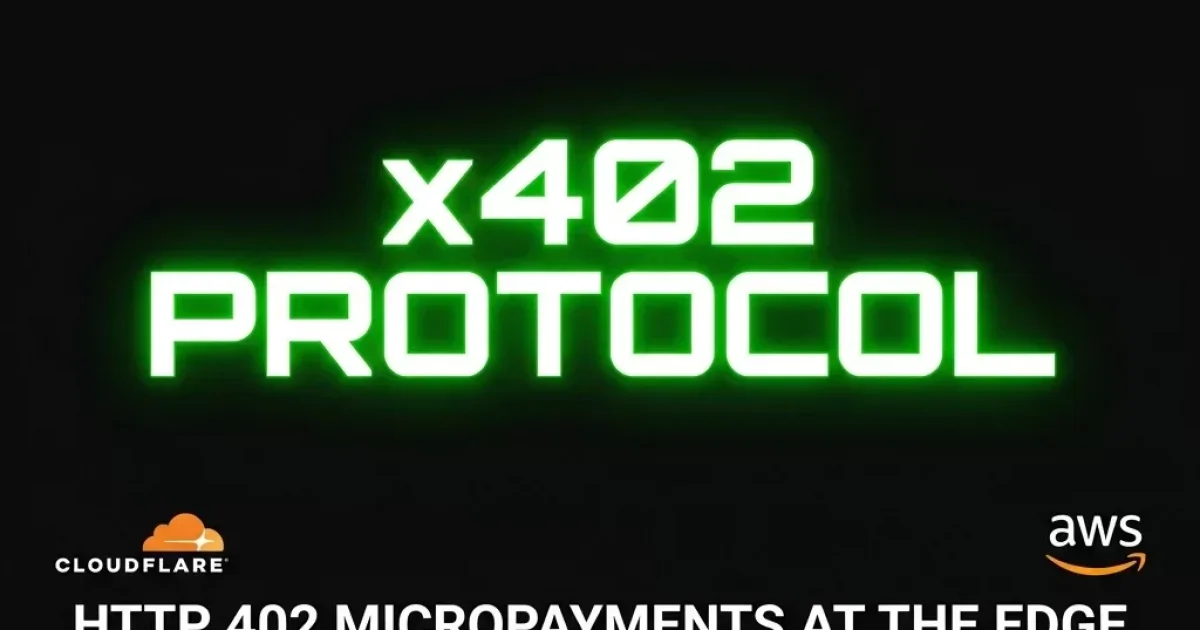
Cloudflare and Amazon Web Services (AWS) have announced native support for the x402 protocol, bringing standardized stablecoin micropayments directly to their global edge networks. By reviving the long-dormant HTTP 402 "Payment Required" status code, the integration allows web publishers, API providers, and Model Context Protocol (MCP) developers to verify and collect high-frequency payments from autonomous AI agents at the network edge before traffic ever reaches the origin server.
The Problem: The High Cost of the Agent Economy
The surge in autonomous AI agents has created a crisis for digital publishers and API providers. Traditional web monetization relied on display advertising, affiliate links, and user logins—models that assume a human user is viewing the page.
AI search crawlers, data aggregators, and coding subagents bypass these monetization layers. They scan text, extract data, and execute API tools without viewing advertisements or creating user accounts. The scale of this traffic is substantial: recent statistics show that AI scrapers and training crawlers account for over 52% of all automated web traffic.
Blocking these crawlers entirely, a feature rolled out by Cloudflare as a default security posture (analyzed in Cloudflare default AI bot blocking), protects site resources but cuts off a potential distribution channel. Publishers and developers need a way to let agents access their data, but only if the agent pays for the resources it consumes.
However, traditional payment gateways like Stripe or PayPal are built for humans. They require accounts, credit cards, billing profiles, and multi-step checkouts—friction that makes automated machine-to-machine transacting impossible.
The Solution: Standardizing HTTP 402 via x402
The x402 protocol addresses this friction by establishing a standard, machine-readable format for HTTP 402 "Payment Required." Originally defined in the HTTP/1.1 specification in 1999, the 402 status code remained reserved for future use for over two decades.
Governed by the x402 Foundation, which launched under the Linux Foundation in April 2026, the protocol is backed by an industry-wide consortium including Cloudflare, AWS, Google, Stripe, Circle, Coinbase, and Microsoft.
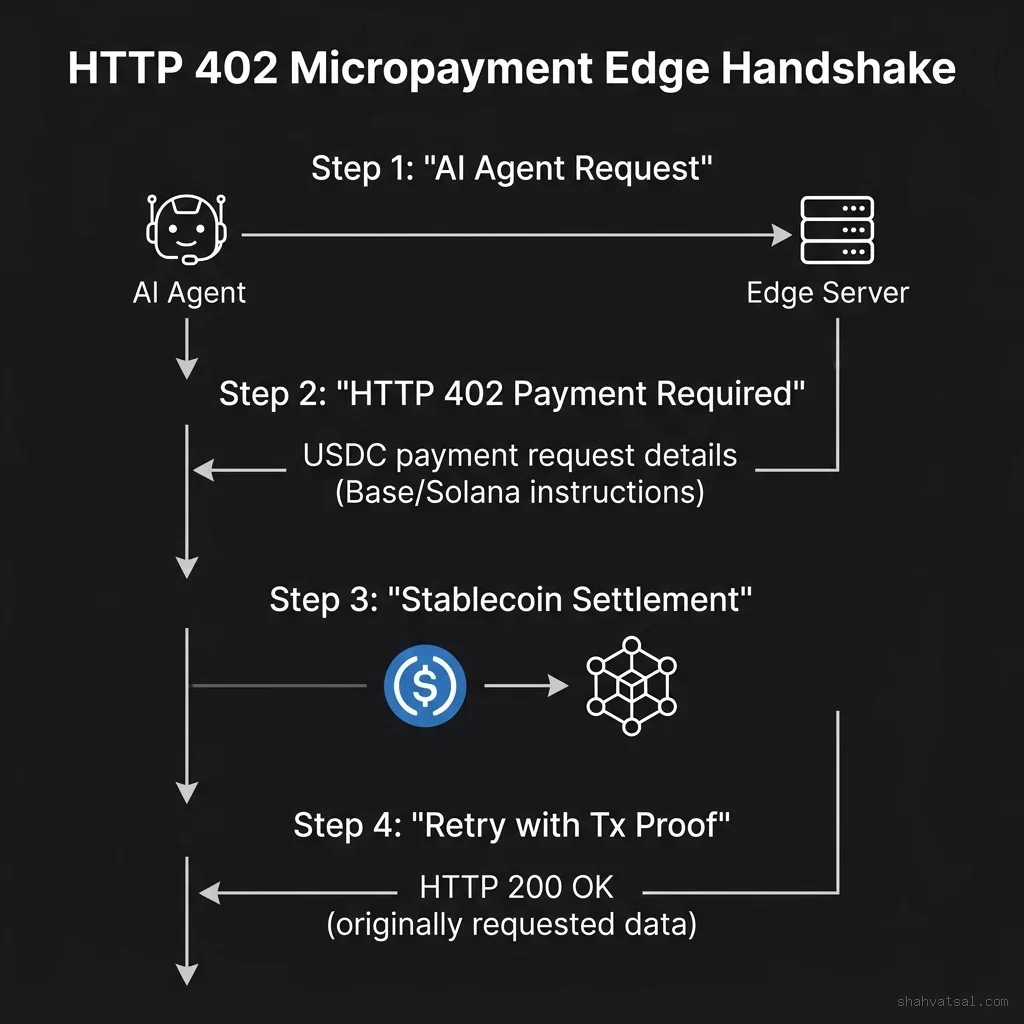
The x402 handshake runs entirely within the HTTP layer:
- Agent Request: The AI agent makes an HTTP request to a resource or MCP tool.
- Payment Required (HTTP 402): The edge server returns an HTTP 402 status code. The response header includes a standardized payment payload specifying the cost (e.g., $0.002), the target network (e.g., Base), the destination wallet, and a unique cryptographic payment identifier.
- Stablecoin Settlement: The agent's local wallet automatically reads the header, signs a micropayment transaction (typically using USDC stablecoin due to low gas fees), and broadcasts it to the specified blockchain.
- Retry with Proof: The agent retries the original HTTP request, appending the transaction hash (
x-402-tx-proof) to the request headers. - Edge Verification & Success (HTTP 200): The edge network verifies the transaction block on the public ledger. If valid, the request is passed through to the origin server, which returns the requested payload with an HTTP 200 status code.
Enforcing Payments at the Edge: Cloudflare vs. AWS
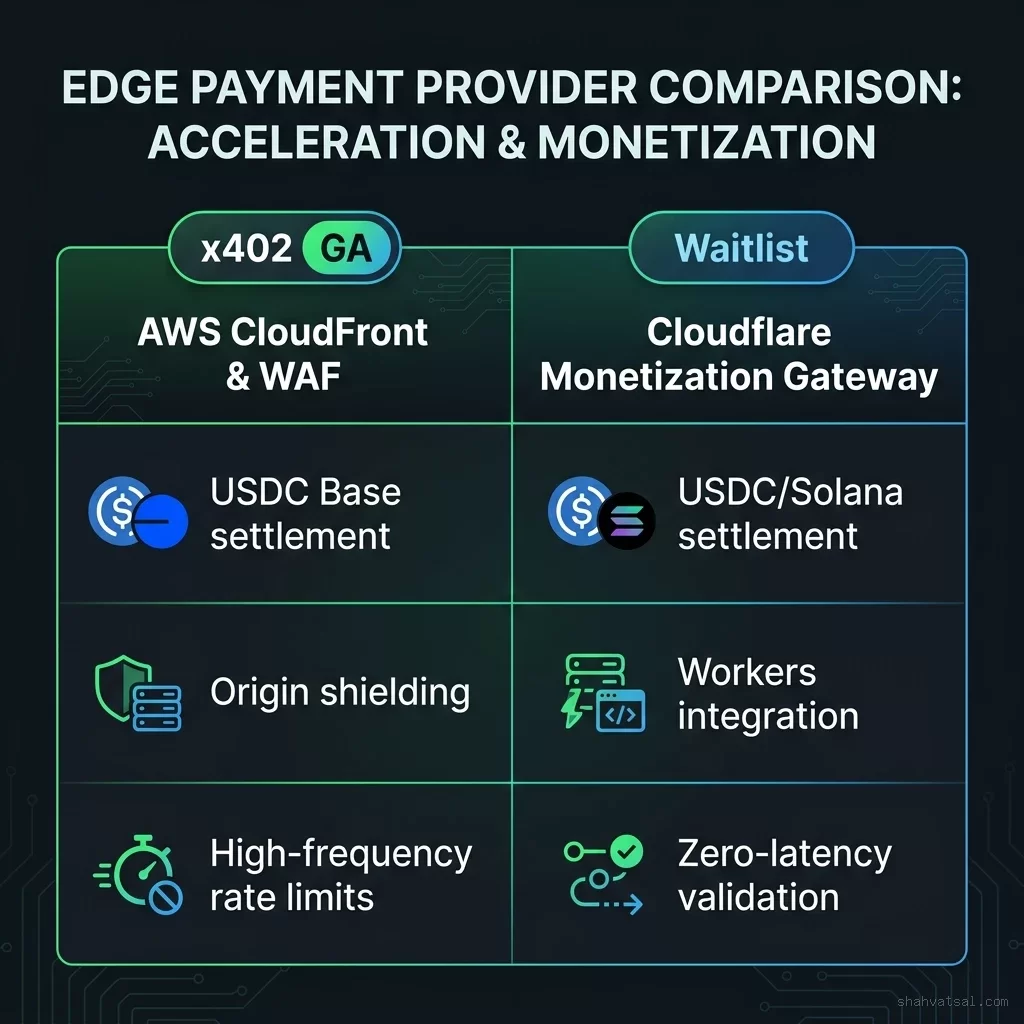
The key value of this release is edge enforcement. If an origin server had to verify blockchain transactions for every API call, the database overhead would crash the application. By integrating x402 into Cloudflare Workers and AWS CloudFront/WAF, payments are verified on the global edge network.
Both hyperscalers have shipped implementation pathways:
Cloudflare Monetization Gateway
Available via a developer waitlist, the Cloudflare Monetization Gateway integrates with Cloudflare Workers. When a request hits a Worker, the gateway intercepts it, evaluates whether payment is required, returns the 402 header, and handles ledger verification. It supports USDC on Solana and Ethereum-compatible L2 networks. Developers can set up paywalls for specific Worker routes with a single line of configuration.
AWS CloudFront and WAF x402
AWS has made x402 integration generally available (GA) via AWS WAF (Web Application Firewall) and CloudFront. WAF rules can be configured to automatically trigger an HTTP 402 challenge for specific request patterns or API endpoints. The ledger verification is handled by an AWS-managed CloudFront function that validates transaction proofs against the Base blockchain in real-time, shield origin databases from validation load.
The Strategic Battle: Edge Monetization vs. Core Cloud
The dual-vendor launch highlights a strategic pivot in cloud hosting:
APIs as Gated Tools: As multi-agent architectures mature, developers are building systems that fetch data using Model Context Protocol (MCP) tools. By monetizing these endpoints using x402, companies can turn public APIs into self-funding services, a structure that fits within enterprise governance parameters (discussed in surviving shadow AI architecture).
Preventing Scraper Arbitrage: Instead of letting crawlers scrape entire sites to train models for free, publishers can charge a fraction of a cent per request. This aligns with other edge security features, such as AWS WAF AI traffic monetization rules, which allow teams to rate-limit and charge scrapers.
Stablecoin Utility: By standardizing on stablecoins (specifically USDC), hyperscalers are bypassing traditional banking settlement times and card fees. Micropayments of $0.001 are economically viable because transaction fees on Layer-2 networks are negligible.
Implementation Guide for Web Publishers and API Teams
To implement x402 edge monetization on your application, follow these guidelines:
Identify Gated Endpoints: Identify the specific API routes, MCP tools, or high-value data directories that receive the highest volume of AI bot traffic. Avoid placing the entire site behind a 402 block to preserve human SEO indexation.
Deploy WAF/Worker Enforcers:
- On Cloudflare, write a Worker that intercepts incoming requests, checks for the
x-402-tx-proofheader, and calls the Monetization Gateway API to validate. - On AWS, attach the managed
AWS-WAF-x402rule group to your CloudFront distribution, setting the target path patterns and stablecoin wallet endpoints in the rule configuration.
Sources: InfoQ · Linux Foundation x402 Announcement July 2026