Google I/O 2026 marks a major pivot to agentic development. With Gemini 3.5 Flash and the Antigravity IDE, Google shifts focus from chat boxes to autonomous code execution.
What Happened
At Google I/O 2026 on May 19, Google DeepMind officially announced Gemini 3.5 Flash, a next-generation foundation model specifically optimized for executing agentic workflows rather than serving standard conversational chat interfaces. Alongside this model release, Google introduced Google Antigravity, an experimental, agent-native Integrated Development Environment (IDE) built from the ground up to orchestrate plan-build-verify loops.
For the past several years, the developer tools industry has focused on autocomplete extensions (such as GitHub Copilot) and side-car chat interfaces (like Cursor). While useful for boilerplate generation, these tools remain highly dependent on continuous human prompt injection. Google's new announcements pivot directly toward autonomous multi-agent systems, where a single developer delegates high-level feature tickets to a swarm of coordinated sub-agents that write code, compile locally, execute test suites, and resolve compiler errors independently.
Gemini 3.5 Flash serves as the high-speed engine for these loops. Featuring a 2-million token context window, native multimodal input processing, and a 40% reduction in time-to-first-token (TTFT) compared to prior models, the model is engineered specifically for parallel, multi-turn agent reasoning. The integration is showcased directly inside the Antigravity IDE, which provides the sandboxed runtimes, execution telemetry, and local compiler feedback loops required to support multi-agent development.
Why It Matters
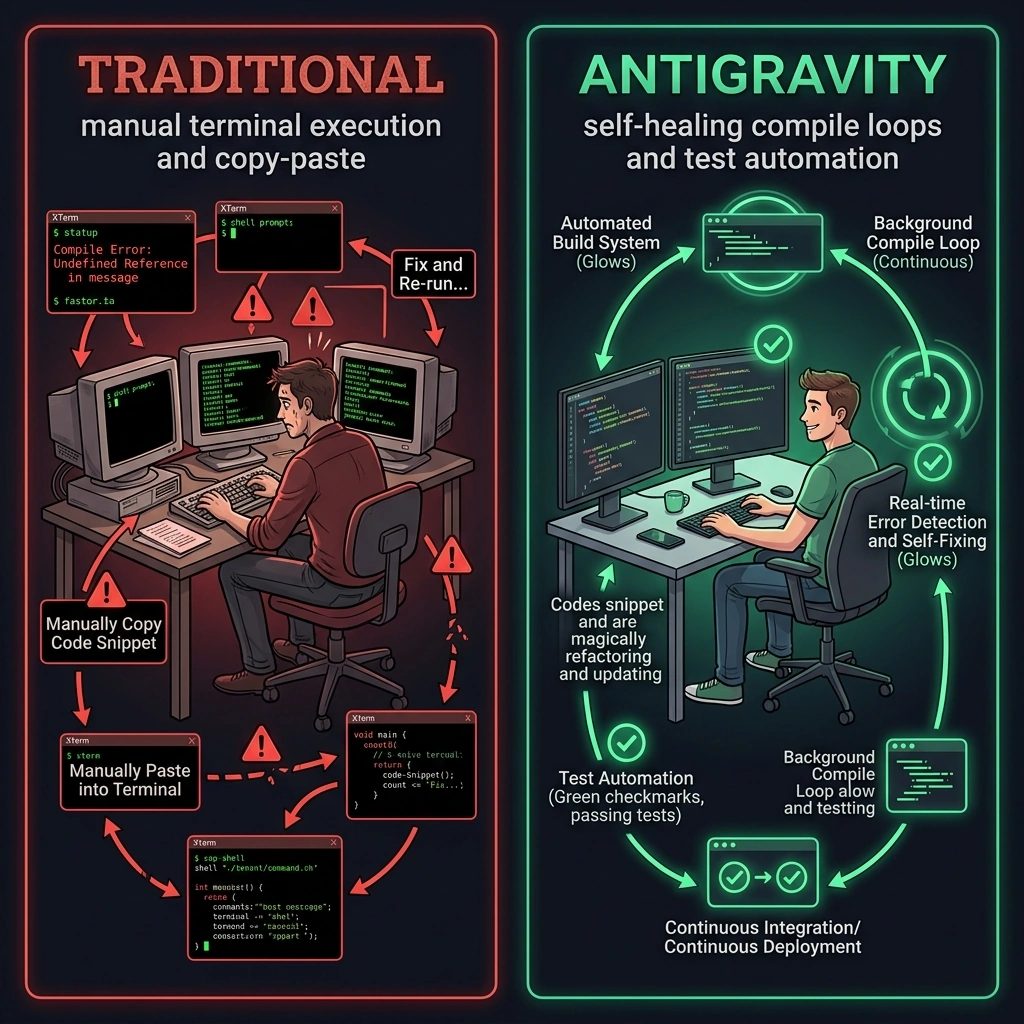
The shift from autocomplete chatbots to autonomous coding agents represents a structural transition in software engineering. Autocomplete tools provide minor productivity lifts by suggesting single lines of code or formatting functions. However, the human developer remains the primary system controller, executing compile commands, writing unit tests, and manually debugging syntax errors.
Autonomous agentic development shifts these tasks to the model. By utilizing a "plan-build-verify" loop, an agent can act as a junior developer working inside a sandboxed workspace. When given a feature request, the system runs through a multi-step execution cycle:
- Strategic Planning: Deconstructing the feature request into atomic file changes, dependency additions, and test cases.
- Implementation (Code Building): Writing or modifying source code files across multiple directories.
- Local Compilation & Test Execution: Running compilers, linters, and unit test suites to verify correctness.
- Autonomous Debugging: Ingesting compiler error logs or stack traces back into the reasoning loop, iteratively fixing code until the tests pass.
Under the Hood: Gemini 3.5 Flash System Architecture and Performance
To understand why Gemini 3.5 Flash is optimized for agents, we must look at how it handles long-context retrieval and parallel token generation. In agentic workflows, the model must frequently ingest the entire codebase, dependency maps, API documentation, and execution history. A 2-million token window allows the model to keep this context in memory, but traditional transformer architectures suffer from quadratic attention computation costs as the context grows.
Google DeepMind has addressed this bottleneck by implementing advanced context compression and speculative decoding techniques within the Gemini 3.5 architecture. By utilizing prompt caching, the model can store the static representation of a large codebase in memory. Subsequent turns in the agent loop—such as receiving a compiler error or updating a single file—only incur the compute cost of processing the new delta tokens. This reduces the latency of multi-turn interactions from minutes to fractions of a second.
Furthermore, Gemini 3.5 Flash features enhanced structured output generation capabilities. Autonomous agents depend on structured formats (such as JSON schemas) to parse tools, call APIs, and modify file trees. If a model outputs malformed JSON or deviates from the requested schema, the agent loop crashes. Gemini 3.5 Flash enforces schema constraints at the decoding level, ensuring 100% syntactic correctness in tool-calling payloads.
Comparison: Traditional Autocomplete vs. Antigravity Agentic IDE
The transition to agentic development requires a corresponding evolution in the IDE. The following table contrasts traditional development tools with the agent-native capabilities introduced in Google Antigravity:
| Feature Vector | VS Code + Copilot / Chat Extensions | Google Antigravity IDE (Preview) |
|---|---|---|
| Core Interaction Model | Proactive inline suggestions & chat Q&A | Delegated autonomous execution loops |
| Runtime Sandbox Integration | Manual terminal commands run by the user | Built-in container virtualization for tool execution |
| Multi-Agent Orchestration | None (Single session context) | Hierarchical planner/worker fan-out trees |
| Feedback Loop Mechanism | Human copy-pastes errors to chat window | Direct linter/compiler/test suite integration |
| Context Management | Vector search (RAG) over local workspace | Full codebase in memory via 2M context window |
Introducing Google Antigravity IDE: The Agent-Native Workspace
Google Antigravity represents a fundamental redesign of the developer interface. Rather than prioritizing text editing panels for human typing, Antigravity prioritizes sandbox controls, execution graphs, and agent telemetry feeds.
When a developer opens Antigravity, the interface is organized into three primary workspaces:
- The Architecture Map: A real-time visual representation of the project's dependency graph, database schemas, and API boundaries.
- The Execution Workspace: An isolated, containerized environment where sub-agents can install dependencies, run compilers, and execute unit tests without risking data corruption on the host machine.
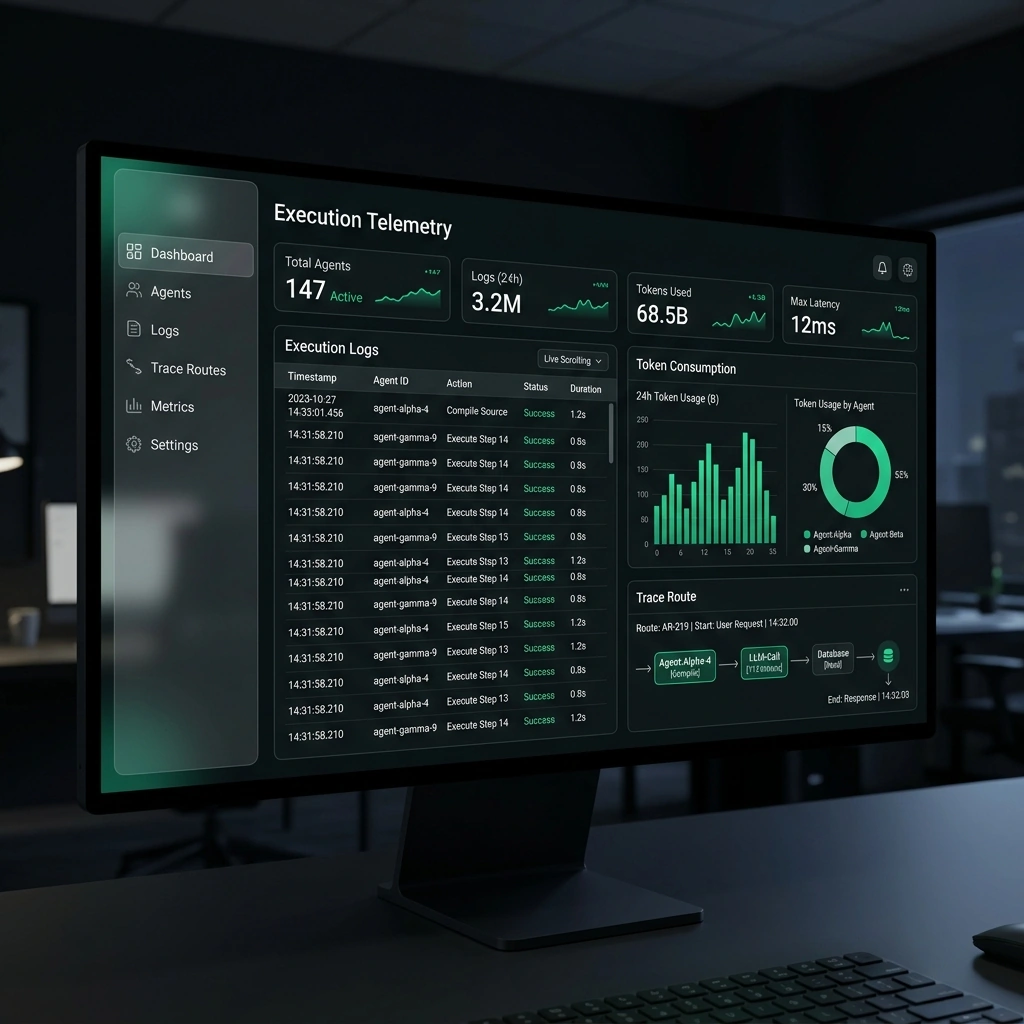
- The Agent Telemetry Panel: A unified dashboard showing active planning steps, token consumption metrics, file modifications, and linter feedback loops.
Execution Lifecycle: How Antigravity Manages Autonomous Sub-Agents
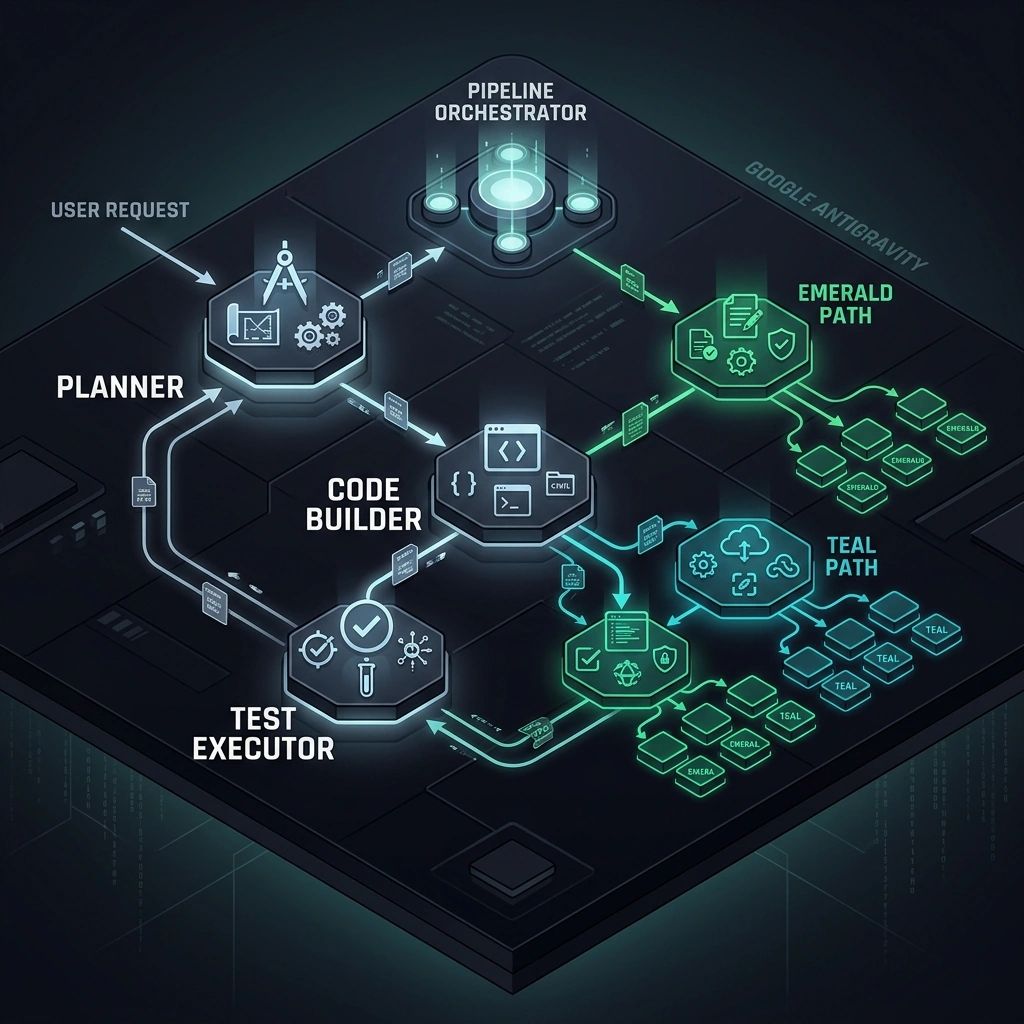
The core logic of Antigravity is managed by a hierarchical agentic framework. When a user submits a ticket, the system initiates a coordinated multi-agent fan-out cycle:
- The Planner Agent: Analyzes the prompt and existing codebase. It constructs a step-by-step implementation plan, defining the specific files that need modification and the corresponding test cases that must pass.
- The Code Builder Agent: Generates the actual code modifications. It interacts with the workspace filesystem via a set of restricted tool definitions, modifying code blocks and updating import trees.
- The Test Executor Agent: Observes linter outputs and runs unit tests. If a compile error occurs, it captures the stdout/stderr stream and passes it back to the Planner and Code Builder agents to initiate an autonomous debugging cycle.
Technical Orchestration: Building a Custom Gemini 3.5 Flash Agent Loop
To show how Gemini 3.5 Flash serves these loops, developers can build custom orchestration scripts using the Gemini API. The following Python example demonstrates a simplified agentic loop that executes a shell command within a restricted sandbox, reads compiler errors, and queries Gemini 3.5 Flash to automatically fix a failing script.
import os
import subprocess
import google.generativeai as genai

# Configure Gemini API client
genai.configure(api_key=os.environ.get("GEMINI_API_KEY"))

model = genai.GenerativeModel(
    model_name="gemini-3.5-flash",
    generation_config={"response_mime_type": "application/json"}
)

def execute_in_sandbox(script_path):
    """Executes code in a sandbox container, returning status and logs."""
    try:
        result = subprocess.run(
            ["python", script_path],
            capture_output=True,
            text=True,
            timeout=5
        )
        return result.returncode, result.stdout, result.stderr
    except subprocess.TimeoutExpired:
        return -1, "", "Execution timed out after 5 seconds"

def autonomous_fix_loop(script_path, max_attempts=5):
    """Iteratively runs code and uses Gemini 3.5 Flash to resolve errors."""
    for attempt in range(1, max_attempts + 1):
        print(f"--- Attempt {attempt} of {max_attempts} ---")

        # 1. Run local verification
        exit_code, stdout, stderr = execute_in_sandbox(script_path)

        if exit_code == 0:
            print("SUCCESS: Code compiles and runs perfectly.")
            return True

        print(f"Error detected (Exit Code: {exit_code}). Consulting Gemini 3.5 Flash...")

        # 2. Ingest script content and execution log
        with open(script_path, "r") as f:
            code_content = f.read()

        prompt = f"""
        You are an autonomous debugging agent. The following Python code failed execution:

        CODE:
        ```python
        {code_content}
        ```

        STDERR LOG:
        ```
        {stderr}
        ```

        Return a JSON object containing the corrected code.
        JSON Schema:
        {{
            "corrected_code": "string",
            "debug_explanation": "string"
        }}
        """

        # 3. Low-latency structured output query
        response = model.generate_content(prompt)
        import json
        payload = json.loads(response.text)

        # 4. Write fix to file and repeat loop
        with open(script_path, "w") as f:
            f.write(payload["corrected_code"])

        print(f"Applied fix: {payload['debug_explanation']}")

    print("FAILED: Unable to resolve errors within maximum attempts.")
    return False

# Example usage
if __name__ == "__main__":
    autonomous_fix_loop("./sandbox/failing_script.py")
The Risks of Autonomous Software Iteration: Cost and Verification Debt
While agentic workflows promise major productivity gains, they introduce significant technical and operational risks:
- Token Cost Explosion: Multi-agent systems frequently exchange large context blocks. If an agent falls into an infinite loop trying to resolve a dependency conflict, it can consume millions of tokens in minutes. Teams must implement strict timeout and token budget policies.
- Verification Debt: As agents write code at superhuman speed, developers can fall behind in code review. Merging agent-generated code without thorough manual audits can introduce subtle security vulnerabilities, logical flaws, or structural design drift.
- Infinite Execution Loops: An agent might try to fix a bug by applying a patch that breaks another feature, leading to endless cyclic iterations. Antigravity enforces execution bounds to prevent infinite loop recursion.
What to Watch Next
As Google rolls out its agentic ecosystem through the latter half of 2026, keep three milestones on your radar:
- Antigravity CI/CD Integration: Google is expected to announce direct integrations between Antigravity and major cloud repositories (such as GitHub Actions and GitLab CI). This will allow agents to operate as autonomous pull request reviewers that fix pipeline build errors before human intervention.
- Standardized Agent Telemetry Protocols: As multi-agent architectures scale, standardizing performance monitoring is critical. Watch for open telemetry specifications specifically designed to track agent logic loops, context window state, and tool-calling latencies.
- Advanced Test-Time Scaling: Future models will likely utilize reinforcement learning during token generation to verify code changes before returning them to the IDE, shifting the verification task from local client compilers to cloud foundation networks.