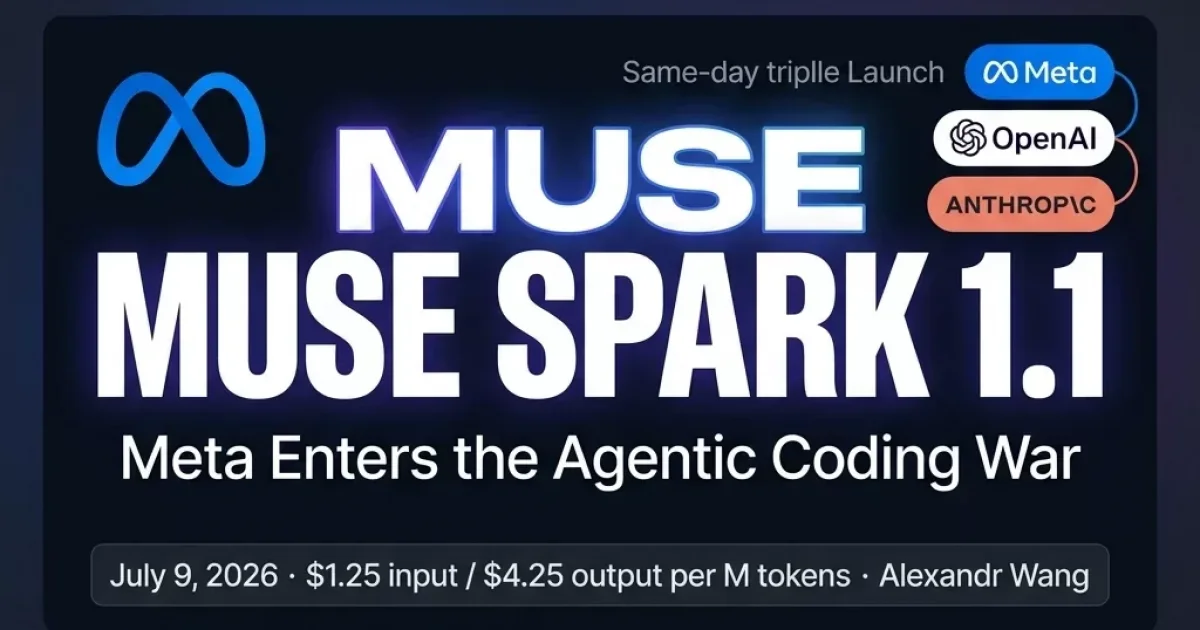
Meta enters the agentic coding race with Muse Spark 1.1 — aggressively priced at $1.25/M input tokens, described as its strongest agentic model yet. Released the same day as OpenAI GPT-5.6 and Anthropic Reflect.
What Happened
July 9, 2026 was not a normal Thursday for AI. Three of the largest players in artificial intelligence — Meta, OpenAI, and Anthropic — all rolled out new products on the same day, each targeting the same rapidly heating market: agentic coding and developer adoption.
Meta's entry was the loudest. Muse Spark 1.1 — the first major update to the model Meta quietly launched in April under AI chief Alexandr Wang — went from restricted partner preview to a full public waitlist, opening access through Meta's developer portal at pricing that Wang called "very aggressive and attractive" compared to what Anthropic and OpenAI are charging.
The numbers back him up.
The Price Point Is the Strategy
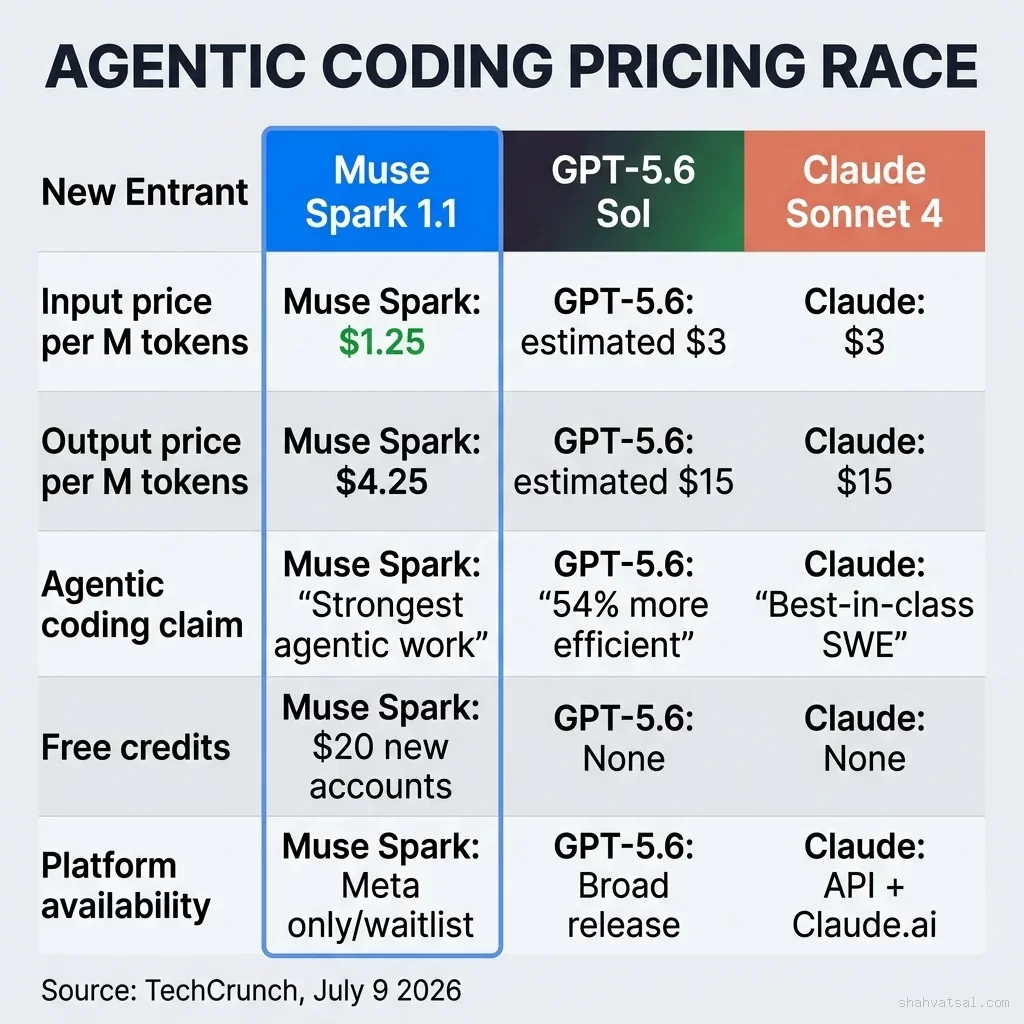
At $1.25 per million input tokens and $4.25 per million output tokens, Muse Spark 1.1 is clearly priced to drive volume. New API accounts get $20 in free credits to start.
Wang laid out the commercial thesis plainly: "The goal is to really have attractive pricing that scales with immense consumption usage." That's not a premium positioning play. That's a land-grab.
For context, the coding-focused AI market has until now clustered around $3–15 per million tokens depending on the model and direction of flow. Muse Spark's input pricing undercuts most competitors by more than 50%.
There's a catch, though. Meta has explicitly said Muse Spark will not be available on third-party platforms like OpenRouter. Access is restricted to Meta's own properties for now. That's a meaningful distribution constraint for developers who've built toolchains around platform-agnostic API routing.
What Muse Spark 1.1 Actually Does
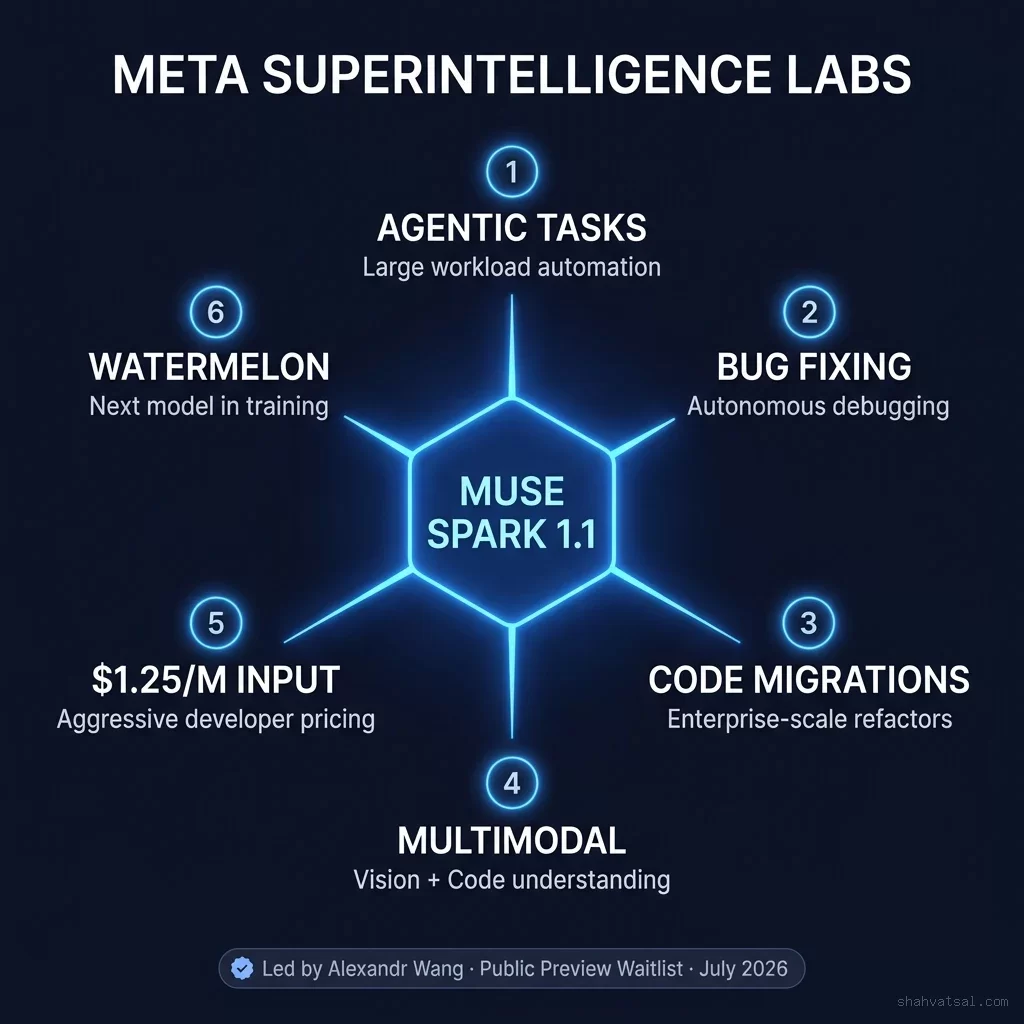
Wang described Muse Spark 1.1 as Meta's "strongest model for agentic and coding work yet." The pitch to enterprise buyers is specific:
- Large agentic workloads — sustained multi-step tasks without context collapse
- Bug fixing — autonomous debugging across large codebases
- Code migrations — enterprise-scale refactors across polyglot repos
- Multimodal understanding — vision plus code in a single context
That's a direct response to what Cursor, Claude Code, and GitHub Copilot have been building. Meta isn't pitching Muse Spark as a chatbot. It's pitching it as infrastructure for autonomous developer agents.
Wang also confirmed that Meta is training a more powerful model, internally code-named Watermelon, though he declined to give a release timeline. A separate open-source variant of Muse Spark is in development without a public date.
The Same-Day Context: OpenAI and Anthropic Also Moved
The Muse Spark launch didn't happen in isolation. The same Thursday, OpenAI made its GPT-5.6 series — Sol, Terra, and Luna — broadly available after an initial government-approved limited release. CEO Sam Altman told CNBC that GPT-5.6 Sol is 54% more token efficient on agentic coding tasks and is "as good or better" than competing models.
That 54% efficiency figure is a direct pricing challenge to Muse Spark's low-cost positioning. Even at higher per-token prices, if GPT-5.6 Sol uses 54% fewer tokens to accomplish the same agentic coding outcome, the effective cost may be comparable or better for some workloads.
Meanwhile, Anthropic shipped Reflect — a built-in usage analytics dashboard for Claude that shows conversation patterns, topics, and task types. Quieter than the other two launches, but strategically significant: it signals Anthropic is leaning into user intelligence and habit formation, not just raw model capability.
What This Means for Developers
If you're building on AI coding agents or evaluating the space, this week reshuffled the board:
Muse Spark 1.1 is worth putting on your evaluation list — not because it's proven, but because that price point changes the math on high-volume agentic workloads. At $1.25/M input, running continuous background agents through Muse Spark costs significantly less than equivalent Anthropic or OpenAI API calls.
The distribution constraint is real. No OpenRouter means you need a direct Meta developer portal account and waitlist acceptance. That's friction, especially for teams that have standardized on aggregator routing for multi-model fallback.
GPT-5.6 Sol's 54% efficiency claim needs independent verification. Sam Altman saying your model is 54% more efficient on agentic coding is a strong claim. Before re-routing production workloads, benchmark it on your actual task distribution.
Anthropic's Reflect is understated but important. Usage analytics isn't a model capability — it's a retention and governance play. For teams managing AI usage policies, knowing what Claude is actually being asked to do matters for compliance.
Sources
- TechCrunch: Meta enters the crowded AI coding battle with Muse Spark 1.1
- TechEchelon: Meta, OpenAI, and Anthropic Each Launch AI Products on the Same Day