Python 3.15 stable release introduces a native Tier 2 JIT compiler and production-ready GIL-free multithreading (PEP 703), eliminating global lock contention and enabling true parallel execution on multi-core systems. For enterprise engineering leaders, upgrading to Python 3.15 unlocks 3x to 8x throughput gains in CPU-bound AI data processing pipelines while reducing container memory footprints by up to 50% compared to traditional multiprocessing architectures.
What Happened
The Python Software Foundation has officially launched the stable release of Python 3.15, marking one of the most critical milestones in CPython history. The headline features of this release are the graduation of GIL-free free-threaded execution (PEP 703) to production-ready status and the introduction of a native Tier 2 Just-In-Time (JIT) compiler.
                                  PYTHON 3.15 COMPILATION PIPELINE
+------------------+     +-------------------+     +------------------+     +-------------------+
| Python Source    | --> | Bytecode Interpreter| --> | Micro-Ops (Uops) | --> | Native Machine    |
| Code (.py)       |     | (Tier 1 Execution)|     | (Tier 2 IR)      |     | Code (JIT)        |
+------------------+     +-------------------+     +------------------+     +-------------------+
                                                            |
                                                            v
                                                   [Optimization Pass]
                                                   - Constant Folding
                                                   - Type Specialization
For over three decades, the Global Interpreter Lock (GIL) restricted CPython to a single operating system thread at a time, forcing developers to rely on multiprocessing for parallel execution. Python 3.15 changes this paradigm. The free-threaded build is now fully supported, allowing developers to execute pure Python code in parallel across hundreds of CPU cores.
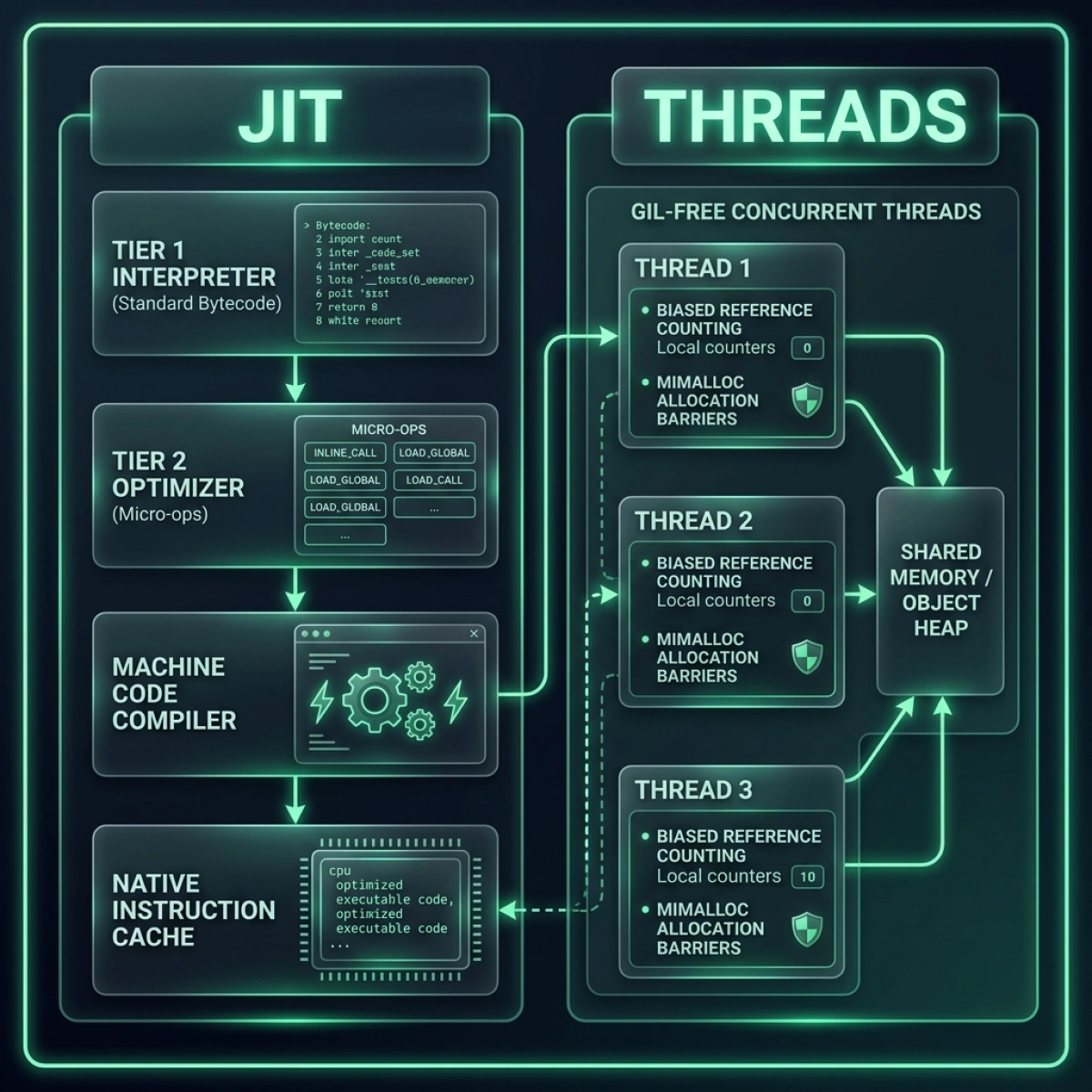
Concurrently, the native JIT compiler has been upgraded. While Python 3.13 introduced an experimental "copy-and-patch" Tier 1 JIT, Python 3.15 introduces the Tier 2 JIT optimization pipeline. This pipeline translates hot interpreter bytecodes into a high-level Micro-ops (uops) Intermediate Representation (IR), applies specialized optimizations (such as type specialization and escape analysis), and compiles the uops into native machine code, boosting execution speed for CPU-bound loops.

Why It Matters
For enterprise technology leaders, Python 3.15 is not a routine version bump; it is an infrastructure paradigm shift. Python is the dominant language for machine learning, data engineering, and backend services. The introduction of production-ready multithreading and native JIT compiler optimization directly addresses the scaling limitations of existing enterprise applications.
To capture these gains, engineering leaders must address the real-world operational challenges of securing these agentic workflows.
1. Decoupling Memory Footprints from Concurrency Scales
Under the traditional GIL model, scaling a Django, FastAPI, or Celery application to utilize a 32-core server required running 32 separate processes. If each process consumed 150MB of RAM at startup, the baseline memory overhead just to keep the runtime active was 4.8GB. As traffic spiked, dynamic allocations frequently drove container memory usage past limits, causing Out-Of-Memory (OOM) kills.In Python 3.15's free-threaded runtime, concurrency is achieved by running 32 threads inside a single CPython process. Because threads share the virtual memory space, the baseline startup overhead remains close to 150MB. By shifting from multiprocessing to multithreading, enterprises can reduce container memory consumption by 50% to 75%, allowing teams to increase container density and lower monthly cloud bills.
2. Eliminating Multiprocessing IPC Latency
Data pipelines processing millions of rows must frequently split workloads across processes. Sharing data between CPython processes requires serialization (pickling) and IPC (Inter-Process Communication) transport over sockets or pipes. This serialization step is highly CPU-intensive and introduces latency bottlenecks.In Python 3.15, threads pass references to shared memory instantly. For memory-intensive pipelines—such as real-time image preprocessing, NLP tokenization, and vector search embeddings—this eliminates IPC serialization, allowing pipelines to execute without database or socket round-trips.
3. JIT-Native Execution for CPU-Bound Loops
The Tier 2 JIT compiler targets Python's primary bottleneck: dynamic type evaluation. Every variable look-up in CPython traditionally requires pointer chasing to resolve object types. The Tier 2 JIT monitors execution, identifies hot paths, and optimizes the CPython bytecode into native micro-ops.If a loop repeatedly performs arithmetic on float variables, the JIT compiles the loop into native float assembly, bypassing the CPython interpreter loop. This results in 20% to 50% performance improvements for CPU-bound business logic, reducing machine load and execution latency.
Technical Deep Dive: Tier 2 JIT Compiler & PEP 703 Mechanics
To safely deploy Python 3.15, engineering teams must understand the CPython internals that govern JIT compilation and thread synchronization.
1. Tier 2 JIT: Bytecode-to-IR Translation and Code Generation
The Python 3.15 Tier 2 JIT compiler goes beyond the basic copy-and-patch mechanics introduced in CPython 3.13. It runs as a multi-stage optimization pipeline:- Trace Collection: CPython monitors bytecode execution. When a specific loop exceeds a predefined execution threshold, it is flagged as a "hot trace."
- Micro-Ops (Uops) Translation: The interpreter bytecode is translated into a specialized Intermediate Representation consisting of low-level micro-operations (uops).
- Optimization Passes: The optimization engine applies constant folding, dead-code elimination, and type specialization directly to the uops. If the optimizer proves a variable type does not change, it strips CPython's dynamic check assertions.
- Copy-and-Patch Compilation: The compiler dynamically patches a pre-compiled template of machine code using the optimized uops, generating optimized native assembly directly in memory.
2. Thread-Safe Memory Management (PEP 703)
Removing the Global Interpreter Lock required a complete rewrite of CPython's memory safety model to prevent race conditions during object allocation and garbage collection.- Biased Reference Counting: Every CPython object tracks its reference count to determine when to free memory. To prevent thread contention, Python 3.15 uses biased reference counting. An object has a "local" refcount managed by the owning thread without atomic locks, and a "shared" refcount modified by other threads using atomic instructions.
- mimalloc Integration: CPython replaces its custom allocator with a customized version of Microsoft's
mimallocallocator.mimallocprovides thread-local heaps, allowing threads to allocate memory without locking the global allocator. - Locking Structures: Collections (such as lists and dicts) now utilize lock-free read operations coupled with fine-grained internal locks for write mutations, ensuring thread-safe access without sacrificing concurrent performance.
# Python 3.15 Concurrency Example: True CPU-Bound Parallel Execution
import sys
from concurrent.futures import ThreadPoolExecutor

# Verify free-threading is enabled
print("Free-threading active:", not sys.flags.gil)

def compute_heavy_pi(iterations: int) -> float:
    # CPU-bound calculation optimized by the Tier 2 JIT
    pi = 0.0
    for k in range(iterations):
        pi += ((4.0 * (-1)**k) / (2 * k + 1))
    return pi

# Runs concurrently across physical CPU cores without GIL contention
with ThreadPoolExecutor(max_workers=8) as executor:
    results = list(executor.map(compute_heavy_pi, [10000000] * 8))
Operational & Migration Playbook: Deploying Python 3.15 in Enterprise AI Pipelines
Migrating production workloads to Python 3.15 requires a staged approach to mitigate risk, especially when using third-party C extensions.
1. Auditing C-Extensions for GIL-Free Compatibility
Standard Python code runs seamlessly in the free-threaded environment. However, compiled C, C++, or Rust extensions (like NumPy, Pandas, or PyTorch) must be audited.- Compatibility Flag: C-extensions must explicitly declare support for free-threading by defining the
Py_GIL_DISABLEDcompilation macro. - Legacy Fallback: If an extension is loaded that does not support free-threading, CPython will automatically re-enable the GIL in the background to prevent memory corruption, negating concurrency benefits. Teams must audit their dependencies for compatibility before expecting full performance gains.
2. Thread-Safety Audits for Pure Python Code
Under the GIL, certain pure Python operations (such as appending to a list or assigning to a dictionary key) were implicitly atomic. In the free-threaded runtime, this guarantee is removed. Developers must audit shared-state codebases and utilize explicit synchronization locks (threading.Lock) when modifying shared mutable structures.
What to Watch Next
- Broad Ecosystem Support. Expect major data science libraries (such as NumPy, SciPy, and Scikit-Learn) to drop experimental labels on free-threaded builds by Q4 2026.
- Cloud Provider Optimization. Serverless runtime engines (AWS Lambda, Google Cloud Run) will release dedicated Python 3.15 runtimes designed for highly concurrent multi-threaded execution, lowering billing scales.
- Stateful Agent Frameworks. Agent orchestration frameworks (such as LangGraph and crewAI) will release local multi-threaded runtimes that bypass process boundaries, allowing hundreds of agents to communicate locally without network or IPC latency.
Risk Mitigation Register
To help engineering teams safely plan their upgrade cycles, this register maps the primary deployment risks of Python 3.15 to concrete mitigation controls:
| Risk Category | Primary Threat Scenario | Technical Mitigation Control | Target KPI / SLA |
|---|---|---|---|
| GIL Re-activation | Legacy C-extension re-activates the GIL, eliminating multithreading benefits. | Run CI checks with PYTHON_GIL=0 and fail builds if the GIL is re-enabled. | 100% GIL-free validation in CI. |
| Race Conditions | Shared state variables mutated concurrently without locks, causing data corruption. | Implement strict thread-safety code audits; use thread-safe data structures. | Zero race-condition defects in production. |
| JIT Memory Overhead | JIT compiler consumes excess memory storing compiled machine code traces. | Tune the JIT trace buffer threshold; allocate container memory buffers. | Keep JIT memory overhead under 15% of runtime. |
| Dependency Blockers | Core enterprise libraries lack stable Python 3.15 support. | Run dependency checks against the Python 3.15 pre-release test suite. | Audit 100% of dependencies before migration. |
**Ready to optimize your AI infrastructure?** I assist enterprise engineering leaders in auditing Python environments, refactoring legacy codebases for free-threaded execution, and tuning high-performance JIT compilation pipelines. Let's maximize your compute efficiency — [schedule a technical review](https://agiletechguru.com/contact) (30 minutes, no sales pitch).

**Looking for architectural frameworks?** Discover how we build robust, high-performance platform solutions on [Services](https://agiletechguru.com/business) or review our delivery [Process](https://agiletechguru.com/process).
Read the official release announcement → Python Software Foundation