June 19, 2026 · Cloud & Kubernetes · 7 min read Why Kubernetes Security Couldn't Handle AI Agents Every enterprise Kubernetes security posture built over the l…

June 19, 2026 · Cloud & Kubernetes · 7 min read
Why Kubernetes Security Couldn't Handle AI Agents
Every enterprise Kubernetes security posture built over the last five years was designed around one assumption: workloads are deterministic. A pod makes known API calls, holds known permissions, and talks to known services. NetworkPolicy blocks unauthorized east-west traffic. RBAC restricts what service accounts can do. OPA/Gatekeeper validates admission at deploy time.
AI agents break every one of these assumptions.
An LLM-powered agent running inside a pod can, at runtime, decide to call an external LLM API it wasn't pre-approved to use, invoke a tool that grants access to a database, spawn sub-agents, or exfiltrate data through a series of benign-looking HTTP calls — none of which are visible to traditional Kubernetes security controls until after the fact.
This is the problem Tigera has been building toward since its Calico platform became the de facto Kubernetes CNI for enterprise deployments. On June 17, 2026, Tigera shipped the answer: Lynx, now generally available.
What Tigera Lynx Actually Does
Lynx is not a security scanner, not an audit log aggregator, and not another Kubernetes admission webhook. It is a dedicated control plane that sits in the execution path of every AI agent interaction in your cluster.
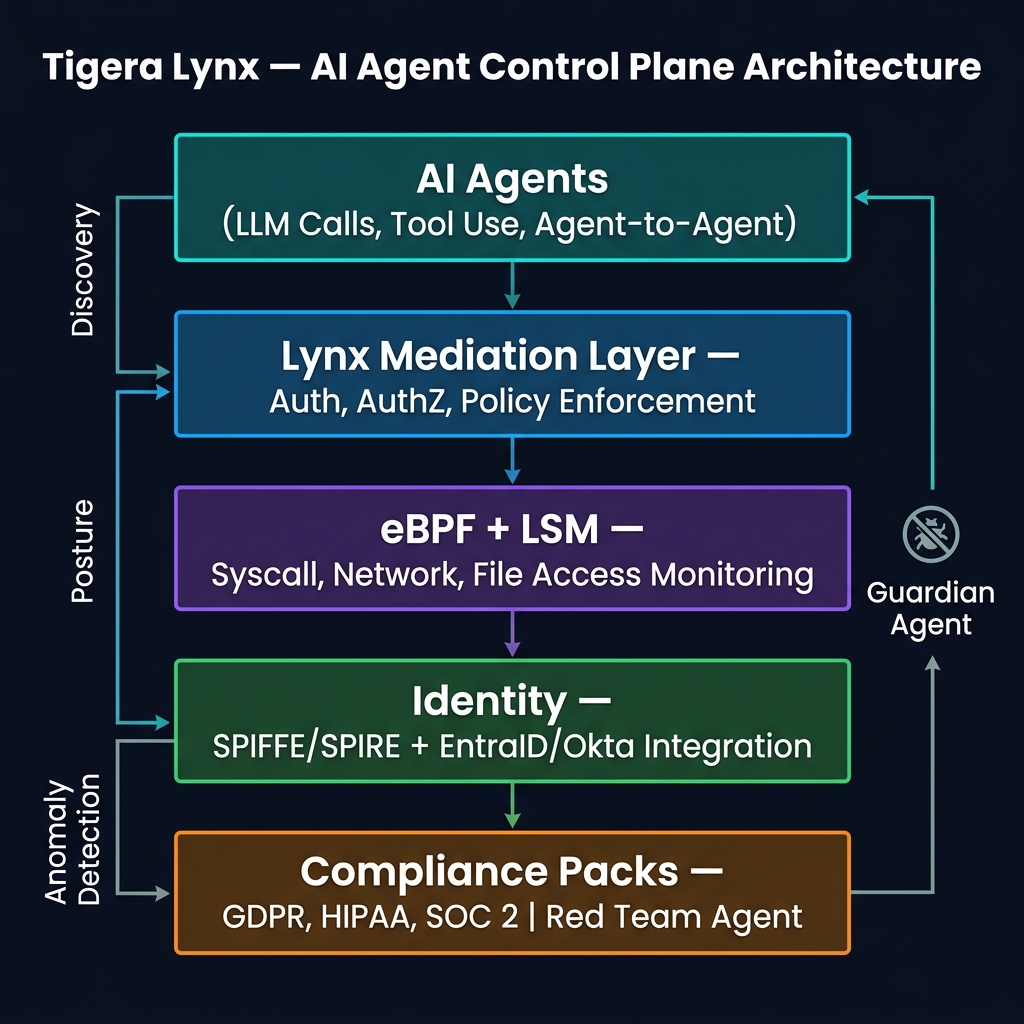
Blueprint: Tigera Lynx five-layer architecture — from agent discovery through compliance enforcement.
Five core capabilities ship in the GA release:
1. Discovery, Registration, and Observability
Lynx maintains a central registry of all AI agents deployed in the cluster. Crucially, it uses eBPF-powered auto-discovery to find agents that weren't formally registered — what the product calls "shadow agents." In most enterprise environments, this is where the first surprise hits: there are almost always more agents running than platform teams know about.
Each agent's actions are reconstructed end-to-end through OpenTelemetry traces, giving you a complete audit trail of every LLM call, tool invocation, and agent-to-agent communication.
2. Configuration and Posture Management
Lynx continuously evaluates every registered agent against configurable security baselines. It detects two high-risk conditions:
- Configuration drift: an agent's permissions or network access has changed since its last reviewed state
- Over-permissions: the agent holds capabilities it hasn't used in a rolling time window — a signal that the blast radius of a compromise is unnecessarily large
The Red Team Agent is the standout feature in this module. It's a built-in adversarial agent that continuously probes the registered agents for exploitable weaknesses — effectively running automated pen tests against your agentic workloads on a scheduled basis.
3. Identity and Authentication
Every AI agent managed by Lynx receives a cryptographic identity — a verifiable certificate that uniquely identifies it to other agents, tools, and LLMs. This is implemented via SPIFFE/SPIRE, the industry standard for workload identity in zero-trust environments.
Crucially, Lynx integrates with existing enterprise identity providers. If you're using Microsoft EntraID (formerly Azure AD) or Okta, agent identities are issued through your existing IdP — there's no separate identity silo to maintain.
4. Policy Enforcement and Mediation
Lynx inserts itself as an inline mediator on three call types:
- Agent → Agent calls
- Agent → Tool calls
- Agent → LLM calls
This inline mediation model is architecturally distinct from out-of-band audit approaches. It doesn't just record violations; it prevents them.
5. Anomalous Behavior Detection
Lynx leverages eBPF and Linux Security Modules (LSM) to monitor activity at a depth that user-space tools can't reach: system calls, raw network connections, and filesystem access patterns. This level of visibility enables detection of:
- Credential theft (an agent reading secrets it hasn't been granted access to)
- Lateral movement (unexpected agent-to-agent connections traversing namespace boundaries)
- Data exfiltration patterns (sustained outbound connections to unexpected external endpoints)
Why This Matters Right Now
The timing of this GA is no accident. Every major cloud provider announced significant AI agent capabilities in Q1–Q2 2026. AWS Bedrock Agents, Azure AI Agent Service, and Google Vertex AI Agent Builder are all production-ready. The enterprise question has shifted from "should we use AI agents?" to "how do we run them safely at scale?"
Lynx is the first production tool that directly answers the "safely at scale" question at the infrastructure layer — below the application layer where most AI security efforts have focused.
For platform engineering teams, this reframes the conversation with security and compliance stakeholders. Instead of debating whether LLM agents are too risky for production, you can now demonstrate a concrete control plane with GDPR/HIPAA/SOC 2 baseline enforcement, cryptographic identity per agent, and inline policy mediation.
That's a materially different risk conversation.
Integration with Calico
Tigera's core CNI product, Calico, is already deployed in a large percentage of enterprise Kubernetes environments. Lynx is designed to layer on top of Calico rather than replace it. The eBPF dataplane Calico uses for network policy enforcement is the same dataplane Lynx uses for agent monitoring.
In practice, this means most Tigera/Calico customers can adopt Lynx by installing the Lynx operator and running the discovery scan — no CNI migration, no networking rearchitecture, no new sidecars.
For organizations not already on Calico, Lynx can operate alongside other CNIs, though some features (particularly the deepest eBPF monitoring capabilities) are optimized for the Calico/eBPF configuration.
What Engineering Teams Should Do This Week
If you run AI agents in Kubernetes (any cloud, any size):
- Audit your agent inventory. Before you can govern agents, you need to know what's running. Even if you're not deploying Lynx yet, run a scan to identify all workloads making outbound LLM API calls. Shadow agents are more common than teams expect.
- Review your agent RBAC. Current Kubernetes service accounts used by agent pods almost certainly hold more permissions than the agent needs. Tighten the service account to the minimum required role as an immediate risk reduction step — no new tooling required.
- Pilot Lynx in a staging namespace. The fastest path to production approval for any new security tool is a staging deployment with clear metrics. Deploy Lynx alongside one non-critical agent workload, run the Red Team Agent, and show the findings to your security team. The Red Team Agent results tend to accelerate approval timelines significantly.
Related coverage: