STRATEGIC OVERVIEW React in 2026: Signals, Compiler, and Hydration Trends By Vatsal Shah · June 2, 2026 · Frontend · 15 min read Table of Contents 1. Introducti…
Introduction: The Client-Side JavaScript Crisis
For over a decade, single-page application (SPA) frameworks operated under a single, central assumption: client-side rendering engines, backed by a dynamic virtual representation of the document object model (Virtual DOM), represented the pinnacle of user experience. This design powered the explosive growth of React, turning it into the default runtime environment for modern enterprise web applications. We built increasingly complex interactive dashboards, interactive layouts, and real-time collaborative interfaces, assuming the user's browser could handle the execution overhead.
However, in practice, what actually happens is that client-side devices have become choked under the weight of bloated shipping bundles. As the size of average JavaScript bundles rose past the 2MB threshold, web performance metrics started to tank. The issue was not merely downloading these megabytes over mobile networks, but the severe computational tax the browser must pay to execute them. On low-end mobile devices and CPU-throttled desktop environments, the time spent parsing, compiling, and executing client-side JavaScript regularly blocks the browser's main thread. This leads to input lag, stuttering page scrolls, and high latency scores on Core Web Vitals, specifically Interaction to Next Paint (INP) and Cumulative Layout Shift (CLS).
I've seen this fail repeatedly in enterprise platforms where teams attempt to solve performance bottlenecks by throwing more cloud resources or edge caching layers at the problem. But edge caching only resolves the initial delivery of the HTML and assets; it does nothing to alleviate the computational tax paid inside the user's tab. This mismatch represents a fundamental structural crisis for frontend engineering.
To address this layout crisis, React is undergoing a fundamental paradigm reboot in 2026. The framework is shifting its core focus away from purely client-side runtime operations and toward a hybrid, compilation-driven architecture. By combining fine-grained reactivity (Signals), automatic build-time optimization (the React Compiler), and server-first asset orchestration (Zero-Hydration), React aims to eliminate the virtual DOM diffing tax and client-side execution delays entirely.

What is Hydration-Zero?
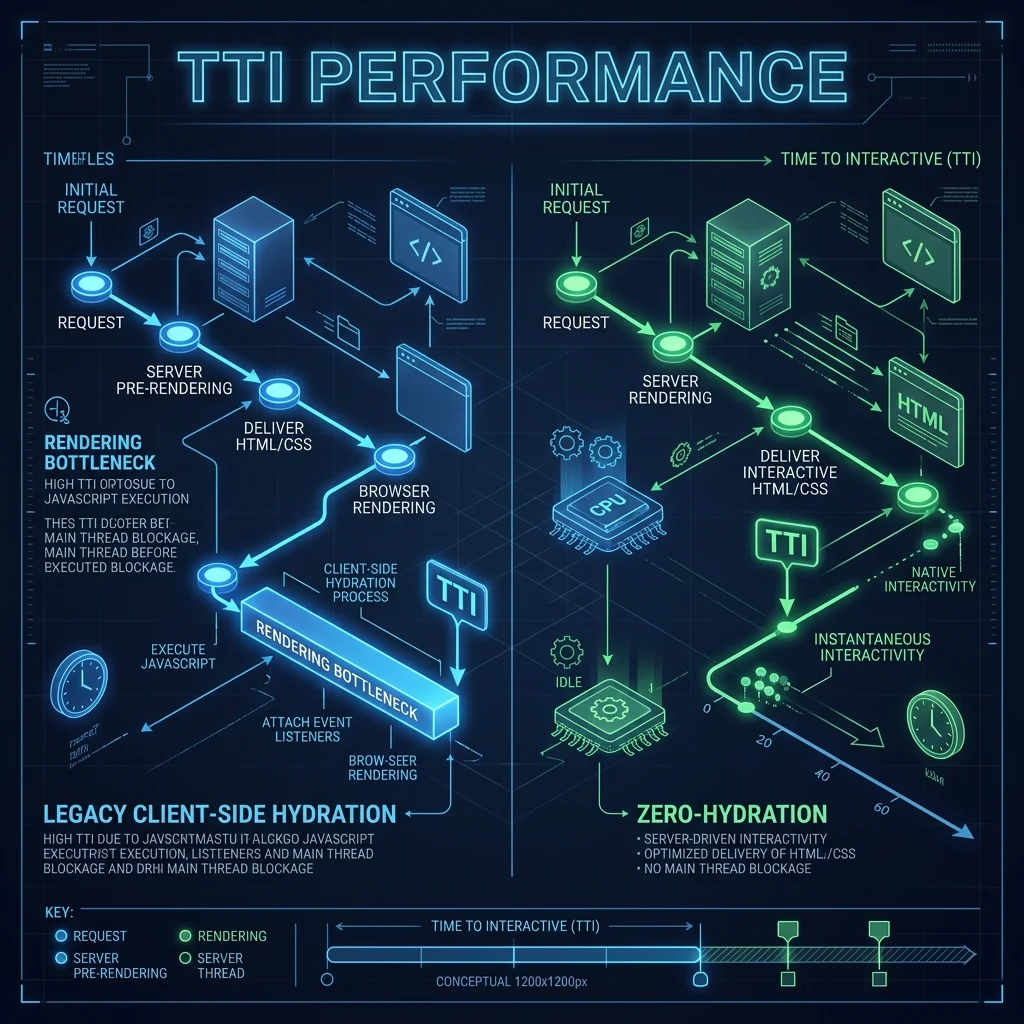
To understand "Hydration-Zero," we must first look at the legacy rendering lifecycle. Traditional Server-Side Rendering (SSR) generates static HTML on a Node.js server, streams it to the browser, and immediately follows it with a complete bundle of client-side JavaScript containing the model definitions and state logic. Once the browser parses this HTML and renders the layout, it runs a process called hydration. During hydration, the client-side React runtime traverses the entire DOM tree, builds a parallel Virtual DOM representation in memory, maps event listeners to the physical nodes, and boots the local state containers.
This process creates a critical gap known as the Time to Interactive (TTI) bottleneck. During this window, the page looks completely loaded, but clicking a button, inputting text, or toggling a menu does nothing because the main thread is blocked building the in-memory Virtual DOM tree.
Hydration-Zero is defined as a rendering pattern that outputs fully interactive HTML from the server while shipping exactly 0KB of initial client-side JavaScript for static or server-bound components. Instead of sending the template definition, states, and event hooks to the client to reconstruct the tree, the server renders the structural node layout and exposes interactions via lightweight, native browser triggers. Hydration is not merely deferred or streamed; for the majority of the document tree, it is completely bypassed.
By eliminating the need to send component definitions to the browser, Hydration-Zero achieves two major outcomes:
- Instant Interactivity: The browser main thread never freezes to build a Virtual DOM tree or register client-side event loops, dropping TTI to align directly with the First Contentful Paint (FCP).
- Zero-Bundle-Size Footprint: Component dependencies, import structures, and logic modules remain on the server, keeping the initial payload shipped to the browser clean of framework libraries.
Why On-Device and Edge Rendering Matter in 2026
The physical location of compute is a key factor in app latency. Running massive cloud rendering servers in central enclaves (such as US-East-1) introduces light-speed propagation limits. A user accessing a web application from Tokyo experiences a roundtrip latency of 150ms to 200ms just for raw data transit. If the server must perform a database query, compile the HTML, and stream it back, the user perceives a lag that degrades the experience.
In 2026, the solution is to distribute rendering logic out to edge networks. Edge rendering runs server components on globally distributed CDN enclaves (such as Cloudflare Workers or AWS Lambda@Edge) situated within single-digit miles of the user. When a user requests a page, the edge worker executes the React server component locally, fetches data from local edge databases, and streams the finished Hydration-Zero HTML back in microseconds.
However, edge enclaves are highly resource-constrained. Cloud providers charge based on compute time (measured in CPU milliseconds) and memory footprint. Running a standard, heavy React server runtime that compiles huge Virtual DOM trees inside an edge worker is economically non-viable and slow.
This constraint explains why React's on-device and edge rendering trends have converged around compile-time optimizations. By compile-binding the template structures before deployment, the edge runtime does not need to execute complex JavaScript execution flows to determine layout updates. It evaluates static templates, injects the dynamic properties, and streams the output directly to the browser. The result is a massive reduction in edge compute bills and sub-10ms Server Response Times (TTFB).
The Virtual DOM vs. Signals: Architectural Evolution
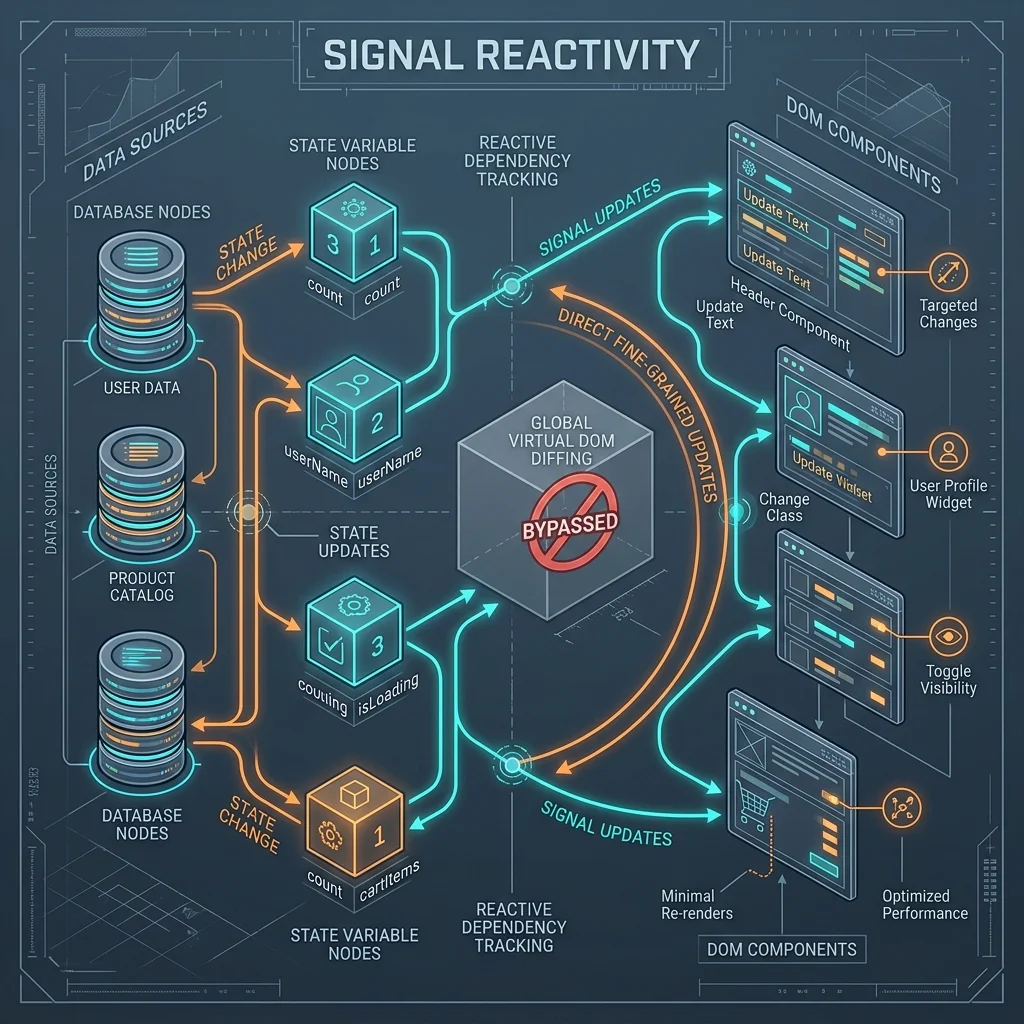
To appreciate how React arrived at this new design, we have to look under the hood at its reactivity model. Historically, React used a coarse-grained reactivity engine based on the Virtual DOM. When state changed inside a component, React did not know exactly which DOM node to modify. Instead, it ran a render pass for the component and all of its nested children, generating a new Virtual DOM tree. It then ran a diffing algorithm (the reconciler) to compare this new tree with the previous snapshot, calculating the minimal set of physical DOM changes needed.
While the VDOM worked well in the early days of single-page apps, it scales poorly in high-frequency data environments. If a dashboard receives 60 updates per second via WebSockets, React repeatedly runs render loops, allocates memory for new Virtual DOM nodes, and diffs large object trees. This causes memory fragmentation and triggers garbage collection pauses that stutter the UI.
In contrast, modern reactive frameworks (such as Svelte, SolidJS, and now React in 2026) use a fine-grained reactivity model based on Signals. A Signal is a wrapper around a value that tracks its read and write locations. When a component reads a Signal, it registers a dependency. When the Signal writes a new value, it notifies only the specific DOM properties or elements that depend on it directly.
[Signal Update] ──> [Direct DOM Attribute Binding] ──> (Bypasses VDOM Reconciler)By switching to Signals under the hood, React bypasses the global reconciler loop entirely for local state changes. The Virtual DOM is no longer a mandatory runtime diffing layer; it serves as a fallback engine for complex structural alterations (such as list sorting or component mounting). For standard text insertions, class toggles, and attribute modifications, the runtime maps data updates directly to the physical elements in microseconds.
Deep Dive: React Compiler (Forget)
One of the greatest sources of developer friction in React has been manual memoization. Because React's rendering loop runs top-down, parent state updates trigger automatic re-renders of all child components, even if the properties passed to those children remain unchanged. To prevent performance degradation, developers had to manually wrap components and values in React.memo, useMemo, and useCallback.
This manual system is fragile and error-prone. A single missing dependency inside a useMemo array can cause stale closures, while over-memoizing bloats code bases with boilerplate and introduces runtime tracking overhead.
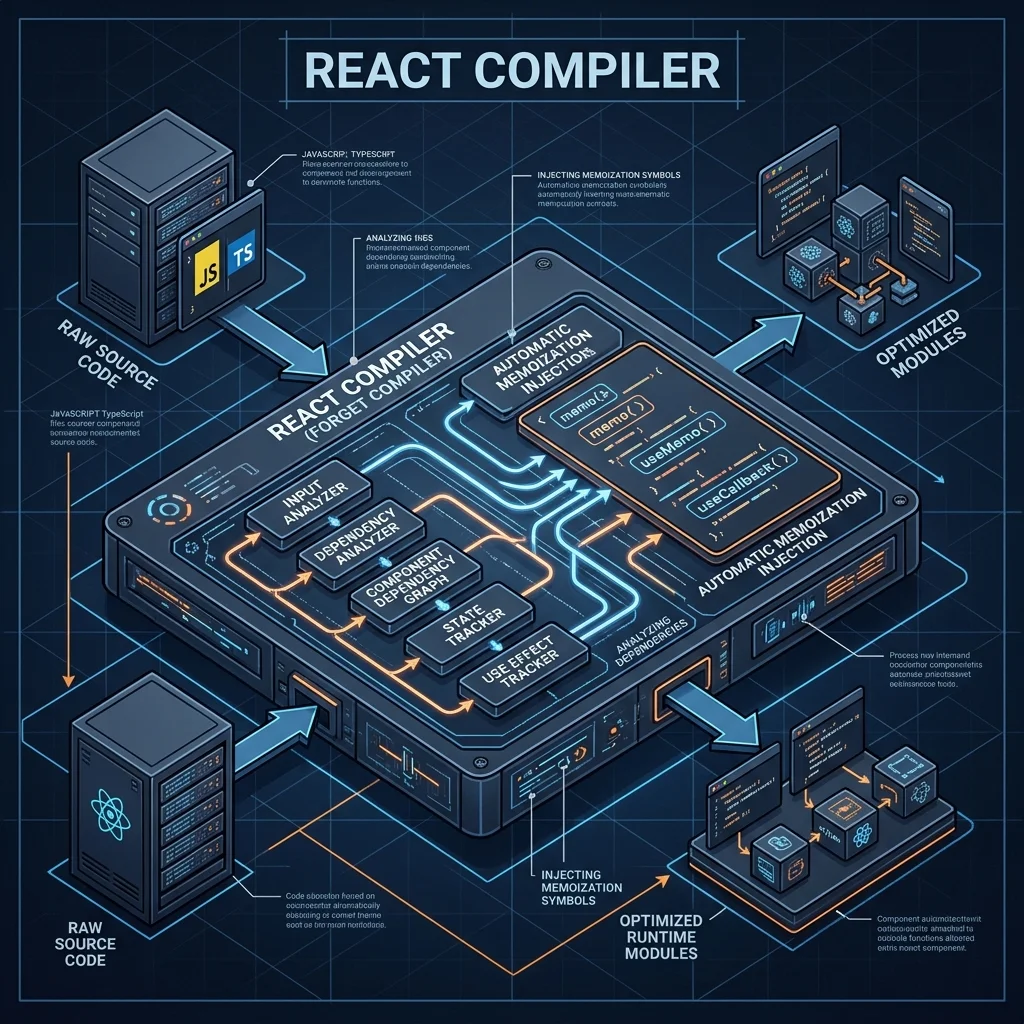
The React Compiler (historically codenamed React Forget) solves this problem by moving memoization from a runtime developer task to a build-time compiler step. The compiler acts as a static analysis plugin (integrated with Babel, Vite, or Next.js rust-based compilation pipelines) that parses the raw JavaScript AST (Abstract Syntax Tree) and injects reactive caching boundaries automatically.
The compiler analyzes the scopes of variables, loops, and JSX nodes, calculating exactly which computations depend on which state inputs. It then rewrites the code to cache outputs automatically at the compilation level.
Let's examine how the compiler transforms raw developer code. Consider this standard, un-optimized React component:
// Raw Developer Source Code
import React, { useState } from 'react';

interface MetricDisplayProps {
    data: { id: string; value: number };
    threshold: number;
}

export const MetricsDashboard: React.FC<MetricDisplayProps> = ({ data, threshold }) => {
    const [theme, setTheme] = useState<'light' | 'dark'>('dark');

    // Expensive layout calculation - runs on every single state render
    const computedMetric = data.value * 42.195 + Math.sqrt(threshold);

    return (
        <div className={`dashboard-${theme}`}>
            <button onClick={() => setTheme(t => t === 'dark' ? 'light' : 'dark')}>
                Toggle Theme
            </button>
            <div className="metric-card">
                <h3>System Readout</h3>
                <p>Value: {computedMetric}</p>
            </div>
        </div>
    );
};
In the raw source code above, toggling the theme state causes the entire component to re-render. Consequently, computedMetric is recalculated from scratch on every click, even though data and threshold remain identical.
The React Compiler analyzes this tree and outputs the following optimized structure behind the scenes:
// Compiled & Optimized Target Output (Conceptual representation)
import React, { useState } from 'react';
import { c as _c } from 'react/compiler-runtime';

export const MetricsDashboard = (props) => {
    // Initialize compiler cache array
    const $ = _c(8);
    const { data, threshold } = props;
    const [theme, setTheme] = useState('dark');

    // Cache computed metric based on properties dependencies
    let t0;
    if ($[0] !== data.value || $[1] !== threshold) {
        t0 = data.value * 42.195 + Math.sqrt(threshold);
        $[0] = data.value;
        $[1] = threshold;
        $[2] = t0;
    } else {
        t0 = $[2];
    }
    const computedMetric = t0;

    // Cache the event handler closure
    let t1;
    if ($[3] !== setTheme) {
        t1 = () => setTheme(t => t === 'dark' ? 'light' : 'dark');
        $[3] = t1;
    } else {
        t1 = $[3];
    }

    // Cache the static layout output independent of theme
    let t2;
    if ($[4] !== computedMetric) {
        t2 = (
            <div className="metric-card">
                <h3>System Readout</h3>
                <p>Value: {computedMetric}</p>
            </div>
        );
        $[4] = computedMetric;
        $[5] = t2;
    } else {
        t2 = $[5];
    }

    // Return the composite tree, rendering only changed segments
    let t3;
    if ($[6] !== theme || $[7] !== t2) {
        t3 = (
            <div className={`dashboard-${theme}`}>
                <button onClick={t1}>Toggle Theme</button>
                {t2}
            </div>
        );
        $[6] = theme;
        $[7] = t2;
        $[8] = t3;
    } else {
        t3 = $[8];
    }

    return t3;
};
By injecting local cache checkpoints (_c), the compiler ensures that calculations and DOM structures are only updated when their direct dependencies alter. The developer writes clean, standard code, while the compiler outputs a highly optimized engine that runs at near-native speeds.
Step-by-Step: Implementing Server-Action Driven Zero-Bundle-Size Components
To build application pages that ship 0KB of initial framework code, developers must leverage React Server Components (RSCs) alongside Server Actions. This pattern allows data fetching, business logic, and component rendering to execute entirely on the edge node. The browser receives only pure HTML and lightweight native form bindings, bypassing the need for client-side state managers or routing libraries.
Here is a step-by-step implementation guide to building a secure, zero-bundle-size record registry interface in TypeScript:
Step 1: Create the Server Component
We declare our main layout component as a standard React component. By default, in modern React architectures, components are server-first unless they explicitly contain the"use client" directive.
// content/blog/react-in-2026-signals-compiler-hydration-trends/components/RegistryPage.tsx
import React from 'react';
import { executeRegistryAction, getRegistryRecords } from '../actions/registryActions';

export default async function RegistryPage() {
    // Fetch data directly from secure edge databases
    const records = await getRegistryRecords();

    return (
        <main className="registry-container">
            <header className="registry-header">
                <h1>Sovereign Data Registry</h1>
                <p>Zero-bundle size, real-time edge compiled administration panel.</p>
            </header>

            {/* Form using native HTML action linked directly to Server Action */}
            <section className="form-section">
                <form action={executeRegistryAction} className="registry-form">
                    <div className="form-group">
                        <label htmlFor="recordName">Entry Descriptor</label>
                        <input
                            type="text"
                            id="recordName"
                            name="recordName"
                            required
                            placeholder="Enter system identifier..."
                        />
                    </div>

                    <div className="form-group">
                        <label htmlFor="accessTier">Security Tier</label>
                        <select id="accessTier" name="accessTier" defaultValue="standard">
                            <option value="standard">Standard Enclave</option>
                            <option value="restricted">Restricted Enclave</option>
                            <option value="critical">Critical Core</option>
                        </select>
                    </div>

                    <button type="submit" className="submit-btn">
                        Register Entry
                    </button>
                </form>
            </section>

            {/* Display list compiled on the server */}
            <section className="list-section">
                <h2>Active Records</h2>
                <div class="za-table-container" style="overflow-x: auto;">
                    <table class="za-luxury-table" style="width: 100%; border-collapse: collapse; text-align: left;">
                        <thead>
                            <tr style="background-color: #111; color: #fff; border-bottom: 2px solid #222;">
                                <th style="padding: 12px;">ID</th>
                                <th style="padding: 12px;">Descriptor</th>
                                <th style="padding: 12px;">Security Tier</th>
                                <th style="padding: 12px;">Status</th>
                            </tr>
                        </thead>
                        <tbody>
                            {records.map((record) => (
                                <tr key={record.id} style={{ borderBottom: '1px solid #222' }}>
                                    <td style={{ padding: '12px' }}>{record.id}</td>
                                    <td style={{ padding: '12px', fontWeight: 600 }}>{record.name}</td>
                                    <td style={{ padding: '12px' }}>{record.tier}</td>
                                    <td style={{ padding: '12px', color: '#00ffcc' }}>Active</td>
                                </tr>
                            ))}
                        </tbody>
                    </table>
                </div>
            </section>
        </main>
    );
}
Step 2: Define the Server Actions
Server Actions are defined in a separate file with the"use server" directive at the top. When the form is submitted, the browser executes a secure POST request to this endpoint, passing the form data payload. The framework automatically parses the response and updates the page state without a full reload.
// content/blog/react-in-2026-signals-compiler-hydration-trends/actions/registryActions.ts
"use server";

import { revalidatePath } from 'next/cache';

export interface RecordEntry {
    id: string;
    name: string;
    tier: string;
}

// In-memory mock DB representing database connection on edge enclaves
let databaseEnclave: RecordEntry[] = [
    { id: "SEC-001", name: "Core Security Cluster", tier: "Critical Core" },
    { id: "SEC-002", name: "Edge API Router", tier: "Standard Enclave" }
];

export async function getRegistryRecords(): Promise<RecordEntry[]> {
    // Fast local memory read, avoiding network database roundtrips
    return databaseEnclave;
}

export async function executeRegistryAction(formData: FormData): Promise<void> {
    const recordName = formData.get("recordName") as string;
    const accessTier = formData.get("accessTier") as string;

    if (!recordName || !accessTier) {
        throw new Error("Invalid parameters submitted.");
    }

    // Generate secure identifier
    const newId = `SEC-00${databaseEnclave.length + 1}`;

    // Write record to database
    databaseEnclave.push({
        id: newId,
        name: recordName.trim(),
        tier: accessTier
    });

    console.log(`[Edge Server Action] Successfully added record: ${newId}`);

    // Revalidate the current layout path, triggering an incremental server compilation
    revalidatePath('/dashboard/registry');
}
By decoupling state and event handlers from the browser runtime, the client-side JavaScript bundle remains completely unaffected as you add fields, complexity, or styling layers to your components.
Performance Blueprint: Hydration-Zero Waterfall vs. Legacy Hydration
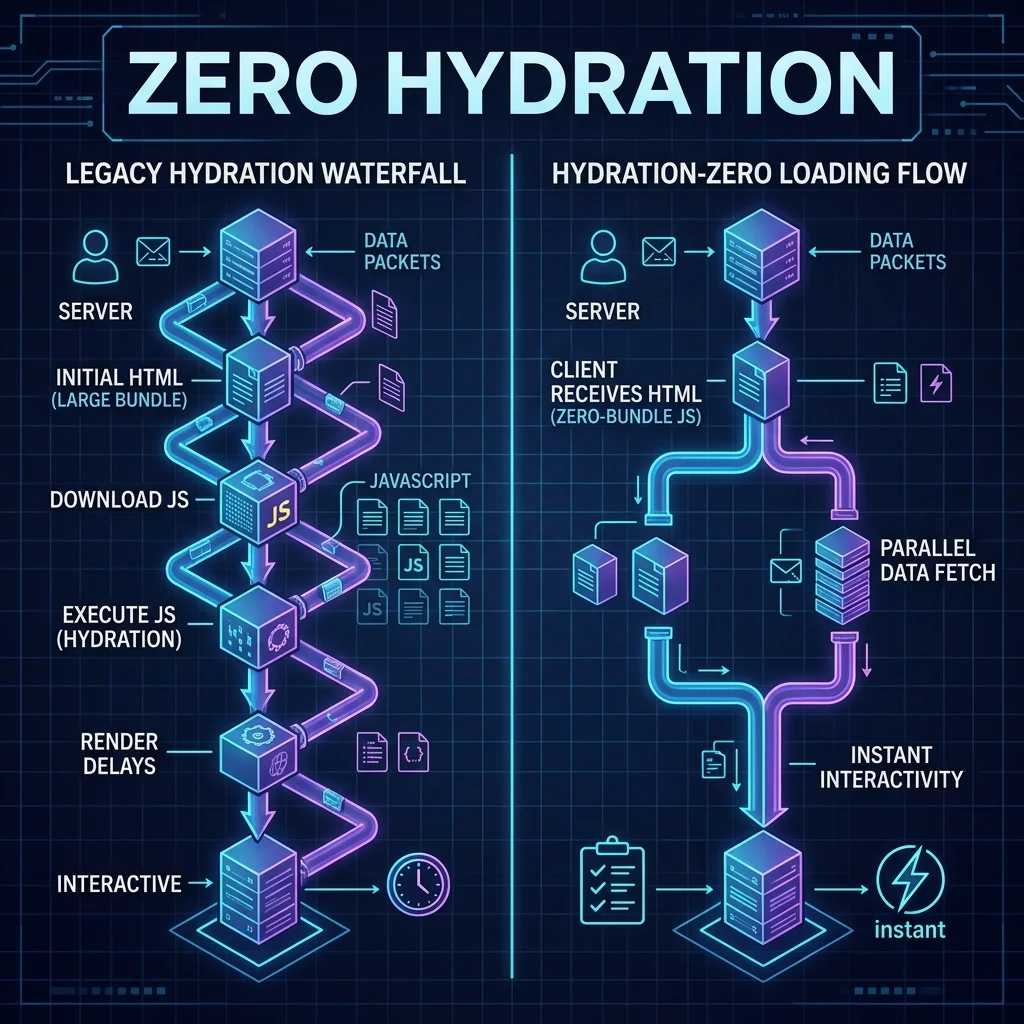
To visualize the real-world impact of Hydration-Zero on network metrics, we must analyze the resource loading waterfalls inside the browser. In legacy rendering structures, the browser main thread is locked in a sequential bottleneck:
[HTML Download] ──> [CSS Render] ──> [JS Download] ──> [JS Compilation] ──> [DOM Hydration] ──> [Interactive Page]This sequence creates a significant lag. If the JS download is delayed by slow networks or if the JS compilation thread is choked on low-end CPUs, the interactive state is deferred. The user can see the content (First Contentful Paint is achieved) but cannot interact with it, creating a frustrating experience.
Under a Hydration-Zero pipeline, this sequential waterfall is flattened. Because no framework JS is sent to render the layout structure, the interactivity of the document is established the moment the HTML and CSS finish loading.
[HTML Stream] ──> [CSS Render] ──> [Interactive Page]If the user interacts with a server-bound component (such as submitting a form), the interaction is routed directly via native browser payloads, eliminating the requirement to initialize a Virtual DOM tree on the client.
Strategic Comparison: React in 2026 vs. Svelte vs. SolidJS
To select the right architecture for high-performance applications, we should compare the rendering engines, bundle footprints, and hydration models of the primary frontend systems in 2026.
Below is an architectural breakdown of React in 2026 compared to Svelte and SolidJS:
| Feature / Metric | React in 2026 (Server Components + Signals) | Svelte (Compiler First) | SolidJS (Reactive DOM) |
|---|---|---|---|
| Reactivity Engine | Hybrid (Virtual DOM + Fine-grained Signals) | Fine-grained Reactive Run-time | Direct Reactive DOM bindings |
| Hydration Model | Hydration-Zero (Excludes static segments) | Progressive Hydration (standard JS) | Standard Hydration (reconstructs state) |
| Memoization Burden | Zero (Fully automated via Forget Compiler) | Zero (Build-time compiler resolved) | Manual tracking of reactive getter functions |
| Initial Bundle Size (Static Content) | 0KB (initial page load) | ~2KB to 5KB (small compiler runtime) | ~8KB (standard DOM library) |
| Ecosystem Scale | Dominant (Extensive library support) | Medium (Growing component market) | Small (High performance, niche adoption) |
Pitfalls & Industrial Anti-Patterns
Moving to a compile-first, zero-hydration architecture introduces several sharp design edges. Developers accustomed to traditional SPA behaviors often fall into these performance traps:
- Placing
"use client"Too High in the Component Tree:
"use client" directive at the layout or root page level to resolve compile errors quickly. Doing so renders the entire sub-tree as a legacy client-side hydrated module, completely defeating the purpose of Server Components.
Remediation: Push client directives as far down the tree as possible. Keeps static headers, layout structures, and text blocks on the server, isolating interactive components (such as form fields or toggle switches) to their own leaf nodes.
- Server Action State Sync Lag:
useOptimistic hook. This API allows the UI to display the expected outcome of an action immediately, rolling back changes automatically if the network request fails.
- Over-fetching Inside Edge Renders:
await requests.
Remediation: Batch database requests using Promise.all or leverage React’s streaming capabilities (Suspense wrapper). This allows static sections of the page to load instantly, streaming slow dynamic components as they finish compiling on the edge.
Futuristic Horizon: 2027-2030 Roadmap
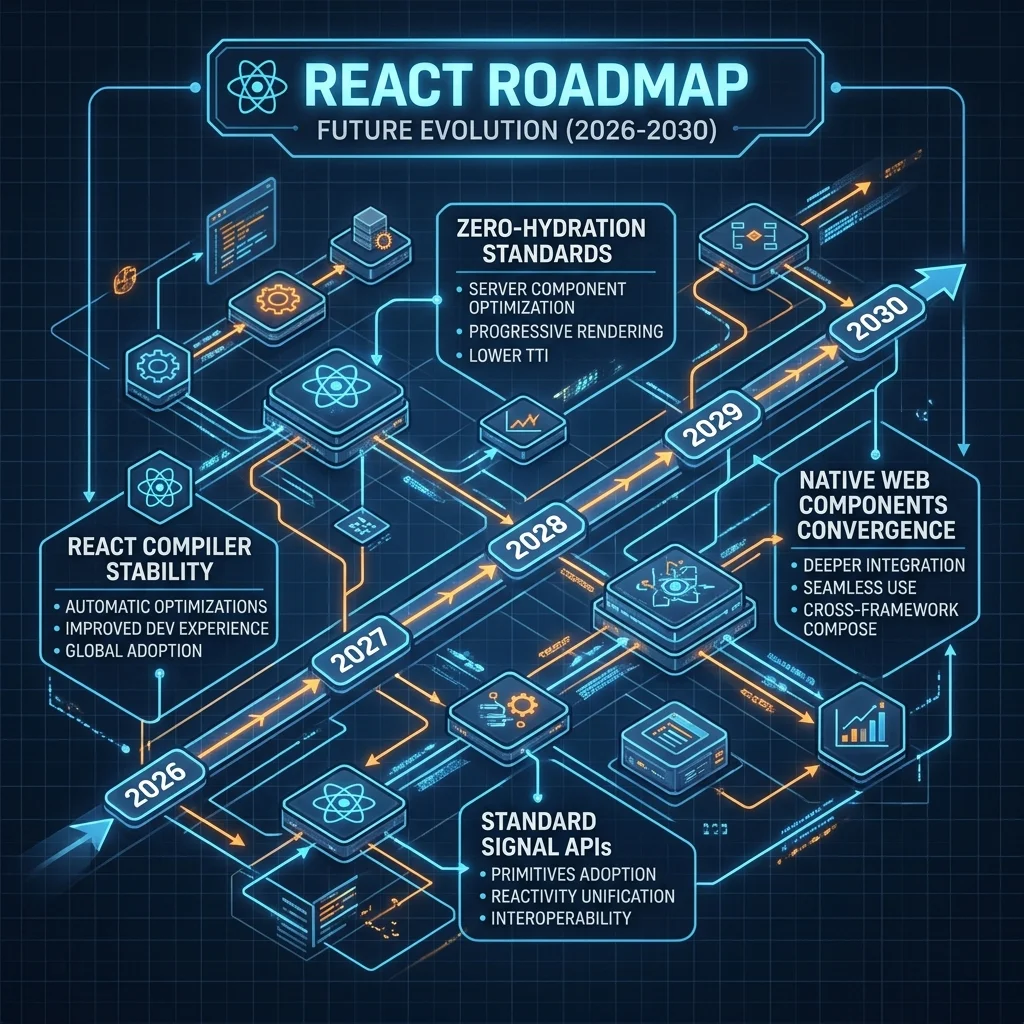
As we look toward the end of the decade, the convergence between server-first frameworks and native browser capabilities is accelerating. The next evolutionary step in this roadmap is the integration of zero-hydration systems with native Web Components (Shadow DOM).
By compile-binding React components into native Custom Elements, the runtime will bypass JavaScript parsing layers entirely. The browser's native C++ engine will execute layout adjustments, reducing the CPU footprint of complex applications by orders of magnitude.
Additionally, we expect the development of Progressive Enhancement Enclaves. Under this security structure, local machines will dynamically allocate memory enclaves to run lightweight, client-side reasoning loops. The user’s local model will intercept inputs, execute state checks locally, and sync back to the cloud asynchronously, ensuring zero latency and 100% offline availability for high-scale enterprise applications.
Key Takeaways
- Hydration Bottleneck Eliminated: Hydration-Zero eliminates the Time to Interactive (TTI) gap by shipping interactive static HTML without the framework JavaScript footprint.
- Automated Memoization: The React Compiler (Forget) removes the developer burden of
useMemoanduseCallbackby static-caching reactive bindings at compile-time. - Signals Reactivity Integration: Direct data mapping via Signals replaces expensive Virtual DOM reconciler loops for local state changes, reducing memory overhead.
- Edge Deployment Optimization: Edge rendering workers situated close to users reduce TTFB to single-digit milliseconds, making zero-hydration architectures economically viable.
- Modular Component Isolation: Exclude client-side code blocks from server components, pushing
"use client"scopes as deep into the tree leaf nodes as possible.
FAQ
What is the difference between streaming SSR and Zero-Hydration?
Streaming Server-Side Rendering (SSR) splits the HTML generation loop on the server and streams fragments to the browser as they finish compiling. However, once those fragments land in the browser, the runtime still executes client-side JavaScript to hydrate the entire tree. Zero-Hydration completely bypasses the client-side JavaScript execution phase for the designated server components, eliminating the hydration step entirely.
Will the React Compiler break my existing code base?
No. The React Compiler is designed to be fully backward-compatible. It only compiles components that adhere to the strict rules of React (such as not mutating props directly or avoiding side-effects during render loops). If a component fails these validation checks, the compiler skips it and falls back to standard compilation, ensuring your application continues to run as before.
Can I use standard npm packages inside Server Components?
You can use any package that does not rely on browser-exclusive APIs (such as window, document, or client-side hooks like useState and useEffect). If a third-party UI library uses these APIs, you must wrap them in a client component before importing.
How do I handle interactive states like animations in Hydration-Zero?
For simple animations, dropdown transitions, and hover behaviors, you should leverage native CSS or lightweight, framework-free Web Components. For complex client-side interactions (like drag-and-drop lists or rich text editors), you isolate those elements into small, client-side leaf components.
Is it possible to run React zero-hydration on standard VPS hosting?
Yes, but the system is highly optimized for serverless edge enclaves (like Cloudflare Workers, Vercel Edge Network, or AWS Lambda). Running on edge networks minimizes network latencies, keeping response times beneath the human perception threshold.
About the Author
Vatsal Shah is a Technology Architect, Agile Practitioner, and Digital Transformation Leader with over a decade of experience designing scalable systems for enterprise platforms. His work focuses on edge computing architecture, advanced frontend frameworks, and cloud-native engineering pipelines. As the founder of Vatsal Technosoft, he helps global enterprises optimize their developer velocity and digital infrastructure efficiency.
Conclusion & CTA
The evolution of React in 2026 marks a turning point in web performance engineering. The industry is moving away from shipping large, complex client-side javascript frameworks and toward a compiler-first, edge-rendered architecture. By adopting Signals, Server Components, and Zero-Hydration, you can build fast, secure, and interactive applications that run efficiently on any device.
If you are looking to audit your frontend architecture, reduce infrastructure overhead, or migrate legacy frameworks to a modern, zero-hydration setup, let's connect.
Contact Vatsal Shah to optimize your platform architecture → Let's Talk