Microsoft Build 2026 agents represents a major shift as Copilot Studio autonomous agents and Azure AI Foundry GA patterns integrate directly with Windows OS and Microsoft Entra security. By placing agent orchestration inside native cloud and OS control planes, enterprises can safely deploy agentic workflows using existing identity boundaries, accelerating pilot-to-production rollouts while maintaining strict blast radius controls.
What Happened: Deepening the Platform Control Plane
At Microsoft Build 2026, the tech giant announced the General Availability (GA) of autonomous agent hosting inside Copilot Studio and Azure AI Foundry. Rather than positioning agents as external add-ons, Microsoft is wiring them directly into Windows OS components and cloud runtime environments.
Key technical announcements from the keynote include:
- Copilot Studio Autonomous Agents: Enterprises can now design and host autonomous agent fleets that trigger asynchronously in response to system alerts, email flows, or database changes, shifting from passive chat autocomplete to background automation.
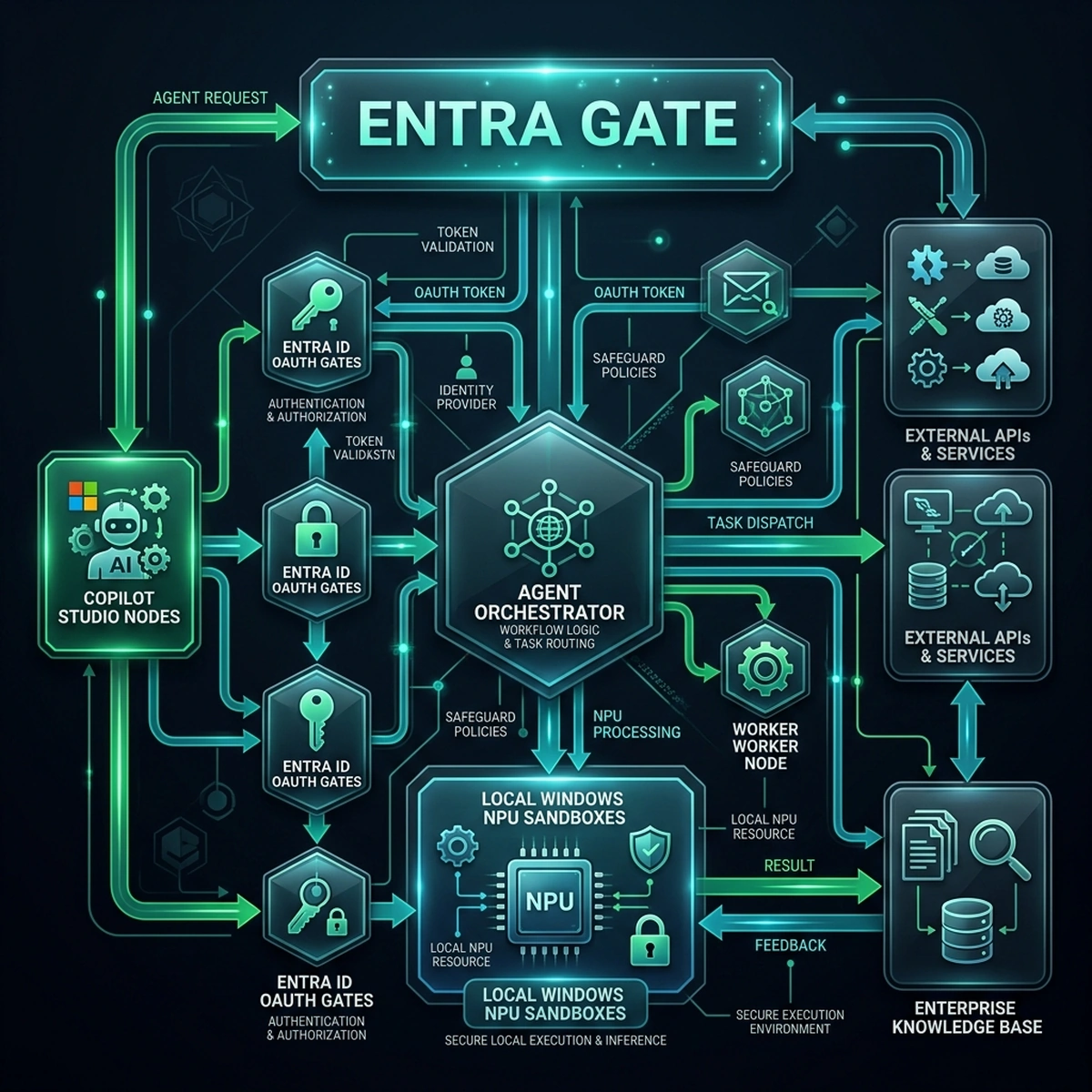
- Native Windows Agent APIs: Microsoft introduced native on-device APIs in Windows 11, allowing developers to run small language models (SLMs) locally on NPUs. These local models coordinate with cloud systems, accessing files and applications through a secure, sandboxed OS boundary.
- Azure AI Foundry (GA): The unified developer platform integrates monitoring, tracing, and prompt evaluation. This lets platform teams track agent steps, identify hallucination patterns, and manage token consumption in real-time.
- Entra ID Security Gating: Agent tool access is now secured via Microsoft Entra ID. This allows agents to propagate the user's active JSON Web Token (JWT) during tool calls, ensuring that database read/writes respect existing organizational privileges.
Why It Matters: Overcoming the Identity and Deployment Gap
For enterprise technology leaders, Build 2026 represents the end of the "agent playground" era. While tool-first orchestrators or proprietary wrappers require custom API connectors, Microsoft's updates bridge the execution gap by using existing identity infrastructure.
In my view, this platform-native approach highlights several critical shifts:
- The Authorization Problem Solved: Historically, giving an agent database or API write permissions created a major security risk. By integrating Microsoft Entra ID, tool calls inherit the user's specific access scopes. If an agent tries to modify a table that the user cannot access, the gateway blocks the request automatically.
- Hybrid Local-Cloud Execution: Native Windows Agent APIs mean that routine formatting, syntax checks, and file routing run locally on Windows NPUs. This lowers cloud API token bills, leaving large frontier models in Azure AI Foundry free to handle complex logic.
- Contrast with Google's Antigravity: While Google's I/O 2026 announcements focused on developer-centric environments (such as the Gemini 3.5 Flash & Antigravity Agentic IDE), Microsoft is focusing on the IT administrator. This positions Windows and Azure as a managed host for corporate agent fleets.
What to Watch Next
As enterprises begin adopting these platform-native agent patterns, watch for these developments:
- Cost Guardrails: The GA release of Azure AI Foundry will likely see new FinOps features that allow administrators to set spending ceilings per user session, protecting API budgets.
- On-Device OS Tooling: Future Windows 11 updates will expand local NPU capabilities, allowing agents to execute complex UI actions directly inside desktop applications.
- Orchestration Standardization: Development teams will need to align on standard orchestration patterns, such as the Agentic SDLC, to coordinate code deployments securely.